Explore jobs
Find specific jobs
Explore careers
Explore professions
Best companies
Explore companies
Job outlook for junior quality assurance analysts/analysts in the United States
Junior quality assurance analyst/analyst job and salary trends over time
Junior quality assurance analyst/analyst jobs over time
Junior quality assurance analyst/analyst job growth rate over time
| Year | # of jobs | % of population |
|---|---|---|
| 2021 | 142,607 | 0.04% |
| 2020 | 136,555 | 0.04% |
| 2019 | 93,807 | 0.03% |
| 2018 | 66,072 | 0.02% |
| 2017 | 54,716 | 0.02% |
Average junior quality assurance analyst/analyst salary over time
Junior quality assurance analyst/analyst salary by year
| Year | Avg. salary | Hourly rate | % Change |
|---|---|---|---|
| 2025 | $67,999 | $32.69 | +3.4% |
| 2024 | $65,759 | $31.61 | +2.3% |
| 2023 | $64,270 | $30.90 | +2.0% |
| 2022 | $63,017 | $30.30 | +2.3% |
| 2021 | $61,593 | $29.61 | +1.5% |
Junior quality assurance analyst/analyst jobs by state
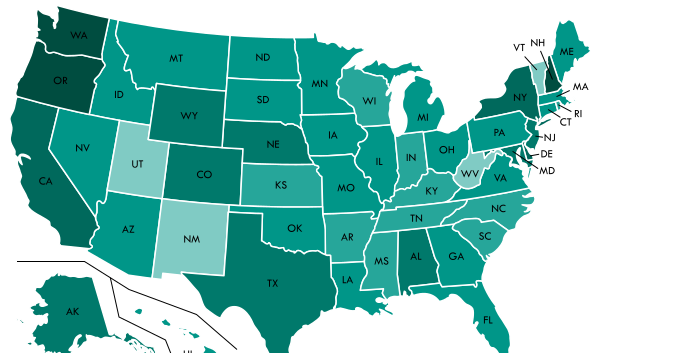
Most common states for junior quality assurance analysts/analysts
| Rank | State | Population | # of jobs | Employment/ 1000ppl |
|---|---|---|---|---|
| 1 | District of Columbia | 693,972 | 471 | 68% |
| 2 | Maryland | 6,052,177 | 1,665 | 28% |
| 3 | Virginia | 8,470,020 | 2,190 | 26% |
| 4 | Utah | 3,101,833 | 760 | 25% |
| 5 | Delaware | 961,939 | 229 | 24% |
| 6 | Massachusetts | 6,859,819 | 1,494 | 22% |
| 7 | Minnesota | 5,576,606 | 1,146 | 21% |
| 8 | Vermont | 623,657 | 134 | 21% |
| 9 | Colorado | 5,607,154 | 1,072 | 19% |
| 10 | Rhode Island | 1,059,639 | 205 | 19% |
| 11 | North Dakota | 755,393 | 139 | 18% |
| 12 | California | 39,536,653 | 6,656 | 17% |
| 13 | North Carolina | 10,273,419 | 1,768 | 17% |
| 14 | Indiana | 6,666,818 | 1,153 | 17% |
| 15 | Oregon | 4,142,776 | 691 | 17% |
| 16 | Connecticut | 3,588,184 | 617 | 17% |
| 17 | Washington | 7,405,743 | 1,220 | 16% |
| 18 | Nebraska | 1,920,076 | 309 | 16% |
| 19 | New Hampshire | 1,342,795 | 217 | 16% |
| 20 | Wyoming | 579,315 | 95 | 16% |
Most common cities for junior quality assurance analysts/analysts
| Rank | City | # of jobs | Employment/ 1000ppl | Avg. salary |
|---|---|---|---|---|
| 1 | Hartford | 3 | 2% | $65,969 |
| 2 | Rockville | 1 | 1% | $70,355 |
Junior Quality Assurance Analyst/Analyst job outlook: Expert opinions
Our panel of junior quality assurance analyst/analyst experts
Widener University
SUNY College at Geneseo
Siena College
University of Maryland - College Park
Washington and Lee University
University of Nevada - Las Vegas
Florida Gulf Coast University
The University of the South
Indiana University Bloomington
Framingham State University
Ashford University
University of Connecticut
Pennsylvania State University

King University

Brigham Young University-Hawaii
What Junior Quality Assurance Analyst/Analyst skills would you recommend for someone trying to advance their career?
Dr. Swagata Banerjee PhD: Digital literacy: As technology continues to evolve, proficiency in digital tools and platforms will become increasingly essential. Adaptability: The ability to quickly learn new skills and adapt to changing circumstances will be crucial in a rapidly evolving industry landscape. Data literacy: Understanding and analyzing data will become more important for making informed decisions and optimizing strategies. Interdisciplinary skills: The ability to work across different disciplines and collaborate effectively with diverse teams will be highly valued. Emotional intelligence: Soft skills such as empathy, communication, and teamwork will continue to be in demand as workplaces become more interconnected and dynamic.
What Junior Quality Assurance Analyst/Analyst skills would you recommend for someone trying to advance their career?
Adam Roth: I recommend that students start by identifying a specific skill in demand within your field, such as data analysis or social media marketing, and focus on developing expertise in that area. Research salary ranges and living costs in particular areas where you’re interested in working to ensure your compensation aligns with the local market. Always negotiate a salary and consider other aspects of the offer, such as funds for continuing education, technology and more. Continuing to network and establish demand for your services is essential; attend industry events, join professional associations, and engage with professionals in your field. Never miss an opportunity to reach out to and check in with your professional contacts. Pursue additional learning opportunities and education, such as certifications or advanced degrees, to provide a competitive advantage and increase your earning potential over time.
Tongyang Yang Ph.D.
Assistant Professor of Economics and Business AnalyticsWidener University
Business/Commerce
What general advice would you give to a Junior Quality Assurance Analyst/Analyst?
Tongyang Yang Ph.D.: There are many reasons that people like about being a business analyst, including reasons listed as follows: 1. Analytical Skills and Data Exploration: BAs often analyze data to understand trends and identify areas for improvement. Seeing a successful implementation and its positive impact can be very rewarding. 2. Problem-solving. BAs get to identify inefficiencies and propose solutions that can improve how a business operates. 3. Continuous learning. Business analysts may work on a range of projects and the field of business analysis may be constantly evolving, which required BAs to actively cultivate skills in new businesses. For example, the coming of the AI era requires BAs to master AI fundamentals and data fluency. 4. While some thrive on the problem-solving and communication aspects of a BA role, others may find them less appealing. Carefully consider your personality and preferences to see if this aligns with your career goals.
Jasmine Tang
SUNY College at Geneseo
Bilingual, Multilingual, And Multicultural Education
What Junior Quality Assurance Analyst/Analyst skills would you recommend for someone trying to advance their career?
Jasmine Tang: Be confident of their major/minor or the subject they like and do best of the field they like for themselves not for money or please their parents or fulfill the dream of others.
What will help Junior Quality Assurance Analysts/Analysts increase their earning potential?
Jasmine Tang: I always advise the students to apply any job that accept their degree or go for the one they really like.
What general advice would you give to a Junior Quality Assurance Analyst/Analyst?
Sunita Goel PhD: Great. Will send you the responses soon. Please let me know the latest deadline by which you need them.
What Junior Quality Assurance Analyst/Analyst skills would you recommend for someone trying to advance their career?
Sunita Goel PhD: Great. Will send you the responses soon. Please let me know the latest deadline by which you need them.
What Junior Quality Assurance Analyst/Analyst skills would you recommend for someone trying to advance their career?
Dr. Rellie Derfler-Rozin: Though those skills have always been crucial for managers’ success, I think people’s skills will become even more important. Some more content-related areas/skills might be easier to navigate using technology, AI etc, but there will always be a need to manage people, and given the advanced technology there will be even more of a need to be sensitive to how people react to new technology, to make sure people use the technology in both effective and ethical manner. A lot of this will come from role modeling and showing ethical strong leadership.
What general advice would you give to a Junior Quality Assurance Analyst/Analyst?
Oliver Keys Jr: The power of mentorships and networking early in your career will be beneficial in the long run. Also, understanding that professional skills can be half the battle. Showing up on time, dressing appropriately, and communicating effectively can be challenging for some students. Internships and externships are great for students to get technical and professional experience.
What Junior Quality Assurance Analyst/Analyst skills would you recommend for someone trying to advance their career?
Michelle Cowan Ph.D.: I’m not sure about this question since I haven’t really discussed this with any business analysts. I’ll pass this question on and see if I get a response. Otherwise, ask me about content strategy, UX, writing, and communication jobs, and I can speak more freely, since that’s what I did for 15 years before moving into academia.
What Junior Quality Assurance Analyst/Analyst skills would you recommend for someone trying to advance their career?
Prof. Kim Jovanovich P.E.: Attached please see the responses to your interview questions. I hope this sheds some light on the questions you asked!
What will help Junior Quality Assurance Analysts/Analysts increase their earning potential?
Joseph Taylor: The role of a Business Analyst can vary greatly from company to company, and even from department to department, so it is very important to look at the details of a particular position that you are applying for. One common factor from all Business Analyst is that they are generally expected to make sense of data, and to be effective communicators that can apply insights to real-world problems.
What Junior Quality Assurance Analyst/Analyst skills would you recommend for someone trying to advance their career?
Joe Protopapa: The first two skills that come to my mind are managing data/data analysis and an ability to communicate internal to your organization and outside of it as well. Being able to manage and analyze data to make informed decisions is already vital to a successful business, and I expect this skill to continue to rise in prevalence on the next 3 - 5 years. Communication is always a staple of a strong employee and strong business, and as the business world continues to fragment due to technological advancements and the evolution of how business is done globally, having an ability to communicate within and outside of an organization will be just as important as ever.
Jacqueline Eastman Ph.D.
Alico Chair, Marketing, Eminent Scholar and ProfessorFlorida Gulf Coast University
Finance And Financial Management Services
What general advice would you give to a Junior Quality Assurance Analyst/Analyst?
Jacqueline Eastman Ph.D.: As a new college graduate just starting out, you need to have reasonable expectations for your career progression. You need to demonstrate your work ethic and ability to learn and work with others. You also need to have respect and empathy for your coworkers and those reporting to you as they may be older and/or have different backgrounds/experiences than you. This is the time to say yes to new opportunities at your organization, even if it means more work, as it will provide you with additional experience that may help you advance. Finally, seek out a mentor that can help guide you as the work environment is very different from what you may be used to as a college student. This does not need to be a formal mentorship program, but rather look for someone who you can trust and who is willing to help.
What general advice would you give to a Junior Quality Assurance Analyst/Analyst?
Christopher Wayne FACHE, MBA, MS: While both healthcare administrative and medical roles are projected to grow I think the top new grads will have a minor in areas such as finance, information technology, marketing and many others. However, subject matter expertise is just the price of admission, so be sure to take full advantage of your degree program and ongoing education to appreciate the importance of learning so many other skills likely available to you such as sales and marketing, how to build consensus/facilitate, problem solve, writing and public speaking. These will be the skills that can lead to leadership opportunities if that’s something of interest.
What general advice would you give to a Junior Quality Assurance Analyst/Analyst?
Erastus Ndinguri: A couple of ways to maximize your salary potential are;
Through first salary negotiation - By understanding the job market of your field, knowing what you can offer and preparing well for your salary negotiation you can positively maximize your first salary potential. This can affect your future earnings especially if you rise up the corporate ladder in the same organization.
Not settling, but continuing to learn- Learn a new skill that will help in building your resume. Network with colleagues in your organization and learn from them. Continuous learning and self-improvement create opportunities for higher earnings.
Embrace mentorships- Having a good seasoned colleague/mentor can open opportunities for higher earning. A mentor can help you prepare for a salary negotiation and also steer you to the right projects that lead to career advancements hence a higher salary.
What will help Junior Quality Assurance Analysts/Analysts increase their earning potential?
Anil Agarwal: Some skills will always be in Demand - such as Interpersonal communications , Project Management , Learning different languages and having great listening skills. What new skills will be in demand : Social media, content and Digital marketing. Data Analytics and or Business Analytics. Cross cultural management , Leadership Skills. Financial Management . Getting an MBA, MFS ( Masters of Finance ) , MSM ( Masters in Analytical Marketing ) or a Masters in Economics or an MHA ( Masters in Health Sciences. The fields of Bio Technology are also exploding if that is your bent of mind.
Travis Grosser Ph.D.
Associate Professor of Management (@ UConn School of Business)University of Connecticut
Human Resources Management And Services
What Junior Quality Assurance Analyst/Analyst skills would you recommend for someone trying to advance their career?
Travis Grosser Ph.D.: The following are critical skills that will grow in importance in the coming years:
1. Innovative and Critical Thinking: The ability to think creatively and critically to solve complex problems will be highly valued, especially in a rapidly changing business landscape.
2. Emotional Intelligence: The ability to understand and manage one's own emotions, as well as empathize with others, will be crucial for successfully navigating a workplace where change, diversity, and collaboration will continue to increase.
3. Leadership and Change Management: Skills in leading teams, managing change, and inspiring innovation will be essential as businesses navigate through transitions and transformations.
4. Digital Literacy and Technological Proficiency: As technology continues to evolve rapidly, proficiency in digital tools and platforms will be crucial. Understanding emerging technologies like artificial intelligence, blockchain/Web3, and data analytics will be increasingly valuable.
What Junior Quality Assurance Analyst/Analyst skills would you recommend for someone trying to advance their career?
Jennifer Coupland: Anticipate what is needed and demonstrate your worth.
Jason Caudill Ph.D.
Professor of BusinessKing University
Management Information Systems
What hard/technical skills are most important for Junior Quality Assurance Analysts/Analysts?
Jason Caudill Ph.D.: The number one technical skill for today's professionals is the ability to learn new systems. Regardless of expertise in a particular platform, there are going to be updates and changes, and different companies will likely be on different major platforms to perform the same functions. A strong foundation of technical skills in communications software, spreadsheets, and cloud applications will give someone the foundation they need to function in most modern workplaces, but the real skill is being able to translate that understanding of the architecture to multiple platforms so they can manage change.
What skills will help Junior Quality Assurance Analysts/Analysts earn the most?
Jason Caudill Ph.D.: I think the two most profitable skills will be communication and adaptability. Almost nothing happens in a vacuum, so to be successful, today's professionals have to be able to effectively collaborate with others in various departments and in other organizations. That can only happen with effective communication skills. Coupled with that is the fact that dynamic markets, shorter product lifespans, and longer careers are demanding that people change their skill sets and adapt to different markets more than they ever have before. The professional who can continuously adapt to the demands of the market, who is willing to add new skills over time as a lifelong learner, will be the most prepared to offer continued value to a company, which will result in higher earnings.
What experience really stands out on Junior Quality Assurance Analyst/Analyst resumes?
David Preece: Most employers look for indicators of character and "soft skills" related to leadership, problem-solving, teamwork, initiative, diligence, responsibility, and integrity. Naturally, each company and job position requires some minimal technical or functional capabilities, but many of those skills can be taught to new employees with strong potential. Character is more difficult, if not impossible, to develop in entry-level employees, and these soft skills are proven to impact organizational culture and productivity.