Explore jobs
Find specific jobs
Explore careers
Explore professions
Best companies
Explore companies
Job outlook for junior systems analysts in the United States
Junior systems analyst job growth summary. After extensive research, interviews, and analysis, Zippia's data science team found that:
The projected junior systems analyst job growth rate is 9% from 2018-2028.
About 56,000 new jobs for junior systems analysts are projected over the next decade.
Junior systems analyst salaries have increased 8% for junior systems analysts in the last 5 years.
There are over 59,123 junior systems analysts currently employed in the United States.
There are 119,599 active junior systems analyst job openings in the US.
The average junior systems analyst salary is $69,271.
Are junior systems analyst jobs in demand?
Junior systems analyst job and salary trends over time
Junior systems analyst jobs over time
Junior systems analyst job growth rate over time
| Year | # of jobs | % of population |
|---|---|---|
| 2021 | 59,123 | 0.02% |
| 2020 | 92,278 | 0.03% |
| 2019 | 41,614 | 0.01% |
| 2018 | 74,144 | 0.02% |
| 2017 | 73,418 | 0.02% |
Average junior systems analyst salary over time
Junior systems analyst salary by year
| Year | Avg. salary | Hourly rate | % Change |
|---|---|---|---|
| 2025 | $69,271 | $33.30 | +3.4% |
| 2024 | $66,988 | $32.21 | +2.3% |
| 2023 | $65,472 | $31.48 | +0.5% |
| 2022 | $65,125 | $31.31 | +1.2% |
| 2021 | $64,350 | $30.94 | +1.7% |
Junior systems analyst jobs by state
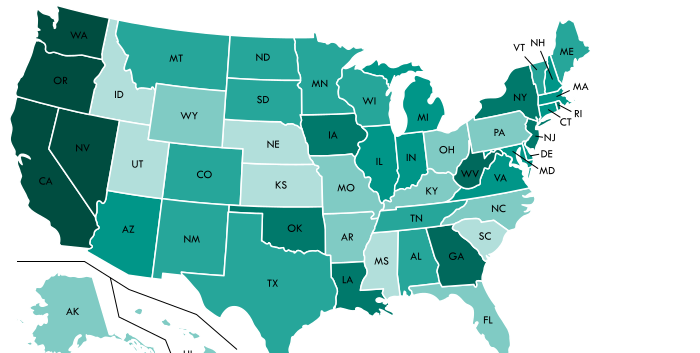
Most common states for junior systems analysts
| Rank | State | Population | # of jobs | Employment/ 1000ppl |
|---|---|---|---|---|
| 1 | District of Columbia | 693,972 | 542 | 78% |
| 2 | Virginia | 8,470,020 | 2,657 | 31% |
| 3 | Maryland | 6,052,177 | 1,578 | 26% |
| 4 | Vermont | 623,657 | 158 | 25% |
| 5 | New Hampshire | 1,342,795 | 323 | 24% |
| 6 | North Dakota | 755,393 | 181 | 24% |
| 7 | Rhode Island | 1,059,639 | 234 | 22% |
| 8 | Wyoming | 579,315 | 127 | 22% |
| 9 | Nebraska | 1,920,076 | 396 | 21% |
| 10 | Massachusetts | 6,859,819 | 1,326 | 19% |
| 11 | Oregon | 4,142,776 | 804 | 19% |
| 12 | South Dakota | 869,666 | 162 | 19% |
| 13 | Washington | 7,405,743 | 1,342 | 18% |
| 14 | Utah | 3,101,833 | 559 | 18% |
| 15 | New Mexico | 2,088,070 | 381 | 18% |
| 16 | North Carolina | 10,273,419 | 1,707 | 17% |
| 17 | Idaho | 1,716,943 | 289 | 17% |
| 18 | Illinois | 12,802,023 | 2,062 | 16% |
| 19 | Kansas | 2,913,123 | 476 | 16% |
| 20 | Iowa | 3,145,711 | 487 | 15% |
Most common cities for junior systems analysts
| Rank | City | # of jobs | Employment/ 1000ppl | Avg. salary |
|---|---|---|---|---|
| 1 | Bethesda | 1 | 2% | $70,511 |
| 2 | Doral | 1 | 2% | $62,218 |
| 3 | Columbia | 1 | 1% | $70,600 |
| 4 | Evansville | 1 | 1% | $68,563 |
| 5 | Huntsville | 1 | 1% | $67,088 |
Junior Systems Analyst job outlook: Expert opinions
Our panel of junior systems analyst experts
Widener University
University of Wisconsin - Green Bay
Belmont University
SUNY College at Geneseo
Siena College
Mount St Mary's University
Cumberland University
Brigham Young University - Idaho
Harding University
The University of the South
University of Maryland - College Park
Tuskegee University

King University
What Junior Systems Analyst skills would you recommend for someone trying to advance their career?
Adam Roth: I recommend that students start by identifying a specific skill in demand within your field, such as data analysis or social media marketing, and focus on developing expertise in that area. Research salary ranges and living costs in particular areas where you’re interested in working to ensure your compensation aligns with the local market. Always negotiate a salary and consider other aspects of the offer, such as funds for continuing education, technology and more. Continuing to network and establish demand for your services is essential; attend industry events, join professional associations, and engage with professionals in your field. Never miss an opportunity to reach out to and check in with your professional contacts. Pursue additional learning opportunities and education, such as certifications or advanced degrees, to provide a competitive advantage and increase your earning potential over time.
Tongyang Yang Ph.D.
Assistant Professor of Economics and Business AnalyticsWidener University
Business/Commerce
What general advice would you give to a Junior Systems Analyst?
Tongyang Yang Ph.D.: There are many reasons that people like about being a business analyst, including reasons listed as follows: 1. Analytical Skills and Data Exploration: BAs often analyze data to understand trends and identify areas for improvement. Seeing a successful implementation and its positive impact can be very rewarding. 2. Problem-solving. BAs get to identify inefficiencies and propose solutions that can improve how a business operates. 3. Continuous learning. Business analysts may work on a range of projects and the field of business analysis may be constantly evolving, which required BAs to actively cultivate skills in new businesses. For example, the coming of the AI era requires BAs to master AI fundamentals and data fluency. 4. While some thrive on the problem-solving and communication aspects of a BA role, others may find them less appealing. Carefully consider your personality and preferences to see if this aligns with your career goals.
What will help Junior Systems Analysts increase their earning potential?
Praneet Tiwari: Continue to be a learner! Business degrees give students the foundation they need to begin their careers but to continue to do well in their careers, they need to keep learning. Find opportunities to learn more to keep evolving whether it’s the use of free resources when available or if your organization funds additional degrees then use those opportunities too. The business world is constantly evolving so it’s important to stay current. Another important thing to focus on is networking. Often after we get our first jobs, we get complacent when it comes to networking but building a network is crucial. Connect with other professionals through LinkedIn, your university’s alumni associations, and events specific to your industry.
What general advice would you give to a Junior Systems Analyst?
Dr. Tisha Brown-Gaines: Over the next five years, the expanding landscape of Big Data facilitated via Information Systems will continue to play a major role in the structure of how Smart Systems are created and maintained. As a result, having skills that will allow for effectively accessing, modifying, analyzing, storing and securing data is key. The integration of these skills are strengths that will support fields under the umbrella of computer science and data science that expand into machine learning, natural language processing and the Internet of Things (IoT) concepts.
What Junior Systems Analyst skills would you recommend for someone trying to advance their career?
Dr. Tisha Brown-Gaines: Colleges and universities try very hard to prepare students for life after graduation. Most students have the required skill sets for their field of study. However, the journey after attaining a degree still can be tricky. Selecting the right field for you is paramount. Information Systems (IS) is a great major. The interdisciplinary aspect of Information Systems (IS) allows graduates to select from numerous opportunities in the field. However, this can be quite overwhelming when students have options to apply to countless jobs. My advice would be to reflect on several assignments, projects or internship experiences during your undergraduate career that captured your interest, made you smile while completing the assignment or even one which began as a random goal and became personal. Start by identifying tasks that made you inquire more about a topic outside of the minimum requirements or a task that was challenging but helped to improve a skill set. Reflecting on these experiences will allow you to effectively navigate what areas to consider and what jobs to apply to in a sea of endless opportunities. Additionally, having the ability to reflect on past accomplishments can motivate and challenge graduates to achieve additional goals as they continue building their careers.
What will help Junior Systems Analysts increase their earning potential?
Dr. Tisha Brown-Gaines: Employers will seek candidates that have knowledge on topics such as database systems, networking, cybersecurity and artificial intelligence. Leveraging the skills acquired from your degree and extending those by acquiring external certifications in these fields will help distinguish you from other candidates. There are many online programs which offer certifications in AWS, Network+, Certified Information Systems Security Professional (CISSP) and SAP that are innovative and provide real-world case studies to prepare students to have successful careers.
Jasmine Tang
SUNY College at Geneseo
Bilingual, Multilingual, And Multicultural Education
What will help Junior Systems Analysts increase their earning potential?
Jasmine Tang: I always advise the students to apply any job that accept their degree or go for the one they really like.
What Junior Systems Analyst skills would you recommend for someone trying to advance their career?
Sunita Goel PhD: Great. Will send you the responses soon. Please let me know the latest deadline by which you need them.
What general advice would you give to a Junior Systems Analyst?
Sagar Raina D.Sc.: The transition from the academic world to the industry is a significant milestone and may be overwhelming for the beginners. The first and foremost advice I would give is to be “patient”, be “positive” and be “open to learning”. The field of Information Systems consists of the three important components – people, processes, and technology. The graduates beginning their careers should be able to understand and learn about the “people” working in the organization, the “processes” of the organization and the “technology” used by the organization. To accomplish this, work hard, be open to ask questions to the senior colleagues and keep yourself informed about the new trends in Information Systems sector.
What Junior Systems Analyst skills would you recommend for someone trying to advance their career?
Sagar Raina D.Sc.: One of the recommendations would be to get an entry-level industry certification within the Information Systems field. For example, if you are interested in networking, you can go for CompTIA Network+, similarly, if you are interested in cybersecurity, you can go for CompTIA Security+. In addition to your college degree, industry certifications are well recognized by the organizations which can maximize your salary potential when starting a career in Information Systems.
What will help Junior Systems Analysts increase their earning potential?
Sagar Raina D.Sc.: Apart from the traditional knowledge expected in the field such coding, computer networking, database design and development, systems analyses, web technologies and development, data analytics; the use of generative Artificial Intelligence (AI) and the knowledge about cybersecurity will be considered as the important and prevalent skills sought among the new graduates in the field.
Robert Affe
Senior Lecturer, EmeritusWhat Junior Systems Analyst skills would you recommend for someone trying to advance their career?
Robert Affe: Realize that your first job is not a lifetime job. In fact, you probably will not have that job in a year or two, so keep a steady emotional mindset about your responsibilities. Digital/tech industries are evolving at an accelerated pace. Learn to “think like your boss”. It will demonstrate that you are observant, and can learn; and your boss will appreciate and likely reward that extra effort. Demonstrate your "commitment to the enterprise”, whether it is your specific assignment or the other goal of the company. Do what is expected of you——and then do more.
What general advice would you give to a Junior Systems Analyst?
Oliver Keys Jr: The power of mentorships and networking early in your career will be beneficial in the long run. Also, understanding that professional skills can be half the battle. Showing up on time, dressing appropriately, and communicating effectively can be challenging for some students. Internships and externships are great for students to get technical and professional experience.
What general advice would you give to a Junior Systems Analyst?
Dr. Karah Sprouse D.B.A.: Year after year I tell my graduates that the best thing that they can do is get in the game. As a new graduate, you are not supposed to know exactly what you want to do with your degree, and even if you do know, the only way to become experienced is through it. Do your best to find a job opportunity that aligns with your values, interests, and qualifications and begin navigating your career path from there. Secondly, be patient with yourself as you are learning new things and do not be afraid to ask questions when you need help or clarity to do your job well. Companies are in desperate need of new graduates who are motivated to learn and bring value where possible.
What Junior Systems Analyst skills would you recommend for someone trying to advance their career?
Prof. Kim Jovanovich P.E.: Attached please see the responses to your interview questions. I hope this sheds some light on the questions you asked!
What will help Junior Systems Analysts increase their earning potential?
Kevin Kimball: Continue learning and make social connections within your employer’s umbrella, within your profession and within your larger community. The ones who have significant earnings upside are the ones who can sell the business and be connectors between people.
What general advice would you give to a Junior Systems Analyst?
Kevin Jetton: Now referred to simply as Information Systems or Enterprise Systems, they are the mission-critical applications that run the enterprise and used to provide information, processes, data and outcomes to all parties such as internal employees, customers and partners/suppliers. Example such systems are all the Financial Applications (Accounts Payable/Receivable, General Ledger, Payroll, Human Resources, Fixed Assets, Budgeting and more), Supply Chain Management, Customer Relationship Management, Manufacturing, Enterprise Resource Management, Order/Service Fulfillment and more. What do individuals do on a daily basis? Depends on the individual's role in the overall process: Unit Managers/Users: Part of a project team to analyze/design/test/train/implement new or modified systems for their unit. IT Professionals: Project Management, Systems Analysts, Enterprise Architects to design solutions, Database and Security experts, Application Developers/Programmers, Testing and Training Teams, Data conversion specialists, Scheduling and Implementation teams.
What Junior Systems Analyst skills would you recommend for someone trying to advance their career?
Kevin Jetton: The need for IT skilled employees has never faded despite the right-sizing of many organizations IT staffing components post-pandemic when there was a hiring surge to enhance systems and processes to accommodate more online-only services and offerings. The key is to have a diverse skill-set or base so as to see the bigger picture and able to not only communicate to business users and executives, but to solve problems for the enterprise and deliver them.
What will help Junior Systems Analysts increase their earning potential?
Kevin Jetton: The phrase itself has been retired basically and broadened to include ALL information systems - focusing on the mission-critical applications and processes to deliver results to all the parties both inside and outside the organization. Originally, Management Information Systems (MIS) focused ONLY on the Financial/Accounting/Payroll/Manufacturing aspects and was the label for them and the department of IT staffers 1970's-1990's eras. By the year 1995-2000 with the looming Y2K issue, the mission-critical nature of these applications enterprise-wide rose to the forefront of everyone's mind when the realization that the systems may not function properly 1/1/2000 and beyond basically introduced the phrase Enterprise Systems to the world that serve the enterprise internally and externally. Like: The excitement of being involved in such key applications/systems serving the entire organization. Working side-by-side by all units/levels of fellow staff members and partner organizations to identify and solve pain-points within the organization and more that could be solved/automated/enhanced through technology. Helping deliver applications and tools that serve your organization's customers, fellow-employees and partners. Dislike: Long projects that could span months-to-years. Underestimated project schedules that rush through the phases but deliver short-changed results. Pressure to meet deadlines and expectations. Constantly changing/evolving technology and services. Outsourcing to non-employees outside the organization perhaps globally. Being on-call 24x7 to handle and resolve system outages and downtime/failures.
What will help Junior Systems Analysts increase their earning potential?
Joseph Taylor: The role of a Business Analyst can vary greatly from company to company, and even from department to department, so it is very important to look at the details of a particular position that you are applying for. One common factor from all Business Analyst is that they are generally expected to make sense of data, and to be effective communicators that can apply insights to real-world problems.
What general advice would you give to a Junior Systems Analyst?
Dr. Joe Faith: Skills involving how to properly use AI and AI-enabled tools will be big. We've already seen huge changes since November of 2022. I only think the life cycle for these products will continue to get shorter. It's not AI that you need to worry about displacing you from your job. It's a smart human that knows how to use AI. I think that, for IS professionals specifically, you need to focus not only on hard skills, but soft skills as well. Many individuals can either communicate well or program well but not many can do both. There is a niche there that needs to be filled.
What Junior Systems Analyst skills would you recommend for someone trying to advance their career?
Dr. Joe Faith: One of the major things is either having more education or certifications to help with inflating your initial salary. Besides that, I would say that the industry and location you move to will have a large hand to play in terms of the salary you get. You always need to balance the cost of living though, if you're focusing more on location as your proxy. The types of jobs you can get in IS are so varied that it can make a huge difference in terms of earning potential right off the bat. For example, if you were to go into software development, data analytics, project management, or cybersecurity after getting your IS degree (which we've had many students do), then you would definitely be earning more than if you took an entry level support technician role (think help desk) for a company. I always try to talk with my advisees about this subject, so that they can decide what path is best for them. Sometimes, students aim lower than they necessarily have to, and that can hurt their initial salary.
What will help Junior Systems Analysts increase their earning potential?
Dr. Joe Faith: I think the best general advice would be to not be scared to take a risk on yourself. There are a lot of jobs out there that people are oftentimes afraid to apply for. This can be for several factors but one of the main ones I hear is that they don't feel like they are qualified enough. I can't tell you how many times I've had students that got a job they were slightly underqualified for because they were smart, had drive, and were a great culture fit for the firm in question. Along with that, I would say that certifications can help land your first gig. After a while, in many cases, experience will be more important. But, a cert can be just the thing to get you 'over the top' and land that first job after college.
What general advice would you give to a Junior Systems Analyst?
Jasser Jasser: Creativity is paramount, whether you're part of an established company, a nonprofit, or kickstarting your venture. Challenge conventional thinking and utilize cutting-edge AI tools to stay ahead. Genuine creativity stems from a deep understanding of the latest trends and technologies. Remain vigilant for new breakthroughs, immerse yourself in tech-centric literature, and constantly ponder how these advancements can elevate your career and amplify your creative output. Additionally, cultivate a robust professional network and seek mentorship. Industry connections can offer priceless advice, open pathways to career opportunities, and provide insights that facilitate career growth and salary enhancement.
What Junior Systems Analyst skills would you recommend for someone trying to advance their career?
Jasser Jasser: As AI becomes increasingly central to Information Systems, mastering the integration of effective, ethical, explainable, and secure AI into your work is indispensable. Alongside these technical skills, prioritize the development of soft skills such as communication, teamwork, and problem-solving. In the technical realm of Information Systems, the ability to collaborate effectively and articulate complex ideas clearly is what often separates the most accomplished professionals.
What will help Junior Systems Analysts increase their earning potential?
Jasser Jasser: In an era where intelligent chatbots like ChatGPT and Gemini can perform a myriad of tasks, it's essential to infuse authenticity into your work. Whether crafting a new user experience or devising strategies against cyber threats, ensure your ideas are genuinely yours. Yet, this doesn't mean you should overlook the capabilities of these AI tools. Leverage them to refine and enhance your concepts. Equally critical is adaptability in our fast-evolving field. Embrace new roles, technologies, and methodologies with an open mind, as this flexibility can unlock doors to unexpected and fulfilling career opportunities.
What Junior Systems Analyst skills would you recommend for someone trying to advance their career?
John Bono: The skills that will become more important and prevalent in the business field in the next 3-5 years fall under two categories: technical and non-technical. Technical fluency in emerging technologies like artificial intelligence, machine learning, blockchain, cloud computing, internet of things, augmented/virtual reality, and quantum computing will be crucial. Data fluency will also rise in importance, focusing on effective communication using data. Non-technical skills such as adaptability, flexibility, teamwork, and collaboration will continue to be critical in the evolving business landscape.
Dalya Fadlalla
Adjunct FacultyTuskegee University
Computer/Information Technology Administration And Management
What general advice would you give to a Junior Systems Analyst?
Dalya Fadlalla: People who work as A_AN JOB_TITLE may enjoy their work because they know what is expected from them, as it is clear on JOB_TITLE. It also, helps them be unstressed due to the clear responsibility. They can have a great opportunity to learn new skills, which has a significant impact on their organization.
Some people may find the work is more stressful, challenging, and need long hours
As a Computer Information Systems graduate entering the job market, they can explore what people like and dislike about being a Computer Information Systems professional.
Many people like working in this field, as Technology advances very fast there is always something new to learn and discover. Others may think it is hard to keep up with new technologies.
Many people appreciate that their work has a significant impact on the world. For example, if they are developing new software.
Therefore, this will depend on the person, and how he sees working in this field. By understanding the advantages and disadvantages of the field, you can make you can decide if this is the right path for you.
What Junior Systems Analyst skills would you recommend for someone trying to advance their career?
Dalya Fadlalla: Some companies and industries with JOB_TITLE positions are showing growth and progression. Computer Information Systems (CIS) is a field worth considering with the quick advance in technology and great profession to enter now.
This field offers many benefits including reasonable salaries, many great opportunities for advancement and development, and job security.
The demand for CIS graduates has increased, so CIS graduates should expect and
Believed that to be in high demand in many industries.
Computer Information Systems (CIS) is a career with great potential and a promising future.
What will help Junior Systems Analysts increase their earning potential?
Dalya Fadlalla: JOB_TITLE for day-to-day activities will be different depending on the specific role and industry they are working in. When it comes to Computer Information Systems (CIS) graduates entering the job market, it will be useful to have a clear understanding of a job description, and daily activities with expectations of the job for someone who entered the field.
Daily basis activities will depend on their specific job title. Some of the common job titles in this field include IT or IT project manager, programs developer, computer administrator, and database administrator. There are common tasks for Computer Information Systems including managing projects, analyzing data, leading research, managing projects, creating presentations or reports, checking and maintaining computer networks, and collaborating with team members.
For someone entering this field, his day might include learning new skills, completing tasks assigned by a supervisor, working on small projects, collaborating with other team members, and managing and organizing large amounts of data.
Someone who entering the field needs to be open to learning and willing to take on new challenges to grow and develop their skills in the field. CIS offers a wide range of job opportunities with unique daily activities and responsibilities
Jason Caudill Ph.D.
Professor of BusinessKing University
Management Information Systems
What hard/technical skills are most important for Junior Systems Analysts?
Jason Caudill Ph.D.: The number one technical skill for today's professionals is the ability to learn new systems. Regardless of expertise in a particular platform, there are going to be updates and changes, and different companies will likely be on different major platforms to perform the same functions. A strong foundation of technical skills in communications software, spreadsheets, and cloud applications will give someone the foundation they need to function in most modern workplaces, but the real skill is being able to translate that understanding of the architecture to multiple platforms so they can manage change.
What skills will help Junior Systems Analysts earn the most?
Jason Caudill Ph.D.: I think the two most profitable skills will be communication and adaptability. Almost nothing happens in a vacuum, so to be successful, today's professionals have to be able to effectively collaborate with others in various departments and in other organizations. That can only happen with effective communication skills. Coupled with that is the fact that dynamic markets, shorter product lifespans, and longer careers are demanding that people change their skill sets and adapt to different markets more than they ever have before. The professional who can continuously adapt to the demands of the market, who is willing to add new skills over time as a lifelong learner, will be the most prepared to offer continued value to a company, which will result in higher earnings.