Explore jobs
Find specific jobs
Explore careers
Explore professions
Best companies
Explore companies
Job outlook for lead analyst/developers in the United States
Lead analyst/developer job growth summary. After extensive research, interviews, and analysis, Zippia's data science team found that:
The projected lead analyst/developer job growth rate is 9% from 2018-2028.
About 56,000 new jobs for lead analyst/developers are projected over the next decade.
Lead analyst/developer salaries have increased 8% for lead analyst/developers in the last 5 years.
There are over 170,408 lead analyst/developers currently employed in the United States.
There are 207,294 active lead analyst/developer job openings in the US.
The average lead analyst/developer salary is $93,571.
Are lead analyst/developer jobs in demand?
Lead analyst/developer job and salary trends over time
Lead analyst/developer jobs over time
Lead analyst/developer job growth rate over time
| Year | # of jobs | % of population |
|---|---|---|
| 2021 | 170,408 | 0.05% |
| 2020 | 181,034 | 0.05% |
| 2019 | 112,841 | 0.03% |
| 2018 | 169,074 | 0.05% |
| 2017 | 165,871 | 0.05% |
Average lead analyst/developer salary over time
Lead analyst/developer salary by year
| Year | Avg. salary | Hourly rate | % Change |
|---|---|---|---|
| 2025 | $93,571 | $44.99 | +3.4% |
| 2024 | $90,488 | $43.50 | +2.3% |
| 2023 | $88,439 | $42.52 | +0.5% |
| 2022 | $87,971 | $42.29 | +1.2% |
| 2021 | $86,924 | $41.79 | +1.7% |
Lead analyst/developer jobs by state
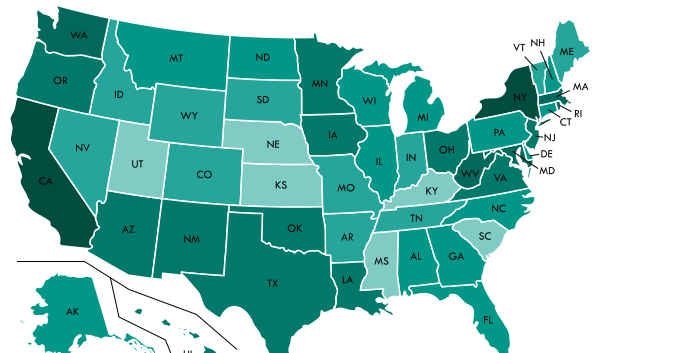
Most common states for lead analyst/developers
| Rank | State | Population | # of jobs | Employment/ 1000ppl |
|---|---|---|---|---|
| 1 | District of Columbia | 693,972 | 508 | 73% |
| 2 | Alaska | 739,795 | 256 | 35% |
| 3 | Nebraska | 1,920,076 | 650 | 34% |
| 4 | Montana | 1,050,493 | 324 | 31% |
| 5 | Kansas | 2,913,123 | 885 | 30% |
| 6 | South Dakota | 869,666 | 260 | 30% |
| 7 | New Mexico | 2,088,070 | 589 | 28% |
| 8 | Idaho | 1,716,943 | 441 | 26% |
| 9 | Minnesota | 5,576,606 | 1,397 | 25% |
| 10 | Virginia | 8,470,020 | 2,055 | 24% |
| 11 | Nevada | 2,998,039 | 699 | 23% |
| 12 | Arkansas | 3,004,279 | 697 | 23% |
| 13 | Rhode Island | 1,059,639 | 248 | 23% |
| 14 | Massachusetts | 6,859,819 | 1,477 | 22% |
| 15 | Maryland | 6,052,177 | 1,306 | 22% |
| 16 | Colorado | 5,607,154 | 1,243 | 22% |
| 17 | Delaware | 961,939 | 210 | 22% |
| 18 | North Dakota | 755,393 | 162 | 21% |
| 19 | Vermont | 623,657 | 132 | 21% |
| 20 | Washington | 7,405,743 | 1,473 | 20% |
Most common cities for lead analyst/developers
| Rank | City | # of jobs | Employment/ 1000ppl | Avg. salary |
|---|---|---|---|---|
| 1 | Midland | 1 | 2% | $86,745 |
| 2 | Boca Raton | 1 | 1% | $85,128 |
| 3 | Davenport | 1 | 1% | $92,608 |
| 4 | Grand Rapids | 1 | 1% | $85,793 |
| 5 | Hartford | 1 | 1% | $88,626 |
| 6 | Huntsville | 1 | 1% | $89,758 |
| 7 | Atlanta | 1 | 0% | $86,896 |
| 8 | Baltimore | 1 | 0% | $99,485 |
| 9 | Denver | 1 | 0% | $81,025 |
| 10 | Des Moines | 1 | 0% | $91,772 |
| 11 | Detroit | 1 | 0% | $87,042 |
| 12 | Fresno | 1 | 0% | $117,073 |
| 13 | Gilbert | 1 | 0% | $91,745 |
| 14 | Jacksonville | 1 | 0% | $86,630 |
| 15 | Miami | 1 | 0% | $84,434 |
| 16 | New Orleans | 1 | 0% | $95,002 |
| 17 | New York | 1 | 0% | $107,360 |
Lead Analyst/Developer job outlook: Expert opinions
Our panel of lead analyst/developer experts
Kent State University
Widener University
Xavier University
University of Wisconsin - Green Bay
SUNY College at Geneseo
Metropolitan State University of Denver
Siena College
University of Maine
University of Central Arkansas
Western Kentucky University
University of Maryland - College Park
Spelman College
Indiana University - Purdue University Indianapolis
University of Indianapolis
Mount Saint Mary's University
Washington and Lee University
What Lead Analyst/Developer skills would you recommend for someone trying to advance their career?
Adam Roth: I recommend that students start by identifying a specific skill in demand within your field, such as data analysis or social media marketing, and focus on developing expertise in that area. Research salary ranges and living costs in particular areas where you’re interested in working to ensure your compensation aligns with the local market. Always negotiate a salary and consider other aspects of the offer, such as funds for continuing education, technology and more. Continuing to network and establish demand for your services is essential; attend industry events, join professional associations, and engage with professionals in your field. Never miss an opportunity to reach out to and check in with your professional contacts. Pursue additional learning opportunities and education, such as certifications or advanced degrees, to provide a competitive advantage and increase your earning potential over time.
What Lead Analyst/Developer skills would you recommend for someone trying to advance their career?
Dr. Vaneet Kaur: There are two sets of skills I will highly encourage graduates to proactively start building. Firstly, business graduates need to develop higher-order skills and capabilities like knowledge-based dynamic capabilities. These will help them to (a) constantly collect knowledge about emerging opportunities (and threats) in the industry, (b) mobilize themselves and their resources to bring identified opportunities into fruition, and (c) constantly renew their skills to effectively respond to the changes in the environment. Developing such knowledge-based dynamic capabilities will automatically prepare them for the different waves of skill set requirements that will keep arising in the job market. Secondly, it is no secret that we are living in the times of artificial intelligence and automation. So, in this day and age, it is extremely important that graduates learn to ride the wave of automation rather than being discouraged by it. Business graduates are set to contribute to the world with their business acumen and expertise, what they can do to complement it is to develop low-code, no-code skills. Such skills will help graduates to automate routine processes so that their time and energies can be strategically channelized towards those activities and processes that can add significant value to their organizations.
Tongyang Yang Ph.D.
Assistant Professor of Economics and Business AnalyticsWidener University
Business/Commerce
What general advice would you give to a Lead Analyst/Developer?
Tongyang Yang Ph.D.: There are many reasons that people like about being a business analyst, including reasons listed as follows: 1. Analytical Skills and Data Exploration: BAs often analyze data to understand trends and identify areas for improvement. Seeing a successful implementation and its positive impact can be very rewarding. 2. Problem-solving. BAs get to identify inefficiencies and propose solutions that can improve how a business operates. 3. Continuous learning. Business analysts may work on a range of projects and the field of business analysis may be constantly evolving, which required BAs to actively cultivate skills in new businesses. For example, the coming of the AI era requires BAs to master AI fundamentals and data fluency. 4. While some thrive on the problem-solving and communication aspects of a BA role, others may find them less appealing. Carefully consider your personality and preferences to see if this aligns with your career goals.
What Lead Analyst/Developer skills would you recommend for someone trying to advance their career?
Tongyang Yang Ph.D.: The rise of AI has brought many opportunities for the professions like business analysts in terms of AI integration. Businesses will need analysts who can bridge the gap between AI and human needs and focus on more strategic areas like identifying ethical considerations of AI implementation, developing plans to mitigate AI bias, and designing human-AI collaboration workflows. For people who are interested in entering this profession, I would suggest adapting your skillset to include AI understanding, data storytelling, and strategic thinking to be well-positioned in the future.
What will help Lead Analyst/Developers increase their earning potential?
Dr. DAWN TOLONEN MBA: For the near future concentrate on three areas, soft skills, critical thinking, and artificial intelligence (AI). Your technical skills helped you land the job, but it’s your soft skills that lead to promotion.
What will help Lead Analyst/Developers increase their earning potential?
Praneet Tiwari: Continue to be a learner! Business degrees give students the foundation they need to begin their careers but to continue to do well in their careers, they need to keep learning. Find opportunities to learn more to keep evolving whether it’s the use of free resources when available or if your organization funds additional degrees then use those opportunities too. The business world is constantly evolving so it’s important to stay current. Another important thing to focus on is networking. Often after we get our first jobs, we get complacent when it comes to networking but building a network is crucial. Connect with other professionals through LinkedIn, your university’s alumni associations, and events specific to your industry.
Jasmine Tang
SUNY College at Geneseo
Bilingual, Multilingual, And Multicultural Education
What Lead Analyst/Developer skills would you recommend for someone trying to advance their career?
Jasmine Tang: Be confident of their major/minor or the subject they like and do best of the field they like for themselves not for money or please their parents or fulfill the dream of others.
What will help Lead Analyst/Developers increase their earning potential?
Stephen Long: 3. Don't say no. Say yes to tasks that stretch you; imagination, creativity and capabilities. Move outside your comfort zone and work with a variety of coworkers that will give you multiple perspectives and techniques to accomplish challenging tasks.
What general advice would you give to a Lead Analyst/Developer?
Sunita Goel PhD: Great. Will send you the responses soon. Please let me know the latest deadline by which you need them.
What Lead Analyst/Developer skills would you recommend for someone trying to advance their career?
Sunita Goel PhD: Great. Will send you the responses soon. Please let me know the latest deadline by which you need them.
What general advice would you give to a Lead Analyst/Developer?
Dr. Ryan LaRochelle Ph.D.: Be flexible. Today's job market is not the same as the one that your parents or grandparents entered into. It's unlikely that you'll be with the same company for your entire working career, so look at every experience as a potential opportunity to learn and explore. Also, the work environment you're joining is more important than the job title and position description. Do some research about what it's like to work at the place that is looking to hire you, and don't be afraid to reach out to current employees to get some candid feedback. Your job title and job description is much easier to change or renegotiate over time, but it's really hard to completely transform a toxic organizational culture and environment.
What will help Lead Analyst/Developers increase their earning potential?
Dr. Ron Duggins: Here are a few skills and mindsets that are mentioned by employers today. Certainly having a growing skillset in the practical use of AI is becoming more important all the time. Strong communication skills continue to be vital and will help set young applicants apart if they both speak and write well. In terms of a mindset, being able to approach work with a problem-solving mindset is important. This includes having a level of curiosity and looking for opportunity, not just seeing problems. When encountering issues or problems as a young employee, be sure to bring potential solutions to your boss or supervisor, not just an acknowledgment of the problem or call for help. An awareness of emotional intelligence (EQ) and continuing one's EQ growth is also important. Young workers need to be there and be aware. Being there is as simple as showing up (early if possible) and being there to volunteer or be willing to do whatever is asked. Being aware is to have a mindset of problem-solving and being aware of the purpose of their role and how it fits into the broader purpose of the organization.
What general advice would you give to a Lead Analyst/Developer?
Ron Ramsing Ph.D.: Relationships matter – continue to build your network by being a contributing member of a team while treating others well. Seek opportunities to actively learn and expand your knowledge and understanding of the industry. Mentors are important for providing guidance, feedback, and support. While it may take time, explore ways to connect with a mentor may it be formally or informally. Continue to hone your interpersonal skills through active listening, being conscientious, flexible, and willing to support and assist others. Be authentic!
What Lead Analyst/Developer skills would you recommend for someone trying to advance their career?
Dr. Rellie Derfler-Rozin: Though those skills have always been crucial for managers’ success, I think people’s skills will become even more important. Some more content-related areas/skills might be easier to navigate using technology, AI etc, but there will always be a need to manage people, and given the advanced technology there will be even more of a need to be sensitive to how people react to new technology, to make sure people use the technology in both effective and ethical manner. A lot of this will come from role modeling and showing ethical strong leadership.
What will help Lead Analyst/Developers increase their earning potential?
Rebecca Choudhury Ph.D.: That would be awesome! We were hoping you could answer the following questions: 1. What general advice would you give to a graduate beginning their career in the field?
What general advice would you give to a Lead Analyst/Developer?
Rachel Rice: Could you provide some details about the article and what specifically you're looking for so I can best direct your request?
What general advice would you give to a Lead Analyst/Developer?
Oliver Keys Jr: The power of mentorships and networking early in your career will be beneficial in the long run. Also, understanding that professional skills can be half the battle. Showing up on time, dressing appropriately, and communicating effectively can be challenging for some students. Internships and externships are great for students to get technical and professional experience.
What Lead Analyst/Developer skills would you recommend for someone trying to advance their career?
David Olawale PhD, PMP: - Get one or two mentors within and outside the organization you would be working at. Be willing to seek and take on new projects and learn new things that will help you to grow and develop your capacity and leadership abilities.
What Lead Analyst/Developer skills would you recommend for someone trying to advance their career?
Carissa Newton: For recent graduates, I always recommend a few things as they begin to work in their chosen field. First, I encourage them to never stop learning. Seek out certification and industry learning to expand what you know and to keep up on emerging trends. Second, as they enter their field and work in specific industries, learn how to immerse yourself in that industry by following industry news and monitoring competition. Third, I recommend that they stay active in networking, so that they can build a peer group that will provide advice, mentorship, and learning.
Dr. Michelle Holloway
Professor and Doheny Program DirectorMount Saint Mary's University
International Business
What will help Lead Analyst/Developers increase their earning potential?
Dr. Michelle Holloway: Figure out what you are good at, then consider what you would enjoy doing professionally. Your strengths will tell you what job function to do (e.g., sales, accounting, procurement). Your interests will tell you what industry to work in (e.g., tech, entertainment, retail).
What Lead Analyst/Developer skills would you recommend for someone trying to advance their career?
Michelle Cowan Ph.D.: I’m not sure about this question since I haven’t really discussed this with any business analysts. I’ll pass this question on and see if I get a response. Otherwise, ask me about content strategy, UX, writing, and communication jobs, and I can speak more freely, since that’s what I did for 15 years before moving into academia.
What Lead Analyst/Developer skills would you recommend for someone trying to advance their career?
Prof. Kim Jovanovich P.E.: Attached please see the responses to your interview questions. I hope this sheds some light on the questions you asked!