Explore jobs
Find specific jobs
Explore careers
Explore professions
Best companies
Explore companies
Job outlook for lead data architects in the United States
Lead data architect job growth summary. After extensive research, interviews, and analysis, Zippia's data science team found that:
The projected lead data architect job growth rate is 5% from 2018-2028.
About 8,400 new jobs for lead data architects are projected over the next decade.
Lead data architect salaries have increased 14% for lead data architects in the last 5 years.
There are over 15,723 lead data architects currently employed in the United States.
There are 150,424 active lead data architect job openings in the US.
The average lead data architect salary is $112,015.
Are lead data architect jobs in demand?
Lead data architect job and salary trends over time
Lead data architect jobs over time
Lead data architect job growth rate over time
| Year | # of jobs | % of population |
|---|---|---|
| 2021 | 15,723 | 0.00% |
| 2020 | 24,916 | 0.01% |
| 2019 | 25,218 | 0.01% |
| 2018 | 14,894 | 0.00% |
| 2017 | 14,618 | 0.00% |
Average lead data architect salary over time
Lead data architect salary by year
| Year | Avg. salary | Hourly rate | % Change |
|---|---|---|---|
| 2026 | $112,015 | $53.85 | +3.4% |
| 2025 | $108,324 | $52.08 | +2.3% |
| 2024 | $105,872 | $50.90 | +4.2% |
| 2023 | $101,628 | $48.86 | +3.4% |
| 2022 | $98,288 | $47.25 | +1.0% |
Lead data architect jobs by state
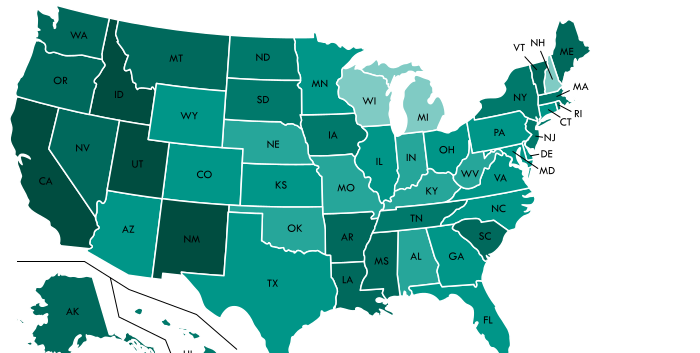
Most common states for lead data architects
| Rank | State | Population | # of jobs | Employment/ 1000ppl |
|---|---|---|---|---|
| 1 | District of Columbia | 693,972 | 741 | 107% |
| 2 | Montana | 1,050,493 | 380 | 36% |
| 3 | Alaska | 739,795 | 260 | 35% |
| 4 | Massachusetts | 6,859,819 | 2,237 | 33% |
| 5 | Idaho | 1,716,943 | 547 | 32% |
| 6 | North Dakota | 755,393 | 239 | 32% |
| 7 | Nebraska | 1,920,076 | 592 | 31% |
| 8 | South Dakota | 869,666 | 272 | 31% |
| 9 | Maryland | 6,052,177 | 1,625 | 27% |
| 10 | Kansas | 2,913,123 | 754 | 26% |
| 11 | New Hampshire | 1,342,795 | 347 | 26% |
| 12 | Virginia | 8,470,020 | 2,081 | 25% |
| 13 | New Mexico | 2,088,070 | 519 | 25% |
| 14 | Rhode Island | 1,059,639 | 269 | 25% |
| 15 | Connecticut | 3,588,184 | 870 | 24% |
| 16 | Utah | 3,101,833 | 737 | 24% |
| 17 | Illinois | 12,802,023 | 2,920 | 23% |
| 18 | Minnesota | 5,576,606 | 1,301 | 23% |
| 19 | Nevada | 2,998,039 | 702 | 23% |
| 20 | Arkansas | 3,004,279 | 678 | 23% |
Most common cities for lead data architects
| Rank | City | # of jobs | Employment/ 1000ppl | Avg. salary |
|---|---|---|---|---|
| 1 | Dover | 3 | 8% | $100,509 |
| 2 | Tallahassee | 7 | 4% | $100,156 |
| 3 | Cambridge | 4 | 4% | $107,470 |
| 4 | Hartford | 4 | 3% | $96,866 |
| 5 | Springfield | 4 | 3% | $95,578 |
| 6 | Lansing | 3 | 3% | $86,091 |
| 7 | Urban Honolulu | 7 | 2% | $105,590 |
| 8 | Des Moines | 5 | 2% | $102,384 |
| 9 | Phoenix | 9 | 1% | $100,126 |
| 10 | Atlanta | 7 | 1% | $98,617 |
| 11 | Washington | 7 | 1% | $110,174 |
| 12 | Sacramento | 6 | 1% | $131,506 |
| 13 | Boston | 5 | 1% | $107,518 |
| 14 | Denver | 4 | 1% | $97,862 |
| 15 | Tampa | 4 | 1% | $97,963 |
| 16 | Baton Rouge | 2 | 1% | $116,208 |
| 17 | Chicago | 4 | 0% | $97,257 |
| 18 | Jacksonville | 4 | 0% | $99,307 |
| 19 | Indianapolis | 3 | 0% | $91,532 |
Lead Data Architect job outlook: Expert opinions
Our panel of lead data architect experts
Worcester Polytechnic Institute
Missouri University of Science and Technology
Massachusetts Institute of Technology
University of Florida
University of Rhode Island
University of California, Irvine
Morgan State University
Nazareth College of Rochester
University of Nevada - Las Vegas
University of Oregon
Central Connecticut State University
University of Minnesota - Duluth

University Of Nevada, Las Vegas
University Of Nevada, Las Vegas

University of Idaho
University of New Mexico
Arizona State University
Dr. Steven Van Dessel Ph.D. Assoc. AIA
Associate Professor, Director Architectural Engineering ProgramWorcester Polytechnic Institute
Architectural Engineering
What general advice would you give to a Lead Data Architect?
Dr. Steven Van Dessel Ph.D. Assoc. AIA: Employers always stress the importance of students knowing the fundamentals of engineering and the integration of engineering fundamentals with architectural design. Our program is quite unique in this respect as we are the only degree program in the country where students can earn an architectural engineering degree that is ABET accredited (they can get their PE) - and then also can gain their NAAB accredited architecture degree with one additional year (allowing them to also become architects). Knowledge of building information modeling is required, and I would think that AI at some point will also play a role when combined with advanced surveying technologies.
What general advice would you give to a Lead Data Architect?
Rebecca Dolgas: 2. The ability to implement VR, AR, and AI capabilities. Clients are coming to expect photorealistic renderings and to be able to walk through their space virtually. Having the skill set to implement these tools will be crucial in keeping clients informed and pleased with your work.
What Lead Data Architect skills would you recommend for someone trying to advance their career?
Rebecca Dolgas: 3. Be aware of your strengths and don't be afraid to negotiate. If you have multi-faceted skillsets make sure they are known. For example if you do well maintaining your own social media make a point that you would like to assist with marketing in a smaller firm. A great Marywood specific example is how closely interiors and architecture learn together. Being able to have a collaborative spirit and bring both disciplines together can be invaluable. If you can show your interdisciplinary skill set, it will make you more valuable and thus able to negotiate for a better salary.
Heath Pickerill PhD
Assistant Teaching ProfessorMissouri University of Science and Technology
Architectural Engineering
What will help Lead Data Architects increase their earning potential?
Heath Pickerill PhD: By boosting your resume through participation in professional organizations and design teams within the field, as well as diverse work experience with on-the-job training through internships and co-ops.
What Lead Data Architect skills would you recommend for someone trying to advance their career?
Paul Pettigrew AIA, NCARB, MIT M.Arch ʼ88: Adaptability, the ability and desire to constantly learn new tools, techniques, business practices, and construction technologies/methodologies. The architecture profession has changed dramatically since the introduction of computers into practice, and all indications are that architectural practice will continue to change as computers, fabrication machines that talk to and work with computers, and technologies related to issues of sustainability, continue to adapt to the economics, business, practice, and significance of the architecture profession.
What general advice would you give to a Lead Data Architect?
Martin Gold FAIA: The most widespread complaint from people in the field is that it consumes ones attention, requires long hours, and relative to other professions, such as medicine, law, accounting, or engineering, the pay is lower on a per hour basis. On the other hand, architecture is more of an art than other professions and offers opportunities for creative people to have prosperous careers. The famous French architect Le Corbusier would say, architecture is a way of life.
Ms. Jacqueline Kelley Esq.
Adjunct ProfessorUniversity of Rhode Island
Public Administration
What general advice would you give to a Lead Data Architect?
Ms. Jacqueline Kelley Esq.: Data analysis is becoming more and more important to create informed decision making.
What Lead Data Architect skills would you recommend for someone trying to advance their career?
Dr. Jessie Borelli Ph.D.: The value of technical skills keeps increasing, and I can only imagine that these skills will continue to rise in value. One edge that psychological science students bring to the table is the ability to interpret data, as well as to understand the user experience that influences human behavior in digital spaces. For example, people with training in psychological science will be needed to consult on interpersonal interactions, promoting mental health in an increasing digital world and how to address issues of equity and inclusion in digital spaces.
Dr. Jacqueline Holland EdD, CFCS
Associate ProfessorMorgan State University
Family And Consumer Sciences/Human Sciences
What will help Lead Data Architects increase their earning potential?
Dr. Jacqueline Holland EdD, CFCS: In the next 3-5 years, skills such as data analysis, digital literacy, and adaptability will become more important and prevalent in the field.
Dr. Heather Lewis
Nazareth College of Rochester
Mathematics
What will help Lead Data Architects increase their earning potential?
Dr. Heather Lewis: Many of our students double major - a popular pairing is Mathematics and Ethical Data Science - which gives them experience with both real-life data and practice with applying their problem-solving skills to a variety of situations.
What Lead Data Architect skills would you recommend for someone trying to advance their career?
Grant Mosey Ph.D.: I would advise architecture students to be as flexible as possible. While NAAB accredited schools award 6,000 to 7,000 professional degrees per year, NCARB states that fewer than 3,500 architects reach licensure each year. This suggests that many of those educated as architects are actually finding work in allied subjects. I know of many graduates who are set to become architects who end up becoming real estate professionals, construction professionals, policy-makers, academics, and more. Even for those dead set on architectural practice, these opportunities in adjacent fields can open doors to more design-focused practice.
Dr. Alfredo Rosete PhD
Associate Professor of EconomicsCentral Connecticut State University
Economics
What general advice would you give to a Lead Data Architect?
Dr. Alfredo Rosete PhD: Critical thinking, strategizing using data insights, creating a strategy for data collection
What Lead Data Architect skills would you recommend for someone trying to advance their career?
Brett Zollinger Ph.D.: There will be so much data coming to us from various online sources (including much that is AI-generated) that knowing how to scrutinize it, mine it for quality gems, and then apply it will be highly valuable to organizations. Sociology graduates on the job will need solid footing in research methods, data literacy, and AI prompt engineering -- skills being taught in sociology curricula. The ability to make compelling cases for new or enhanced programmatic funding will be increasingly important, a reason that we require grant proposal writing in our core sociology curriculum. Also, sociology majors tend to be good at "reading the room" for the many social cues occurring in meetings, collaborative work, etc., and they also tend to be skilled in anticipating ways that organizational change affects other social actors - both internal and external to the organization. It's difficult to imagine that these abilities won't always be highly appreciated by employers for the foreseeable future.
Ahmed Maamoun Ph.D.
Assistant Professor of Marketing & 8X Recipient of the University of Minnesota’s Certificate for “Outstanding Teaching and Dedication to Helping Students Learn”University of Minnesota - Duluth
Marketing
What will help Lead Data Architects increase their earning potential?
Ahmed Maamoun Ph.D.: The news from the job market is quite startling. A recent study from McKinsey & Company
estimates that nearly half of all U.S. jobs will be automated by 2030. Artificial Intelligence,
machine learning, and robots will make routine and conventional jobs obsolete. Most of what
students are learning will be irrelevant and dated by the time they graduate. This highlights the
need for emphasizing not just the academic abilities of graduates, but their soft and professional
skills as well. Graduates (regardless of their undergraduate major) who demonstrate a capacity to
think critically, communicate clearly, learn adaptively, make ethical decisions, work well with
others, and solve complex problems will stand a better chance of surviving in that ever-changing
job market. For example, in one survey, 93% of employers reported that "a candidate's
demonstrated capacity to think critically, communicate clearly, and solve complex problems is
more important than his or her undergraduate major."
Dak Kopec Ph.D.
Associate Professor, Coordinator, BA Interior Architecture and Design and Master of Design ProgramUniversity Of Nevada, Las Vegas
School of Architecture
What skills stand out on Lead Data Architect resumes?
Dak Kopec Ph.D.: Having an area of expertise beyond the common skills that most graduates possess. Many firms are looking for those promotable employees, and these folks often speak with a high degree of intelligence about one or more aspects of design. I see that those with added skills in Health, Education, Sustainability, Technology, etc., often lead those departments in the firm, which becomes their mobility path to executive management. It's all about having something different or better than your competitors.
Dak Kopec Ph.D.
Associate Professor, Coordinator, BA Interior Architecture and Design and Master of Design ProgramUniversity Of Nevada, Las Vegas
School of Architecture
What experience really stands out on Lead Data Architect resumes?
Dak Kopec Ph.D.: Experience in the areas where one intends to practice. If someone wants to work in hospitality design, an employer will see what kind of experience they have. This is why selecting one's internship location is so important.
Many employers are also looking to see how well the Interior Designer can think outside the box and develop innovative design ideas.
An area of specialized knowledge that will complement the existing design team. Most firms are looking for future leaders.
Randall Randall
Program Head Architecture, ProfessorUniversity of Idaho
Architecture Department
What hard/technical skills are most important for Lead Data Architects?
Randall Randall: Adept with hand-drawing, model making, CAD, and graphics software (photoshop, illustrator). Experience with some kind of hands-on-making/construction is a plus.
How have salaries changed over time for Lead Data Architects?
Tamarah Begay: Salaries have changed a lot over the time I have spent in the Architectural Field. Minority women are now getting the recognition that they deserve in a field that has predominantly been ruled by non-minority males, and although it still is not equal, we have gained admission to higher compensation than we used to receive.
What are the biggest trends we'll see in the Lead Data Architect job market given the pandemic?
Tamarah Begay: One of the largest trends in the job market given the pandemic is the usage of different online and virtual platforms for interviews and meetings. Not only are these platforms being used to communicate ideas and design but to connect and link professionals to job seekers. This has allowed the industry to have shifted to predominantly working remotely. There has also been a rise and increase in anti-microbial materials, space planning, and incorporating a cleaner HVAC and air quality system into buildings. This can include using hard surface floors and furniture without fabrics to allow for ease of cleaning and to help reduce the spread of germs and incorporating specialty air filters or lights. The industry has also seen an increase in wanting to incorporate outdoor spaces within designs.
What certifications/licenses/courses can have the biggest impact for Lead Data Architects?
Tamarah Begay: Certifications and licenses that can be locally, nationally, and universally applicable are most impactful for a future job prospect to have. Being a licensed Architect and having or being LEED certified is of great impact for job prospects on all levels. Staying up to date on continuing education courses and staying knowledgeable about new products or methods should be a habitual update to one's personal knowledge bank. Bringing versatility and diversity to the work place in any form, whether it is through licenses or courses, is beneficial and can have a great impact.
What technical skills for a Lead Data Architect stand out to employers?
Marc Neveu Ph.D.: Here is a baseline of technical skills, usually related to the software used in the office, but software changes. I was in a conversation recently with Christiana Moss, who is a partner at Studio Ma, and she had a great quote. She needed recent graduates "who could be useful." This meant being able to think on their own, to ask questions, and to be able to take on a project without the need to be told how to do everything. We don't expect graduates to know everything they need to know to build a building, but they should be aware of what they don't know and be able to ask good questions, work collaboratively, and also independently.
Anonymous Professor
How have salaries changed over time for Lead Data Architects?
Anonymous Professor : With regard to money and employment compensation ... those who can be willing to try new things and move with the flow will do well ... very well. Those who cannot, it's McDonald's and minimum wage ...
A footnote: ... the people I contact do not care about who you are, what you are, or how you are. So things like pronouns, and victimization, and excuses, and hanging on to reasons for failure will not cut it in the workplace of the future ... learn ... grow ... and you will have success ...
What are the biggest trends we'll see in the Lead Data Architect job market given the pandemic?
Anonymous Professor : With regards to trends during the pandamic ... I think that there are huge opportunities to be had, if the graduates have their acts together. I network with my former students who are now partners or upper managers in companies. The era of Monday morning meetings in conference rooms is over. In the future, networking with colleagues and clients will be done via some distance system. So the Zoom classes taken today will prepare students for the boardroom tomorrow. Quit whinning and see the opportinities waiting the be catured ... they are there ... the challenges with distance learning will separate the 'wheat from the chaf' ... those who can adapt to a new way of thinking will survive ... those who cannot will be quickly sent to the scrap heap. But, graduates cannot act like young spoiled people. They need to have skills and abilities ... AND ... people skills ... big time ...
What certifications/licenses/courses can have the biggest impact for Lead Data Architects?
Anonymous Professor : With regard to student graduates with the license issue and their potential, it's all about and their ability to think ... my contacts tell me that they want people who can look outside the box ... and be flexible to change ... and make no mistake about it ... the future is all about a willingness to change and be flexible to change. Professional license requirements is a think of the past ... it's all about what you can do now.