Explore jobs
Find specific jobs
Explore careers
Explore professions
Best companies
Explore companies
Job outlook for lead java developers in the United States
Lead java developer job growth summary. After extensive research, interviews, and analysis, Zippia's data science team found that:
The projected lead java developer job growth rate is 13% from 2018-2028.
About 20,900 new jobs for lead java developers are projected over the next decade.
Lead java developer salaries have increased 11% for lead java developers in the last 5 years.
There are over 76,965 lead java developers currently employed in the United States.
There are 240,248 active lead java developer job openings in the US.
The average lead java developer salary is $104,818.
Are lead java developer jobs in demand?
Lead java developer job and salary trends over time
Lead java developer jobs over time
Lead java developer job growth rate over time
| Year | # of jobs | % of population |
|---|---|---|
| 2021 | 76,965 | 0.02% |
| 2020 | 120,478 | 0.04% |
| 2019 | 61,729 | 0.02% |
| 2018 | 57,278 | 0.02% |
| 2017 | 55,738 | 0.02% |
Average lead java developer salary over time
Lead java developer salary by year
| Year | Avg. salary | Hourly rate | % Change |
|---|---|---|---|
| 2026 | $104,818 | $50.39 | +3.4% |
| 2025 | $101,364 | $48.73 | +2.3% |
| 2024 | $99,070 | $47.63 | +2.1% |
| 2023 | $97,015 | $46.64 | +2.8% |
| 2022 | $94,361 | $45.37 | +1.8% |
Lead java developer jobs by state
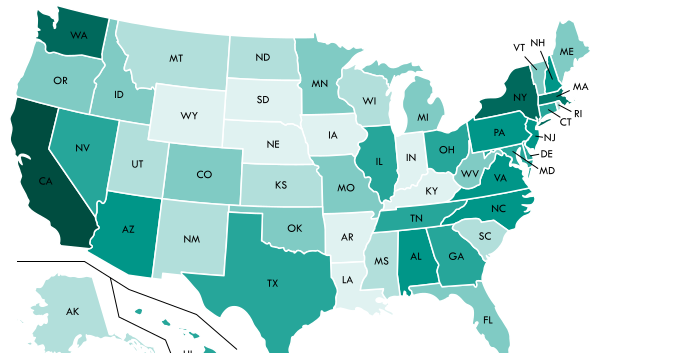
Most common states for lead java developers
| Rank | State | Population | # of jobs | Employment/ 1000ppl |
|---|---|---|---|---|
| 1 | District of Columbia | 693,972 | 862 | 124% |
| 2 | Rhode Island | 1,059,639 | 469 | 44% |
| 3 | Virginia | 8,470,020 | 3,588 | 42% |
| 4 | Montana | 1,050,493 | 435 | 41% |
| 5 | Nebraska | 1,920,076 | 732 | 38% |
| 6 | Vermont | 623,657 | 235 | 38% |
| 7 | Delaware | 961,939 | 348 | 36% |
| 8 | Massachusetts | 6,859,819 | 2,375 | 35% |
| 9 | Oregon | 4,142,776 | 1,442 | 35% |
| 10 | South Dakota | 869,666 | 305 | 35% |
| 11 | Idaho | 1,716,943 | 578 | 34% |
| 12 | Maryland | 6,052,177 | 1,997 | 33% |
| 13 | Utah | 3,101,833 | 1,021 | 33% |
| 14 | Washington | 7,405,743 | 2,403 | 32% |
| 15 | Kansas | 2,913,123 | 943 | 32% |
| 16 | Alaska | 739,795 | 239 | 32% |
| 17 | New Mexico | 2,088,070 | 653 | 31% |
| 18 | New Hampshire | 1,342,795 | 391 | 29% |
| 19 | Minnesota | 5,576,606 | 1,586 | 28% |
| 20 | North Dakota | 755,393 | 212 | 28% |
Most common cities for lead java developers
| Rank | City | # of jobs | Employment/ 1000ppl | Avg. salary |
|---|---|---|---|---|
| 1 | Reston | 7 | 12% | $107,068 |
| 2 | McLean | 4 | 8% | $107,121 |
| 3 | Alpharetta | 4 | 6% | $101,178 |
| 4 | Irving | 11 | 5% | $98,764 |
| 5 | Jersey City | 9 | 3% | $104,773 |
| 6 | Atlanta | 10 | 2% | $101,158 |
| 7 | Saint Louis | 7 | 2% | $95,415 |
| 8 | Tampa | 7 | 2% | $94,627 |
| 9 | Dallas | 8 | 1% | $98,828 |
| 10 | Austin | 7 | 1% | $100,906 |
| 11 | Denver | 5 | 1% | $94,324 |
| 12 | Indianapolis | 5 | 1% | $84,655 |
| 13 | San Francisco | 5 | 1% | $133,096 |
| 14 | Seattle | 4 | 1% | $117,800 |
| 15 | Washington | 4 | 1% | $111,380 |
| 16 | New York | 9 | 0% | $115,345 |
| 17 | Chicago | 7 | 0% | $102,367 |
| 18 | Charlotte | 4 | 0% | $106,645 |
| 19 | Phoenix | 4 | 0% | $105,429 |
| 20 | San Diego | 4 | 0% | $118,456 |
Lead Java Developer job outlook: Expert opinions
Our panel of lead java developer experts
California State University - Sacramento
Nova Southeastern University
Carnegie Mellon University
Seminole State College of Florida
Eastern Washington University
University of Wisconsin - Eau Claire
Texas A&M University
Nova Southeastern University
Southern Illinois University Edwardsville
Oklahoma State University Institute of Technology - Okmulgee
Texas A&M University San Antonio
Middle Georgia State University
Mount St. Joseph University
University of Richmond
Idaho State University
What Lead Java Developer skills would you recommend for someone trying to advance their career?
Sepehr Mohammadian: 1. This is a pretty broad question. CS degree graduates can engage in different tasks and responsibilities based on the nature of their profession. Examples include 1) software engineering, in which the individual's efforts are toward leading or contributing to software development projects, 2) IT management, where the individual mainly oversees technology strategies and their implementation, 3) cybersecurity, where the individual's responsibilities are associated with the protection of systems and data from cyber threats, and 4) data and AI engineering, where the individual works on machine learning applications and analyze and derive insights from large datasets.
What general advice would you give to a Lead Java Developer?
Kin Chung Kwan: Computer science is rapidly growing, with new technologies emerging daily. The desired skill set can vary from year to year. We should always stay updated on the latest global developments and prepare to learn something new. Keeping your skills up-to-date and aligning them with the current needs of employers and target customers is crucial to maximizing salary potential.
Junping Sun Ph.D.
ProfessorNova Southeastern University
Computer Software And Media Applications
What Lead Java Developer skills would you recommend for someone trying to advance their career?
Junping Sun Ph.D.: Computer Science and its applications in various fields are very dynamic and constantly evolving, and anyone in the fields needs to prepare to be adaptive by lifelong learning.
What Lead Java Developer skills would you recommend for someone trying to advance their career?
Jonathan Aldrich: AI is a powerful new tool but it is also unreliable. Learn how you can use it but also what its limitations are, so that you can protect yourself and your customers from those limitations. Always have a way to double-check that the results of AI are sensible and appropriate. No one is a lone coder anymore--you'll be more effective if you can work with other people and with tools that multiply your capabilities. Work on your teamwork skills and keep your eye out for new tools and technologies that make you more effective.
What will help Lead Java Developers increase their earning potential?
Holger Findling: Technologies are changing very fast, and you must change with it. Don't be rigid. AI is going to increase in the next five years, and the demand for programmers will be high. You would have to take courses studying AI concepts. Bio-Medical fields and Biometrics will be expanding in capabilities and these fields will need a lot of programmers. Take some additional courses, for example Biology and Chemistry.
Dan Tappan
Eastern Washington University
Computer Software And Media Applications
What will help Lead Java Developers increase their earning potential?
Dan Tappan: There's not much room for salary negotiation as a new graduate with no experience. Every CS graduate shares roughly the same required background. What often distinguishes one applicant from another, or boosts the salary, is non-required experience with personal projects, contributions to open-source development, and so on. This shows not only applications of the required background, but also the initiative to learn and do more than is expected for the degree.
What general advice would you give to a Lead Java Developer?
Dale Dzielski MBA, CMA®, PMP®, SAFe® 4 Agilist: Be prepared for a lifelong learning experience; it just begins now. Be confident in what you know but open to learn more because you will.
What general advice would you give to a Lead Java Developer?
Lyle Ford: Having a broad base of skills, both technical and interpersonal are very valuable. Often, physics majors are hired to be problem solvers and each problem has its own set of unique conditions that may require a different set of skills to solve. The ability to be an effective team member is vital and proof of that will make you stand out. Evidence of independent work is also helpful so highlight and research or internship experiences you have had.
What Lead Java Developer skills would you recommend for someone trying to advance their career?
Lyle Ford: Be flexible and open to new experiences. Technology changes rapidly and your skills will have to evolve to keep up. You will always need your creativity and problem solving skills, but the way in which you implement them will change with your environment which will require you to constantly update your skillset. Always look for opportunities to network. This can give you insights into developing areas and open doors for future paths you may be unaware of.
What Lead Java Developer skills would you recommend for someone trying to advance their career?
Aakash Tyagi: Treat your career as a marathon, not a sprint. Early years in one's career are best spent understanding the technology at its core and what drives innovation. You'll be a great developer and a great leader if your technical fundamentals are strong. This has never been so true than now in the age of generative AI and LLM where creativity and depth of understanding is what will set you apart from others (human and machine).
What general advice would you give to a Lead Java Developer?
Dr. Frank Mitropoulos Ph.D.: As you begin your career in Computer Applications, remember that the technology industry highly values adaptability and continuous learning. Commit to staying current with emerging technologies, programming languages, tools, and methodologies. Engage in online courses, attend workshops, and network with other professionals in your field. This dedication to self-learning and the connections you make can lead to job opportunities, mentorship, and collaborations that could shape your future career path.
What Lead Java Developer skills would you recommend for someone trying to advance their career?
Dr. Frank Mitropoulos Ph.D.: Maximizing your salary potential as a new graduate with a Computer Applications degree involves strategic positioning, skill enhancement, and effective negotiation. Following are a few strategies to help increase your salary now and in the future: Specialize in High-Demand Areas: Identify and specialize in high-demand areas that generally offer higher salaries. Build a Strong Portfolio: Develop a portfolio that showcases your skills. A compelling portfolio can strengthen your position during salary negotiations. Develop Soft Skills: While technical skills are essential, soft skills like problem-solving, communication, and leadership hold equal significance. Enhancing these skills can give you an edge in negotiations. Do your Homework and Negotiate: Some industries and locations offer higher salaries. Decide what type of industry you want to focus on and do the background research needed to determine whether your skills will help as leverage. Use your portfolio, certifications, and skill set to strengthen your position. Be ready to articulate your value and how you can contribute to the company's success.
What will help Lead Java Developers increase their earning potential?
Dr. Frank Mitropoulos Ph.D.: As we look toward the future of careers in Computer Applications, several skills stand out for their growing importance. These skills revolve around specific technologies that are expected to continue to grow and evolve. Technologies related to Cloud Computing, Artificial Intelligence (AI), Cybersecurity, and Data Science are quickly evolving and being applied across the technology sector. Cloud Computing: Given the widespread adoption of Cloud services, Cloud computing expertise is indispensable. Understanding how to leverage platforms like Azure, AWS, and Google Cloud is crucial to developing scalable, efficient solutions that meet business needs. Artificial Intelligence: AI and Machine Learning are transforming the world. Skills in these areas to solve real-world problems will be even more critical in the future. Cybersecurity: Digital threats are becoming more sophisticated. Safeguarding data, networks, and systems will require encryption, intrusion detection, development, and regulation skills. Data Science: Skills in Data Science will be increasingly sought after as businesses embrace data-driven decision-making. Extracting meaningful insights from extensive datasets and effectively communicating these findings will be essential. Soft skills: Finally, soft skills such as teamwork, problem-solving, and effective communication cannot be overlooked. Adapting, communicating, and leading will be essential for success.
What will help Lead Java Developers increase their earning potential?
Ahmed Imteaj PH.D.: Research Salary Trends: Before entering the job market, research salary trends for entry-level positions in your field and location. Websites like Glassdoor, PayScale, and LinkedIn Salary can provide valuable insights into typical salary ranges for different roles.
Acquire In-Demand Skills: Identify in-demand skills and technologies in your field and focus on acquiring them through coursework, certifications, internships, or personal projects. Skills such as machine learning, cloud computing, cybersecurity, and data science are highly valued and can command higher salaries.
Gain Relevant Experience: Prioritize gaining relevant experience through internships, co-op programs, part-time jobs, or freelance projects. Practical experience can significantly increase your market value and make you more attractive to employers.Customize Your Resume and Cover Letter: Tailor your resume and cover letter to highlight your relevant skills, experiences, and achievements that align with the job requirements. Highlighting your unique qualifications can increase your chances of landing interviews and negotiating a higher salary.
Prepare for Salary Negotiations: Before entering salary negotiations, research the typical salary range for the position and location, considering factors such as cost of living and industry standards. Practice articulating your value proposition and be prepared to negotiate confidently for a salary that reflects your skills, experience, and market value.
Consider Additional Benefits: In addition to salary, consider other benefits and perks offered by employers, such as health insurance, retirement plans, paid time off, flexible work arrangements, professional development opportunities, and bonuses. These benefits can add significant value to your overall compensation package.
What general advice would you give to a Lead Java Developer?
Evgenia Smirni: I would say that quick pivoting and embracing changes is very important - this is a very fast changing field.
Ali Alouani
Professor of ECEWhat will help Lead Java Developers increase their earning potential?
Ali Alouani: Have co-op/internship experience, good GPA, and impress the recruiter.
Mr. Mark Pranger
Instructor, School of Creative and Information TechnologiesOklahoma State University Institute of Technology - Okmulgee
Mining And Petroleum Technologies/Technicians
What general advice would you give to a Lead Java Developer?
Mr. Mark Pranger: The first skill would be one I mentioned up in the first question and that is your communication skills. Not only is it important now, but it will also remain important as time goes forward. A skill that many overlook is the ability to teach yourself. We are in a technical field that changes daily. I do countless interviews with students doing their internships and, on the way, out the door, I give the advice of being a lifelong learner. Be prepared to reinvent yourself in about 5 to 10 years. Our technology changes and is that demanding of us. Do not depend on your company to direct your self-learning. Your career is your responsibility. So, oversee your learning. The company may teach you new skills, but they will be skills they want you to have. It might take you far into the company but you still have to manage your career for your best results. My next piece of advice is to consider a non-technical advanced degree. Consider a business degree to complement your technical degree. As you move up in the organization, things like finance, management, and other business disciplines will increase in importance. You may end up managing a department or even the entire organization's technical future. You will need to understand how all those pieces of the business interact with each other and the related business environment. My last skill to suggest is the skill to maintain a work and life balance. If you put too much into work, you may wake up one day and ask yourself, is it worth it? When one spends all their time working to get ahead, when do they get time to be ahead and enjoy it?
What Lead Java Developer skills would you recommend for someone trying to advance their career?
Mr. Mark Pranger: The biggest advice here is to show the organization the long haul. It costs a lot of money to advertise, find, recruit, hire, and train employees in our field. The company wants to know their return on that investment will be higher. A large technical breadth versus a deep technical understanding is the balance you have to maintain. Many companies I deal with as an internship coordinator tell me that they can train the technical niche needs that they have but the student has to be able to show that they can learn and absorb that knowledge and put it to use. Going back to the portfolio, this gives someone looking at it insight into what extent you can learn, absorb, and produce. I personally am a true believer in the depth over breadth in the computer science programming field. While syntax changes from language to language, the concepts that we use to engineer our software remain the same. So Java does one activity different than C# or Ruby, that concept though will be important and the syntax can be picked up easier if you understand the concept. To me, a deeper understanding of one language and the ability to adapt quickly to another language is more important than having a little knowledge in a wide breadth of language but no depth. I have been in this field for 30 years now and probably know about half that number of languages that I have used over those 30 years. I didn't start with all those languages, but I did start with a very deep understanding of just one or two. I could spend my time quickly learning syntax to pick up a new language for a new position because I understood the concepts so well in my root language. Learn it deep, understand it deep and show you can transfer it across laterally. Put together that portfolio. The portfolio reinforces the narrative I discussed in the earlier question also.
What will help Lead Java Developers increase their earning potential?
Mr. Mark Pranger: My first piece of advice a student graduating is to not wait until the last minute to do any networking in their field. If your college/university offers career fairs, start attending those as soon as possible. Start putting your name and associated face out there so when HR sees the name on the resume, they already know the face that goes with it. Put in the shoe leather or other sole material in early and often as possible. My second piece of advice is to target your cover letter, resume, and subsequent contacts such as interviews to the individual companies. Show them that you have taken the time to get to know the company. You may find common ground or may find that you are not a good match. Your time as well as their time is valuable, invest in well into finding the match for you that you can work at and feel rewarded. Make sure to clean up those resumes and other written communications before you send them. One simple grammar or spelling mistake could remove you from consideration in their very competitive world. Practice interviewing if at all possible. Go to any mock interviews your institution offers or clubs offer. If there is not any, ask those in the industry or management positions that you might know to mock interview you for the practice. Show respect for their time and be serious about the mock interview. Show up in person dressed like you are doing a real interview. Your entire interaction with a company and their representatives is your chance to create the narrative they will remember. In that narrative, you take them on the journey of getting to know you, finding out you are a good match to the company, and a good match to the position to which you are applying. The outcome you want is that job offer. One might notice my advice is not technical but more in the way you are looking for a position. Once you get into the position, the actual question that was asked here, start by absorbing anything they are willing to throw at you. Look for opportunities to show the company what you can do and what they can expect from you. Be mindful of your plate size and don't take on too much too early. They will remember two major things about your early days: That you tried and how you handled success and failure. Continue your networking at the job. Though we are in a technical field, we will interact with others not in our field. Our written and verbal communication skills will be put to the test. Nothing kills a great presentation idea more than bad communication skills. Never assume you are the best. Always work on the premise that someone is better and strive to become better. The education has given you the technical side of the coin. But it takes the non-technical side such as communication skills to showcase to others and your company your technical prowess. If you have not already, put together a portfolio of your work. Show the employers what you have done in the field. This includes what you did in school as projects. Having interacted with many hiring managers through advisory committees, one thing that keeps coming up is the creation of a portfolio. Those are not just for the artist, they are for anyone to show what they can do. Don't give up. The pile of rejection letters may become larger before that right position and company comes your way. You do have to search for it but it is out there.
MARLA KRAMER
Assistant Vice President of Marketing and CommunicationsWhat general advice would you give to a Lead Java Developer?
MARLA KRAMER: Do the necessary course work from a reputed institution, where you can get the necessary hands-on experience under the tutelage of an established expert. Create a portfolio of your work on GitHub so that you can share your projects with potential employees. It is more important to demonstrate your skills through code, than it is to provide a list of classes that you have taken. Certification courses are expensive, but getting an accredited certificate in Mobile Application Development or any of the rapidly growing fields is always an advantage. The internet has a lot of uncurated, self-published, and incorrect information, especially when it comes to computer science. It is important that you pick your sources wisely as you build your skills.
What Lead Java Developer skills would you recommend for someone trying to advance their career?
MARLA KRAMER: Computer Science, and IS in general, is a field that is constantly evolving. It is not enough to know what everybody else knows. Becoming a subject matter expert with deep knowledge is important to be successful in the long run. You have to pick your area of expertise carefully, keep yourself focused and educated in that specific area, and be prepared for a career of continuous learning.
What will help Lead Java Developers increase their earning potential?
MARLA KRAMER: It is unlikely that software development will be fully automated in the near future. Writing correct and efficient applications is a skill set that will only grow as we invent more ways to improve the quality of our lives. As more and more commerce and critical services migrate onto the internet, IS development will require a deeper knowledge of cybersecurity, data analytics, and cloud computing. According to the U.S. Bureau of Labor Statistics (BLS), Information Security Analysis jobs are expected to grow by 32% over the next 10 years. The BLS estimates Software Developers, Quality Assurance and Testing will grow by 25% over the next decade.
Right now, however, software development is going through a lull because of competition from abroad. Being an expert in at least two popular programming languages, having a solid theoretical foundation, and being able to innovate is pivotal. Artificial Intelligence is being deployed to solve some problems now, thanks to the powerful computers we have today. Learning to effectively use AI frameworks as part of your application development will add a lot of value to your skillset.
Izzat Alsmadi
Associate ProfessorTexas A&M University San Antonio
Computer Science
What Lead Java Developer skills would you recommend for someone trying to advance their career?
Izzat Alsmadi: With the quick and rapid evolution language models, they are expected to be great assets in accelerating many jobs. Its important for new graduates to be aware of such models or tools and how they can be used
Programming skills will still be important but languages will be more mature and graduates need to be aware of the different available tools and resources online and how they can be used
What general advice would you give to a Lead Java Developer?
Izzat Alsmadi: Computing fields are unique that they have a very large spectrum of possible jobs.
New graduates should be open and flexible to seek opportunities beyond a narrow focus that they may have in mind.
The degree itself is a great start but in most cases will not be enough and you have to seek own training in new software, tools, etc.
Certificates can be also important for some particular sub-disciplines (e.g. cyber security)
What will help Lead Java Developers increase their earning potential?
Izzat Alsmadi: The market is very large, make your deep analysis on top trending jobs, their pays and requirements, unlikely to have high paying jobs for fresh graduates with extra skills, certificates, etc.
Tina Ashford
Professor of Information Technology/Faculty Curator of the Museum of Technology/DoIT Internship CoordinatorMiddle Georgia State University
Computer And Information Sciences And Support Services
What will help Lead Java Developers increase their earning potential?
Tina Ashford: My first piece of advice is to embrace lifelong learning. Tech never sleeps, so neither should your curiosity. View mistakes as growth opportunities, and stay a student forever. Next, optimize your communication and teamwork skills to bridge the gap between techies and everyone else. Critical thinking is your secret sauce, so use it to solve problems creatively and anticipate the future. Finally, specialization is great, but keep an open mind. A broader skillset makes you adaptable, ready to seize unexpected opportunities. Network actively, build relationships, and most importantly, stay passionate. Let your tech enthusiasm fuel your career.
What general advice would you give to a Lead Java Developer?
Tina Ashford: Technical expertise is crucial: cloud fluency, cybersecurity awareness, and understanding Artificial Intelligence/Machine Learning (AI/ML) potential, however, soft skills are equally important - clarity in communication, seamless collaboration, and an ever-growing appetite for learning to adapt to the ever-changing tech landscape. Even with AI on the scene, uniquely human problem-solving and fresh ideas will set you apart. This blend of technical and soft skill agility, and never-ending curiosity should bring you success in the field of IT.
What Lead Java Developer skills would you recommend for someone trying to advance their career?
Tina Ashford: Build relationships with professionals in your industry. This can lead to new opportunities and provide valuable insights. If you have multiple job offers, use them to negotiate a better deal. However, remember to consider factors like career growth and job satisfaction along with the salary. Keep improving your skills through courses, certifications, or volunteering. The more skilled you are, the higher your earning potential. Don't hesitate to seek advice from career coaches, mentors, or HR professionals. They can provide personalized guidance to help you navigate your career path. Remember, increasing your earnings is a continuous process, not a one-time event. By strategically investing in your skills and staying informed about your industry, you can confidently navigate and achieve a fulfilling and financially rewarding career.
Rebecca Allen
Mount St. Joseph University
Special Education And Teaching
What general advice would you give to a Lead Java Developer?
Rebecca Allen: AI, for sure. I have heard it said that AI might not replace humans, rather humans who know how to use AI well may replace humans who don't.
What Lead Java Developer skills would you recommend for someone trying to advance their career?
Rebecca Allen: Get hands-on experience. Join the workstudy program, take the co-op or the internship. Be sure to apply what you've learned!
What will help Lead Java Developers increase their earning potential?
Rebecca Allen: I'd suggest that you hop in to coding and just get started. Even a tiny bit helps. Python is a very popular language, and free to download (Python.org). Once you download, there are some many ways to start learning coding. My personal favorites are Mimo and LearnPython.org. You can also ask ChatGPT for suggestions-remember that ChatGPT can often help your write and explain simple code. Don't understand something? Ask ChatGPT!
Ahmed Temani
Senior InstructorUniversity of Richmond
Computer/Information Technology Administration And Management
What general advice would you give to a Lead Java Developer?
Ahmed Temani: A lot of the buzz is about using chatbots to improve coding efficiency. However, there is a great need for systems level thinking and design as software is deployed across cloud and edge computing devices. Gaining more experience in systems design provides you with additional skills that complement whatever AI-based technology gets deployed.
What Lead Java Developer skills would you recommend for someone trying to advance their career?
Ahmed Temani: This one I'm not sure how to answer as it is too broad. I would say work hard and do quality work, but that seems obvious.
What will help Lead Java Developers increase their earning potential?
Ahmed Temani: As an early career developer, you will likely rotate among different software products and teams. Even if the work is not your current skill set, the new challenges will build new skills and allow you to make more connections within the company.
What general advice would you give to a Lead Java Developer?
Nikyra Capson: I encourage my students to take advantage of opportunities now-don't wait. Idaho State University has a program called Career Pathway Internships (CPI), which allows students to graduate with 2-3 years of work experience in their field. Seeking out these kinds of opportunities while in school will help them obtain a job after graduation. I also encourage my students to connect with their classmates and build solid relationships with the people around them. These relationships can help them in the future.
What Lead Java Developer skills would you recommend for someone trying to advance their career?
Nikyra Capson: Don't be afraid of being rejected. If they see a job they want, apply. Even if they don't think they'll get it, still apply. The worst thing that could happen is being told no. Not applying is an automatic no, so they might as well try.
What will help Lead Java Developers increase their earning potential?
Nikyra Capson: Understanding artificial intelligence and developing technology are essential skills for students to have so they're prepared for the future. Software is constantly updating, so designers need to be able to evolve with it and be constantly learning.