Explore jobs
Find specific jobs
Explore careers
Explore professions
Best companies
Explore companies
Job outlook for learning center coordinators in the United States
Are learning center coordinator jobs in demand?
Learning center coordinator job and salary trends over time
Learning center coordinator jobs over time
Learning center coordinator job growth rate over time
| Year | # of jobs | % of population |
|---|---|---|
| 2021 | 427 | 0.00% |
| 2020 | 404 | 0.00% |
| 2019 | 397 | 0.00% |
| 2018 | 370 | 0.00% |
| 2017 | 356 | 0.00% |
Average learning center coordinator salary over time
Learning center coordinator salary by year
| Year | Avg. salary | Hourly rate | % Change |
|---|---|---|---|
| 2025 | $50,677 | $24.36 | +2.4% |
| 2024 | $49,473 | $23.79 | +0.6% |
| 2023 | $49,198 | $23.65 | +0.8% |
| 2022 | $48,786 | $23.45 | +2.3% |
| 2021 | $47,703 | $22.93 | +1.4% |
Learning center coordinator jobs by state
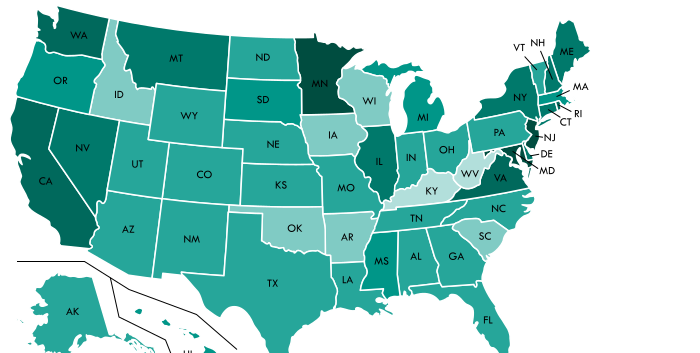
Most common states for learning center coordinators
| Rank | State | Population | # of jobs | Employment/ 1000ppl |
|---|---|---|---|---|
| 1 | Maine | 1,335,907 | 479 | 36% |
| 2 | Montana | 1,050,493 | 319 | 30% |
| 3 | Delaware | 961,939 | 260 | 27% |
| 4 | Nebraska | 1,920,076 | 497 | 26% |
| 5 | District of Columbia | 693,972 | 180 | 26% |
| 6 | Idaho | 1,716,943 | 424 | 25% |
| 7 | New Mexico | 2,088,070 | 497 | 24% |
| 8 | Oklahoma | 3,930,864 | 775 | 20% |
| 9 | Kansas | 2,913,123 | 597 | 20% |
| 10 | Alabama | 4,874,747 | 919 | 19% |
| 11 | Minnesota | 5,576,606 | 953 | 17% |
| 12 | North Dakota | 755,393 | 129 | 17% |
| 13 | Kentucky | 4,454,189 | 693 | 16% |
| 14 | Missouri | 6,113,532 | 893 | 15% |
| 15 | Alaska | 739,795 | 104 | 14% |
| 16 | Virginia | 8,470,020 | 1,130 | 13% |
| 17 | West Virginia | 1,815,857 | 232 | 13% |
| 18 | South Dakota | 869,666 | 112 | 13% |
| 19 | Illinois | 12,802,023 | 1,587 | 12% |
| 20 | New Hampshire | 1,342,795 | 160 | 12% |
Most common cities for learning center coordinators
| Rank | City | # of jobs | Employment/ 1000ppl | Avg. salary |
|---|---|---|---|---|
| 1 | Phoenix | 2 | 0% | $42,504 |
| 2 | Mesa | 1 | 0% | $42,188 |
| 3 | Washington | 1 | 0% | $69,403 |
Learning Center Coordinator job outlook: Expert opinions
Our panel of learning center coordinator experts
Rocky Mountain College

Tarleton State University

Seattle University

East Tennessee State University
American University

Frostburg State University
Precious McKenzie Ph.D.
Associate Professor of EnglishRocky Mountain College
Division Chair for Humanities & Fine Arts
What are the biggest trends we'll see in the Learning Center Coordinator job market given the pandemic?
Precious McKenzie Ph.D.: The pandemic has brought many new and unexpected challenges. The job market seems to be evolving. As companies have shifted to virtual meetings and remote work, employers will continue to need employees with time management and communication skills. They will need employees who are team builders. These are essential qualities especially when teams are unable to meet face-to-face because of COVID-19.
Amber Diaz
Assistant Professor, Department HeadTarleton State University
Department of Curriculum and Instruction
What skills stand out on Learning Center Coordinator resumes?
Amber Diaz: Technology and evidence of application. It is one thing to say you know how to use Google Classroom, but actually having a Google Classroom that is well designed as an artifact has significant value. Multidisciplinary Teaching will continue to find value in the classroom as there will be a greater need to ensure all students are learning and successful on grade level content. Culturally Responsive & English Learner knowledge and/or certification. Our nation continues to see an increase in the diversity of the students we teach, as such there continues to be an increase of English Learners. As educators, we have an obligation to be fully prepared to reach all learners with culturally relevant pedagogies.
Theresa Earenfight Ph.D.
Professor of History, Director, Women, Gender, and Sexuality Studies ProgramSeattle University
History Department
Will there be an enduring impact of the coronavirus pandemic on Learning Center Coordinators?
Theresa Earenfight Ph.D.: As a historian of the European Middle Ages, I'm struck by how students this past year have acquired something scarce: historical empathy. The past can seem so remote, so very different from our lived experiences today, and this can make history seem irrelevant. But this fall, I was teaching a section on the bubonic plague, which historians of medicine now know was a global pandemic, not just an epidemic in Europe. Usually, students are fascinated by the gruesome medical details, but not this group.
They did not need or want to look death in the eyes. They wanted to know how did people react? How did they get back to normal? When we ticked off the list of reactions--fear, distrust of science (such as it was in 1348), xenophobia, scapegoating, economic collapse, hoarding supplies, turn to religion, gallows humor about worms crawling about corpses--they got it. When we talked about the aftermath--eat, drink, be merry, and protest the inequality--they got it. That is historical empathy, and I'm sad that this was how it had to be learned, but it will give them broader compassion that can encompass people alive today.
Will there be an enduring impact of the coronavirus pandemic on Learning Center Coordinators?
Dr. Frederick Gordon Ph.D.: Graduate students will need to refocus on the changing institutional role, being both remote and in-person, and impacting agency goals and performance.
How do you envision technology impacting Learning Center Coordinators in the next 5 years?
Dr. Adelaide Kelly-Massoud: Well, every teacher and teacher candidate was thrust into distance learning. Misguided attempts to foster understanding often leaned our adult distant learning pedagogy. Teachers, and those who prepare teachers, found their job to research, define, design, and implement meaningful teaching and learning using a virtual platform. Words such as synchronous and asynchronous are now a part of our everyday vernacular. But there is a much more optimistic change on the horizon that we can thank coronavirus for.
Communication and collaboration have been forced to change. Parents and Teachers are more connected and have been put in a position to leverage technology to build networks of support and consistent dialog. I urge teachers to leverage this in their future as we work to reopening schools; we should learn from this experience to leverage technology to keep us connected.
Jamelyn Tobery-Nystrom
Coordinator of M.Ed. Special EducationFrostburg State University
Educational Professions
How do you envision technology impacting Learning Center Coordinators in the next 5 years?
Jamelyn Tobery-Nystrom: Technology impacts special education in many ways. First, technology is the primary tool for kids with communication disorders. So, knowing how to find and use technology with students is critical. Second, instruction is now online for many of our students; therefore, learning new ways to teach using technology is needed. Technology will continue to evolve and be central to instruction.