Explore jobs
Find specific jobs
Explore careers
Explore professions
Best companies
Explore companies
Job outlook for learning design specialists in the United States
Learning design specialist job growth summary. After extensive research, interviews, and analysis, Zippia's data science team found that:
The projected learning design specialist job growth rate is 8% from 2018-2028.
About 28,900 new jobs for learning design specialists are projected over the next decade.
Learning design specialist salaries have increased 6% for learning design specialists in the last 5 years.
There are over 3,808 learning design specialists currently employed in the United States.
There are 68,913 active learning design specialist job openings in the US.
The average learning design specialist salary is $72,967.
Are learning design specialist jobs in demand?
Learning design specialist job and salary trends over time
Learning design specialist jobs over time
Learning design specialist job growth rate over time
| Year | # of jobs | % of population |
|---|---|---|
| 2021 | 3,808 | 0.00% |
| 2020 | 3,604 | 0.00% |
| 2019 | 3,541 | 0.00% |
| 2018 | 3,302 | 0.00% |
| 2017 | 3,177 | 0.00% |
Average learning design specialist salary over time
Learning design specialist salary by year
| Year | Avg. salary | Hourly rate | % Change |
|---|---|---|---|
| 2025 | $72,967 | $35.08 | +2.4% |
| 2024 | $71,233 | $34.25 | +0.6% |
| 2023 | $70,837 | $34.06 | +0.8% |
| 2022 | $70,244 | $33.77 | +2.3% |
| 2021 | $68,684 | $33.02 | +1.4% |
Learning design specialist jobs by state
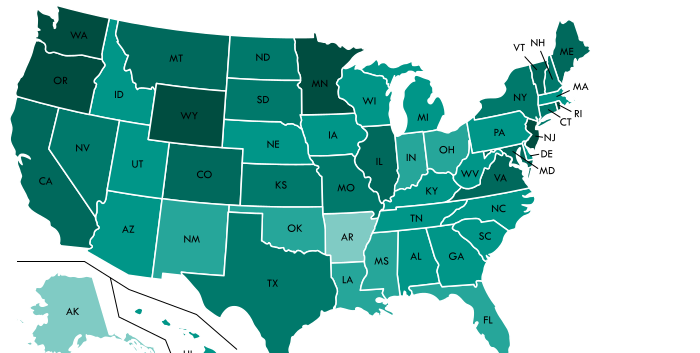
Most common states for learning design specialists
| Rank | State | Population | # of jobs | Employment/ 1000ppl |
|---|---|---|---|---|
| 1 | District of Columbia | 693,972 | 261 | 38% |
| 2 | Delaware | 961,939 | 213 | 22% |
| 3 | Iowa | 3,145,711 | 622 | 20% |
| 4 | Wyoming | 579,315 | 113 | 20% |
| 5 | Vermont | 623,657 | 113 | 18% |
| 6 | Alaska | 739,795 | 127 | 17% |
| 7 | Virginia | 8,470,020 | 1,322 | 16% |
| 8 | Massachusetts | 6,859,819 | 1,106 | 16% |
| 9 | Oregon | 4,142,776 | 666 | 16% |
| 10 | New Hampshire | 1,342,795 | 215 | 16% |
| 11 | North Dakota | 755,393 | 118 | 16% |
| 12 | Colorado | 5,607,154 | 868 | 15% |
| 13 | Utah | 3,101,833 | 480 | 15% |
| 14 | Nebraska | 1,920,076 | 287 | 15% |
| 15 | Arizona | 7,016,270 | 1,005 | 14% |
| 16 | Washington | 7,405,743 | 1,004 | 14% |
| 17 | Minnesota | 5,576,606 | 776 | 14% |
| 18 | Kansas | 2,913,123 | 396 | 14% |
| 19 | Montana | 1,050,493 | 151 | 14% |
| 20 | South Dakota | 869,666 | 120 | 14% |
Most common cities for learning design specialists
| Rank | City | # of jobs | Employment/ 1000ppl | Avg. salary |
|---|---|---|---|---|
| 1 | Bridgewater | 1 | 4% | $63,749 |
| 2 | Frankfort | 1 | 4% | $65,657 |
| 3 | Annapolis | 1 | 3% | $77,900 |
| 4 | Dover | 1 | 3% | $67,590 |
| 5 | Juneau | 1 | 3% | $53,476 |
| 6 | Carmel | 1 | 1% | $59,896 |
| 7 | Hartford | 1 | 1% | $71,996 |
| 8 | Lansing | 1 | 1% | $63,603 |
| 9 | Little Rock | 1 | 1% | $53,208 |
| 10 | Atlanta | 2 | 0% | $63,928 |
| 11 | Denver | 2 | 0% | $76,878 |
| 12 | Baton Rouge | 1 | 0% | $60,680 |
| 13 | Boston | 1 | 0% | $63,553 |
| 14 | Des Moines | 1 | 0% | $65,708 |
| 15 | Indianapolis | 1 | 0% | $59,856 |
| 16 | Montgomery | 1 | 0% | $66,507 |
Learning Design Specialist job outlook: Expert opinions
Our panel of learning design specialist experts
University of Hawaii at Manoa
Indiana University Bloomington
Robert Morris University
Armstrong State University
Illinois State University

Edgewood College

Nyack College

University of Alaska Anchorage
University of Central Missouri
The Catholic University of America
University of Kentucky
Rocky Mountain College
Central Connecticut State University

University of Puget Sound

Tarleton State University
What general advice would you give to a Learning Design Specialist?
Dr. Michael Menchaca: While it is important to have specialized knowledge of industry-standard tools such as Articulate, AI, etc., it is more important to understand design-thinking and possess strong problem-solving skills. Understanding and utilizing a design framework is key to the creation of contemporary learning systems.
What Learning Design Specialist skills would you recommend for someone trying to advance their career?
Dr. Michael Menchaca: Possess a health balance of general design skills and specific tool knowledge. Understand which tools are prevalent by reviewing job descriptions (AI does a great job of this) and augment your skill set. Don't wait for your graduate program to cover every tool; sometimes you have to learn some on your own. Practice presentation and interview skills and look for practicums and internships in your program.
What will help Learning Design Specialists increase their earning potential?
Dr. Michael Menchaca: Funny you should ask. Artificial Intelligence is not over-hyped even though it may feel that way from the barrage of media and articles about it. If graduates don't at least have a working understanding of AI, especially as it relates to education, then they are behind. I especially advise that ed tech graduates practice prompt engineering and research AI as it relates to their specific areas of interest and expertise. In addition, complex problem-solving and understanding of cognition and neurosciences will be key.
Gamze Ozogul Ph.D.
Department Chair of Learning, Design, and Adult Education, LDAE, Associate Professor of Instructional Systems Technology, ISTIndiana University Bloomington
Educational/Instructional Media Design
What general advice would you give to a Learning Design Specialist?
Gamze Ozogul Ph.D.: Experience may help with maximizing salary potential as one enters the career in my field. Generally, degree programs offer various options for that, e.g., Indiana University has a studio-based option for a residential MS program, or course projects with clients (both in online and residential programs), internships, service learning, being involved in research projects. If a starting job candidate can show evidence from various experiences in their graduation portfolio (website), it may help them maximize the salary potential as they start their career.
What Learning Design Specialist skills would you recommend for someone trying to advance their career?
Gamze Ozogul Ph.D.: Adaptability, flexibility, and being open to continuously learning (after the degree completion). Technology, learning environments, learning needs, and content to be mastered by the learners are constantly changing. The educational technologist has to be open to learn continuously and change and adapt to the changes happening in these areas. Additionally, soft skills such as being a team member and clear communication are very important, as educational technologists work in a team or lead a team.
What will help Learning Design Specialists increase their earning potential?
Gamze Ozogul Ph.D.: Everyone needs to start somewhere. Learn most from each experience in the field and build your resume, experiences, and skills.
What general advice would you give to a Learning Design Specialist?
Dr. Richard Fuller: AI is growing and becoming more and more part of the lexicon of teaching and learning in all areas of prek-12, higher education, and corporate training and development. This will need to be understood on both the offensive side, which is using AI as pedagogy as well as the defensive side to combat academic integrity issues. Online teaching and learning, in both synchronous and asynchronous modalities in addition to more traditional f2f methodologies and pedagogies, will become more and more important as Universities look for more sustainable tools. Much was learned during the pandemic lock-down and this knowledge and skill are being used in a post-pandemic world. Keep an open mind to new innovations in curriculum design and different theories and methods to map, align, and develop curriculum. This ever-changing dynamic is grounded, however, in the fundamentals that were learned through your degree. Additionally, stay up on all the technology that is advancing. This is key in the C&I; and the instructional design world. Tech moves very fast and what you know today is outmoded tomorrow. C&I; must stay current and active to assist others through teaching and design. Knowing how to use tech and different software is tantamount to success as an instructional designer or teacher.
What Learning Design Specialist skills would you recommend for someone trying to advance their career?
Dr. Richard Fuller: Be open to opportunities that will present themselves in Prek-12, higher education or corporate training and development. Many places will see the value in hiring employees with the knowledge and skills that come with a Curriculum and Instruction (C&I;) degree and will create positions accordingly. Most organizations see the value of a training and development department with specific uses. Hospitals, k-12 schools, for profit organizations and nonprofit organization incorporate instructional designers with a curriculum and instruction degree. Even higher education (HE) hire instructional designers to work with faculty. HE faculty are subject matter experts but don’t know about instruction or curriculum or how to teach online or in person f2f. They also don’t understand the value or how to design and develop curriculum and transfer that to the classroom. PreK-12 utilize C&I; grads as both trainers and as coordinators of curriculum. This may require an advanced degree (graduate or doctoral), but nonetheless, it is an opportunity and something to think about as you progress through your career. Training and Development is an obvious opportunity in many corporations and organizations as C&I; prepared graduates have a body of knowledge and skills that align with training needs in designing and delivering training for corporate and organizational initiatives in all areas. There are those with a C&I; degree who also hold teaching certificates in some area of Prek-12. This may open other doors for them in teaching in the classroom but with the degree may present additional opportunities in an organization’s administrative capacity or training.
What Learning Design Specialist skills would you recommend for someone trying to advance their career?
Dr. Kymberly Harris PhD: In the coming years, proficiency in educational technology is expected to become increasingly important. Graduates should focus on honing their skills in integrating digital tools into the curriculum, leveraging data for informed decision-making, and staying abreast of advancements in online and blended learning environments. Additionally, addressing diversity, equity, and inclusion in education will be crucial for educators to create inclusive and culturally responsive learning environments.
What general advice would you give to a Learning Design Specialist?
Dr. Kymberly Harris PhD: New graduates entering the field of Curriculum & Instruction should prioritize building a diverse skill set, staying current with educational trends, and actively seeking opportunities for professional development. Cultivating strong verbal and written communication skills will enhance collaboration with colleagues, parents, and students. Adapting to evolving educational methodologies, such as culturally relevant pedagogies, will contribute to long-term success.
What general advice would you give to a Learning Design Specialist?
Anthony Piña Ed.D.: If you have not done so already, become active in professional associations that align to your career interests. Attend (and consider presenting at) their professional conferences. This will be a source of professional development, networking, and future employment opportunities. Look for opportunities to gain practical experience-even as a volunteer. For example, if you have an interest in instructional design, you may check out Designers for Learning (designersforlearning.org), which can match you with service-learning opportunities. You should become familiar with the instructional designer competencies from the International Board of Standards for Training, Performance and Instruction (ibstpi.org) and work on those in which you might have less training or experience.
What Learning Design Specialist skills would you recommend for someone trying to advance their career?
Anthony Piña Ed.D.: Educational Technology is a very broad field with practitioners in various work settings and with differing emphases and responsibilities. Ultimately, potential employers of both full-timers and consultants will want to now 1) what you can do and 2) what you have done. Depending upon your career emphasis, you can: 1) spend some time with trial software and tutorials to gain expertise in specific applications; 2) co-author articles and co-present at conferences to build up your name recognition and credentials; 3) see if colleagues will allow you to participate in their projects: 4) do not pass up opportunities to work-even if it is low-paid or volunteer with non-profits, civic groups, etc. to build your experience and resume--so many of these lead to future jobs.
What will help Learning Design Specialists increase their earning potential?
Anthony Piña Ed.D.: Working with and leading people-including managing conflict-is undertaught in our current ed tech programs. Accessibility and Universal Design for Learning will continue to rise in importance. Those going into industry (and increasingly in academe) are expected to have skills in multimedia/video production and interactive authoring, e.g., Articulate, Adobe Captivate. Of course, an ed tech professional will be expected to be up-to-speed in the use and affordances of AI.
Dr. Tom Holub Ph.D.
Director of Curriculum & InstructionEdgewood College
Department of Curriculum and Instruction
What are the biggest trends we'll see in the Learning Design Specialist job market given the pandemic?
Dr. Tom Holub Ph.D.: From my vantage point, and the research we are engaging in, it is clear that emotional wellness has been, and will continue to become, a major issue in society. The wide-ranging concerns for emotional and mental health cross lines of all demographics. Specialist, interventionists and therapists will be needed for children and adults post-pandemic. The specialization of needs, for example in adolescent interaction with the pandemic, will further complicate our nation's critical needs in this area. To this end, the opportunities for employment will grow in our field and the benfits of high quality training programs will become a priority.
What technical skills for a Learning Design Specialist stand out to employers?
Dr. Tom Holub Ph.D.: This field is very qualitative in nature, but there are significant issues relative to our technologies as well. As Rehabilitation Psychologists and Special Education (RPSE) personnnel, reliance upon systems of data support and communication are critical. Having the ability to navigate qualitative research technologies will help an RPSE candidate show a competetive edge over other candidates.
How have salaries changed over time for Learning Design Specialists?
Dr. Tom Holub Ph.D.: There has been great stability in the field, with salaries increasing over time. The new and improved alliances with insurance companies have eased some pressure that families have felt. Previously, in many cases, families did not seek out the assistance of a certified RPSE because of the hourly fees. More contemporarily insurance coverage has made this access much better. The efficacy of our interventions is increased when families do not have deep-seated worries about paying for these necessary services.
What are the biggest trends we'll see in the Learning Design Specialist job market given the pandemic?
David Emanuel Ph.D.: Given the pandemic, I think the biggest trend that we see in the job market is the switch to functioning in a remote environment. The demand to be present in a traditional "office" is fading as more and more employers are forced to find new ways for their staff members to work at home. This opens up new opportunities for applicants because now they are less restricted to applying for work within a commutable distance. More opportunities are opening for a graduate living in New York, for example, to apply for a job with offices in Orlando. Because the need to be physically present in the office has become less crucial, employees do not need to live locally.
What technical skills for a Learning Design Specialist stand out to employers?
David Emanuel Ph.D.: I think employers are especially looking out for students that have acquired strong technical skills along with their major. Graduates with knowledge of Zoom, GoogleMeets, social media, etc., are more likely to impress employers. Here, it is not just the ability to use existing technological platforms, but also the willingness to learn and adapt to new technological changes in the workplace. Along with the newer applications, a sound knowledge of basic programs such as MS Word and Excel also helps to distinguish students.
What's a good job out of college for Learning Design Specialists?
David Emanuel Ph.D.: With a degree in biblical studies, especially at Nyack College, graduate students have at least two options. Either the academic route, furthering their education at a seminary or secular institution. Many of our students have taken this route, and have continued to doctoral studies at a variety of institutions, both in the US and abroad. Alternatively, students have entered the job market serving in a variety of different roles. Most commonly students work for local churches, specifically in the area of teaching. Outside of the church, however, a good option is teaching at private Christian schools. A third great option, if the student possesses strong writing skills, is to enter the world of editing, specifically for books centered around Bible and Theology.
Anonymous Professor
What general advice would you give to a Learning Design Specialist?
Anonymous Professor : Getting a degree in Africana Studies or any other similar major (e.g., Ethnic Studies, Latin American and Latino Studies, etc.), is no different from getting a degree in any other Arts & Sciences department, in the sense that it provides a strong liberal arts education, but in an interdisciplinary field, that provides an additional lens for studying the same things students study in "traditional" academic disciplines.
Students with these degrees graduate college with the same career options available to them as those graduating from any other Arts and Science degree. Some go to graduate or professional school, others enter the labor market across a variety of fields, including finance.
What's a good job out of college for Learning Design Specialists?
Anonymous Professor : A good first job out of college is one that pays enough to cover expenses and save, but also makes you happy. It might also further your educational experience by providing real-world experience and helping young adults refine their goals and aspirations. What that looks like "on the ground" is different for everyone.
Ginger Blackmon
Assistant Professor of Educational LeadershipUniversity of Alaska Anchorage
College of Arts and Science; School of Education; Educational Leadership Program
What are the biggest trends we'll see in the Learning Design Specialist job market given the pandemic?
Ginger Blackmon: I believe the biggest trends we will see in the education job market given the pandemic include an increase in the teacher shortage as a number of retirement-age professionals will choose to leave the classroom rather than risk returning the face-to-face instruction that increases their chance of exposure to the coronavirus. This trend will lead to a shift in how state departments, school districts, and university preparation programs think about the preparation of teachers and school leaders to fill these positions.
What Learning Design Specialist skills would you recommend for someone trying to advance their career?
Ginger Blackmon: If a graduate needs to take a gap year, gaining skills and experience in working among diverse groups of school-age children in non-school settings will enhance their work as teachers. Volunteering in after-school programs, sports programs, boys and girls clubs, and academic/arts programs will give graduates opportunities to build meaningful relationships with children. Gaining experience in building meaningful relationships with children and families outside of the stress and pressure of the modern classroom will enhance their success as they begin their teaching careers.
What general advice would you give to a Learning Design Specialist?
Ginger Blackmon: The general advice I would give to a graduate beginning their career as an educational professional is to first and foremost understand that students, colleagues, and parents need to know that you care. Authentic, caring, and positive relationships build the foundation for the success and well-being of students and adults within the school setting. Second, I would suggest that they continue to learn. Understanding that educators leave their preparation programs simply knowing enough to get started. Not only is there so much more to learn, but engaging in and modeling lifelong learning is critical in order to address the learning needs of an ever-changing student population, and to educate the next general to address the problems confronting an ever-changing world only enhances the ability to build strong relationships with students, colleagues, and parents.
Lea Porta
InstructorUniversity of Central Missouri
Early Childhood Education Department
Will there be an enduring impact of the coronavirus pandemic on Learning Design Specialists?
Lea Porta: Endure, yes, we must endure. The students I've encountered are facing these challenges head on and then overcoming these new obstacles. These students are thinking on their feet! Learning and even adapting to real time change. Although, I wish none of us were in this position, it has moved the bar and standards up. I think our students are achieving lifelong skills.
What type of skills will young Learning Design Specialists need?
Lea Porta: Technology is obvious... But I feel UCM's block classes give students a real opportunity to work in classes and be more prepared for student teaching and graduation.
What experience really stands out on Learning Design Specialist resumes?
Lea Porta: I think if they have Google certification, that might be a bonus. Any work or volunteering in their field of study, as well as substituting.
Agnes Cave Ph.D.
Chair, Director of Teacher Education, Coordinator, Master's in Learning and Instruction, Coordinator, Elementary Education, Associate Professor of EducationThe Catholic University of America
Department of Education
What are the biggest trends we'll see in the Learning Design Specialist job market given the pandemic?
Agnes Cave Ph.D.: a. If schools have the funds (and many do not), they will need to hire more student-teachers to deliver instruction online. The student teaching ratio will have to be lower to deliver instruction online effectively, so those schools that can afford it will try to hire two teachers in each classroom where teachers will collaborate or teach smaller groups of students.
b. As I mentioned in my previous point, teachers will need to collaborate with one another more because of the higher demands of online instruction; i.e., challenges to engage students (especially the younger ones) meaningfully (e.g., the logistics of hands-on activities in the online environment) and also because of the difficulties in managing classroom behavior virtually.
c. Teachers also have to become proficient end-users of various platforms, programs, and apps to deliver content online; e.g., Zoom, Google Meet, Google Classroom, Microsoft Teams, etc.
What Learning Design Specialist skills would you recommend for someone trying to advance their career?
Agnes Cave Ph.D.: a. Students in general need more support in a virtual classroom. Those students who have exceptionalities or other needs, such as English Language Learners, need even more scaffolding and assistance. Differentiating instruction to meet the needs of all students including those with special needs or ELL learners is one of the most important and also most difficult skills to learn to implement with real students in a real classroom. Differentiating instruction for all learners in a virtual environment is probably the most challenging task that the majority of teachers have not been prepared for intentionally.
b. Teachers must use assessment data to inform their instruction. Today, we have access to more and more data, so the new skill that teachers have to learn is working with, managing, and analyzing big data in order to understand trends in their students' learning.
c. As I mentioned before, becoming a proficient end user of technology platforms is now a basic skill, the foundation upon which differentiation and all other aspects of teaching rest. Thus, learning more technology including apps, programs, and platforms has become an essential skill that teachers can learn about in their formal and informal professional development. For example, it's not enough to be able to use Zoom and allow all parties to be able to share their screens, the teacher will have to be very good at using the Zoom breakout room feature without a glitch. It's also important to learn to troubleshoot technical glitches.
d. In our ever-evolving, exponentially growing technological society, new technology appears daily. It's important to explore, identify, evaluate, and adopt new digital resources and tools for learning and instruction. I recommend reading useful sources of educational technology and its use in the classroom. It's not enough though to learn about learning apps. Teachers must also learn how to use these learning apps (e.g., Duolingo), programs (e.g., Literably for reading levels), and platforms (e.g. Kahn Academy) to their advantage in the classroom; for instance, for flipping the classroom to create more time for meaningful learning in person and on the screen.
e. Ethical and legal questions have always abound in the field of education, but recently more and more topics require ethical decision making and legal knowledge. Teachers and educator preparation candidates should make sure that they familiarize themselves with topics, such as privacy in online instruction; safe, ethical and legal practice of digital media and tools; protection of intellectual rights and property; management of personal data and digital identity; and protection of student data privacy.
f. Teachers and educator preparation candidates looking for employment will also have to learn how to present themselves virtually to employers, so I recommend practicing interviewing skills by themselves on HandShake, an interviewing platform offered by universities or practice with a career expert at their University Career Center.
g. Good teachers are life-long learners. They continue upskilling and learning more about their content by reading textbooks, primary sources, and literature - but it's not sufficient to read only research literature, it's essential to read high-quality literature! Teachers should also stay current with research that supports improved student learning outcomes, including findings from the learning sciences. In order to keep up with the latest research findings, I recommend that teachers read research articles of effective teaching strategies in their content area.
h. How and where can future teachers practice if they are not in the classroom? They can always find students who need help. Students can be family members, friends' children, neighbors, or school children whose parents look for paid or unpaid additional support. Thus I recommend tutoring students in the age group educator preparation candidates are learning to teach. Even after multiple field experiences in practica and student teaching, more practice is always useful, especially in a virtual environment. Practice teaching online (especially alternative ways of delivering hands-on activities for students of all ages) and implementing behavior management techniques for young online learners.
What general advice would you give to a Learning Design Specialist?
Agnes Cave Ph.D.: a. Start professional networking now (e.g., on LinkedIn).
b. Reach out to principals to introduce yourself and inquire about job opportunities. If you are able to, offer to tutor a few students to be able to learn more about the school and give them the opportunity to learn about you.
c. Think strategically about your teaching career
-Do you first want to go to grad school? If yes, in what area?
-Do you want to start teaching? In what type of school? Reach out to alumni of your program to establish relationships and ask professional questions. Introduce yourself and see if they can also put in a good word for you or help you get an interview.
-Until you are hired, are you interested in teaching students in pods during the pandemic or in the summer? Teaching in pods provides great practice and a decent income until you can get a full-time job.
d. Important skills for teachers in the classroom (besides all aspects of teaching)
-Flexibility, adaptability to change
-Time management and prioritization
-Collaboration with others
-Effective oral and written communication
-Interest in innovation and creativity
-Ethics and legal matters, moral code in teaching
Dr. Kun Huang Ph.D.
Assistant Professor of Instructional Systems DesignUniversity of Kentucky
Department of Curriculum & Instruction
Will there be an enduring impact of the coronavirus pandemic on Learning Design Specialists?
Dr. Kun Huang Ph.D.: While the pandemic will affect graduates of all disciplines in varying degrees, the impact on graduates in educational technology may be a little different due to the fact that many organizations rely more on technology to support their training and communication operations. Educational institutions also need more expertise in this area. According to insidehighered, while many universities instituted a hiring freeze in 2020, many have been hiring graduates in fields related to educational technology.
What type of skills will young Learning Design Specialists need?
Dr. Kun Huang Ph.D.: They will need a good balance of theories and practice. On the theories side, they will need to develop a solid understanding of how people learn, factors facilitating or hindering the learning process, models, principles, and best practices of learning experience design, just to name a few. On the practice side, it would be helpful for students to develop hands-on expertise designing instructional solutions using technology. Familiarity with technology packages used by the industry would be beneficial.
What experience really stands out on Learning Design Specialist resumes?
Dr. Kun Huang Ph.D.: As I alluded to above, hands-on experience in actual projects is likely to stand out on resumes. Such experience can be demonstrated by real-world projects from prior coursework, internships, or other practice opportunities.
Precious McKenzie Ph.D.
Associate Professor of EnglishRocky Mountain College
Division Chair for Humanities & Fine Arts
What are the biggest trends we'll see in the Learning Design Specialist job market given the pandemic?
Precious McKenzie Ph.D.: The pandemic has brought many new and unexpected challenges. The job market seems to be evolving. As companies have shifted to virtual meetings and remote work, employers will continue to need employees with time management and communication skills. They will need employees who are team builders. These are essential qualities especially when teams are unable to meet face-to-face because of COVID-19.
What skills stand out on Learning Design Specialist resumes?
Precious McKenzie Ph.D.: Employers in the United States and in Europe look for tech skills (database skills, Excel, Adobe and such), but they also acknowledge that they can train employees on how to use technology. What employers cannot teach are skills such as critical thinking and communication, including writing and public speaking. I firmly believe that if a college student majors or minors in English, this will set them apart from the competition in the job market. I have talked with scientists, engineers, and business people who bemoan the fact that professionals in their fields have difficulty with writing, researching, and public speaking. My advice: pick up a minor in English. It will serve you well. In the interest of full disclosure, I am an English professor.
Are there any particularly good places in the United States for Learning Design Specialists to find work opportunities?
Precious McKenzie Ph.D.: The larger cities seem to have more opportunities available, places such as Denver, Seattle, Minneapolis; yet, there are opportunities in smaller towns across the U.S. The questions then become personal: do you want to work for a large corporation or a smaller one? Are you willing to relocate? Regarding specific industries, engineering seems to remain strong as does healthcare, software engineering, and digital media. Education is seeing massive changes because of COVID-19. Quite a few of my undergraduate students in the field of English go on to law school.
Mary Collins
Professor, Creative Writing/Nonfiction, Program Coordinator, Writing Minors, Career/Internship AdvisorCentral Connecticut State University
English Department
What are the biggest trends we'll see in the Learning Design Specialist job market given the pandemic?
Mary Collins: Those in the performing arts have been decimated by the pandemic, having lost jobs at a rate unseen in nearly any other category. Those in the writing/editing fields have had more luck because their skills translate better to virtual work. Indeed, many big companies must build a much better platform online and in virtual meetings etc. They rely heavily on good writers/editors to help them pull that off. Instead of in-person meetings, maybe they have a newsletter now, for example, to sustain a sense of community among employees.
The writing market for places like Buzzfeed, Bitch, Vice, and other media is glutted with young writers out of work who think they can freelance good pieces. The end result is overwhelmed editors going through huge slush piles to find the good work and then offering less money for it. The best answer: find a company or organization and to hire you on as a steady employee or consistent contractor. Again, these types of organizations are looking for workers.
What Learning Design Specialist skills would you recommend for someone trying to advance their career?
Mary Collins: The pandemic has altered the gap-year entirely. In general, I encourage students to travel overseas if they can since many Americans remain very provincial in their education and we live in a global economy. But that's not possible now. Given that we must be in a virtual market, I recommend skill-building. Do they know Chromecast, Microsoft Teams, Webex, Zoom? Can they advance their writing skills and also add other communication skills such as audio and video editing or In-Design?
What general advice would you give to a Learning Design Specialist?
Mary Collins: The main point: your career STARTS IN COLLEGE. The one best place to secure good skills is at the university itself. You can take on tasks at the Student Center that no company would hire you for because you are so inexperienced. So edit the literary journal, write for the newspaper, work for the radio station. Take an internship for course credit. Those that do these things and secure a good faculty mentor do much better when they get out than students who do not. Indeed, national studies show that these factors are more important than the school you go to by far.
Sue Dahlin
Associate Director of Career and Employer EngagementUniversity of Puget Sound
Career and Employment Services
What are the biggest trends we'll see in the Learning Design Specialist job market given the pandemic?
Sue Dahlin: Virtual isn't going anywhere for a while, so get comfortable with going through an entirely virtual hiring process.
What skills stand out on Learning Design Specialist resumes?
Sue Dahlin: The resume should be tailored specifically to the role you're applying for. When required or preferred skills that were mentioned in the job description are included in your resume, they'll be excited to talk to you. If the job requires familiarity with the Adobe Creative Suite, I would expect to see how you've used those tools over the course of your experiences, not just buried in a laundry list of skills at the bottom of the resume.
Are there any particularly good places in the United States for Learning Design Specialists to find work opportunities?
Sue Dahlin: As History majors can go a lot of different directions with their degree, that's harder to pinpoint, but I can say this: when job markets tighten, it really helps for a candidate to be flexible about as much as possible, including where (geographically and by type of organization) they'll consider working. Starting in locations where you have a good network can be a good strategy. Always look at that first role out of school as a learning opportunity and a chance to build new skills. You don't have to be tied to it forever.
Amber Diaz
Assistant Professor, Department HeadTarleton State University
Department of Curriculum and Instruction
What are the biggest trends we'll see in the Learning Design Specialist job market given the pandemic?
Amber Diaz: When we think about the education landscape, a significant change will be the preparation of teachers who will teach in a variety of platforms. Many school districts across the nation had to teach in ways they had never done so before. What the pandemic taught us is how we can actually be more effective in our jobs as educators. We learned the importance and need to stay current and learn technology applications that support rich learning. This will create a larger and more diverse educational community in which families may want to continue to opt for students learning from home.
What skills stand out on Learning Design Specialist resumes?
Amber Diaz: Technology and evidence of application. It is one thing to say you know how to use Google Classroom, but actually having a Google Classroom that is well designed as an artifact has significant value. Multidisciplinary Teaching will continue to find value in the classroom as there will be a greater need to ensure all students are learning and successful on grade level content. Culturally Responsive & English Learner knowledge and/or certification. Our nation continues to see an increase in the diversity of the students we teach, as such there continues to be an increase of English Learners. As educators, we have an obligation to be fully prepared to reach all learners with culturally relevant pedagogies.
Are there any particularly good places in the United States for Learning Design Specialists to find work opportunities?
Amber Diaz: Texas is a great state for a career in education. I can specifically speak to the school districts in Central Texas. The Texas Governor and Commissioner of Education made time to listen to the communities' concerns and proactively addressed needs through policy and support. I love being an educator in Texas!