Explore jobs
Find specific jobs
Explore careers
Explore professions
Best companies
Explore companies
Job outlook for managers, design and production in the United States
Are manager, design and production jobs in demand?
Manager, design and production job and salary trends over time
Manager, design and production jobs over time
Manager, design and production job growth rate over time
| Year | # of jobs | % of population |
|---|---|---|
| 2021 | 772 | 0.00% |
| 2020 | 759 | 0.00% |
| 2019 | 809 | 0.00% |
| 2018 | 800 | 0.00% |
| 2017 | 787 | 0.00% |
Average manager, design and production salary over time
Manager, design and production salary by year
| Year | Avg. salary | Hourly rate | % Change |
|---|---|---|---|
| 2026 | $79,444 | $38.19 | +2.4% |
| 2025 | $77,554 | $37.29 | +3.5% |
| 2024 | $74,964 | $36.04 | +3.4% |
| 2023 | $72,479 | $34.85 | +2.2% |
| 2022 | $70,901 | $34.09 | +1.6% |
Manager, design and production jobs by state
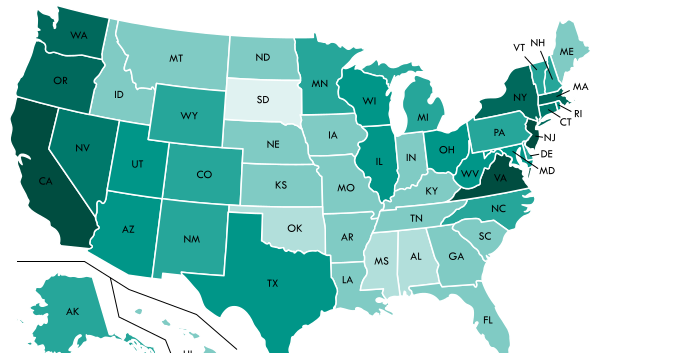
Most common states for managers, design and production
| Rank | State | Population | # of jobs | Employment/ 1000ppl |
|---|---|---|---|---|
| 1 | District of Columbia | 693,972 | 124 | 18% |
| 2 | Vermont | 623,657 | 110 | 18% |
| 3 | Wisconsin | 5,795,483 | 960 | 17% |
| 4 | Iowa | 3,145,711 | 539 | 17% |
| 5 | Minnesota | 5,576,606 | 877 | 16% |
| 6 | Oregon | 4,142,776 | 625 | 15% |
| 7 | New Hampshire | 1,342,795 | 203 | 15% |
| 8 | Utah | 3,101,833 | 433 | 14% |
| 9 | Washington | 7,405,743 | 933 | 13% |
| 10 | California | 39,536,653 | 4,743 | 12% |
| 11 | Massachusetts | 6,859,819 | 855 | 12% |
| 12 | Indiana | 6,666,818 | 814 | 12% |
| 13 | Nebraska | 1,920,076 | 225 | 12% |
| 14 | Maine | 1,335,907 | 160 | 12% |
| 15 | Delaware | 961,939 | 117 | 12% |
| 16 | Ohio | 11,658,609 | 1,286 | 11% |
| 17 | Michigan | 9,962,311 | 1,054 | 11% |
| 18 | Virginia | 8,470,020 | 892 | 11% |
| 19 | Arizona | 7,016,270 | 758 | 11% |
| 20 | Colorado | 5,607,154 | 642 | 11% |
Most common cities for managers, design and production
| Rank | City | # of jobs | Employment/ 1000ppl | Avg. salary |
|---|---|---|---|---|
| 1 | Cupertino | 1 | 2% | $107,750 |
| 2 | San Antonio | 1 | 0% | $72,509 |
Manager, Design And Production job outlook: Expert opinions
Our panel of manager, design and production experts
Moravian College
University of Northern Iowa

University of Cincinnati- Clermont College

California Polyechnic State University
Flagler College

Arizona State University
Montana State University - Bozeman
Howard University

Emory University

Albion College

Stonehill College

California State University - Stanislaus

Tyler School of Art and Architecture, Temple University
Maryland Institute College of Art

Art Academy of Cincinnati

University of Washington
Santa Ana College
SUNY Oneonta
Meredith College
Fairleigh Dickinson University
Dr. MaryJo Rosania-Harvie
Assistant Professor of Practice | Art Education Coordinator | Interim Art Department ChairMoravian College
Fine And Studio Arts
What will help Managers, Design And Production increase their earning potential?
Dr. MaryJo Rosania-Harvie: For someone beginning their career, I would advise them to consider the problem-solving and critical thinking skills they developed in school, and highlight those skills when meeting with potential employers and clients. They can consider themselves entrepreneurs, and should try to be flexible and open-minded.
Elizabeth Sutton
Department Head, Professor of Art HistoryUniversity of Northern Iowa
Department of Art
What skills stand out on Manager, Design And Production resumes?
Elizabeth Sutton: What really stands out is the quality of the student's portfolios and that they have client-based real-world experience.
What soft skills should all Managers, Design And Production possess?
Elizabeth Sutton: There are many--the ability to collaborate and communicate effectively is absolutely necessary. The ability to ask for feedback and be able to take that feedback and incorporate it into a process is very important. Of course, meeting deadlines is also very important.
Dr. Andy Curran
Professor, Area CoordinatorUniversity of Cincinnati- Clermont College
Digital Media Communications
What skills stand out on Manager, Design And Production resumes?
Dr. Andy Curran: -Design awards from recognized organizations in the industry
-Years of experience working for a variety of clients and employers
-Industry certifications
What soft skills should all Managers, Design And Production possess?
Dr. Andy Curran: -Creative skills
-Problem solving
-Communication (written & verbal)
-Project management (personnel, budgeting, time, resources)
What hard/technical skills are most important for Managers, Design And Production?
Dr. Andy Curran: -File management
-Computer literacy skills
-Software proficiency
Will there be an enduring impact of the coronavirus pandemic on Managers, Design And Production?
Kenneth Macro Ph.D.: Seemingly, it hard to say at this juncture. Graphic Communication represents an over-encompassing and vast field of disciplines that are all attempting to determine their futures.
In the commercial printing sector there are jobs to be had. Many are on the production floors, yet some can be found in customer service, sales, and marketing. The packaging market experienced significant growth over the past year as more and more people order products online. I believe packaging to continue in a growth trend indicating an increase in job opportunities, both on the production floor and the CSR/sales suite. Label market has remained strong and will see some increase in job availability, again, on the production floor and sale/marketing and product development areas. Graphic Communication, at least from our perspective, also includes web development, user-interface design, user-experience design and human computer interaction (HCI). Although there was some decline in employment numbers at the beginning of the pandemic, opportunities have seemed to ramp-up quite significantly over the past several months.
Bottomline, the job opportunities were not as readily available for our graduates in 2020 and 2021 as they have been in years past, allowing them to choose between multiple offers. However, there are jobs available today and I am confident that--with some patience and persistence--jobs (and careers) can be had.
What's a good job out of college for Managers, Design And Production?
Kenneth Macro Ph.D.: Many of graduates are finding jobs in UX/UI design with companies based primarily within CA. However, they are finding them nationally as well. Such positions are well-paid with adequate benefits and provide opportunities for newly hired students to work remotely. Today, that is a highly coveted benefit.
What will help Managers, Design And Production increase their earning potential?
Kenneth Macro Ph.D.: Today is about wanting to learn all that one can learn. Meaning, using an online learning platform like LinkedIn Learning or others to brush up on software applications or gain experience with a current programming language, or experimenting with web development or web design applications-or simply exploring newer office enterprise management packages-all can provide skills to a portfolio that extend one's employability. Companies want to know that their potential hires are resourceful, open to learning new ways in which to work, be productive, communicate in teams, and quickly prepare and adjust for change. This is applied to all people in every field that encompasses Graphic Communication.
Diana Lodi
Assistant Professor of Graphic DesignFlagler College
Department of Visual and Performing Arts
What are the biggest trends we'll see in the Manager, Design And Production job market given the pandemic?
Diana Lodi: There will be a continued trend of remote interactions for both the interviewing process and meetings as the video/webinar formats provide face-to-face interactions without the need to travel. Some companies may be more willing to offer flex-schedules or full-remote options as well.
How have salaries changed over time for Managers, Design And Production?
Diana Lodi: Salaries have progressed at a steady state. There has always been an emphasis on finding Graphic Designers who are also well-versed in web design, app development, and UX design. Possessing knowledge in AI and VR technologies could also impact pay scales in the future.
Prescott Perez-Fox
Lecturer - Graphic Information TechnologyArizona State University
The Polytechnic School
What are the biggest trends we'll see in the Manager, Design And Production job market given the pandemic?
Prescott Perez-Fox: It may sound obvious, but remote interviewing will become normal. Remote work in general is here to stay. The ability to communicate to a camera and work a productive day from your home office is essential in the modern era. All that advice about shaking hands is demoted to a footnote. Ditch the suits and ties for a crisp black t-shirt.
What certifications/licenses/courses can have the biggest impact for Managers, Design And Production?
Tracy Sullivan: If you know exactly what avenue of graphic design you want to pursue, then any additional coursework or related experience showcasing you understand what that role entails will help. As a hiring manager, what gets my attention most is someone with a solid portfolio...excellent type handling skills, attention to detail, a good mix of graphic styles, and of course creativity. During an interview, I want to see enthusiasm and a willingness to learn. On the job, I want to see software skills enhancing creativity, not impeding it.
What are the biggest trends we'll see in the Manager, Design And Production job market given the pandemic?
Tracy Sullivan: The pandemic has been a giant leap forward for encouraging remote work. I expect that to continue beyond the pandemic. The creative industry is not new to utilizing contractors and freelancers off-site, so the confidence in their ability to get work done has always been high, but I think this will expand to permanent employees having the opportunity to work remotely where ever they are inspired.
What are the biggest trends we'll see in the Manager, Design And Production job market given the pandemic?
Alexander McSwain: Versatility, like the job market post housing market crash a decade ago, companies are having to cut back their workforce due to a range of reasons. So, having someone with a range of skills is more appealing to companies while the "ship is being steadied". As a designer, knowing email and social media marketing, layout, web design, and more importantly motion graphics.
What certifications/licenses/courses can have the biggest impact for Managers, Design And Production?
Alexander McSwain: Courses that help in today's market would be ones around: typography, animation, marketing, and web design. Knowing software like Canva, not just the Adobe framework, remembering that the software is just a tool of design, not what makes design.
What's a good job out of college for Managers, Design And Production?
Alexander McSwain: Any job out of college is a good job, but finding a job with opportunity for growth is key. That will depend on the individual and what their personal goals are. Any job that allows you to grow within the company or one that supports your personal aspirations within or outside the company is a good job. It is equally what you can bring to the company and what they can offer you as a company.
Ariel Fristoe
Instructor, Artistic Director of Out of Hand TheaterEmory University
Theater Studies
What are the biggest trends we'll see in the Manager, Design And Production job market given the pandemic?
Ariel Fristoe: Visual and performing arts organizations are suffering, and after the pandemic, they will need to re-think many of the old ways of doing things, and innovate quickly. They will need to hire new talent to develop socially-relevant programs, and invent new ways to connect to donors and audiences. The arts play a vital role in bringing communities together, in creating empathy for each other and promoting social change, but only if they're catalyzed for these purposes. Otherwise arts organizations risk losing relevance, and by extension, audiences and funding.
David Abbott
ChairAlbion College
Department of Music
Will there be an enduring impact of the coronavirus pandemic on Managers, Design And Production?
David Abbott: Clearly academic challenges of not getting either enough material and/or not being able to receive it as effectively as traditional in class experiencial learning has potentially negative consequences not unlike that of pre-college students although generally to a lesser degree of negative impact. Much virtual teaching can be effective and Albion has utilized this to a great deal as have many other colleges and R1 institutions. We offer combined virtual/ in person "hybrid", as well as all virtual only and all in person teaching both in classes and applied music lessons.
It remains to be seen in the coming post-pandemic years how much of a deleterious effect this pandemic will ultimately have on learning. My personal view is that the effects will vary but overall there will be negative implications across many colleges and universities. Much will depend on the success of testing/tracing which in the case of Albion College where we were very diligent and effective including use of an Aura tracking app required of all students, we were able to isolate and quarantine students suspected of illness, or with positive test results of COVID, safely isolate them for the required time and then they returned to lasses as before. During quarantine/isolation, all Albion students had virtual access to all classes after making arrangements with their individual instructors.
In comparison, I know Hillsdale College not more than 40 miles away, while an outstanding academic institution with enviably high standards, was decimated by the pandemic, simply because the administration chose not to follow science and they had at one point no less 175 positive covid cases, in early November while Albion had an average of only 3-5 on campus. I understood that the virus ravaged their music department and shut down most if not all live instruction. These numbers continued to rise in the next two weeks (Albion had only 11 total cases, all safely in isolation while Hillsdale's numbers exceeded 200 and more), it became difficult for many schools who ultimately chose to send their students home as a precaution to avoiding massive infection. Albion did this with 11 positive cases simply to follow recommended state guidelines. My understanding was Hillsdale hung on for much longer and continued to keep students on campus in spite of these dangerously high numbers of life threatening infections.
I pray their students/faculty ultimately left safe and mostly out of danger by the end of Fall semester and perhaps this was their way of maintaining academic integrity by keeping students on campus. At Albion, we ultimately sent students home only 7 school days earlier than our planned close of classes. We employed a controversial "module" system that essentially compressed 14 week classes into 7 weeks and classes met avg 5 days a week compared to the traditional 2-3x per week. Ultimately faculty/students hated this model and accepted it simply in an effort to keep students on campus for learning rather than keep everyone home in virtual only as many colleges and universities chose to do. We are continuing this module system now in the current Spring semester. We intend to return to traditional classes if at all possible by Fall '21.
Will there be an enduring impact of the coronavirus pandemic on Managers, Design And Production?
Matthew Greene: Theatre has been hit particularly hard during the pandemic. Theatres worldwide have been dark since March, and best-case-scenarios doesn't have them opening until next fall. Recent graduates enter a field that is on hold. Current students are having to perform scene work on Zoom or masked at a distance. It's all quite antithetical to the immediacy and connection that is at the heart of how we typically train students. That is not to say we have thrown our hands in the air, but instead have taken the challenge to produce productions in unconventional ways. Ultimately, this will benefit recent and future graduates by forcing them to engage audiences in new and creative ways.
What skills stand out on Manager, Design And Production resumes?
Abby Guido: Skills is always an interesting portion of a resume. In addition to adding the tools you currently use, I think it is important to express that you can problem solve and enjoy and embrace learning new technology/software. Our tools are constantly changing, and what you use today may be considered outdated next month, so be sure to list not just the software you use, but what you use it to create. For example, if you use Adobe XD you would also have wireframing and prototyping skills.
What are the biggest trends we'll see in the Manager, Design And Production job market given the pandemic?
Brockett Horne: A big trend is that experienced designers and alumni are reaching out to help recent graduates with portfolio reviews, mentoring, referrals, AMA sessions, and so on. Some industries are flourishing in the pandemic but others are either struggling or planning to come out even stronger when it concludes. For design graduates, we see a few trends: short-term employment, such as fellowships or internships, the ability to work with agility across media and scope is even more important, emerging designers might be competing against those with more experience who are between positions, employers are inundated with applications so investment in a strong online presence is essential to stand out.
Are there any particularly good places in the United States for Managers, Design And Production to find work opportunities?
Brockett Horne: "Word of mouth" openings such as newsletters, people posting openings on LinkedIn or university job boards are particularly fruitful now. Networking is an important skill, but sometimes harder for recent graduates. Know that time spent reaching out to professionals for informational interviews, portfolio feedback, or events, can help build an effective professional network.
Will there be an enduring impact of the coronavirus pandemic on Managers, Design And Production?
Mark Thomas: I believe so. As with all professions, students graduating in the visual arts will work from home studios and offices, interface often with clients and the extended creative team remotely, not necessarily to reduce infection spread but for economic practicality and efficiency of time and space. The pandemic has in a way, compressed the world even more providing the use of electronic tools and platforms to connect effectively with people everywhere.
The ability to incorporate these tools into the creative tool box is now an expected skill. Whole industries within the economy that rely heavily on visual artists work have been decimated or radically changed by the pandemic-entertainment, restaurants, retail and travel. This will significantly change how these businesses advertise, brand or rebrand and determine marketing strategies. The new designers will need to adapt to all of these changes as they invent new methods for communicating, innovating and collaborating.
What experience really stands out on Manager, Design And Production resumes?
Mark Thomas: Experience that demonstrates a person's ability to work with others, collaboration, empathy, a willingness and desire to improve our world and the people in it. So projects that are socially driven, volunteering or work that demonstrates empathy for others.
Overall the resume needs to show an established work ethic and ability to think creatively and critically.
What are the biggest trends we'll see in the Manager, Design And Production job market given the pandemic?
Annabelle Gould: Communication skills, the ability to tell stories and deliver convincing messages to an audience that is fractured, skeptical and short on time and patience. This means good verbal skills as well as strong visual skills. The world is full of templates for visual design so it's easy for everything to look the same. Being able to distinguish yourself and your message while most of us are experiencing the world through a screen at home is important.
What Manager, Design And Production skills would you recommend for someone trying to advance their career?
Annabelle Gould: A good time to deep dive into a specific skill that you might not have been able to explore otherwise (learning new technology, programming, a personal project, photography etc). Also consider writing, reflecting on design, consider how your own practice is impacted by the global issues such as climate change, the pandemic, remote working etc. Everyone is looking for chances to connect so reach out - form a Zoom reading group, a "designing" group, even take this opportunity to meet designers in other cultures (via Zoom or Teams of course). It's hard to think about living in another city or country right now but the lessons we learn from other cultures are invaluable.
What general advice would you give to a Manager, Design And Production?
Annabelle Gould: Just because you finished school doesn't mean the learning stops! Your first job won't be your only job, use every opportunity as chance to learn and grow. If you are still looking for a job, don't get too discouraged by the state of the economy or politics. Designers are needed in all areas of industry all around the world.
Will there be an enduring impact of the coronavirus pandemic on Managers, Design And Production?
Jennifer McMillan: There will not be an enduring impact for those who choose to take a proactive approach to their current situation. Now, what can a student do to be more proactive? And I think there's a couple of really concrete things that they can do. Number one of the really simple but is often overlooked is to clean up your social media accounts. So this is not the time to have, like, you know, the drunk party picks on your social media. You don't want to have anything on there that's going to make you look like you're irresponsible or that someone should not put their trust or their faith in you when it comes to hiring you for a certain position.
So just go through their social media, clean out everything that doesn't make you look like a responsible person that you want to hire. So that's one thing. Another thing that is super important that a lot of students seem to overlook is preparing an online portfolio so they can easily send their samples of their work to potential clients or hiring managers. I think of portfolio should have, you know, five to maybe 10 solid pieces of work. So that way it's really, really easy for somebody to kind of take a look at your stuff and decide, yes, this person is a good fit. No, they're not a good fit. And the quicker that you can get yourself a portfolio, the more easier it is for you to kind of shop yourself around.
And then additionally, I think that creating a LinkedIn profile is really, really key, especially for those who are trying to find jobs within this current pandemic that we're living through. I get a lot of I get a lot of work, I should say, off of LinkedIn. And it's a great way for students to maybe apply for jobs, number one, for them to create content to showcase their skills to potential clients and hiring managers. But it's also good just to network with people. So a lot of times, you know, companies or managers, whatever, they may not have a current opportunity, but you can always reach out to someone and kind of say, hey, I'm interested, I'm a new graduate. Here's some work. You know, can I have an informational interview? Are you looking for interns? That kind of thing. So LinkedIn is really, really important. And it's something that a lot of students tend to overlook, especially creative students.
What type of skills will young Managers, Design And Production need?
Jennifer McMillan: In my opinion, new graduate is going to need a combination of tenacity, creativity and humility. So they're going to need tenacity to go out there and keep searching for opportunities. So because we're living through a pandemic, there are a lot of people who are out of work. I know I'm a freelance designer, you know, outside of teaching, I do that, too.
And, you know, my freelance business has struggled quite a bit. So people are going to have to be really tenacious to go out there and keep looking for jobs and applying for jobs. Sometimes I apply for opportunities on LinkedIn and I have a pro account so I could look on there and see that there are so many people who are applying for jobs. I mean, you have hundreds of people applying for one position. So there are also a lot of people who are more seasoned and have more experience than new graduates, and they are in positions where they're trying to make ends meet.
So these people are applying for jobs that are below their pay rate and kind of like lesser jobs and what they're used to. So the impact on that for a current a new graduate is really, really tough because they're going to find themselves missing out on jobs that they may have been hired for originally. So I just say that they have to be tenacious to go out there and and just keep hope alive and keep applying to things. And eventually they'll find what they're looking for right after that.
I think that creativity is super important because we are living in a pandemic, opportunities may not be as plentiful as they once were, but that doesn't mean it's the end of the world for a young graduate. What they can do is get really creative when it comes to finding things to give them work experience, but also put a little bit of money in their pocket. Right. So a couple of things that I recommend to my students are, number one, they can ask their friends and family for anybody that needs design work.
You know, the beautiful thing about this pandemic is that there are so many people who are starting up, you know, quote unquote, side hustles. There are people that have businesses that kind of were put on hold, but because everybody is in such a financial pinch. Know people are looking to launch businesses or they're looking for ways to further promote their businesses that they currently have up and running. So that's a really good opportunity for people who are new in the market to get some experience, you know, get a little bit of income generated, but also start to build relationships with people that might be lasting, you know, down the road.
And I think these are great opportunities for young graduates, too, because a lot of these business owners or people who are starting from scratch, they may not have the biggest budgets in the world. So they may pay slightly less than, you know, what is average or standard within the industry. But it also gives the student a good opportunity to build relationships and again, start creating these portfolio pieces that they can then parlay into bigger jobs or more jobs in the future.
So getting creative is super important. Another point to the creativity is making rebuilding relationships with peers that will allow them to team up and go after jobs collectively as a group. So, you know, I always encourage my students to make friends with people who do something different than you. Right? So if I have graphic designers in my class, I always say, hey, who do you know? That's the illustrator. Who do you know? That's a great video editor.
Who do you know can shoot video? Who do you know that can build Web sites, you know, team up with people. And then, you know, collectively, you guys can go after small businesses and say, hey, you know, we can put a package together for you for X, Y, Z amount. And, you know, we can all, you know, eat and we can all start to build our portfolios together. So sometimes the collective power of creatives, you know, reaches a lot further than we could ever go individually.
So that's a super important thing as well.
Oh, and also I mentioned humility is really important. These are really tough times. And sometimes we have to be OK with humble beginnings. And I know that, you know, our first opportunity out of college may not always be our dream job. It may not always be the best. But I always recommend to students that, you know, if you take an opportunity that may not be the best one that you apply for, sometimes a lot of these jobs can be blessings in disguise.
And it's really important for you to go into that job with the end goal in mind. So if there's a certain skill that you need to learn, make sure you show up, you do a wonderful job, make sure you make yourself as indispensable as possible and make sure you get those skills that you really want to learn. Or if you get those projects under your belt, whatever it is you're looking for, make sure you have an end goal in mind so that you can use that opportunity to make you a better creative and that you can build additional opportunities for yourself in the future.
What experience really stands out on Manager, Design And Production resumes?
Jennifer McMillan: I've been on the hiring and applicant side of things, so my answer is a bit different than others in my field.
I don't know that a resume for a graphic designer has as much power as a portfolio. For example, if you interned at a major creative agency, but all you did was filing or something that wasn't super creative, I don't think that makes you a better candidate than someone with limited work experience but has a good portfolio.
Personally, I value a good portfolio over a prestigious name on a resume. Ultimately, it doesn't matter where you've worked. What really matters at the end of the day is what you can produce. For that reason, if I had to say what stands out most on a resume, I'd say that the actual work you created at the companies listed on your resume matters most.
Will there be an enduring impact of the coronavirus pandemic on Managers, Design And Production?
Katherine Spitzhoff: The pandemic forced the graphic designers to find new ways to get work done. Many more people are now comfortable working completely online and remotely. Virtual meetings have become the norm. Recent graduates will find that one of the most enduring effects of this time will be a rethinking of what it means to be part of a team, and what our relationship to an office space is.
Eventually, designers will have a choice of returning to the office or staying home. The costs of commuting in both time and money, will be examined, as will the price of office space. As recent graphic design graduates will be accustomed to working remotely at an early stage in their careers, this flexibility will be part of their skill set. It will be a strength in moving forward in their careers.
Since the pandemic began, many colleges have had to move their classes online. Young designers who are graduating after spending a semester or two completing remote classes will be adept at learning through video lessons and online groups. Learning resources, such as video training libraries and courses offering micro-credentials have become important as sources of training for the design community. Life-long learning is required of a graphic designer to remain current. Recent graphic design graduates will be experienced in finding the online instruction they need for whatever skill they wish to strengthen.
What type of skills will young Managers, Design And Production need?
Katherine Spitzhoff: Employers are looking for a broad set of skills. Young designers must be comfortable with producing assets for screen as well as files for print. They must have empathy for the experience of the user of the product they are designing. They must be able to think strategically to coordinate design with the business goals of an organization. They must think of how designs will translate through many different mediums. Newer areas of design such as instructional design or interactive infographics are seeking qualified individuals.
Young graduates should express that they are willing and able to learn new software and new skills on the job. Many companies require the basic skills of Adobe software but may also have proprietary software that is specialized for their area. Asking questions about the software might show the future employer that the candidate is ready to learn more.
A knowledge of coding is a strong plus when competing with other recent design graduates. Even if you are not filling the role of the person who builds the site, knowledge of coding will help you design so that the digital product will function correctly and be pleasant for the user.
Young design graduates must also be prepared to enter a professional community has become more inclusive and socially aware than it was in earlier decades. Many design projects are influenced by issues of environmental impact and social causes. It is advantageous to have portfolio pieces that show an awareness of the role that design plays in creating positive change.
What experience really stands out on Manager, Design And Production resumes?
Katherine Spitzhoff: Experience that shows great organization, communication skills and time management will be sought after by employers. Internships and real-life clients will show a commitment to becoming a professional and will create portfolio pieces that are valued.
Any experience that involves being part of a team and being able to take direction and handle responsibility should be expressed on the resume. Taking positions of leadership, even outside of design, are good for an employer to know about. A young person should not hesitate to list such things as being on the e-board of a club or organizing food drives.
Recent graduates are encouraged to join professional organizations such as AIGA or The Graphic Artists Guild. Showing membership on a resume and LinkedIn page helps to convey the serious intent of the person entering the design field. The resources of these organizations are excellent and there are networks to help with the transition to being a professional.
What Manager, Design And Production skills would you recommend for someone trying to advance their career?
Woody Holliman: In graphic design, they should be looking for freelance projects (even pro bono projects for a
worthy nonprofit organization). They should also become active in their local design community,
becoming a student member of AIGA (American Institute of Graphic Arts) and helping to
organize online events/workshops. This is a terrific opportunity to work alongside more senior
designers and art directors and find professional mentors.
What general advice would you give to a Manager, Design And Production?
Woody Holliman: In graphic design, recent graduates will need to be patient since many design firms have
downsized during Covid times. Be persistent and keep your spirits up by taking on freelance
projects (even pro bono projects) and becoming active in your local chapter of AIGA.
What are the biggest trends we'll see in the Manager, Design And Production job market given the pandemic?
Janet O'Neil: I believe the job market will open up more opportunities for working remotely and in freelancing. Fortunately, graphic design, web design, and illustration are conducive to a stay-at-home environment. Students can work on time management, online networking, freelancing (if they have not already started). They can build a strong web presence and portfolio and design products to sell on Shopify, Red Bubble, Society Six, Spoonflower, and other online stores. Stay positive, read blogs and magazines, and join communities that teach skills like Skillshare and LinkedIn. If they need portfolio projects and there are no clients in sight, they can design for charity, family, and friends.
The 100 Day Project is a great way to start developing personal projects to showcase progression on Instagram, Facebook, and other social media venues. Employers love to see how designers think, not just their final slick creations. To maintain emotional and physical well-being, designers can join Zoom, FB Messenger, or Facetime for virtual interaction. Eat healthy, exercise, get enough sleep, meditate or pray, and talk to people on the phone. I personally hike as much as I can, and it not only clears my head but also gives me the opportunity to think about projects I am working on.
What Manager, Design And Production skills would you recommend for someone trying to advance their career?
Janet O'Neil: At Fairleigh Dickinson University, we feel strongly that our online learning program in graphic design will help students forge through this challenging time. I personally do not feel the best route is to take a gap year. Students can try and remain on target and work with their professors to complete projects and learn independently. A university degree is still one of the most dependable ways to enter the design and illustration industries. If a student does need to take a gap year due to finances or personal reasons, I would recommend keeping their Adobe Creative Cloud account active and work on portfolio pieces while learning new aspects of the software. They can develop further skills in Adobe Fresco and Procreate. Students could do a 30-day, 100-day, or 365-day illustration or design series of projects to keep them active.
What general advice would you give to a Manager, Design And Production?
Janet O'Neil: If students do not have web design skills yet, they can develop a Behance or Adobe portfolio site and keep updating it. Students can look for awards, contests, and online exhibitions to enter. They can join design groups and develop relationships with professors and other design students for networking and feedback. Designers should not always look for accolades but should be open to criticism and learning through their failures. They can keep current in design and illustration trends by reading books, magazines, and blogs and by sharing their work and knowledge. They might create some online videos on how to illustrate or design because teaching always helps the facilitator as much as the learner. Above all, look for ways to stay positive and be grateful for what they do have in life! One day, the pandemic will be history, and new doors will open up. In the words of my beloved mother, "This too shall pass."