Explore jobs
Find specific jobs
Explore careers
Explore professions
Best companies
Explore companies
Job outlook for managers of online communications in the United States
Are manager of online communications jobs in demand?
Manager of online communications job and salary trends over time
Manager of online communications jobs over time
Manager of online communications job growth rate over time
| Year | # of jobs | % of population |
|---|---|---|
| 2021 | 552 | 0.00% |
| 2020 | 535 | 0.00% |
| 2019 | 522 | 0.00% |
| 2018 | 476 | 0.00% |
| 2017 | 433 | 0.00% |
Average manager of online communications salary over time
Manager of online communications salary by year
| Year | Avg. salary | Hourly rate | % Change |
|---|---|---|---|
| 2026 | $69,242 | $33.29 | +3.9% |
| 2025 | $66,651 | $32.04 | +1.9% |
| 2024 | $65,404 | $31.44 | +1.6% |
| 2023 | $64,401 | $30.96 | +0.8% |
| 2022 | $63,889 | $30.72 | +1.9% |
Manager of online communications jobs by state
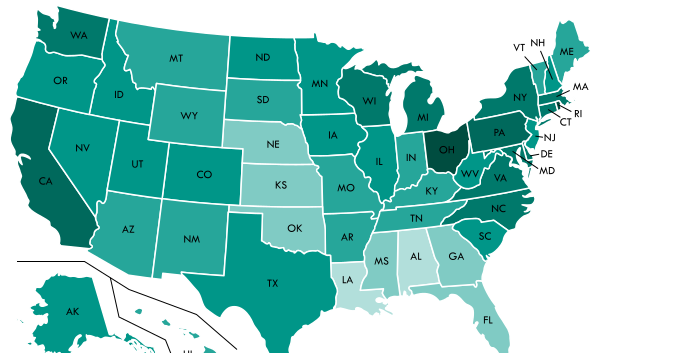
Most common states for managers of online communications
| Rank | State | Population | # of jobs | Employment/ 1000ppl |
|---|---|---|---|---|
| 1 | District of Columbia | 693,972 | 512 | 74% |
| 2 | Delaware | 961,939 | 237 | 25% |
| 3 | Massachusetts | 6,859,819 | 1,610 | 23% |
| 4 | Vermont | 623,657 | 136 | 22% |
| 5 | Rhode Island | 1,059,639 | 203 | 19% |
| 6 | Washington | 7,405,743 | 1,311 | 18% |
| 7 | Oregon | 4,142,776 | 750 | 18% |
| 8 | Utah | 3,101,833 | 547 | 18% |
| 9 | New York | 19,849,399 | 3,110 | 16% |
| 10 | Virginia | 8,470,020 | 1,358 | 16% |
| 11 | New Hampshire | 1,342,795 | 209 | 16% |
| 12 | Alaska | 739,795 | 117 | 16% |
| 13 | California | 39,536,653 | 5,914 | 15% |
| 14 | Illinois | 12,802,023 | 1,952 | 15% |
| 15 | New Jersey | 9,005,644 | 1,346 | 15% |
| 16 | Maryland | 6,052,177 | 902 | 15% |
| 17 | Minnesota | 5,576,606 | 848 | 15% |
| 18 | Montana | 1,050,493 | 162 | 15% |
| 19 | Colorado | 5,607,154 | 799 | 14% |
| 20 | North Dakota | 755,393 | 108 | 14% |
Most common cities for managers of online communications
| Rank | City | # of jobs | Employment/ 1000ppl | Avg. salary |
|---|---|---|---|---|
| 1 | Atlanta | 1 | 0% | $54,182 |
Manager Of Online Communications job outlook: Expert opinions
Our panel of manager of online communications experts
Cabrini University
Maryville University of Saint Louis
Huntington University

University of the Incarnate Word

University of Houston - Downtown

Southern Illinois University

University of Colorado at Colorado Springs

Saint John's University

Penn State University, Brandywine
Morehouse College
Berea College

Montana State University Billings
Neumann University

Evangel University

Dixie State University

Evangel University

Campbellsville University
What will help Managers Of Online Communications increase their earning potential?
Rich Johnson: Digital media covers a lot of mediums and requires many skill sets (print, static online, animation, interactive). The print arm is a lesser component although still valuable in the scope of marketing. Smartphones, tablets and gaming have moved a lot of digital into a customer expectation of interactive and customizable content. The present model of career specialization in a certain aspect of this spectrum of skills is changing. The age of the generalist is becoming more of a reality as design tools are becoming more accessible and A.I. is assisting in the more complex tasks. I would say that someone working in digital media will need to focus more on the big picture of design, predicting trends and developing solutions from a point of view with perspective. It will be even more important to understand the needs of a system from the top down and provide solutions that enhance that system. This might be through partnering with marketing and sales to conceptualize solutions, pitching product ideas and other functions related to creative and art direction. And be curious, all of the time. Keep up to date with everything that is happening. Take classes, watch tutorials, read articles and be obsessed with the breakneck rate of change. Digital media is constantly changing and possibilities are always expanding. It can be near impossible to be a master of all of these trajectories, but you can understand them well enough to bring in a specialist when the challenge requires it. This is where I predict that A.I. will be a major paradigm shift. There will be a time when you will ask the system to solve a problem, and you can choose what parts of the process that you want to control. So to boil it down... Develop a well rounded set of skills Further develop specialist level skills where you excel Keep on top of change and keep a thirst for learning Strengthen your connection to problem solving and creative innovation Keep an eye on the future predicting what might be around the bend
What general advice would you give to a Manager Of Online Communications?
Dr. Kaley Martin M.A. '16: For Digital Media degree graduates whether that’s in my field, Mass Communication, or other fields such as Communication Studies, Digital Filmmaking, Marketing, Social Media, etc. graduates need to have strong work portfolios entering the field. To gain that experience and portfolio work, I encourage students to join academic organizations that align with those interests and also turn every class assignment into an opportunity to gather portfolio work! I think at times students think “this is for a class only”, but really these are great opportunities to double-dip and get portfolio pieces while also completing your course work. Additionally, as much as you can, outside of the classroom create content in whatever medium fits your field of interest. Keep growing and practicing your craft so that your skills are continually worked like building muscle in a sense. Finally, entering the field, do not think your learning stops when you graduate. Our field is changing rapidly and constantly so you need to be plugged in to reputable organizations and resources that help you consistently grow in your chosen digital medium area to always be forward-thinking and able to move forward with our digital media ecosystem.
What will help Managers Of Online Communications increase their earning potential?
Dr. Kaley Martin M.A. '16: The most important thing when negotiating salary in Digital Media fields is knowing your worth and pricing accordingly. So many freelance artists and newcomers tend to take lower salaries and rates due to creative work being culturally underpriced, but knowing you own worth and doing research will help you have those negotiation conversations. Additionally, knowing your worth means providing true value to those hiring you by showing you are bringing true skill, strategy, and artistry to the table — not just a degree. How are you using that degree to advance and innovate the field? My degree from the University of Montevallo, for instance, taught me as an undergraduate to be a consistent learner and be watchful of the changing tides of my field due to my university’s foundation in the liberal arts. Liberal arts foundations immerse students in not only their given area, but also expose them to diverse areas in the arts, sciences, humanities, business, and more. That allowed me to always examine how these areas intersect with my own and has made me a dynamic, sought-after, and decorated professional now. So, even if you are not coming from a liberal arts background, have that mindset about you on how I can show my true value to the employer and what I bring to the table that’s unique, different, and worth the money you are asking for. Also, if you are considering a degree in Digital Media, I strongly encourage you to research the paths we have for you here at the University of Montevallo.
Professor Cheryl Pilchik
Marketing at Cabrini U.Cabrini University
Business Administration, Management And Operations
What general advice would you give to a Manager Of Online Communications?
Professor Cheryl Pilchik: Dress to impress for interviews. Consider the benefits offered by the company, not just the compensation. Use the position as a steppingstone in your field to a second job in the future.
What Manager Of Online Communications skills would you recommend for someone trying to advance their career?
Professor Cheryl Pilchik: Look at all the benefits offered by the company, such as medical, holidays, 401K, etc. Also, consider using the position as a steppingstone in your field to a second job in the near future.
What will help Managers Of Online Communications increase their earning potential?
Professor Cheryl Pilchik: Within Marketing, social media is still huge. There are many types of jobs within social media, including being an expert social media guru at an ad agency. I advise all students to be prepared and sign up for online courses if needed.
What general advice would you give to a Manager Of Online Communications?
Kara Alaimo PhD: The communication landscape is always changing. The social media platforms that are popular right now may not even exist by the time my students graduate, and of course they're always changing their algorithms and the kinds of content they prioritize, so professional communicators can never get too comfortable in their work. Therefore, one of the most important skills to acquire is how to stay on top of all these changes, keep learning how different platforms work, and come up with creative ideas to use on them.
What Manager Of Online Communications skills would you recommend for someone trying to advance their career?
Kara Alaimo PhD: A lot of my former communication students who are commanding the highest salaries are working in social media management. This is because often senior communication executives who have been working in the field for decades feel like they don't know how TikTok and emerging platforms work and think people who grew up as digital natives hold the secrets of the universe, so they empower them at earlier stages in their careers to run organizations' social channels. It's not uncommon for me to see a former student who manages social media accounts on behalf of an organization get multiple promotions and raises within their first few years of graduation.
What will help Managers Of Online Communications increase their earning potential?
Kara Alaimo PhD: I strongly recommend that students consider jobs managing social media accounts on behalf of people and organizations. There's a lot of demand among employers to hire people for these positions right now, and a lot of my students are thrilled to discover that they can make a good living creating social media content - which many of them consider to be more like fun than work. This is why at Fairleigh Dickinson University we just created new academic programs in social media to give students the skills and credentials to go after these kinds of exciting jobs with significant labor market demand that often have particularly attractive starting salaries.
Dr. Leilani Carver-Madalon Ph.D.
Director of Graduate and Undergraduate Communication and Associate Professor of Strategic Communication and LeadershipMaryville University of Saint Louis
Public Relations, Advertising, And Applied Communication
What general advice would you give to a Manager Of Online Communications?
Dr. Leilani Carver-Madalon Ph.D.: People hire people who they know, like, and are competent. So, how do you become known, liked, and competent? Beyond college, some unexpected ways to a successful career are 1) Internships 2) Informational Interviews, and 3) earning certifications.
Internships: Getting an internship is not a new idea but it is a very important one. Some organizations now only hire people who intern for them first. The internship now becomes a trial before hire. For example, Fleishman Hillard, ranked the fourth best PR agency in the World, offers many full-time Internships, 40 hours a week. Recent grads who want to work for Fleishman Hillard should see getting an Internship as the best avenue towards getting a job at Fleishman Hillard. Many organizations use their internship pools as potential hiring pools so do not be afraid to do a paid internship after graduation for a premier organization.
Informational Interviews: This is a wonderful way for people within an organization to get to know you and for you to learn from others with experience. Informational interviews are short interviews where you connect with someone in our field, research them, and their company and prepare questions to ask for advice. These interviews expand your network and also help you learn. These are a wonder source of networking.
Earn Certifications: Besides going to class and doing well, it is also important to be able to show what you know through certifications. For example, Hubspot has free certifications that you can take and link to your LinkedIn account. One I recommend is their Social Media Marketing Certification at https://academy.hubspot.com/courses/social-media?library=true&= This is yet another way to show your knowledge and expertise in our field. Showing through certifications is always preferable to telling someone you have the skillset.
What Manager Of Online Communications skills would you recommend for someone trying to advance their career?
Dr. Leilani Carver-Madalon Ph.D.: Many of my students get hired to do social media for organizations because organizations need help in this area. Knowing how to create engaging and creative content, produce quality videos, manage and understand data analytics, and respond to crises are some of the most important skills. Additionally, utilizing AI to do more with less will also become more and more important.
What will help Managers Of Online Communications increase their earning potential?
Dr. Leilani Carver-Madalon Ph.D.: The first thing is to do your research so that you know the market and what the salary range is for your job in your city. This article has a list of free salary calculators.
Then, you wait until an offer is made. Once an offer is made you can negotiate (but never before).
Then, you ask politely. The amount is usually around 5- 10% of the salary. I encourage you to ask for 10% because they will likely try to meet you in the middle.
For a script, you could say something like...
Thank you so much for this offer. I am very excited to work at Company X. I know my internship experiences and degree from X University will help me be able to bring value to this organization.
Regarding salary, I was looking for something closer to $_________. Is this possible?
(Then be quiet).
It is beneficial to ask. The worst thing they can say is no. Also realize that you can negotiate vacation days, working from home, a 4-day work week, and other benefits that may be important to you if they cannot offer you more money. Once when I worked for a non-profit, I maxed out their salary but I negotiated another week of paid vacation because I asked. Asking after research and with respect is always a win.
Brock Zehr
Associate Professor of Business & Economics and MBA DirectorHuntington University
Religion/Religious Studies
What general advice would you give to a Manager Of Online Communications?
Brock Zehr: Social media content development, data analytics, and quality video content generation will all be in greater demand. Employers tell me that the "soft skills" of being a team player, excellent communication skills, integrity, and a strong work ethic are still valued skills.
What Manager Of Online Communications skills would you recommend for someone trying to advance their career?
Brock Zehr: Do your homework. Research salaries for the position, geographic location, and your experience level on sites like salary.com and zippia.com to determine the salary range for the position. Know the numbers. Let the employer provide the first salary number and decide how much to negotiate from there. Also, look at the entire compensation package and not the salary alone. Benefit packages vary and can encompass and large portion of compensation.
What will help Managers Of Online Communications increase their earning potential?
Brock Zehr: Become a solution to an employer's problem. During the application and interview process, identify the needs of the employer and propose ways you can fulfill those needs. Every job, person, project, and client can lead to greater opportunities. So even if your first job is not ideal; do it well because it can be the impetus to propel your career forward. A positive, can-do attitude and quality work can take you wherever you want to go.
Dr. Trey Guinn
Associate Professor and Program DirectorUniversity of the Incarnate Word
Communication Arts
What hard/technical skills are most important for Managers Of Online Communications?
Dr. Trey Guinn: In addition to education and experiences related to corporate and strategic communications, it is helpful to have a healthy working knowledge related to the industry to which they have applied. A communications manager in the tech industry should be well-versed in that technology. The same goes for oil and gas, consumer product goods, education, healthcare, etc. Beyond this, we find that organizations gravitate toward candidates with quantitative reasoning skills and an analytical mindset. So, if you have been avoiding courses and projects that require taking deep dives into data, now is the time to brush up!
What skills will help Managers Of Online Communications earn the most?
Dr. Trey Guinn: Companies large and small, especially those offering impressive salary ranges, seek individuals who can go beyond the traditional definition of the role. Organizations are looking for communications managers who can work cross-functionally, employ quantitative reasoning to extract meaningful insights, and then utilize their emotional intelligence and interpersonal savvy to turn nuggets of data into compelling stories presented to senior leaders. They seek people who can lead projects from ideation and strategy phases through implementation and assessment. Best-in-class communications managers also exhibit tremendous ability to influence internal and external stakeholders, unlock potential, and drive value.
Dr. Richard Conde Ph.D.
Assistant ProfessorUniversity of Houston - Downtown
Marilyn Davies College of Business
What soft skills should all Managers Of Online Communications possess?
Dr. Richard Conde Ph.D.: The need for soft skills are consistent through time. With our societal focus on social media, texting, emojis, etc. It appears to me companies are looking for the following:
- Active listening skills
- Willingness to be self-reflective and accept feedback
- Accept different perspectives. The collision of ideas creates knowledge
- Communicate to the listener (at their level). Flex communicators
- Cultural intelligence. Demographics changes will require better understanding of team member's, boss', customer's, etc. cultural context
Justin Young
Assistant LecturerSouthern Illinois University
School of Communication Studies
What hard/technical skills are most important for Managers Of Online Communications?
Justin Young: I would say it's less important that someone knows the latest video editing software than they have a sound understanding of film theory. I'm more concerned that someone shooting a 30-second clip for Instagram understands how to compose a shot than they necessarily know how to integrate visual effects. That basic idea is true across the board. Technology is shifting so rapidly today that a core understanding of the principles of design, composition, and even something like UX allows a young person straight out of college to adapt over the next five years as a lot of their physical tech may phase out of use.
18-year-olds aren't using Twitter anymore, but a fundamental understanding of how algorithms work will translate to newer social platforms such as Tik-Tok.
Sherry Morreale Ph.D.
ProfessorUniversity of Colorado at Colorado Springs
Department of Communication
What hard/technical skills are most important for Managers Of Online Communications?
Sherry Morreale Ph.D.: A very recent analysis of 82 million job postings uncovered a critical demand by employers for what often is referred to as durable skills (America Succeeds, 2021). By contrast to hard skills, durable skills, sometimes referred to as soft skills, comprise important professional capabilities (Leadership, Critical Thinking, Communication, etc.) and personal qualities (Creativity, Mindfulness, Fortitude, etc.) that last throughout a person's entire career. In this analysis, two key findings are:
-In the job postings, the top five durable skills were requested nearly four (3.8) times more than the top five hard skills.
-Also, Communication and Leadership were in the highest demand, requested by 50+% of postings. These two durable (soft) skills sets include the following specific knowledge and skills.
A third durable skill or competency identified in the job postings, closely related to Leadership and Communication, is Collaboration. The Collaboration knowledge and skills connected to Communication and Leadership are interpersonal communications, coordinating, teamwork, team-oriented, team leadership, collaboration, team building, cooperation, and virtual teams.
Nancy DiTunnariello Ph.D.
Assistant ProfessorSaint John's University
Mass Communication
What skills will help Managers Of Online Communications earn the most?
Nancy DiTunnariello Ph.D.: One of the characteristics that help you earn the most is your experience when searching for a job. Employers like to see that you have previous experience working in the field - especially if you have been working with other organizations in the same market. For example, suppose you are applying for a job in public relations at an agency specializing in entertainment PR, and you have had other positions in entertainment PR in the past. In that case, the hiring organization knows you are familiar with journalists and already have contacts in this market. This is why college programs really REALLY advocate for internships in the field before graduation. Any way you can get experience in the field that you plan to go into helps provide you with references who can speak on your abilities in the field and help you work on skills you will be utilizing throughout your entire career. More experience often equates to more money.
Hans Schmidt Ph.D.
Associate Professor of Communications, Coordinator, Schreyer and Cooper Honors ProgramsPenn State University, Brandywine
Communications Department
What skills stand out on Manager Of Online Communications resumes?
Hans Schmidt Ph.D.: It is important to have a wide range of communication skills -from effectively participating in and leading meetings to write in style appropriate for the setting to media productions skills. When people move into the "manager" role, of course, this entails having developed a broad awareness of the culture at that particular organization and the skills needed to lead a group of people. So, really, skills related to communication touch on a wide range of job functions and responsibilities.
What soft skills should all Managers Of Online Communications possess?
Hans Schmidt Ph.D.: I know that "soft skills" is commonly used, but I'm not a fan of the term. I think it implies that some of these skills are "soft" or "easy" or "unimportant." They aren't. In many ways, so-called "soft skills" - things like interpersonal communication skills - can be among the most important skills for any worker. This is especially the case in communication-related fields, where there is an expectation that human interaction - both in-person and mediated - is important. This is true with leadership skills and presentation/speaking skills.
What hard/technical skills are most important for Managers Of Online Communications?
Hans Schmidt Ph.D.: Having the ability to write well is important in most knowledge-based fields today. It is especially critical in any communication-related field of job specialization. Otherwise, the specific technical skills are important variations between the particular company and/or job expectations. Some fields use proprietary software that one typically learns about once one starts the job. Some fields require media production competencies - related to basic video production, audio production, imaging or photography, or even web design/management. The important thing is to develop a general competency with technology - and to learn how to learn. That allows you to pivot to develop new skills in different situations and roles.
What skills will help Managers Of Online Communications earn the most?
Hans Schmidt Ph.D.: There are so many variables here. For one thing, market needs are constantly changing. Similarly, there is a wide range of salaries between different employers. This is why it is so important to, again, "learn how to learn." That enables you to be adaptable, flexible, and capable of adjusting to different environments. Also, it emphasizes why the development of fundamental communication skills related to spoken communication, written communication, and - today - mediated communication are so important. You can take these skills and specialize them in any number of ways.
What certifications/licenses/courses can have the biggest impact for Managers Of Online Communications?
Matthew Lange Ph.D.: Specific credentials are often a prerequisite to a particular career path. In the field of education, primary- and secondary-school teachers need licensure in their state of employment to teach in public schools, and those requirements are covered in the undergraduate education program. If one moves to another state, however, the new state's Department of Education (or Public Instruction) has to grant new licensure in its state. In contrast, professors and instructors at the post-secondary level require no teaching credentials. Instead, the college or university stipulates a PhD, MA or even simply BA.
The vast majority of German majors/minors learn the language and culture to apply that knowledge to their primary field of study, most often in business or the sciences, to expand their work, study, and research options. Some opportunities have minimum language proficiency expectations, however. Instead of taking applicants self-evaluations of language proficiency (the term "fluent" means different things to different people), employers can rely on standardized tests such as the Oral Proficiency Interview (OPI) or Writing Proficiency Test (WPT), which were developed by the American Council on the Teaching of Foreign Languages (ACTFL). German language programs aim to produce graduates with proficiency at the intermediate-high or advanced-low on the ACTFL scale, which ranges from novice-low to distinguished, since that is simultaneously the expected minimum set by the respective state Department of Education for teaching licensure. One can also look beyond the US border to various tests at the Goethe Institut, which evaluate the four modalities of listening, reading, speaking, and writing. These tests evaluate according to the Common European Reference Framework (CERF) that ranges from A1 to C2. German universities require B1 on the CERF scale to enroll directly in university.
Most important for a well-rounded education, of course, is a study abroad experience. By being "a stranger in a strange land" one develops negotiation techniques and problem-solving skills when dealing with linguistically- and culturally-ambiguous situations. Studies have shown that study and work abroad increases creativity and flexibility, which are crucial for personal and professional growth.
J. Ian Norris Ph.D.
Professor of Marketing and Fellow, American Council on EducationBerea College
Economics and Business Department
What certifications/licenses/courses can have the biggest impact for Managers Of Online Communications?
J. Ian Norris Ph.D.: Digital marketing skills are essential for any area of marketing. Luckily there are many online certifications available for this purpose. On the research side, Google Analytics offers a certification. It will also be valuable to know the analytics platforms on social media sites such as facebook, Instagram, and TikTok. Conversely, all of these sites also offer training on digital advertising and promotion, such as Google AdWords. Any coursework in digital marketing that provides instruction in Search Engine Marketing (SEM) will also be highly valuable. Finally, digital video and editing skills are also quite valuable, as all kinds of companies and organizations are using the short video format for storytelling and brand advertising.
Will there be an enduring impact of the coronavirus pandemic on Managers Of Online Communications?
Samuel Isaac Boerboom Ph.D.: It's difficult to predict the enduing impact, but graduates will need to be savvier than ever about establishing and maintaining online communication skills, especially web conferencing and virtual communication. Graduates may be working remotely for an extended period of time even after the COVID-19 crisis is managed. Time management and self-motivation skills will be more important than before.
Dr. Alfred Mueller Ph.D.
Dean, School of Arts and Sciences, Professor of Communication ad Digital mediaNeumann University
School of Arts and Sciences
Will there be an enduring impact of the coronavirus pandemic on Managers Of Online Communications?
Dr. Alfred Mueller Ph.D.: The pandemic is the single greatest disruption of American life we could ever have imagined. I predict that more workplaces will allow for telecommuting from home, businesses will retain some of the services they set up to address the pandemic, and health will be our primary focus for the next decade as the long-term effects of COVID are realized. As someone who sees opportunity in obstacles, I want to think that a graduate with an entrepreneurial approach will be able to take advantage of many of these cultural shifts. The Biden Administration will likely address student debt, but there are still many financial issues surrounding housing that have to be sorted out. So the next five years will be much more addled than anything we have seen in recent memory, but the end of the decade should see a return to prosperity.
Cameron Pace Ph.D.
Professor of Communication, Department ChairpersonEvangel University
Communication Department
What experience really stands out on Manager Of Online Communications resumes?
Cameron Pace Ph.D.: Specific software the student knows, types of equipment they have used, areas of experience they have worked in or had special training. Details matter here. If they can recount successes, number of sales, clients, or products they have produced or served, that's very helpful. The more professional-type experiences, the better.
Dr. James Stein
Assistant Professor and Director of Interpersonal Communication CurriculumDixie State University
Communication Studies Department
What Manager Of Online Communications skills would you recommend for someone trying to advance their career?
Dr. James Stein: Well, first, if you have the means/finances to take a full year off, I commend you. My advice would be to immerse yourself in the use of technology and social media. Every company is always looking for good PR and a good "vibe." So, if you're taking a gap year, I would recommend using that time not to figure out what you want to do, but rather to hone the thing(s) that you're already good at and make them work for you.
Will there be an enduring impact of the coronavirus pandemic on Managers Of Online Communications?
Melinda Booze: Undoubtedly, the pandemic will have an enduring impact in ways that we can't yet identify. One trend that seems counterintuitive but has been consistent both prior to and during the pandemic is graduates who start their professional lives as entrepreneurs. Even those who ultimately were hired by employers were persistent in creating their own content to showcase their work before employment was certain. -Melinda Booze, assistant professor of communication, Evangel University.
Jeannie Clark
General Manager, WLCU-TV/FM, Assistant Professor of Broadcasting & Director of Broadcast ServicesCampbellsville University
What are the biggest trends we'll see in the Manager Of Online Communications job market given the pandemic?
Jeannie Clark: From the employers I have worked with in the industry recently, I am seeing a trend for more remote work and a requirement for multi-skilled workers. The graduates that bring with them a combination of a degree, experience, and multiple skills seem to be more successful post-graduation than graduates that only have the degree and have not done any work to gain experience in their chosen field. With many businesses scaling down their workforce to save money, those that have multiple skills seem to be more valuable to employers than those who are qualified to do one job.
What skills stand out on Manager Of Online Communications resumes?
Jeannie Clark: Experience is the thing that most employers I have worked with are looking for. An applicant that has worked with specific types of equipment and software used in the industry is also more desirable since the learning curve for training is quicker.
Are there any particularly good places in the United States for Managers Of Online Communications to find work opportunities?
Jeannie Clark: I do not know of any particular area that is needing more than another. All stations I have worked with across the country are dealing with the same issues-downsized staffs and budgets. These issues, coupled with Covid-19 concerns and remote wok situations, make the job market a challenging thing to navigate. One good thing I've been told is that with remote work allowing some businesses to cut their overhead costs, there may be some new factors which will create a more optimistic future for the media job market.