Explore jobs
Find specific jobs
Explore careers
Explore professions
Best companies
Explore companies
Job outlook for manufacturing development engineers in the United States
Manufacturing development engineer job growth summary. After extensive research, interviews, and analysis, Zippia's data science team found that:
The projected manufacturing development engineer job growth rate is 10% from 2018-2028.
About 30,600 new jobs for manufacturing development engineers are projected over the next decade.
Manufacturing development engineer salaries have increased 6% for manufacturing development engineers in the last 5 years.
There are over 164,618 manufacturing development engineers currently employed in the United States.
There are 105,577 active manufacturing development engineer job openings in the US.
The average manufacturing development engineer salary is $77,888.
Are manufacturing development engineer jobs in demand?
Manufacturing development engineer job and salary trends over time
Manufacturing development engineer jobs over time
Manufacturing development engineer job growth rate over time
| Year | # of jobs | % of population |
|---|---|---|
| 2021 | 164,618 | 0.05% |
| 2020 | 164,398 | 0.05% |
| 2019 | 164,792 | 0.05% |
| 2018 | 155,231 | 0.05% |
| 2017 | 145,077 | 0.04% |
Average manufacturing development engineer salary over time
Manufacturing development engineer salary by year
| Year | Avg. salary | Hourly rate | % Change |
|---|---|---|---|
| 2026 | $77,888 | $37.45 | +1.1% |
| 2025 | $77,074 | $37.05 | +1.1% |
| 2024 | $76,216 | $36.64 | +1.4% |
| 2023 | $75,200 | $36.15 | +1.9% |
| 2022 | $73,825 | $35.49 | +1.0% |
Manufacturing development engineer jobs by state
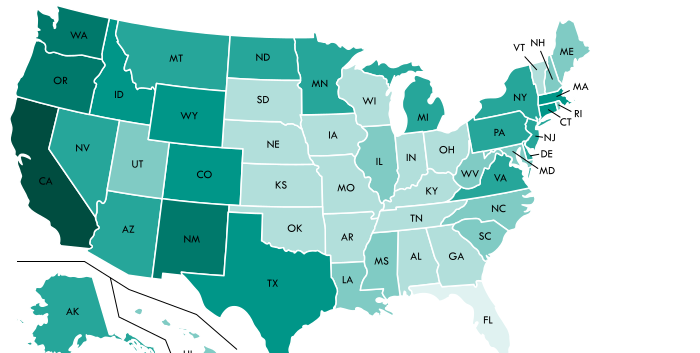
Most common states for manufacturing development engineers
| Rank | State | Population | # of jobs | Employment/ 1000ppl |
|---|---|---|---|---|
| 1 | District of Columbia | 693,972 | 236 | 34% |
| 2 | North Dakota | 755,393 | 231 | 31% |
| 3 | Massachusetts | 6,859,819 | 2,037 | 30% |
| 4 | Nebraska | 1,920,076 | 513 | 27% |
| 5 | Montana | 1,050,493 | 281 | 27% |
| 6 | Arizona | 7,016,270 | 1,793 | 26% |
| 7 | Indiana | 6,666,818 | 1,641 | 25% |
| 8 | Iowa | 3,145,711 | 790 | 25% |
| 9 | New Hampshire | 1,342,795 | 330 | 25% |
| 10 | Georgia | 10,429,379 | 2,453 | 24% |
| 11 | Alabama | 4,874,747 | 1,163 | 24% |
| 12 | Michigan | 9,962,311 | 2,335 | 23% |
| 13 | Wisconsin | 5,795,483 | 1,347 | 23% |
| 14 | Minnesota | 5,576,606 | 1,303 | 23% |
| 15 | Kansas | 2,913,123 | 659 | 23% |
| 16 | New Mexico | 2,088,070 | 473 | 23% |
| 17 | Alaska | 739,795 | 172 | 23% |
| 18 | South Dakota | 869,666 | 187 | 22% |
| 19 | California | 39,536,653 | 7,921 | 20% |
| 20 | Oregon | 4,142,776 | 840 | 20% |
Most common cities for manufacturing development engineers
| Rank | City | # of jobs | Employment/ 1000ppl | Avg. salary |
|---|---|---|---|---|
| 1 | Florence | 2 | 6% | $62,989 |
| 2 | Clarence | 1 | 3% | $73,756 |
| 3 | East Hartford | 1 | 2% | $82,776 |
| 4 | Santa Clara | 1 | 1% | $113,671 |
| 5 | Boston | 1 | 0% | $83,954 |
| 6 | Cincinnati | 1 | 0% | $63,372 |
| 7 | Long Beach | 1 | 0% | $103,245 |
Manufacturing Development Engineer job outlook: Expert opinions
Our panel of manufacturing development engineer experts
University of Maine
Arizona State University at the Polytechnic Campus
University of Alabama at Huntsville
Northern Illinois University
North Carolina State University
Marshall University
Worcester Polytechnic Institute
Oklahoma State University
University of Wisconsin - Green Bay
University of Massachusetts - Lowell

University of Hawaii at Manoa
York College of Pennsylvania

Medical College of Wisconsin

Cincinnati State Technical & Community College

University of Delaware

Grand Valley State University
Jiayue Shen
Mechanical Engineering Technology Program CoordinatorWhat Manufacturing Development Engineer skills would you recommend for someone trying to advance their career?
Jiayue Shen: It's essential to stay curious and eager to learn, as the field is continually evolving. Keeping abreast of the latest technologies and trends through seeking out learning opportunities and maintaining a curiosity about new developments is crucial. Additionally, building a robust professional network and seeking mentorship can offer valuable insights and guidance. Embracing interdisciplinary projects is also key, as the field is expanding beyond purely mechanical aspects. Being dynamic and proactive in interacting with individuals from diverse backgrounds will be beneficial, as collaboration across disciplines is increasingly important in this field.
What will help Manufacturing Development Engineers increase their earning potential?
Karissa Tilbury Ph.D: Be willing to take calculated risks, frequently biomedical engineering students graduate feeling as if they are a jack of all trades but master of none. Turn this on its head and be sure to know how you can sell yourself as a potential employee.
Jerry Gintz CMfgE
Teaching ProfessorArizona State University at the Polytechnic Campus
Manufacturing Engineering
What general advice would you give to a Manufacturing Development Engineer?
Jerry Gintz CMfgE: When entering a career in manufacturing engineering, consider starting as a technician to gain experience with the company before transitioning into engineering. This will allow you to build confidence and better understand the production systems you will be responsible for as an engineer.
What Manufacturing Development Engineer skills would you recommend for someone trying to advance their career?
Jerry Gintz CMfgE: From a manufacturing engineering perspective, the most important skills an engineer will need is the ability to understand, design, assemble, and deploy production capable systems. This includes an expertise with computer-aided engineering tools to assist in the design and verification of engineered systems before a company expends capital on the equipment.
What will help Manufacturing Development Engineers increase their earning potential?
Jerry Gintz CMfgE: From a manufacturing engineering perspective, compensation is normally tied to capability so the more relevant skills a candidate has entering the workforce the higher compensation they can expect to receive. This is especially true in manufacturing given the shortage of qualified engineering talent available for hire. Additionally, consider focusing on industrial automation as a resource to aid efficient production. Manufacturing is always looking to increase efficiency and a foundational knowledge of industrial automation systems will serve you well as you build a career in manufacturing engineering.
Professor Alejandro Ojeda
ProfessorWhat Manufacturing Development Engineer skills would you recommend for someone trying to advance their career?
Professor Alejandro Ojeda: As amazing new technologies such as AI invariably become mainstream, I believe, however, that the skills which will become even more important and valuable aren’t necessarily technical, but rather intra and interpersonal. Great engineering is, has always been, and will always be about *people*. Machines and computers are wonderful tools, but they will never replace the human element. They’re complimentary, not substitutive. The most successful engineers are those who have mastered the ability to lead, to communicate effectively, to reciprocate, to think critically and creatively, to feel comfortable taking risks, to problem solve, to prioritize, to make difficult decisions, to work well within teams, to show confidence in adversity, to perform under pressure, and to self-motivate and self-validate.
What will help Manufacturing Development Engineers increase their earning potential?
Professor Alejandro Ojeda: Accept the fact that this is only the beginning of your journey. Despite how well prepared and knowledgeable you are coming out of engineering school, there is still so much to learn and discover. Keep an open mind. Make it your ethos to become approachable and coachable. You will now have the time and latitude to actively pursue your interests and grow as an engineer. Learn something new every day. You’d be amazed at how many seasoned engineering professionals are willing to teach you and train you if you are willing to ask.
What Manufacturing Development Engineer skills would you recommend for someone trying to advance their career?
Ana Wooley Ph.D.: For a graduate beginning their career in Industrial Systems Engineering, my advice is to be genuinely proactive and to take initiative. This field, like any other, comes with a steep learning curve as you familiarize yourself with the company's operations, culture, and processes. Actively seek out and engage with experienced colleagues who can mentor and guide you. Don’t hesitate to volunteer for challenging tasks, as these opportunities will significantly improve your learning and skill development. Another piece of advice I would give is not to be discouraged if you find yourself not enjoying your first job. It's important to remember that you never truly know until you experience it firsthand. This initial job can be a great learning opportunity, helping you identify what aspects of the field you don't enjoy and guiding you towards roles that are a better fit for your interests and skills. Every experience, even those that are not ideal, contributes to your overall career growth and helps you identify your career path.
What general advice would you give to a Manufacturing Development Engineer?
Theodore Hogan PhD, CIH: Engineering Technology B.S. graduates apply both engineering knowledge and industrial management skills to practical problem solving. The day-to-day work includes collaborating with management and line workers to troubleshoot issues along with planning and implementing process improvements. More experienced Engineering Technology graduates apply these people and problem-solving skills to manage traditional engineers and general business operations.
Dr. Gregory Buckner Alumni Distinguished Undergraduate Professor
Alumni Distinguished Undergraduate ProfessorNorth Carolina State University
Manufacturing Engineering
What general advice would you give to a Manufacturing Development Engineer?
Dr. Gregory Buckner Alumni Distinguished Undergraduate Professor: Experience with robotics and automation, additive manufacturing, and CNC machining processes. Understanding the emerging roles of data analytics and artificial intelligence in process optimization and quality control.
What Manufacturing Development Engineer skills would you recommend for someone trying to advance their career?
Dr. Gregory Buckner Alumni Distinguished Undergraduate Professor: One way to maximize your salary potential is to continue the formal education process by taking graduate engineering or business courses. Many employers reimburse the tuition expenses, and with the increasing availability of online courses you can earn a master's degree in engineering or an MBA one course at a time.
What will help Manufacturing Development Engineers increase their earning potential?
Dr. Gregory Buckner Alumni Distinguished Undergraduate Professor: I'd encourage students to embrace new technical challenges and opportunities to learn and collaborate in an industrial setting, which can be quite different from the academic setting. I'd emphasize the importance of developing communication and team working skills, and building professional relationships. I'd also encourage students to join professional societies related to their field and keep updated on new manufacturing trends.
Michael Buechler
Professor Manufacturing TechnologyWhat general advice would you give to a Manufacturing Development Engineer?
Michael Buechler: I counsel my students to know their worth and know the job market. Most important is starting out in a position that challenges you and provides training for future wage and skill growth. Many graduates can get caught in a job that pays the bills but may not provide a path to the next career step. Be ambitious and seek to attain the advanced skills quickly but keep in mind the field is complex and there is a lot to learn. If you are in a high wage position but it does not provide the training or room for advancement it might not be the best career option.
What Manufacturing Development Engineer skills would you recommend for someone trying to advance their career?
Michael Buechler: Model based definition, highly technical computer skills, 5 axis & familiarity with macros is going to be the future of advanced manufacturing. It is paramount that high skill individuals START with as much set-up experience as possible. In order to command 100k + as a programmer you need to know the correct inputs and physics of the manufacturing program you are making
What will help Manufacturing Development Engineers increase their earning potential?
Michael Buechler: I would suggest beginning career individuals maintain an open mind as to where their carrer leads, they may find interest in areas of manufacturing not previously known or explored by them. Also work especially hard early in your career and try and find an employer that gives you the best opportunity to grow professionally and learn new skills.
What general advice would you give to a Manufacturing Development Engineer?
James Blanchette: Health care is a massive industry. Individuals with a strong quantitative background will have opportunities to engage in entrepreneurship, optimization of devices/processes and advancing fundamental knowledge. This work can be done in a field which has a positive impact on the quality of life of those around you.
What will help Manufacturing Development Engineers increase their earning potential?
James Blanchette: Health care is a massive industry. Individuals with a strong quantitative background will have opportunities to engage in entrepreneurship, optimization of devices/processes and advancing fundamental knowledge. This work can be done in a field which has a positive impact on the quality of life of those around you.
Dr. Yousef Sardahi
Associate Professor of Mechanical EngineeringMarshall University
Engineering
What general advice would you give to a Manufacturing Development Engineer?
Dr. Yousef Sardahi: In the next 3-5 years, several skills are expected to become increasingly important in the mechanical engineering field: Advanced Computational Skills, Robotics and Automation, Additive Manufacturing and 3D Printing, Renewable Energy Technologies, Data Analysis and IoT, Materials Science, Systems Engineering and Integration, Project Management and Leadership, Interdisciplinary Collaboration, Communication and Soft Skills.
What Manufacturing Development Engineer skills would you recommend for someone trying to advance their career?
Dr. Yousef Sardahi: In the next 3-5 years, several skills are expected to become increasingly important in the mechanical engineering field:
Advanced Computational Skills: Proficiency in simulation and modeling software (like ANSYS, SolidWorks, or MATLAB) will be crucial as these tools become more integral in designing and testing complex systems.
Robotics and Automation: With industries moving towards automation, skills in robotics, automated systems, and knowledge of AI integration will be highly sought after.
Additive Manufacturing and 3D Printing: Expertise in 3D printing and additive manufacturing techniques will be valuable as these technologies revolutionize product development and manufacturing processes.
Renewable Energy Technologies: As the world shifts towards sustainable energy sources, mechanical engineers with knowledge in solar, wind, and other renewable energy technologies will be in high demand.
Data Analysis and IoT: Skills in data analytics and understanding the Internet of Things (IoT) will be important as more mechanical systems are connected and produce large amounts of data.
Materials Science: Knowledge in advanced materials, such as composites or smart materials, will be crucial for developing more efficient and sustainable products and systems.
Systems Engineering and Integration: The ability to understand and integrate various subsystems within a larger system will be key, especially in complex projects.
Project Management and Leadership: As projects become more complex, skills in project management and leadership will be essential for overseeing projects and leading teams effectively.
Interdisciplinary Collaboration: The ability to work effectively across disciplines, understanding aspects of electrical engineering, computer science, and even business, will be increasingly important.
Communication and Soft Skills: Strong communication skills, both for technical and non-technical audiences, along with teamwork and problem-solving skills, will always be invaluable in the engineering field.
What will help Manufacturing Development Engineers increase their earning potential?
Dr. Yousef Sardahi: To maximize salary potential in mechanical engineering, focus on companies with growth opportunities, develop in-demand skills and specializations, and enhance your marketability through continuous learning and effective networking. Negotiating skills and considering geographical influences on salary also play a key role.
Jianyu Liang
Director of Materials and Manufacturing Engineering Program, Department of Mechanical and Materials Engineering, WPIWorcester Polytechnic Institute
Materials Engineering
What general advice would you give to a Manufacturing Development Engineer?
Jianyu Liang: At the start of your career, actively engaging in the manufacturing professional communities to develop an in-depth understanding of the current high-demand areas and the trends in the industry will help you position yourself in high-demand areas. This proactive approach allows you to make informed decisions on obtaining relevant certifications or advanced education, tailoring your skill set to meet the evolving needs of the industry. Proactively engaging in projects and practices to grow your experience. Building a strong professional network and finding mentors in the industry can provide guidance, expose you to new opportunities, and offer insights on navigating your career path effectively. Embracing continuous learning and staying abreast of technological advancements in manufacturing, such as automation, robotics, and digital manufacturing technologies, will ensure you remain a valuable asset to employers. Demonstrating flexibility and a willingness to adapt to new methods and technologies can set you apart in a competitive job market.
What Manufacturing Development Engineer skills would you recommend for someone trying to advance their career?
Jianyu Liang: For manufacturing engineers, the next 3-5 years promise significant evolution due to advancements in technology and changes in manufacturing processes. Here are some skills that are expected to become more important and prevalent in the field: proficiency in automation and robotics, advanced data analysis and data-driven optimization, digital twin technology, additive manufacturing and 3D printing, application of artificial intelligence and machine learning in manufacturing, cybersecurity for manufacturing systems, and supply chain management.
What will help Manufacturing Development Engineers increase their earning potential?
Jianyu Liang: Get Your Hands Dirty: There's no substitute for hands-on experience. The lessons learned through direct involvement are invaluable, offering insights and skills that theoretical knowledge alone cannot provide. Embrace every opportunity to participate in projects, volunteer for tasks, and experiment within your role. This proactive approach not only accelerates your learning but also showcases your work ethic and dedication to potential mentors and leaders.
Be Mindful and Intentional in Your Job: While immersing yourself in your work, adopt a reflective practice. Actively seek feedback and analyze your experiences. This intentional approach to learning from every task helps to grow your skills rapidly.
Be Open-Minded and Adaptable: The landscape of nearly every industry is rapidly evolving, particularly with the integration of automation and artificial intelligence (AI). These technologies are not just changing the way we work; they are reshaping the skills and roles in demand. Stay open to new ideas, technologies, and methodologies. Continuous learning and adaptability are key to remaining relevant and thriving in a tech-driven workplace. Attend workshops, webinars, and courses on emerging technologies and trends in your field to keep your skills sharp and your perspective fresh.
Cultivate a Professional Network: Building relationships within your industry is crucial. Networking isn't just about finding job opportunities; it's about learning from peers, gaining insights into industry trends, and establishing a support system. Attend industry conferences, join professional organizations, and engage in communities related to your field. These connections can provide guidance, mentorship, and support as you navigate your career path.
What general advice would you give to a Manufacturing Development Engineer?
Guiping Hu Ph.D.: People like the diversity and flexibility of being an industrial engineer. You can work on all kinds of problems with your industrial engineering skills. However, if you are only looking for a very narrow area in a specific engineering discipline, industrial engineering may not be right for you since we focus on system efficiency improvement and welfare of the workers.
What Manufacturing Development Engineer skills would you recommend for someone trying to advance their career?
Guiping Hu Ph.D.: Industrial Engineering is a very inclusive, diverse, and dynamic discipline. IE is about choices, other engineering disciplines apply skills to very specific areas. IE gives you the opportunity to work on a variety of businesses. If you are interested in management and interacting with people and improving systems, IE is a great choice for you.
What will help Manufacturing Development Engineers increase their earning potential?
Guiping Hu Ph.D.: Industrial Engineers design, build, and improve production systems. As IEs, we focus on both the quality of what is made and how it is made. Industrial Engineering is a very inclusive, diverse, and dynamic discipline. Whether it is shortening a roller-coaster line, streamlining an operating room, distributing products world wide or manufacturing superior automobiles, all share the common goal of reducing costs and increasing efficiency.
Uises Gonzalez-Valle
Assistant ProfessorUniversity of Wisconsin - Green Bay
Mechanical Engineering Related Technologies/Technicians
What general advice would you give to a Manufacturing Development Engineer?
Uises Gonzalez-Valle: We are currently transitioning to an era where computers are becoming a fundamental part of every field and engineering (especially ME and MET) is one of the more beneficiated fields as well as one that is adopting this transition faster. Thus, as a technical skill, anything related to computers is beneficial for professional development. Computer-aided design (CAD), Data Analysis, Machine learning, and a good awareness of cybersecurity are some examples of computer-based skills that are fundamental for an engineer in our current society. In addition to this, interpersonal skills are also important for an engineer; adaptability, communication, cross-disciplinary knowledge, and project management are some skills that will contribute to building a great engineer.
What Manufacturing Development Engineer skills would you recommend for someone trying to advance their career?
Uises Gonzalez-Valle: The beginning of professional life is not simple independent of the career path that you follow and ME and MET can have their own complications. However, some good advice would be to develop independence and adaptability which are key traits of an engineer, and always keep yourself updated with the most recent technological developments. If you are independent and adaptable, you have all the skills to learn and further your professional development. In addition, I would say it is essential to start building a network, including peers and mentors. Having a strong network of peers and mentors helps you significantly to progress in your professional line. From day-to-day to daily changing decisions, having a strong network to support would significantly help in building your professional path. Lastly, I would say that having a good Work-life balance is vital too, since our personal life is as important as our professional life. Remember, we should work to live instead of live to work.
What will help Manufacturing Development Engineers increase their earning potential?
Uises Gonzalez-Valle: The beginning of professional life is not simple independent of the career path that you follow and ME and MET can have their own complications. However, some good advice would be to develop independence and adaptability which are key traits of an engineer, and always keep yourself updated with the most recent technological developments. If you are independent and adaptable, you have all the skills to learn and further your professional development. In addition, I would say it is essential to start building a network, including peers and mentors. Having a strong network of peers and mentors helps you significantly to progress in your professional line. From day-to-day to daily changing decisions, having a strong network to support would significantly help in building your professional path. Lastly, I would say that having a good Work-life balance is vital too, since our personal life is as important as our professional life. Remember, we should work to live instead of live to work.
Colin Briskey
Visiting Assistant Professor of VoiceUniversity of Massachusetts - Lowell
Biomedical/Medical Engineering
What general advice would you give to a Manufacturing Development Engineer?
Colin Briskey: While I would give slightly different advice for someone who is soon to graduate, has graduated and is looking for a job, or has graduated and is starting a job, there are some universal pieces of advice that I've found useful.1) Your environment should be full of opportunities. Take advantage of them. Whether there are technical/soft skill training opportunities inside/outside the institution, or opportunities to simply observe a senior personnel doing what you hope to do one day, pursue the opportunities that interest you and match with your professional goals the most. If you find yourself in an organization that doesn't create opportunities for their employees/students, you may want to look for another organization. 2) Along those lines, find your people. There are a seemingly infinite number of quotes that reflect the sentiment, but the idea is that you'll be influenced most by those around you; not the geographical region or the size/shape of your desk. As you look toward your next position/opportunity, consider how the values of that institution match with yours. If they don't, there's no amount of pay and compensation that will keep you happy in that position after 3-5 years.
What Manufacturing Development Engineer skills would you recommend for someone trying to advance their career?
Colin Briskey: Like the associated curricula, Biomedical Engineering jobs are so multi-disciplinary that this is a difficult question to answer. I'll speak to an emerging intersection within Biomedical Engineering; between cell and tissue engineering and drug development. The FDA has recently gained congressional authorization and further signaled that in vitro models may now serve as Drug Development Tools (DDTs) and, in some cases, take the place of small animal testing. Once the FDA releases the detailed criteria for qualifying in vitro DDTs, there will be a strong push within industry toward developing qualifying tissue models and the internal infrastructure necessary to apply them at scale. The skill sets necessary to thrive in that emerging market will be aseptic culture techniques, development and/or operation of multiplexed bioreactors, extracellular electrophysiology and impedance spectroscopy, and induced pluripotent stem cell differentiation, to name a few. Additionally, there will be new positions related to the regulatory compliance of qualifying and using qualified DDTs.
What will help Manufacturing Development Engineers increase their earning potential?
Colin Briskey: Like the associated curricula, Biomedical Engineering jobs are so multi-disciplinary that this is a difficult question to answer. I'll speak to an emerging intersection within Biomedical Engineering; between cell and tissue engineering and drug development. The FDA has recently gained congressional authorization and further signaled that in vitro models may now serve as Drug Development Tools (DDTs) and, in some cases, take the place of small animal testing. Once the FDA releases the detailed criteria for qualifying in vitro DDTs, there will be a strong push within industry toward developing qualifying tissue models and the internal infrastructure necessary to apply them at scale. The skill sets necessary to thrive in that emerging market will be aseptic culture techniques, development and/or operation of multiplexed bioreactors, extracellular electrophysiology and impedance spectroscopy, and induced pluripotent stem cell differentiation, to name a few. Additionally, there will be new positions related to the regulatory compliance of qualifying and using qualified DDTs.
Song Choi Ph.D.
Assistant DeanUniversity of Hawaii at Manoa
What soft skills should all Manufacturing Development Engineers possess?
Song Choi Ph.D.: Critical thinking - logical, problem-solving methodology... I'm not quite sure to categorize this as soft/professional skills or hard/technical skills, but probably one of the most necessary assets.
Communication - written, verbal, and overall listening (helps focus on the problem statement and requirements). Most, if not all, projects/tasks are worked in large groups; thus, listening and expressing correctly is important.
Time management - scheduling of tasks and deadlines are important in all levels of engineering, from small fabrication projects/tasks to medium-sized manufacturing projects/tasks to large development/research endeavors. In Hawaii, one of the most important has been the transportation of materials, parts, components, etc., as most items are flown or shipped to us, and the overall project schedule is dependent on the availability of sub-units.
Collaboration - as most if not all engineering projects are dependent on multiple sub-categories. Due to the collaborative nature of engineering, communication is of importance again.
Creativity, innovation, and initiative - it's really about making our future better, more convenient, safer, cleaner, etc. Think outside of the box or live outside of your comfort zone.
Detail-oriented - it is about replicating results. Everything an engineer performs should be documented and clear.
Honesty and integrity as there have been too many fabricated claims and fraud as well as engineering espionage.
What hard/technical skills are most important for Manufacturing Development Engineers?
Song Choi Ph.D.: Fundamental competence and understanding of the mathematics (calculus), (physics), and fundamental engineering courses, generally the 2nd year and 3rd year courses. If the position requires more development/research type work, a higher competence, and understanding in the 4th year, more specific topic courses would be required. Project descriptions would be extremely important to assess these details.
For general engineering work, overall competence in all facets of mechanical engineering would be preferred - mechanics, fluids, thermodynamics, and materials/manufacturing.
As more and more mechanical engineering projects require the use of computer software and packages, a fundamental understanding of programming and the use of specific software - AutoCad, SolidWorks, MatLab, Simulink, computer languages, etc. would be assets.
If critical thinking is categorized as a technical skill involving logical thinking, it should also be considered...
Documentation of all aspects of engineering.
Stephen Kuchnicki Ph.D.
Associate Professor, Chair, Department of Civil and Mechanical EngineeringYork College of Pennsylvania
Department of Civil and Mechanical Engineering
What hard/technical skills are most important for Manufacturing Development Engineers?
Stephen Kuchnicki Ph.D.: Problem-solving with a foundation of sound engineering principles. Engineers are always trying to solve some problem or another. A lot of our classes are really about how you approach an unfamiliar problem logically and solve it. Sure, we have analysis and math involved in these problems in a class setting, but in the end, we are trying to get students to think logically from what they know to what they don't. That skill is transportable anywhere - I am thinking of students we've had working as co-op employees in a large vehicle manufacturing facility. There was a part that was getting dented somewhere in the process. These students had to figure out how they were getting dented and how to prevent it in the future. That's not something you see in a class - but the logical approach we keep stressing to them helps immensely.
What skills will help Manufacturing Development Engineers earn the most?
Stephen Kuchnicki Ph.D.: I'd have to say that students set themselves apart by having some of those soft skills. They show adaptability and make themselves valuable in multiple roles. They don't stop learning and so are better prepared to adapt. They communicate well and work well as a part of the team, whether in a lead role or a team member role. They do the things that make the team around them better. And they blend that with a sharp analytical mind and the ability to apply logical thinking grounded in basic engineering principles.
Fabrice Jotterand Ph.D.
Professor, Bioethics and Medical Humanities, Director, Graduate Program in Bioethics, Center for Bioethics and Medical Humanities; Director, Philosophies of Medical Education Transformation Laboratory (P-METaL), Kern InstituteMedical College of Wisconsin
Center for Bioethics and Medical Humanities
What skills stand out on Manufacturing Development Engineer resumes?
Fabrice Jotterand Ph.D.: Good foundations in ethical theories, clinical experience (for clinical bioethicists), scholarship productivity, research activities relevant to medicine and health care, community engagement.
Mike DeVore Ph.D.
Professor & Program ChairCincinnati State Technical & Community College
Mechanical Engineering Technology
What hard/technical skills are most important for Manufacturing Development Engineers?
Mike DeVore Ph.D.: -Computer-Aided Design
-Knowledge of manufacturing processes
-A good mathematics foundation
-Technical communication
-Problem solving
Ashutosh Khandha Ph.D.
Assistant Professor, Director, Clinical and Corporate OutreachUniversity of Delaware
Department of Biomedical Engineering
What soft skills should all Manufacturing Development Engineers possess?
Ashutosh Khandha Ph.D.: A positive of the remote working environment is that it can ease the logistical burden of conducting in-person meetings, at least in some cases, but the challenge then becomes effective communication. Given the interdisciplinary audience, clear, effective, and professional communication has always been very important in terms of soft skills for biomedical engineers. An ability to communicate effectively, whether in a remote or in-person environment, be creative despite the challenges of a remote environment, and finally, an ability to adapt and pivot, when necessary, are huge advantages. Most students have had this experience over the past few years, and if they can talk about specific examples pertaining to these skills, that can be very helpful.
What hard/technical skills are most important for Manufacturing Development Engineers?
Ashutosh Khandha Ph.D.: Due to the pandemic and virtual classes, many students may not have received the hands-on exposure to hardware (electrical and/or mechanical, for example) that students generally do. In lieu of that, if students can show that they worked on side projects, whether for labs, companies, or even self-initiated projects, that can help set them apart. These projects could be not only hardware-related but also software-related. It shows that they took the initiative and possess the technical expertise and troubleshooting skills expected of an engineer. Additionally, any experience and exposure pertaining to quality control systems, medical devices and equipment, and the regulatory pathway are extremely useful for biomedical engineers.
What skills stand out on Manufacturing Development Engineer resumes?
Ashutosh Khandha Ph.D.: Often, biomedical engineers must work with an interdisciplinary team composed of medical professionals, patients, and scientists. If students can demonstrate experience or an ability to work in an interdisciplinary team, either through an internship or a project within the curriculum, that can really help them stand out. Most companies and businesses anticipate that fresh graduates will need training on the job, but they do expect that graduates have a clear understanding of engineering fundamentals and will work well in a team setting.
What skills will help Manufacturing Development Engineers earn the most?
Ashutosh Khandha Ph.D.: About 2/3rd of our students seek and obtain employment in business and industry (while 1/3rd pursue higher education) immediately after graduation. Biomedical engineering students at the University of Delaware get hired for the most common positions: associate scientists, quality engineers, test engineers, field engineers, process engineers, and clinical specialists. Salaries tend to vary by location, but anecdotally, compensation in the pharmaceutical and medical device spaces tends to be the highest. Biomedical engineering graduates employed in those spaces are skilled in quantitative modeling of biological processes, computer-aided design, electrical design, biomechanics, biomaterials, and cellular engineering. Exposure to manufacturing and regulatory processes, design of experiments, testing standards and protocols, quality management systems, as well as FMECA (failure mode, effects, and criticality analysis), are a huge plus for biomedical engineers. Finally, regardless of the engineering field, programming and data analysis skills will be extremely important.
What are the biggest trends we'll see in the Manufacturing Development Engineer job market given the pandemic?
Diane LaFreniere: The pandemic has created an enormous opportunity for students to understand the need for adaptability, positivity, and team work. For engineering students, this translates to a broader skillset with the depth and breadth of exposure to transition to interdisciplinary engineering roles that require a strong initiative and willingness to contribute in an individual and group capacity. For employees, this will require an increased awareness and desire to improve computer-related and communication skills to adapt to a flexible or remote work schedule, as well as assume greater responsibility in diverse capacities. For employers, this translates toward revised position descriptions and career paths and recruitment strategies to seek candidates who are equipped to navigate new directions and pivot into a variety of roles within the organization. At Grand Valley State University, we emphasize the need for a strong engineering core with greater specialization for students approaching graduation. The mandatory co-op program and senior capstone experience equips the students with the technical skillset necessary for interdisciplinary engineering teamwork, along with the essential skills necessary to conduct themselves professionally and become future engineering leaders.
What soft skills should all Manufacturing Development Engineers possess?
Diane LaFreniere: All engineering graduates should possess solid time and organizational management skills, as well as the ability to professionally conduct themselves in a team environment that promotes collaboration and inclusivity and a strong initiative to understand the importance of acquiring and applying new knowledge, using appropriate learning strategies. Given the increased focus on professional skills, one of the major objectives of the GVSU engineering co-op program is to ensure that all students understand the significance of an essential skillset, which is necessary for future professional growth and development, as well as career pivoting with changing interests or demand. At GVSU, we have seen an increased interest in employer-sponsored education aimed at talent development that builds technical and professional expertise, with a focus on a growth mindset, as well as project management, ethics, communications, and teamwork. The GVSU co-op program and senior capstone experience provide a unique opportunity for continuous industrial collaboration to build a strong professional skillset through online modules, curricular projects, classroom instruction, and industry-sponsored project work that reinforce discipline-specific industry work.
How have salaries changed over time for Manufacturing Development Engineers?
Diane LaFreniere: Given the increased demand for engineering professionals, the salaries have steadily increased with graduating seniors securing positions with base salaries of $65K+. The starting salaries vary slightly depending upon engineering discipline. Students with a greater depth/breadth of knowledge base and experience often receive base offers of $75-80K or more. At Grand Valley, students often review and compare the cost of living when assessing an offer, as the base salary and future salary increases must be considered in connection with local living expenses. In light of the recent health crisis, more candidates are evaluating the standard/cost of living, in addition to the salary, and making decisions accordingly.