Explore jobs
Find specific jobs
Explore careers
Explore professions
Best companies
Explore companies
Job outlook for manufacturing production supervisors in the United States
Manufacturing production supervisor job and salary trends over time
Manufacturing production supervisor jobs over time
Manufacturing production supervisor job growth rate over time
| Year | # of jobs | % of population |
|---|---|---|
| 2021 | 100,229 | 0.03% |
| 2020 | 95,528 | 0.03% |
| 2019 | 100,496 | 0.03% |
| 2018 | 99,173 | 0.03% |
| 2017 | 97,423 | 0.03% |
Average manufacturing production supervisor salary over time
Manufacturing production supervisor salary by year
| Year | Avg. salary | Hourly rate | % Change |
|---|---|---|---|
| 2025 | $32,337 | $15.55 | +2.5% |
| 2024 | $31,545 | $15.17 | +1.5% |
| 2023 | $31,087 | $14.95 | +2.6% |
| 2022 | $30,289 | $14.56 | +1.9% |
| 2021 | $29,728 | $14.29 | +2.6% |
Manufacturing production supervisor jobs by state
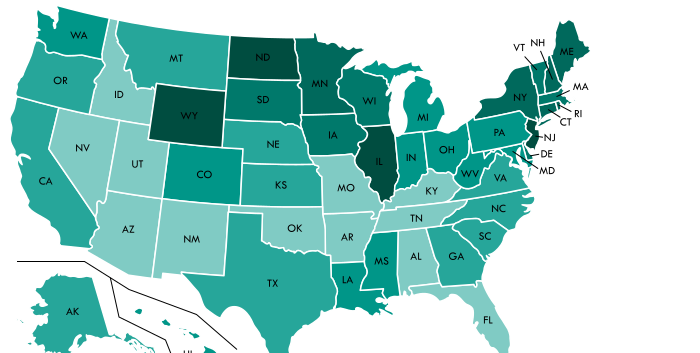
Most common states for manufacturing production supervisors
| Rank | State | Population | # of jobs | Employment/ 1000ppl |
|---|---|---|---|---|
| 1 | Iowa | 3,145,711 | 859 | 27% |
| 2 | Minnesota | 5,576,606 | 1,463 | 26% |
| 3 | Indiana | 6,666,818 | 1,648 | 25% |
| 4 | New Hampshire | 1,342,795 | 338 | 25% |
| 5 | Massachusetts | 6,859,819 | 1,658 | 24% |
| 6 | Wisconsin | 5,795,483 | 1,390 | 24% |
| 7 | Kentucky | 4,454,189 | 1,010 | 23% |
| 8 | Maine | 1,335,907 | 266 | 20% |
| 9 | Vermont | 623,657 | 126 | 20% |
| 10 | Ohio | 11,658,609 | 2,106 | 18% |
| 11 | Michigan | 9,962,311 | 1,751 | 18% |
| 12 | Kansas | 2,913,123 | 510 | 18% |
| 13 | Nebraska | 1,920,076 | 340 | 18% |
| 14 | Illinois | 12,802,023 | 2,160 | 17% |
| 15 | Colorado | 5,607,154 | 929 | 17% |
| 16 | Oregon | 4,142,776 | 686 | 17% |
| 17 | Utah | 3,101,833 | 533 | 17% |
| 18 | Tennessee | 6,715,984 | 1,069 | 16% |
| 19 | Maryland | 6,052,177 | 964 | 16% |
| 20 | Connecticut | 3,588,184 | 575 | 16% |
Most common cities for manufacturing production supervisors
| Rank | City | # of jobs | Employment/ 1000ppl | Avg. salary |
|---|---|---|---|---|
| 1 | Massillon | 2 | 6% | $33,642 |
| 2 | Addison | 1 | 3% | $39,196 |
| 3 | Azusa | 1 | 2% | $28,539 |
| 4 | Bowling Green | 1 | 2% | $26,535 |
| 5 | Cedar Falls | 1 | 2% | $36,991 |
| 6 | Columbus | 1 | 2% | $29,934 |
| 7 | Columbus | 1 | 1% | $27,892 |
| 8 | Concord | 1 | 1% | $29,401 |
| 9 | Dallas | 2 | 0% | $28,213 |
| 10 | Boston | 1 | 0% | $34,579 |
Manufacturing Production Supervisor job outlook: Expert opinions
Our panel of manufacturing production supervisor experts
North Carolina State University
Worcester Polytechnic Institute

California State Polytechnic University - Pomona

Wichita State University

University of California

University of California

California State Polytechnic University, Pomona

MANA

Bethel University
Dr. Gregory Buckner Alumni Distinguished Undergraduate Professor
Alumni Distinguished Undergraduate ProfessorNorth Carolina State University
Manufacturing Engineering
What general advice would you give to a Manufacturing Production Supervisor?
Dr. Gregory Buckner Alumni Distinguished Undergraduate Professor: Experience with robotics and automation, additive manufacturing, and CNC machining processes. Understanding the emerging roles of data analytics and artificial intelligence in process optimization and quality control.
What Manufacturing Production Supervisor skills would you recommend for someone trying to advance their career?
Dr. Gregory Buckner Alumni Distinguished Undergraduate Professor: One way to maximize your salary potential is to continue the formal education process by taking graduate engineering or business courses. Many employers reimburse the tuition expenses, and with the increasing availability of online courses you can earn a master's degree in engineering or an MBA one course at a time.
Michael Buechler
Professor Manufacturing TechnologyWhat general advice would you give to a Manufacturing Production Supervisor?
Michael Buechler: I counsel my students to know their worth and know the job market. Most important is starting out in a position that challenges you and provides training for future wage and skill growth. Many graduates can get caught in a job that pays the bills but may not provide a path to the next career step. Be ambitious and seek to attain the advanced skills quickly but keep in mind the field is complex and there is a lot to learn. If you are in a high wage position but it does not provide the training or room for advancement it might not be the best career option.
What Manufacturing Production Supervisor skills would you recommend for someone trying to advance their career?
Michael Buechler: Model based definition, highly technical computer skills, 5 axis & familiarity with macros is going to be the future of advanced manufacturing. It is paramount that high skill individuals START with as much set-up experience as possible. In order to command 100k + as a programmer you need to know the correct inputs and physics of the manufacturing program you are making
What will help Manufacturing Production Supervisors increase their earning potential?
Michael Buechler: I would suggest beginning career individuals maintain an open mind as to where their carrer leads, they may find interest in areas of manufacturing not previously known or explored by them. Also work especially hard early in your career and try and find an employer that gives you the best opportunity to grow professionally and learn new skills.
Jianyu Liang
Director of Materials and Manufacturing Engineering Program, Department of Mechanical and Materials Engineering, WPIWorcester Polytechnic Institute
Materials Engineering
What Manufacturing Production Supervisor skills would you recommend for someone trying to advance their career?
Jianyu Liang: For manufacturing engineers, the next 3-5 years promise significant evolution due to advancements in technology and changes in manufacturing processes. Here are some skills that are expected to become more important and prevalent in the field: proficiency in automation and robotics, advanced data analysis and data-driven optimization, digital twin technology, additive manufacturing and 3D printing, application of artificial intelligence and machine learning in manufacturing, cybersecurity for manufacturing systems, and supply chain management.
What will help Manufacturing Production Supervisors increase their earning potential?
Jianyu Liang: Get Your Hands Dirty: There's no substitute for hands-on experience. The lessons learned through direct involvement are invaluable, offering insights and skills that theoretical knowledge alone cannot provide. Embrace every opportunity to participate in projects, volunteer for tasks, and experiment within your role. This proactive approach not only accelerates your learning but also showcases your work ethic and dedication to potential mentors and leaders.
Be Mindful and Intentional in Your Job: While immersing yourself in your work, adopt a reflective practice. Actively seek feedback and analyze your experiences. This intentional approach to learning from every task helps to grow your skills rapidly.
Be Open-Minded and Adaptable: The landscape of nearly every industry is rapidly evolving, particularly with the integration of automation and artificial intelligence (AI). These technologies are not just changing the way we work; they are reshaping the skills and roles in demand. Stay open to new ideas, technologies, and methodologies. Continuous learning and adaptability are key to remaining relevant and thriving in a tech-driven workplace. Attend workshops, webinars, and courses on emerging technologies and trends in your field to keep your skills sharp and your perspective fresh.
Cultivate a Professional Network: Building relationships within your industry is crucial. Networking isn't just about finding job opportunities; it's about learning from peers, gaining insights into industry trends, and establishing a support system. Attend industry conferences, join professional organizations, and engage in communities related to your field. These connections can provide guidance, mentorship, and support as you navigate your career path.
Jonathan Puthoff
Associate ProfessorCalifornia State Polytechnic University - Pomona
Chemical and Materials Engineering
What are the biggest trends we'll see in the Manufacturing Production Supervisor job market given the pandemic?
Jonathan Puthoff: I predict a reconsideration of what "attendance" means in a workplace. Knowledge workers have always had some leeway to work from home, but workplaces that have found near-universal remote collaboration congenial may consciously move toward that model. Workers who are afforded more options to work from home should consider carefully the level of support that their employer provides for doing this and should be prepared to negotiate over the exact terms.
Are there any particularly good places in the United States for Manufacturing Production Supervisors to find work opportunities?
Jonathan Puthoff: I always encourage students to look as far afield as their personal circumstances and skill set can accommodate. Geography is a relatively minor constraint in a world with well-developed travel and telework options. I also anticipate that early- and mid-career relocation will be an option or requirement at some point for most tech workers. For these reasons, I think that associating particular opportunities with particular regions might not be a good strategy in an entry-level job search. Graduates should rather identify opportunities and ask "Can I see myself working in this region for the opening years of my career?", understanding that the location will likely change depending on factors both internal and external to their employer.
Dr. Atul Rai Ph.D.
Associate ProfessorWichita State University
School of Accountancy, Barton School of Business
What type of skills will young Manufacturing Production Supervisors need?
Dr. Atul Rai Ph.D.: The work environment has changed drastically over the past three decades due to the faster pace of innovation and shorter product lifecycles. This has a direct impact on what young graduates need to succeed in the future. The primary skill needed is the ability to learn quickly. The skills that a graduate acquires in college will become obsolete in a few years, so they should not count on those skills as a means for financial security for life. In this environment, flexibility is the key to success: flexibility to learn new skills, flexibility to work in a new and different business environment, and flexibility to work with others. We face very complex problems, and to solve these problems, we need teams rather than individuals to solve them. This highlights the importance of critical thinking, multi-disciplinary vision, and communication skills.
What experience really stands out on Manufacturing Production Supervisor resumes?
Dr. Atul Rai Ph.D.: Employers are looking for people who can integrate in multi-disciplinary environments to solve complex problems. They are looking for resumes that show quick learning. Such resumes will permanently be in great demand. Because the world is interconnected much more than it ever was, employees today will deal with customers, supply-chains, and fellow employees who are spread all over the world. It means that an experience that showcases the global perspective will be in demand over the long-term.
What experience really stands out on Manufacturing Production Supervisor resumes?
Diran Apelian: Graduates who have never had industry experience are at a disadvantage. Those who stand out have taken risks and have exposed themselves to various engineering venues through summer jobs and various internships. Theory and practice stands out.
What experience really stands out on Manufacturing Production Supervisor resumes?
Lorenzo Valdevit Ph.D.: As the pandemic has made it harder for students to secure these invaluable internships and other industrial experience, we expect the gap between the most marketable students (those who succeeded in securing these experiences against all odds) and everyone else to grow even deeper this hiring season.
What Manufacturing Production Supervisor skills would you recommend for someone trying to advance their career?
Dr. Kamran Abedini: First of all, I do not recommend a gap year or any interruptions in education as it could require additional warm-up and setup for starting it again in the future. However, if they "need" to do so, I recommend they at least take one course so that they understand the trend and the expectations of students in an educational environment. For example, in the last couple of semesters, both faculty and students have learned and experienced new methods of virtual learning and assessment. If you just plan on coming to school after a few semesters, you would be highly surprised by the changes, taking you much time to prepare, and it would cause falling behind your coursework.
What general advice would you give to a Manufacturing Production Supervisor?
Dr. Kamran Abedini: Larger corporations might have more mentors and give you more time to get familiar with the processes; however, smaller ones need your undivided attention from day one to prove your worth. Both have their own advantages. Learn why you are being hired and work toward satisfying that purpose. Graduates need to be tech-savvy and know how to work remotely. This means a formal work setting at home or taking advantage of remote offices, recently becoming popular for those who want to get out of their homes to feel they are in a working environment. Furthermore, they need to spend more time thinking and taking advantage of cognitive skills as artificial intelligence can substitute natural intelligence, but still, pattern recognition and feeling interpretation is still made by humans. Engineers are tasked to imagine and make a better world. That is what they should wake up thinking every day.
What general advice would you give to a Manufacturing Production Supervisor?
Jerry Leth: We are the Manufacturers' Agents National Association, a trade association of independent manufacturers' representative businesses. We will address this question from that perspective.
To a recent college graduate, a question I pose is, "Am I going to be happier and more satisfied working for someone? Or would I be more satisfied if I embarked on a path that leads me to own my own business?"
If the answer is owning your own business, consider looking for employment as an outside salesperson for an existing manufacturers' representative business. Our average member employs six outside salespersons, and the largest employs 160. Starting out as an employee provides an opportunity to learn about the business while earning an income. When you are ready, many manufacturers' representative firms offer ownership opportunities to employees, or you may choose to move on and start your own business. Either way, you achieve your goal of owning and running your own business.
Jessica Tangen Daniels Ph.D.
Associate Provost - Innovation and Partnerships, Program Director/Professor, Ed.D. Leadership in Higher EducationBethel University
Education Leadership
What skills will help Manufacturing Production Supervisors earn the most?
Jessica Tangen Daniels Ph.D.: For educational leaders, I'm not convinced discrete skills equate to salary. Working hard and working well with others, with a disposition of humility and curiosity, is really powerful. Perhaps the combination of soft and hard skills gained through diverse experiences, positions, and institutional contexts results in the highest earning potential.