Explore jobs
Find specific jobs
Explore careers
Explore professions
Best companies
Explore companies
Job outlook for manufacturing test engineers in the United States
Manufacturing test engineer job growth summary. After extensive research, interviews, and analysis, Zippia's data science team found that:
The projected manufacturing test engineer job growth rate is 10% from 2018-2028.
About 30,600 new jobs for manufacturing test engineers are projected over the next decade.
Manufacturing test engineer salaries have increased 6% for manufacturing test engineers in the last 5 years.
There are over 89,780 manufacturing test engineers currently employed in the United States.
There are 64,188 active manufacturing test engineer job openings in the US.
The average manufacturing test engineer salary is $98,285.
Are manufacturing test engineer jobs in demand?
Manufacturing test engineer job and salary trends over time
Manufacturing test engineer jobs over time
Manufacturing test engineer job growth rate over time
| Year | # of jobs | % of population |
|---|---|---|
| 2021 | 89,780 | 0.03% |
| 2020 | 90,247 | 0.03% |
| 2019 | 90,347 | 0.03% |
| 2018 | 82,729 | 0.02% |
| 2017 | 76,613 | 0.02% |
Average manufacturing test engineer salary over time
Manufacturing test engineer salary by year
| Year | Avg. salary | Hourly rate | % Change |
|---|---|---|---|
| 2025 | $98,285 | $47.25 | +1.1% |
| 2024 | $97,257 | $46.76 | +1.1% |
| 2023 | $96,174 | $46.24 | +1.4% |
| 2022 | $94,893 | $45.62 | +1.9% |
| 2021 | $93,158 | $44.79 | +1.0% |
Manufacturing test engineer jobs by state
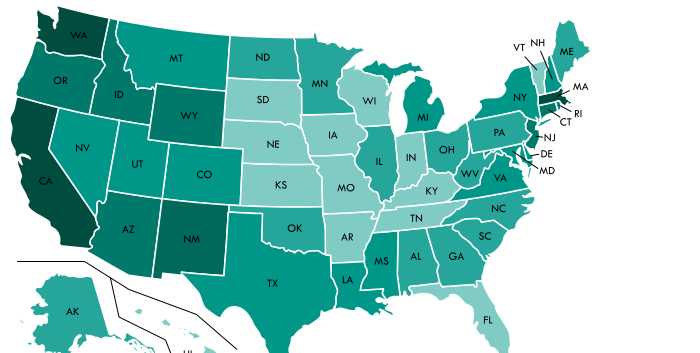
Most common states for manufacturing test engineers
| Rank | State | Population | # of jobs | Employment/ 1000ppl |
|---|---|---|---|---|
| 1 | District of Columbia | 693,972 | 316 | 46% |
| 2 | Massachusetts | 6,859,819 | 2,342 | 34% |
| 3 | New Hampshire | 1,342,795 | 377 | 28% |
| 4 | Maryland | 6,052,177 | 1,596 | 26% |
| 5 | Minnesota | 5,576,606 | 1,431 | 26% |
| 6 | Colorado | 5,607,154 | 1,409 | 25% |
| 7 | California | 39,536,653 | 9,661 | 24% |
| 8 | Delaware | 961,939 | 230 | 24% |
| 9 | Virginia | 8,470,020 | 1,966 | 23% |
| 10 | Oregon | 4,142,776 | 949 | 23% |
| 11 | Washington | 7,405,743 | 1,605 | 22% |
| 12 | Utah | 3,101,833 | 664 | 21% |
| 13 | Vermont | 623,657 | 130 | 21% |
| 14 | Alabama | 4,874,747 | 996 | 20% |
| 15 | Connecticut | 3,588,184 | 703 | 20% |
| 16 | North Carolina | 10,273,419 | 1,926 | 19% |
| 17 | Michigan | 9,962,311 | 1,908 | 19% |
| 18 | North Dakota | 755,393 | 144 | 19% |
| 19 | Arizona | 7,016,270 | 1,265 | 18% |
| 20 | Rhode Island | 1,059,639 | 191 | 18% |
Most common cities for manufacturing test engineers
| Rank | City | # of jobs | Employment/ 1000ppl | Avg. salary |
|---|---|---|---|---|
| 1 | Derry | 2 | 6% | $96,382 |
| 2 | Hudson | 1 | 4% | $96,816 |
| 3 | Florence | 1 | 3% | $81,685 |
| 4 | Alpharetta | 1 | 2% | $86,334 |
| 5 | Coeur dAlene | 1 | 2% | $103,576 |
| 6 | Santa Rosa | 2 | 1% | $132,171 |
| 7 | Clearwater | 1 | 1% | $82,865 |
| 8 | Manchester | 1 | 1% | $96,116 |
| 9 | Melbourne | 1 | 1% | $81,976 |
| 10 | Milpitas | 1 | 1% | $131,531 |
| 11 | Palo Alto | 1 | 1% | $131,676 |
| 12 | San Diego | 3 | 0% | $114,455 |
| 13 | San Jose | 3 | 0% | $131,383 |
| 14 | Dallas | 1 | 0% | $94,892 |
| 15 | Fremont | 1 | 0% | $131,618 |
| 16 | Irvine | 1 | 0% | $117,474 |
| 17 | San Antonio | 1 | 0% | $94,269 |
Manufacturing Test Engineer job outlook: Expert opinions
Our panel of manufacturing test engineer experts
Gonzaga University
Stevens Institute of Technology
Arizona State University at the Polytechnic Campus
North Carolina State University
University of Alabama at Birmingham
San Diego State University
Worcester Polytechnic Institute
Oklahoma State University

North Dakota State University

Weber State University
Clarkson University

California State Polytechnic University - Pomona

Old Dominion University

Kettering University

Pennsylvania State University

North Carolina State University

George Mason University

Wichita State University

University of California
What Manufacturing Test Engineer skills would you recommend for someone trying to advance their career?
Steven Schennum Ph.D. P.E.: The most important skill is the ability to learn new things, and especially to unlearn things you “know” after evidence demonstrates that these things are not true. Learn how to analyze information. Your intuition, simulations, and results should all be in alignment. If they are not, then dig deeper. Learn the terminology and jargon specific to your company and your projects. Spend time reading. Don’t be afraid to ask questions. Don’t be intimidated by new software.
What Manufacturing Test Engineer skills would you recommend for someone trying to advance their career?
Min Song: Communication skills and innovative thinking skills. As emerging technologies continue to be complex and multidisciplinary, it’s important to be able to communicate with professionals in diverse disciplines. Taking robotics, for example, the electrical engineer must be able to work with mechanical and biomechanical engineers, computer engineers, software engineers, artificial intelligence experts, cognitive scientists, system engineers, etc. A person will be able to generate innovative ideas only if the person has a complete and comprehensive understanding of the entire system and can work well with other individuals with a range of expertise.
Jerry Gintz CMfgE
Teaching ProfessorArizona State University at the Polytechnic Campus
Manufacturing Engineering
What general advice would you give to a Manufacturing Test Engineer?
Jerry Gintz CMfgE: When entering a career in manufacturing engineering, consider starting as a technician to gain experience with the company before transitioning into engineering. This will allow you to build confidence and better understand the production systems you will be responsible for as an engineer.
What Manufacturing Test Engineer skills would you recommend for someone trying to advance their career?
Jerry Gintz CMfgE: From a manufacturing engineering perspective, the most important skills an engineer will need is the ability to understand, design, assemble, and deploy production capable systems. This includes an expertise with computer-aided engineering tools to assist in the design and verification of engineered systems before a company expends capital on the equipment.
What will help Manufacturing Test Engineers increase their earning potential?
Jerry Gintz CMfgE: From a manufacturing engineering perspective, compensation is normally tied to capability so the more relevant skills a candidate has entering the workforce the higher compensation they can expect to receive. This is especially true in manufacturing given the shortage of qualified engineering talent available for hire. Additionally, consider focusing on industrial automation as a resource to aid efficient production. Manufacturing is always looking to increase efficiency and a foundational knowledge of industrial automation systems will serve you well as you build a career in manufacturing engineering.
Dr. Gregory Buckner Alumni Distinguished Undergraduate Professor
Alumni Distinguished Undergraduate ProfessorNorth Carolina State University
Manufacturing Engineering
What general advice would you give to a Manufacturing Test Engineer?
Dr. Gregory Buckner Alumni Distinguished Undergraduate Professor: Experience with robotics and automation, additive manufacturing, and CNC machining processes. Understanding the emerging roles of data analytics and artificial intelligence in process optimization and quality control.
What Manufacturing Test Engineer skills would you recommend for someone trying to advance their career?
Dr. Gregory Buckner Alumni Distinguished Undergraduate Professor: One way to maximize your salary potential is to continue the formal education process by taking graduate engineering or business courses. Many employers reimburse the tuition expenses, and with the increasing availability of online courses you can earn a master's degree in engineering or an MBA one course at a time.
What will help Manufacturing Test Engineers increase their earning potential?
Dr. Gregory Buckner Alumni Distinguished Undergraduate Professor: I'd encourage students to embrace new technical challenges and opportunities to learn and collaborate in an industrial setting, which can be quite different from the academic setting. I'd emphasize the importance of developing communication and team working skills, and building professional relationships. I'd also encourage students to join professional societies related to their field and keep updated on new manufacturing trends.
What Manufacturing Test Engineer skills would you recommend for someone trying to advance their career?
Arie Nakhmani: Electrical Engineering has always (from its inception) been a good profession to enter, but now it is better than ever. Now everything is becoming Electrical Engineering, and the world cannot survive without it even for a few days. Electrical Engineering is the most necessary profession for the survival of modern society.
Michael Buechler
Professor Manufacturing TechnologyWhat general advice would you give to a Manufacturing Test Engineer?
Michael Buechler: I counsel my students to know their worth and know the job market. Most important is starting out in a position that challenges you and provides training for future wage and skill growth. Many graduates can get caught in a job that pays the bills but may not provide a path to the next career step. Be ambitious and seek to attain the advanced skills quickly but keep in mind the field is complex and there is a lot to learn. If you are in a high wage position but it does not provide the training or room for advancement it might not be the best career option.
What Manufacturing Test Engineer skills would you recommend for someone trying to advance their career?
Michael Buechler: Model based definition, highly technical computer skills, 5 axis & familiarity with macros is going to be the future of advanced manufacturing. It is paramount that high skill individuals START with as much set-up experience as possible. In order to command 100k + as a programmer you need to know the correct inputs and physics of the manufacturing program you are making
What will help Manufacturing Test Engineers increase their earning potential?
Michael Buechler: I would suggest beginning career individuals maintain an open mind as to where their carrer leads, they may find interest in areas of manufacturing not previously known or explored by them. Also work especially hard early in your career and try and find an employer that gives you the best opportunity to grow professionally and learn new skills.
What Manufacturing Test Engineer skills would you recommend for someone trying to advance their career?
Dr. Arif Engin: Electrical engineering graduates are sought by a wide range of employers in government and industry for many different types of work. The top occupations in electrical engineering fields are projected to grow and sometimes require an advanced degree.
What will help Manufacturing Test Engineers increase their earning potential?
Dr. Arif Engin: Electrical engineers solve problems by skillfully applying mathematics and science. Electrical engineering classes are challenging at college, and electrical engineers must embrace lifelong learning to remain at the top of their skills. In the end, seeing the results of their work in a finished product is a rewarding experience.
Jianyu Liang
Director of Materials and Manufacturing Engineering Program, Department of Mechanical and Materials Engineering, WPIWorcester Polytechnic Institute
Materials Engineering
What general advice would you give to a Manufacturing Test Engineer?
Jianyu Liang: At the start of your career, actively engaging in the manufacturing professional communities to develop an in-depth understanding of the current high-demand areas and the trends in the industry will help you position yourself in high-demand areas. This proactive approach allows you to make informed decisions on obtaining relevant certifications or advanced education, tailoring your skill set to meet the evolving needs of the industry. Proactively engaging in projects and practices to grow your experience. Building a strong professional network and finding mentors in the industry can provide guidance, expose you to new opportunities, and offer insights on navigating your career path effectively. Embracing continuous learning and staying abreast of technological advancements in manufacturing, such as automation, robotics, and digital manufacturing technologies, will ensure you remain a valuable asset to employers. Demonstrating flexibility and a willingness to adapt to new methods and technologies can set you apart in a competitive job market.
What Manufacturing Test Engineer skills would you recommend for someone trying to advance their career?
Jianyu Liang: For manufacturing engineers, the next 3-5 years promise significant evolution due to advancements in technology and changes in manufacturing processes. Here are some skills that are expected to become more important and prevalent in the field: proficiency in automation and robotics, advanced data analysis and data-driven optimization, digital twin technology, additive manufacturing and 3D printing, application of artificial intelligence and machine learning in manufacturing, cybersecurity for manufacturing systems, and supply chain management.
What will help Manufacturing Test Engineers increase their earning potential?
Jianyu Liang: Get Your Hands Dirty: There's no substitute for hands-on experience. The lessons learned through direct involvement are invaluable, offering insights and skills that theoretical knowledge alone cannot provide. Embrace every opportunity to participate in projects, volunteer for tasks, and experiment within your role. This proactive approach not only accelerates your learning but also showcases your work ethic and dedication to potential mentors and leaders.
Be Mindful and Intentional in Your Job: While immersing yourself in your work, adopt a reflective practice. Actively seek feedback and analyze your experiences. This intentional approach to learning from every task helps to grow your skills rapidly.
Be Open-Minded and Adaptable: The landscape of nearly every industry is rapidly evolving, particularly with the integration of automation and artificial intelligence (AI). These technologies are not just changing the way we work; they are reshaping the skills and roles in demand. Stay open to new ideas, technologies, and methodologies. Continuous learning and adaptability are key to remaining relevant and thriving in a tech-driven workplace. Attend workshops, webinars, and courses on emerging technologies and trends in your field to keep your skills sharp and your perspective fresh.
Cultivate a Professional Network: Building relationships within your industry is crucial. Networking isn't just about finding job opportunities; it's about learning from peers, gaining insights into industry trends, and establishing a support system. Attend industry conferences, join professional organizations, and engage in communities related to your field. These connections can provide guidance, mentorship, and support as you navigate your career path.
What general advice would you give to a Manufacturing Test Engineer?
Guiping Hu Ph.D.: People like the diversity and flexibility of being an industrial engineer. You can work on all kinds of problems with your industrial engineering skills. However, if you are only looking for a very narrow area in a specific engineering discipline, industrial engineering may not be right for you since we focus on system efficiency improvement and welfare of the workers.
What will help Manufacturing Test Engineers increase their earning potential?
Guiping Hu Ph.D.: Industrial Engineers design, build, and improve production systems. As IEs, we focus on both the quality of what is made and how it is made. Industrial Engineering is a very inclusive, diverse, and dynamic discipline. Whether it is shortening a roller-coaster line, streamlining an operating room, distributing products world wide or manufacturing superior automobiles, all share the common goal of reducing costs and increasing efficiency.
Dr. David Grewell Ph.D.
Department Chair and ProfessorNorth Dakota State University
Industrial and Manufacturing Engineering Department
What skills stand out on Manufacturing Test Engineer resumes?
Dr. David Grewell Ph.D.: The resume of an IE will detail the ability to solve problems and optimize processes for a broad range of industries, including healthcare, transportation, financial, entertainment, manufacturing, and human resources. These skills are further highlighted by the fact that the IE curriculum includes aspects of business management.
What hard/technical skills are most important for Manufacturing Test Engineers?
Dr. David Grewell Ph.D.: An IE must be able to break down complex problems into manageable issues and provide solutions for these problems that face the world in today's complex interconnected systems. A background in statistics, design and analysis, process management, and a strong foundation in the engineering disciplines make this possible.
What will help Manufacturing Test Engineers increase their earning potential?
Dr. A. Tye Gardner Ph.D.: Getting a master's degree goes a long way to making candidates stand out and improving earnings. My recommendation is to tailor your MS degree to the specific field you're interested in working in, because employers really want to see candidates that are passionate about the field, and very few people survive a graduate degree without at least a little passion. Available salary data indicates that if you choose an affordable program (let's just say Weber State University), it takes only a few years to pay off the added cost, increases starting salaries, and dramatically improves long-term earning potential. Moreover, you can find electrical engineers with MBAs at C-level positions all over the country. It turns out being an EE makes you a good candidate for business leadership.
What technical skills for a Manufacturing Test Engineer stand out to employers?
Tracy Farrell: Technical skills that employers are seeking include "real" computer skills like Microsoft Office Suite tools, proper communication skills via email and website development and postings, developing proper document format that is appropriate to send to stakeholders (i.e., letter formatting, report writing, email formatting); strong communication skills that include speaking professionally and respectfully to stakeholders as well as writing professionally (i.e., making eye contact when speaking, proper handshake, respectful dialogue including questioning); project management - knowing how to organize work and develop a timeline that includes who will be responsible for what and follow through; data analysis - being able to not only present data in an organized and understandable manner; but, be able to interpret data correctly offering the justification behind what they are interpreting and why.
Respectfully, today's graduates do not understand that being able to text and use social media does not prepare them for "real" computer skills. Many students that I have in high school and in college do not have proper writing skills, document formatting skills, or document management skills to know how to save documents properly and where to save to.
What's a good job out of college for Manufacturing Test Engineers?
Tracy Farrell: A "good" job out of college, in my opinion, is an entry-level position with a company that provides advancement. I would recommend that if graduates did not take advantage of internship opportunities, early and often, they will be at a disadvantage to "think they know it all" and have proven not to be as successful. Entry positions offer valuable training and teach transferable skills that can only be gained in entry-level positions (or internships) like communication skills, time management, organization, teamwork, aspects of all positions.
I strongly recommend that a graduate start interning well before they graduate. Internships can serve as "entry-level positions" providing opportunities for learning, growth, and hands-on experience they would not have otherwise. NYS high school business education programs have been offering internships for years, for credit, and many students do not take advantage of these programs.
Jonathan Puthoff
Associate ProfessorCalifornia State Polytechnic University - Pomona
Chemical and Materials Engineering
What are the biggest trends we'll see in the Manufacturing Test Engineer job market given the pandemic?
Jonathan Puthoff: I predict a reconsideration of what "attendance" means in a workplace. Knowledge workers have always had some leeway to work from home, but workplaces that have found near-universal remote collaboration congenial may consciously move toward that model. Workers who are afforded more options to work from home should consider carefully the level of support that their employer provides for doing this and should be prepared to negotiate over the exact terms.
What skills stand out on Manufacturing Test Engineer resumes?
Jonathan Puthoff: Collaboration and communication skills. I also think that students should graduate knowing at least one field-specific software design tool or package, as well as some evidence that they can learn more on the job. Finally, workplaces are more diverse in terms of the generations, ethnicities, and genders represented than they have been at any time in the past, so students who have a wide variety of out-of-classroom experiences (and presumably make more considerate colleagues) could do well to highlight those.
Are there any particularly good places in the United States for Manufacturing Test Engineers to find work opportunities?
Jonathan Puthoff: I always encourage students to look as far afield as their personal circumstances and skill set can accommodate. Geography is a relatively minor constraint in a world with well-developed travel and telework options. I also anticipate that early- and mid-career relocation will be an option or requirement at some point for most tech workers. For these reasons, I think that associating particular opportunities with particular regions might not be a good strategy in an entry-level job search. Graduates should rather identify opportunities and ask "Can I see myself working in this region for the opening years of my career?", understanding that the location will likely change depending on factors both internal and external to their employer.
Will there be an enduring impact of the coronavirus pandemic on Manufacturing Test Engineers?
Michel Audette Ph.D.: My take on this is what I've seen with my wife's work in industry, which suggests that the industrial landscape is going to be increasingly equipped for, and open to, remote work. I think that the implication for graduates is that they may need to be flexible about working within a geographically distributed team. If company deciders feel that someone is worth employing because of a unique skill set, then they would typically be more willing to hire that person even if unable to make it to work regularly, if that is feasible given the nature of the work; some work, such as hardware testing or industrial production, may not lend itself to remote contributions.
Nonetheless, for those areas that accommodate geographically distributed activity, such as software development, graduates can expect to interact with team members all over the US, possibly all over the world, if someone is deemed unique enough to hire despite living abroad. This places a high premium on the ability and willingness to work in a heterogeneous team, where not only will members look different, but also have myriad accents in their English, which will also impose a certain adaptability and tolerance to team members.
A related impact could also be that global hiring will make it easier for multi-national companies to hire a portion of their talent in countries where wages are lower and motivate US-based engineers to seek out graduate degrees in order to increase their competitiveness and employability at US salaries.
What type of skills will young Manufacturing Test Engineers need?
Michel Audette Ph.D.: One skill that is timeless is the ability to communicate effectively, such as taking a complex design process and distilling it into intuitive slides or reports that lend themselves for senior managers to process in order to come to a decision. An engineer who has that ability will always have some tools in his/her toolbox that makes that individual attractive to a company and to the local technical ecosystem, thus a ripe target for headhunters who willing to champion them to companies looking for top talent. Moreover, speaking and writing well also comes with a vital component of diplomacy, especially in the context of increasingly distributed company workforce: the ability not just to get on with colleagues from different parts of the world, increasingly heterogeneous in terms of gender and possibly sexual preference, but embrace them for who they are. This is often maps to opportunities to travel, as some collaborations lead to meetings face to face, post-covid.
This embrace of heterogeneity is even more relevant in that technical problems being solved are increasingly multi-disciplinary, so that an engineer may need to interact with biologists, physicians, clothing or furniture designers, mathematicians, lawyers, and so on: in my own case, I have to wear a multitude of different hats, while recognizing someone who is a perfect fit for one of those hats when I meet that individual, and making the most of that opportunity to build a truly competent team. Engineers must be able to hold a meaningful, respectful conversation with any of these counterparts, not just discuss code or circuit design. I would advocate that they spend time reading, to maintain their vocabulary and stay abreast of the world around them.
Another one that I advocate is the ability to tap into a revolution that has occurred in parallel with the advent of Internet and cellular technologies, these past 30+ years: the explosion of open-source software tools. I am a committed proponent of open source, as a former contributor to them while previously employed at Kitware (a pioneer in this area, behind VTK, ITK, CMake, and myriad others). I see job ads in Indeed.com that specifically ask for the ability to work with these tools, since they save work and make it possible to produce a prototype in much less time than developing it completely in-house. This ability does not just presuppose the ability to program at a competent level, but other abilities: the ability to track bugs that not be in the calling program, but in the open-source software library itself, the willingness to get answers in the community of developers, the eye for details that extends to graphical processor units that result in accelerations an order of magnitude or better, and so on. These go way beyond writing a self-contained algorithm. Hardware designers may also have similar tools, based on broad standards, Arduino, and the prevalence of 3D printers that make it possible to physically replicate digital models.
Finally, a vital skill is the willingness and ability to keep learning, while embracing revolutions that take place at breathtaking pace. The latest one is the reliance on deep neural networks (DNNs) to synthesize algorithms that can learn and adapt to their data, with much faster performances than feasible with the previous algorithms that DNNs have replaced. The point to make here is not to embrace neural networks in a proximal sense, but that we cannot anticipate what will come next, downstream of DNNs. Graduates of 2021 have to be willing to keep their curiosity and work ethic enough to be responsive to the next wave of technologies, and embrace them for the opportunities that they represent.
What experience really stands out on Manufacturing Test Engineer resumes?
Scott Grasman Ph.D.: Graduates that have applied their classroom learning to real work experiences will differentiate themselves from others. Showing that you have particular skills, perhaps through certifications, and highlighting your specific abilities through tangible examples is critical.
In addition to a resume, students could create a portfolio of items that demonstrates their knowledge and ability.
What Manufacturing Test Engineer skills would you recommend for someone trying to advance their career?
Charles Purdum: Certification, certification, certifications! Lean or Six Sigma green belt (e.g., ASQ.com), project management (e.g., PMI.com), and leadership skills.
Dr. Kanton Reynolds Ph.D.
Director, Undergraduate Programs & Associate Teaching ProfessorNorth Carolina State University
Edward P. Fitts Department of Industrial and Systems Engineering
What Manufacturing Test Engineer skills would you recommend for someone trying to advance their career?
Dr. Kanton Reynolds Ph.D.: Today's graduates have to be prepared for the dynamically changing society and the corresponding work environment. With that in mind, they should be proactively engaging in continuous learning so that they can be prepared for the next evolution or disruption in technology. In this case, anything that can enhance data science or data analysis skills is going to be important. Companies now have vast new sources of data to evaluate in making decisions on trends, customer insights, business intelligence, and forecasting. It will be imperative to have a functional understanding of how to navigate this space. In addition, this pandemic has taught us new ways to interact, learn, and collaborate. Learning a new language to help facilitate global business opportunities will certainly be helpful. An increasing number of our students minor in Spanish, participate in study abroad opportunities, and increasingly seek global Internships to hone their skills in this particular area.
What general advice would you give to a Manufacturing Test Engineer?
Dr. Kanton Reynolds Ph.D.: These are unusual times, so they require unusual responses to the prevailing circumstances. Think about other types of careers that do not necessarily align fully with how you envisioned leveraging your major in the workforce. For example, engineers may need to look at careers in services instead of design or development. Also, do not discount industries that are fundamental to our society like consumer-packaged goods as potential career options. Lastly, always seek ways to expand your skills and career footprint. Do not allow yourself to be siloed in a role or function that prevents you from responding to shifts in the marketplace with a corresponding skill set.
Dr. Lance Sherry Ph.D.
Director, Center for Air Transportation Systems Research Assoc. Professor, System Engineering and Operations Research Dept.George Mason University
What experience really stands out on Manufacturing Test Engineer resumes?
Dr. Lance Sherry Ph.D.: Projects: capstone projects and summer intern projects. Not busy work but intellectual work that shows you can design, build, and test a system. This shows that the candidate really understands what it takes to do work in the real world, that the graduate can persevere, and that the graduate can overcome obstacles.
What type of skills will young Manufacturing Test Engineers need?
Dr. Lance Sherry Ph.D.: Critical thinking - don't take things for granted. Instrumentalize the process, and collect the performance data. Analyse the data, and test hypotheses. Once the problem and issue are understood, then, and only then, develop a solution.
Too many times we rush in with a technology solution that does not really solve the problem.
Also go and listen to the stakeholders. Understand their perspectives and account for these perspectives in the design solution.
Too many times we rush in with a technology solution that causes more problems than it solves because we have not truly understood the perspectives of the stakeholders.
Dr. Atul Rai Ph.D.
Associate ProfessorWichita State University
School of Accountancy, Barton School of Business
Will there be an enduring impact of the coronavirus pandemic on Manufacturing Test Engineers?
Dr. Atul Rai Ph.D.: The enduring impact of this pandemic on graduates will be directly related to how this pandemic has affected the society at large.
Any cataclysmic event like this tests the resilience of societies to the limit. These events highlight the best and the worst of the society that we live in. Like Spanish Flu more than one hundred years ago, we can learn from this crisis. For example, a lack of the public health facilities in 1918, at the time Spanish flu pandemic spread, led to a significant improvement in public health in subsequent decades. Similarly, coronavirus has highlighted that our society suffers from great inequalities. The differential impact of this pandemic shows that our society has big economic, racial, and digital divides. Because of these inequalities, some members of the society have been minimally affected, while others have paid a much greater cost. The coronavirus pandemic focuses spotlight on these issues. I hope that in subsequent years, we, as a society, will spend our energies on solving these problems.
Our graduates will experience at a personal level what is happening at the society level. Most of our graduates today were young kids when the Great Recession impacted their parents' jobs. Some were too young when 9/11 happened nineteen years ago. The coronavirus pandemic is the first big crisis many of them have faced as adults. They will see the issues mentioned earlier in their own jobs, families, and friends. It will change the way they look at the world. They will be more motivated to be a part of the solution to the problems they see in the society. They will be more socially active and realize that people must work together. They will be more proactive to make changes in the world we live in, whether to improve economic, social, and racial justice or to deal with climate change. For employers, this means that to retain a talented workforce they will have to align their actions more towards what benefits the society than just shareholders.
What type of skills will young Manufacturing Test Engineers need?
Dr. Atul Rai Ph.D.: The work environment has changed drastically over the past three decades due to the faster pace of innovation and shorter product lifecycles. This has a direct impact on what young graduates need to succeed in the future. The primary skill needed is the ability to learn quickly. The skills that a graduate acquires in college will become obsolete in a few years, so they should not count on those skills as a means for financial security for life. In this environment, flexibility is the key to success: flexibility to learn new skills, flexibility to work in a new and different business environment, and flexibility to work with others. We face very complex problems, and to solve these problems, we need teams rather than individuals to solve them. This highlights the importance of critical thinking, multi-disciplinary vision, and communication skills.
What experience really stands out on Manufacturing Test Engineer resumes?
Dr. Atul Rai Ph.D.: Employers are looking for people who can integrate in multi-disciplinary environments to solve complex problems. They are looking for resumes that show quick learning. Such resumes will permanently be in great demand. Because the world is interconnected much more than it ever was, employees today will deal with customers, supply-chains, and fellow employees who are spread all over the world. It means that an experience that showcases the global perspective will be in demand over the long-term.
Will there be an enduring impact of the coronavirus pandemic on Manufacturing Test Engineers?
Diran Apelian: All of humanity has been impacted by the pandemic - every age, race, and country. For our graduates, it will be a "story" that they will pass on to the next generation someday. Each story will be different, but one theme will be common to all of them: that they learned to be agile, resilient, enterprising, and active learners. There is always a silver lining, and the confidence that they now have in being comfortable with the uncomfortable throughout life is perhaps the greatest and most beneficial impact.
What type of skills will young Manufacturing Test Engineers need?
Diran Apelian: Talent will be the most in-demand asset in the 21st century. It is not about capitalism or socialism - the 21st century is all about "talentism".
Those graduates who will succeed and lead will have:
an understanding of the human dimension;
the ability to harvest the data revolution;
skills in line with the Industry 4.0 pathways; and
commercial and business acumen.
What experience really stands out on Manufacturing Test Engineer resumes?
Diran Apelian: Graduates who have never had industry experience are at a disadvantage. Those who stand out have taken risks and have exposed themselves to various engineering venues through summer jobs and various internships. Theory and practice stands out.