Explore jobs
Find specific jobs
Explore careers
Explore professions
Best companies
Explore companies
Job outlook for marketing instructors in the United States
Marketing instructor job growth summary. After extensive research, interviews, and analysis, Zippia's data science team found that:
The projected marketing instructor job growth rate is 12% from 2018-2028.
About 159,400 new jobs for marketing instructors are projected over the next decade.
Marketing instructor salaries have increased 14% for marketing instructors in the last 5 years.
There are over 6,021 marketing instructors currently employed in the United States.
There are 104,903 active marketing instructor job openings in the US.
The average marketing instructor salary is $64,396.
Are marketing instructor jobs in demand?
Marketing instructor job and salary trends over time
Marketing instructor jobs over time
Marketing instructor job growth rate over time
| Year | # of jobs | % of population |
|---|---|---|
| 2021 | 6,021 | 0.00% |
| 2020 | 6,034 | 0.00% |
| 2019 | 6,345 | 0.00% |
| 2018 | 6,368 | 0.00% |
| 2017 | 6,377 | 0.00% |
Average marketing instructor salary over time
Marketing instructor salary by year
| Year | Avg. salary | Hourly rate | % Change |
|---|---|---|---|
| 2026 | $64,396 | $30.96 | +0.9% |
| 2025 | $63,804 | $30.67 | +3.9% |
| 2024 | $61,433 | $29.54 | +4.6% |
| 2023 | $58,755 | $28.25 | +3.6% |
| 2022 | $56,699 | $27.26 | +2.8% |
Marketing instructor jobs by state
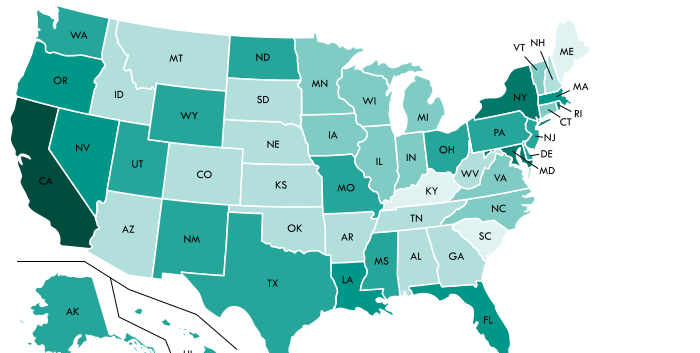
Most common states for marketing instructors
| Rank | State | Population | # of jobs | Employment/ 1000ppl |
|---|---|---|---|---|
| 1 | Wyoming | 579,315 | 139 | 24% |
| 2 | New Hampshire | 1,342,795 | 279 | 21% |
| 3 | Colorado | 5,607,154 | 1,124 | 20% |
| 4 | Alaska | 739,795 | 137 | 19% |
| 5 | Virginia | 8,470,020 | 1,540 | 18% |
| 6 | Minnesota | 5,576,606 | 991 | 18% |
| 7 | North Dakota | 755,393 | 139 | 18% |
| 8 | South Dakota | 869,666 | 151 | 17% |
| 9 | Georgia | 10,429,379 | 1,704 | 16% |
| 10 | North Carolina | 10,273,419 | 1,668 | 16% |
| 11 | Nebraska | 1,920,076 | 295 | 15% |
| 12 | Maine | 1,335,907 | 202 | 15% |
| 13 | Maryland | 6,052,177 | 844 | 14% |
| 14 | South Carolina | 5,024,369 | 687 | 14% |
| 15 | Connecticut | 3,588,184 | 498 | 14% |
| 16 | Kansas | 2,913,123 | 383 | 13% |
| 17 | Pennsylvania | 12,805,537 | 1,600 | 12% |
| 18 | Iowa | 3,145,711 | 393 | 12% |
| 19 | Nevada | 2,998,039 | 322 | 11% |
| 20 | New Mexico | 2,088,070 | 238 | 11% |
Most common cities for marketing instructors
| Rank | City | # of jobs | Employment/ 1000ppl | Avg. salary |
|---|---|---|---|---|
| 1 | Los Angeles | 1 | 0% | $84,248 |
Marketing Instructor job outlook: Expert opinions
Our panel of marketing instructor experts
Tiffin University
College of the Marshall Islands
Morningside University

Macalester College

Angelo State University

College of Charleston

Wright State University

Arkansas Tech University
Northern Seminary

Lafayette College

Northern Illinois University
Franklin and Marshall College
AGWA - American Grant Writers' Association, Inc.

Texas State University

University of Mount Union

Kent State University

Gustavus Adolphus College

Northwestern University

Youngstown State University

University of Idaho
Dr. Stephanie Opfer
Associate Professor of English, Assistant Dean of the School of Creative and Media ArtsTiffin University
Visual And Performing Arts
What will help Marketing Instructors increase their earning potential?
Dr. Stephanie Opfer: Unfortunately, teaching as an adjunct does not pay well. Students should keep their full-time jobs and teach part-time until they find a full-time job at a college or university. That part-time teaching provides them valuable experience and connections that make them more competitive candidates for full-time positions because they'd also be competing with candidates who have PhDs. So adjunct work is more of a long-term investment rather than an immediate return. Also, even full-time teaching jobs don't pay particularly well, so they'll really need to love teaching if they want to do it full-time. If they don't like teaching as an adjunct, they won't like doing it full-time.
What general advice would you give to a Marketing Instructor?
Alexander Velasquez: My general advice to any graduate beginning their career in their field is to continue to learn and be a student of your craft. Be open to learning new things because you never know how they will improve your skills and qualifications. For example, I am currently learning video editing. I never thought I would bother to learn video editing, but it makes me a more versatile instructor being able to give students the option of doing video projects, combining and editing them, and having a digital record of what students have learned in the classroom. And given the rise of online learning, it's important nowadays to be an effective instructor both in the traditional in-person format and within the digital landscape.
What Marketing Instructor skills would you recommend for someone trying to advance their career?
Alexander Velasquez: I think that in the next three to five years the most important skills to have—and I mean this—will be critical thinking and imagination. This may sound a bit outlandish, and maybe even a bit naive, but hear me out: Artificial intelligence is making strides to the point where papers are writing themselves with simple instructions, videos are generating themselves with simple instructions, and software is beginning to write itself; and all this has been happening within the last few years. We may begin to see that in the next three to five years, once coveted programming jobs could become automated. Now, what I'm *not* saying is don't go to school for computer programming; but what I *am* saying is that the nature of work and employment *is* changing. For example, if you and and AI are making a video, and both of you have the same script, same voiceover, and so on, the only thing separating your final product from the AI's is the way you *think and imagine*, the perspective that you have as someone who can think critically about the information and lay it out in a visually appealing manner. AI can't do that—at least not yet—because it simply spits out the information it's given. But critical thought, metalevel thinking about information, is what will be one of the most important assets to have in the coming three to five years.
What will help Marketing Instructors increase their earning potential?
Alexander Velasquez: I think everyone should look into their career fields and find out what it is that makes you more valuable in that field. Are there any certifications that you can get? What is it that you need to know or learn that companies will find valuable? Much can be learned online, so pick up as many of those skills as you can, and make sure they're on your resume or CV. I believe all those things could maximize salary potential, especially when starting out.
Caprice Moore
Assistant ProfessorMorningside University
School of Business
What hard/technical skills are most important for Marketing Instructors?
Caprice Moore: The hard skills that you need to stand out as a job candidate can vary depending on the exact position you are aiming for. Some skills that might shine on your resume include:
The Right Vocabulary
Business communication graduates are invaluable across many different business sectors. Each sector, however, comes with a unique vocabulary. Reading relevant industry publications and news articles can help you to learn the lingo of industry and prepare you to impress at your next job interview.
You might even consider taking a brief course to get yourself up to speed on a particular industry. You might search for local college courses that are relevant or even try to earn a certificate on a platform like Coursera.
Research Capabilities
These days, many people equate "research" with typing something into Google's search box. Real research, however, is much more involved. Being familiar with a range of research tools, and knowing how to differentiate reliable information from unreliable information, can be a huge asset in your job search.
Media and Marketing
Especially if your desired job involves sending messages to the public, you should be familiar with a variety of advertising media and marketing techniques.
What skills stand out on Marketing Instructor resumes?
Caprice Moore: While graduating with a business communications degree is exciting, entering an uncertain job market might not be. The "new normal" created by the COVID-19 pandemic has affected what employers are looking for. Let's talk about what skills might give you a leg up in your quest to kick start your career.
As a recent graduate, you have a multitude of potential opportunities in front of you, even in the current climate of economic uncertainty. The ability to take advantage of such opportunities depends on how well your skills and abilities shine through on your resume. You should always adjust your resume to the description of the job you are applying for. For example, if you wish to work as a dedicated Communications Specialist, it would be wise to include things like project management, strategic planning, and content creation on your resume.
Are you looking for guidance as you navigate the ups and downs of searching for a new job? A qualified coach can help you hone your resume, define your career goals, and possibly land your dream position!
What skills will help Marketing Instructors earn the most?
Caprice Moore: The national average pay for a communications major is around $62,000. However, you might be able to make more by developing and showcasing specific skills, such as:
-Marketing. The base pay for a marketing manager is more than $100,000, while the mid-career median salary of a Vice President of Marketing is more than $162,000.
-Strategic planning. The mid-career median salary of a Director of Strategic Alliances is roughly $160,000
-Account management. The mid-career median pay of a Global Account Manager is more than $138,000.
What hard/technical skills are most important for Marketing Instructors?
Walter Greason Ph.D.: Ability to learn multiple managerial and technical platforms rapidly; facility with both quantitative and qualitative data and the capacity to discern multiple forms of mixed research methodologies.
Dr. Jason Pierce
Professor, Department ChairAngelo State University
Arnoldo De León Department of History
What skills stand out on Marketing Instructor resumes?
Dr. Jason Pierce: Colleges and universities vary in terms of their primary focus. While larger private and public institutions value research as much as teaching, smaller regional institutions, like Angelo State University, put the most emphasis on teaching. Thus, teaching experience is paramount. We look closely at how many sections a candidate has taught and what classes they could offer when hiring a tenure track or non-tenure track instructor. Faculty at my university teach 4 classes per semester, so we must have someone who is "plug and play" and can handle the workload. For larger universities, research projects may need to be emphasized more. Be sure you understand what kind of institution you are applying to so you can get a sense of what skills that institution or department values the most. Researching the institution and the department is critical for success. Thankfully, that's relatively easy to do nowadays.
What experience really stands out on Marketing Instructor resumes?
Dr. Phyllis G. Jestice: The experience that most stands out on resumés, to my mind, is definitely internships or anything where the applicant has had to show initiative and exercise independent thought.
What technology do you think will become more important and prevalent for Marketing Instructors in the next 3-5 years?
Dr. Karla Huebner Ph.D.: Have no idea about technology for the future.
What general advice would you give to a Marketing Instructor?
Dr. Karla Huebner Ph.D.: Grads in art and art history need to be very flexible in their job search, as positions in these fields for people with the BA and BFA are often hard to get and low in pay. That is not to say students should not pursue these fields. Still, they should be open and creative in job searching--be available to positions that seem less in the field or contingent to it, in areas like library science, graphic design, arts journalism, etc. Graduate degrees can improve job prospects, but the same caveats apply.
How would you rate the starting salaries for Marketing Instructors, as well as the prospects for salary advancement?
Dr. Karla Huebner Ph.D.: Salaries are generally low, but now and then, artists and art historians can make good incomes--don't expect to.
What are the biggest trends we'll see in the Marketing Instructor job market given the pandemic?
Sam Strasner: The New York Times reported, early in the pandemic, that 36,000 journalism jobs had been lost in the United States. Poynter observed that later in summer 2020, that figure does not account for freelancers and others who count on their journalism skills supplement their regular income. The rate at which those jobs return and the quality of the opportunities will most likely reflect the pandemic's overall economic recovery. A more robust economy will allow for more advertising expenditures by companies and more subscriptions by consumers. Through it all, the quality will remain paramount. Those who can tell compelling and accurate stories that resonate with an audience will gain access to the best career options.
What technology do you think will become more important and prevalent for Marketing Instructors in the next 3-5 years?
Sam Strasner: It will be fascinating to see if the pandemic convention of Zoom-style interviews becoming permissible for broadcast television and internet news websites will carry over in a post-pandemic world. If it does, distance technology interviews will open up a cost-efficient way to access a much greater variety of sources, stories, and content. I hope that is the case.
Will there be an increase or decrease in demand for Marketing Instructors in the next 5 years?
Sam Strasner: I think it depends upon how one defines the field. The data says we are in the middle of a 10-year period that will see a 10.1 percent decline in journalism jobs. I noticed that trend early in my career and pivoted to public relations. Our society needs journalists. It is essential that we have people who are willing to, and have the skills necessary to, do real reporting. I believe there will always be a need for that. The question is how prevalent that need will be. As a result, my recommendation to someone pursuing a journalism degree today would be to focus their electives in some combination of digital marketing, public relations, or another closely related field based on communication. That subtle diversification in skills could be the key to a new graduate getting that first job and beginning a career journey toward whatever their ultimate dream might be.
What are the biggest trends we'll see in the Marketing Instructor job market given the pandemic?
Rev. Tracey Bianchi: In pastoral ministry, the pandemic has forced many religious institutions and organizations to deliver worship and other elements of spiritual practice online. How faith-based communities do everything from weddings to funerals to worship services has shifted online. While churches and other religious gatherings must continue to employ pastors and still need ordained leaders, the job market has shifted to favor those who also have skills in producing and creating rich online content. Churches with resources are now pivoting to hire content managers and production teams who can help shape and craft meaningful online content that is easy to deliver.
What technology do you think will become more important and prevalent for Marketing Instructors in the next 3-5 years?
Rev. Tracey Bianchi: It is likely that once the pandemic ends, doing church at home will remain an option for millions of people of faith. As the epidemic goes on, families and communities have become comfortable with the flexible, on-demand church option. It may be hard to get many of them back into the pews once it is safe to return to worship. The technology to support this reality will be necessary for the foreseeable future. Career options in production, streaming, and recording will be more prevalent in religious organizations than in the past.
What general advice would you give to a Marketing Instructor?
Karina Skvirsky: Don't worry if you don't yet know what you want to be when "you grow up." Allow yourself to try different jobs to figure it out.
What technology do you think will become more important and prevalent for Marketing Instructors in the next 3-5 years?
Karina Skvirsky: That's hard to predict! I believe Facebook will become dated, and no one under 30 will be using it in the future.
How would you rate the starting salaries for Marketing Instructors, as well as the prospects for salary advancement?
Karina Skvirsky: Art careers are not known to pay well, but they produce enough and can be very satisfying for the mind and the soul.
Linda Saborío
Associate Professor and Assistant ChairNorthern Illinois University
World Languages and Cultures
What experience really stands out on Marketing Instructor resumes?
Linda Saborío: For foreign language majors, study abroad experiences stand out on a resume because they demonstrate an in-depth cultural immersion from living and learning how to thrive in an environment unlike your own. Many employers will view a study abroad experience as a moment of personal growth and independence, especially among younger candidates. Also, any volunteer work with non-profit organizations in other countries will stand out on a resume.
What Marketing Instructor skills would you recommend for someone trying to advance their career?
Linda Saborío: With second language acquisition, it is of utmost importance to continue practicing that language. This means that students needing to take a gap year should consider finding ways to immerse themselves in experiences where they will be using the target language. Many students opt for volunteer work with international NGOs and non-profit organizations. Before agreeing to work for any aid organization, however, you do need to research the organization's quality and standards, their expectations of you and vice versa, and what, if any, will be your out-of-pocket expenses.
What technology do you think will become more important and prevalent for Marketing Instructors in the next 3-5 years?
Linda Saborío: The recent switch in classroom modality from a traditional classroom to virtual learning has led to innovative technology uses in the foreign language classroom. Technology tools provide students with opportunities to connect to foreign lands, where they can be introduced to a different perspective and experience a distinct way of life. There are many innovative and interactive tools available, including Quizlet, Flipgrid, and Audacity; music videos, blogs, and even video chats with partners in another country are all excellent tools for second language acquisition.
In terms of translation technology, one cannot ignore the rapid changes in accuracy. The current technology, neural machine translation, reaches near human-level performance for direct translation. However, language localization, the process of translating images, idiomatic expressions, and a product's overall adaptability from one country to another, requires cultural understanding beyond current technological capabilities.
What general advice would you give to a Marketing Instructor?
David McMahan Ph.D.: Keep open to possibilities beyond the narrow range of what your diploma lists as your major or minor. Whatever job you get trained for today, in 10-20 years, it may be very different. Or it may not exist. Focus on obtaining and maintaining flexibility, critical thinking, creativity, and passion for learning. Being an interesting person is as vital as any credential.
What technology do you think will become more important and prevalent for Marketing Instructors in the next 3-5 years?
David McMahan Ph.D.: Technology is moving so fast that it is unpredictable. One of the most important skills you can have is working with a several thousand years old technology: writing. If you're a good writer, it opens up possibilities that aren't there for those who can't write.
How would you rate the starting salaries for Marketing Instructors, as well as the prospects for salary advancement?
David McMahan Ph.D.: Graduates in Religious Studies don't necessarily go into careers in religion. The standard career path for those involved is going to graduate school, spending several years getting a Ph.D., and facing a tough job market. Starting salaries can vary widely depending on the college or university.
Will there be an enduring impact of the coronavirus pandemic on Marketing Instructors?
John Porter Ph.D.: Grant writing is a very consistent business. It does not matter if the market is up or down or which party is in office. If the economy is down and money is tight, business tends to turn towards grant funding to supplement revenue. If the economy is strong, the company has a little extra cash and is willing to explore grant funding.
When unemployment rises and it isn't easy to find employment, more people will start their own business. If that business is a non-profit, it could receive grant funding for their programs and activities.
Grant writing is an excellent full-time, and part-time opportunity. Many, mostly non-profit organizations, seek Certified Grant Writers to help compensate for the lack of revenue, which has occurred from the recent economic shutdown. Independent Grant Consultants have a lot of control over the number and type of clients they work with, from a few each month to as many as there is time to do.
Certified Grant Writers are in high demand to compensate for issues like the recovery from the economic shutdown, rising taxes, and other financial strains,
What are the biggest trends we'll see in the Marketing Instructor job market given the pandemic?
John Porter Ph.D.: This will depend on what happens in the next six months or so. If the economy stays open and business can operate as it did a year ago, the trend will be more positive. When the economy is working, people are more financially secure. They have money to donate to foundations, and corporations have more profits to put into their funding resources.
If the economic shutdown increases where both businesses and individuals earn less money, there will be less money available for grant funding. The majority of grant funding comes from donations by everyday individuals.
If the economic shutdown is prolonged, then there will be an increase in government grant programs. The government gets its financial resources for things like grants by taxation. So individual taxes will likely increase.
Another line to balance is the excessive taxation of the rich. Nearly all very wealthy people have established a foundation where they give some of their wealth to grant awards to community non-profit organizations. When the government increases the taxes on this group, the excess money goes to the government to spend rather than local non-profits.
What technology do you think will become more important and prevalent for Marketing Instructors in the next 3-5 years?
John Porter Ph.D.: There is not a lot of technology required in grant writing. The most critical and prevalent skill in grant writing, which is lacking, is appropriately writing. Over the past decade, there has been an increase in abbreviation and slang. When put into a standard text, these expressions can become confusing.
The technology is that younger, individual writers may like to stay up on the most recent software and communication methods. Whereas funders, private, corporate, and government, tend not to keep up as fast and have older software versions. This means that the newest and glitziest software may not be compatible with the funder's software when submitting grant proposals and applications.
What type of skills will young Marketing Instructors need?
Dr. Rodney Rohde Ph.D.: I like to tell everyone that the Medical Laboratory degree (at any level, Associates, Bachelors, Masters, and now Doctoral, DCLS) is like majoring in four areas. One of the most rigorous degrees one can obtain, and the professional career is no different because we are continually learning, based on the real-time, best medical evidence of laboratory medicine.
Here are some broad strokes for what new graduates will need in the coming years - 1. Communication skills; 2. Problem-solving and troubleshooting; 3. Use their math and science skills, especially the core foundations of medical laboratory science - hematology, immunohematology (blood bank), clinical chemistry, and microbiology; 4. Professionalism (manage yourself, others, time, and things); 5. Self-starter with the ability to work alone and in groups across healthcare and with the public; 6. Empathy and sympathy for colleagues as well as the patients we serve.
Are there any particularly good places in the United States for Marketing Instructors to find work opportunities?
Dr. Rodney Rohde Ph.D.: There are large vacancy rates all over the country. This is a good news/bad news issue. However, with a degree in medical laboratory science (also known as a clinical laboratory science) AND certification, one can find employment anywhere in the U.S. One of the great things about this career is that graduates honestly can decide where they "fit best" with regard to geography and employer (urban, rural, large, or small).
How do you envision technology impacting Marketing Instructors in the next 5 years?
Dr. Rodney Rohde Ph.D.: Technology in laboratory automation and laboratory information systems (LIS) will continue to explode in the future. We've seen this over the past decade or two, and there is no reason to believe that technology, especially in the area of molecular diagnostics, will not continue to increase.
Dr. Jerome Miksell
Professor (Musicianship, Technology, Viola), Department ChairUniversity of Mount Union
Music Department
What experience really stands out on Marketing Instructor resumes?
Dr. Jerome Miksell: The short answer is an experience that is similar to the desired job and place. This is undoubtedly true of very specialized university jobs.
In the performance world, a resume for entry-level jobs is a secondary matter. Your playing ability matters first and foremost. For example, most symphony orchestra auditions are blind, and resumes are not looked at until the final round.
For someone interested in music, sales experience with the products is critical.
What Marketing Instructor skills would you recommend for someone trying to advance their career?
Dr. Jerome Miksell: An aspiring performer should be practicing and looking for performance opportunities. I would also recommend travel that might enhance understanding of a particular style of music.
Those interested in business opportunities could consider finding a part-time job in a music store.
What technology do you think will become more important and prevalent for Marketing Instructors in the next 3-5 years?
Dr. Jerome Miksell: Anything that makes live sound reinforcement and home studio recording better and more affordable will always have a future. I also think the digitization of sheet music could enjoy great success if someone released a cheap tablet.
What type of skills will young Marketing Instructors need?
Dr. Jay Dorfman: Students entering the music education field need to be well-versed in varied types of music teaching. More and more, we are seeing teachers being asked to teach outside of their music specialty areas. For example, For example, a teacher focused on teaching band might be assigned to teach orchestra or general music. In our programs at Kent State, we account for both breadth and depth so that students are well prepared for whatever comes their way.
Are there any particularly good places in the United States for Marketing Instructors to find work opportunities?
Dr. Jay Dorfman: There are certainly some states with teacher shortages, but that is often because those states' political or economic climates make them less desirable as a place for teachers to work. If teachers' teaching conditions and salaries were improved, there would be more people interested in entering the profession. That said, I typically tell students that the broader their search for a job can be, the more likely they are to find a good fit.
How do you envision technology impacting Marketing Instructors in the next 5 years?
Dr. Jay Dorfman: Technology permeates everything teachers do. Pandemic conditions have made this even more apparent. Music teachers must be comfortable with technology for administering their classrooms, and critical that they can engage their students in meaningful music, creating experiences that involve technology. Those are not easy things to do, and teachers should receive adequate professional development to help them.
What type of skills will young Marketing Instructors need?
Dr. Kathleen Keller Ph.D.: Gustavus history seniors recently met with a career resources representative. She told us that the top three desirable qualities that employers search for are professionalism/work ethic, critical thinking, and written/oral communication. Our history majors develop all these skills. They work incredibly hard, engage in critical thinking in both specific and broad ways, and spend a lot of their time as students writing papers and giving presentations. So, I think they are well-prepared for the workforce.
Are there any particularly good places in the United States for Marketing Instructors to find work opportunities?
Dr. Kathleen Keller Ph.D.: Our students find employment in various fields: business, education, non-profit, government, etc. It's hard for me to say where in the United States would be the best place to find employment. Our graduates (including 2020 grads) have had a lot of success in the Twin Cities.
What experience really stands out on Marketing Instructor resumes?
Helen Callus: It depends on what kinds of position you are applying for, and for performance students, it's going to be playing or teaching mostly. I recommend that students tailor their resumes to suit the positions, so teaching should be prioritized, and the outline should lead to that. I encourage them to put together their overview and then look at gaps - teaching experience, perhaps some administrative experiences that are always helpful.
If they don't have those things, actively search for them to add that line to their resumes. It can be a terrific way to develop the document in ways that can lead to better job success. A range of skills is most likely to appeal to a broader set of jobs. Doing multiple things (things we don't even realize we do, as musicians, daily) can be helpful. The student is then willing to be creative and open to start out doing things that are related but perhaps not their first choice.
What Marketing Instructor skills would you recommend for someone trying to advance their career?
Helen Callus: A gap year is a terrific way to build a resume. By looking at where there might be a lack of experience like competitions, teaching, administration, summer festival interns, assistantships - they can focus their time and build their resumes well. I also think being creative in these current times, showing that you have experience teaching remotely, making a studio, creating a website, writing an article, and doing research that could be helpful later on. You could also spend the time preparing repertoire to teach or take auditions and make your first recording and video YouTube performance.
What technology do you think will become more important and prevalent for Marketing Instructors in the next 3-5 years?
Helen Callus: For many of us instrumental professors (but not all, due to the limitations of the instrument's nature like percussion or piano), we had already been teaching remotely for some years, and been able to adjust to the current restrictions without impacting our student's experiences in lessons. Teaching remotely will be a part of the future - saving students the cost of travel, hotels, time. We are trying to find creative ways to do things we couldn't otherwise do in person, like having a busy guest from Europe, unable to fly in person but teaching a class via Zoom.
I imagine this might become part of the framework that we offer in the future. Students should understand how to present themselves in these situations, understanding sound and picture quality devices (what microphones and cameras are best), internet speeds, ethernet cables, router devices, lighting, etc. But it is an excellent opportunity to understand the media of film/video and how to create best a sound video recording for competitions, summer festivals, or college applications. We were already using that medium for prescreens, so this is a chance to refine that skill as, without doubt, that will be a part of our future.
What experience really stands out on Marketing Instructor resumes?
Dragana Crnjak: Real-life - outside of the classroom - experiences always stand out, such as exhibitions, internships, museum assistantships, public art projects, community projects, etc. We encourage students to participate in many different activities throughout their college years with a range of experiences provided from exhibiting independently, in group exhibits, working on collaborative projects, community public art projects (such as the mural class this semester where students were involved in all stages of decision-making, from sketching and ideation, communication, site preparation, and painting, writing art proposals, etc.), internships, etc. Problem-solving and critical thinking skills are essential to all art projects and processes, and these skills not only contribute well to so many professions and fields, but they are also life-lasting skills that develop creative, engaged, and open-minded thinkers and citizens.
How do you envision technology impacting Marketing Instructors in the next 5 years?
Dragana Crnjak: Technology has expanded the potentials of art professions tremendously within the last decade and more, and helped creative professionals find connections between fields traditionally separated from art, such as science, engineering, medicine, etc. By exposing students to new technologies, such as 3D printing or laser cutting, for example, with open and creative objectives given, students are not only learning how to use these tools, they are directly engaged in the processes of discoveries where they become leaders and owners of the outcomes. These outcomes often trigger discoveries and new challenges, technical and conceptual, with technology providing ways to expand our understanding of humanity, our time, our cultures, the fundamental questions artists have been dealing with for centuries - what it means to be a human?
Will there be an enduring impact of the coronavirus pandemic on Marketing Instructors?
Dragana Crnjak: This year brought many challenges, many drastically changing the ways artists and art institutions operate. The biggest challenge, perhaps, is that we don't know what are the long-term impacts, yet. Interesting is that on the one hand, the restrictions have opened potentials in expanded and vibrant global communication and online collaborations among artists. On the other hand, with these connections more available, I believe, artists are starting to build even stronger relationships with their neighborhoods, communities, regions, and, I hope, we start investing ourselves more fully to this self-sustainable kind of thinking, to create opportunities that will sustain and expand the quality of life and culture locally. We have already seen artists adapting and finding new ways to communicate and do work. I am sincerely optimistic that artists, with the skills I mentioned previously, will keep leading discoveries and finding innovative ways to stay creative.
Will there be an increase or decrease in demand for Marketing Instructors in the next 5 years?
Dr. Lori Khan: As you may know, there is a nation-wide shortage of teachers, and especially in our area, there is a severe shortage of qualified music educators. We have seen music positions go unfilled, sometimes for more than a year, in our rural areas, which is devastating to the continuance of any program in the Arts. Most of our students have jobs when they graduate, or very shortly after. This trend will continue as we see educators leaving the field through the ravages of COVID 19.
Are there any particularly good places in the United States for Marketing Instructors to find work opportunities?
Dr. Lori Khan: Jobs are available both in the public school systems and in charter and private schools. Most of my contacts are in the Pacific North West, and this continues to be the right area for young Music Education graduates looking for their first placement.