Explore jobs
Find specific jobs
Explore careers
Explore professions
Best companies
Explore companies
Job outlook for mechanical design drafters in the United States
Mechanical design drafter job growth summary. After extensive research, interviews, and analysis, Zippia's data science team found that:
The projected mechanical design drafter job growth rate is -3% from 2018-2028.
About -6,700 new jobs for mechanical design drafters are projected over the next decade.
Mechanical design drafter salaries have increased 7% for mechanical design drafters in the last 5 years.
There are over 30,452 mechanical design drafters currently employed in the United States.
There are 54,189 active mechanical design drafter job openings in the US.
The average mechanical design drafter salary is $58,371.
Are mechanical design drafter jobs in demand?
Mechanical design drafter job and salary trends over time
Mechanical design drafter jobs over time
Mechanical design drafter job growth rate over time
| Year | # of jobs | % of population |
|---|---|---|
| 2021 | 30,452 | 0.01% |
| 2020 | 32,488 | 0.01% |
| 2019 | 34,280 | 0.01% |
| 2018 | 34,317 | 0.01% |
| 2017 | 34,100 | 0.01% |
Average mechanical design drafter salary over time
Mechanical design drafter salary by year
| Year | Avg. salary | Hourly rate | % Change |
|---|---|---|---|
| 2026 | $58,371 | $28.06 | +2.1% |
| 2025 | $57,159 | $27.48 | +2.0% |
| 2024 | $56,017 | $26.93 | +1.4% |
| 2023 | $55,226 | $26.55 | +1.2% |
| 2022 | $54,575 | $26.24 | +1.8% |
Mechanical design drafter jobs by state
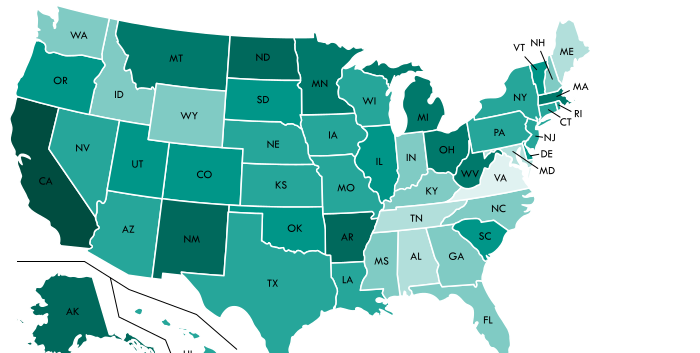
Most common states for mechanical design drafters
| Rank | State | Population | # of jobs | Employment/ 1000ppl |
|---|---|---|---|---|
| 1 | District of Columbia | 693,972 | 108 | 16% |
| 2 | New Hampshire | 1,342,795 | 174 | 13% |
| 3 | Massachusetts | 6,859,819 | 849 | 12% |
| 4 | Oregon | 4,142,776 | 479 | 12% |
| 5 | Vermont | 623,657 | 67 | 11% |
| 6 | Minnesota | 5,576,606 | 546 | 10% |
| 7 | Utah | 3,101,833 | 302 | 10% |
| 8 | California | 39,536,653 | 3,542 | 9% |
| 9 | Washington | 7,405,743 | 644 | 9% |
| 10 | Georgia | 10,429,379 | 864 | 8% |
| 11 | Virginia | 8,470,020 | 682 | 8% |
| 12 | Arizona | 7,016,270 | 565 | 8% |
| 13 | Wisconsin | 5,795,483 | 489 | 8% |
| 14 | Maryland | 6,052,177 | 456 | 8% |
| 15 | Colorado | 5,607,154 | 444 | 8% |
| 16 | Kansas | 2,913,123 | 223 | 8% |
| 17 | Delaware | 961,939 | 75 | 8% |
| 18 | North Dakota | 755,393 | 63 | 8% |
| 19 | Alaska | 739,795 | 58 | 8% |
| 20 | Wyoming | 579,315 | 44 | 8% |
Most common cities for mechanical design drafters
| Rank | City | # of jobs | Employment/ 1000ppl | Avg. salary |
|---|---|---|---|---|
| 1 | Frankfort | 1 | 4% | $51,789 |
| 2 | Annapolis | 1 | 3% | $51,068 |
| 3 | Englewood | 1 | 3% | $59,466 |
| 4 | Juneau | 1 | 3% | $63,631 |
| 5 | Livermore | 2 | 2% | $73,255 |
| 6 | East Hartford | 1 | 2% | $55,879 |
| 7 | Eden Prairie | 1 | 2% | $60,809 |
| 8 | Jefferson City | 1 | 2% | $55,233 |
| 9 | Lenexa | 1 | 2% | $54,982 |
| 10 | Lansing | 1 | 1% | $60,793 |
| 11 | Tallahassee | 1 | 1% | $53,151 |
| 12 | Boston | 2 | 0% | $61,754 |
| 13 | Baton Rouge | 1 | 0% | $55,766 |
| 14 | Fremont | 1 | 0% | $73,277 |
| 15 | Saint Paul | 1 | 0% | $60,859 |
| 16 | Tampa | 1 | 0% | $53,079 |
Mechanical Design Drafter job outlook: Expert opinions
Our panel of mechanical design drafter experts
University of Wisconsin - Green Bay

Cincinnati State Technical & Community College

Murray State University
Arizona State University

Southern Illinois University Edwardsville
University of North Carolina at Charlotte

University of Alaska Fairbanks

Idaho State University

ADDA
Jiayue Shen
Mechanical Engineering Technology Program CoordinatorWhat will help Mechanical Design Drafters increase their earning potential?
Jiayue Shen: In the next 3-5 years, skills such as electronic control, basic programming, and critical thinking will become increasingly important in the field of Mechanical Engineering Technology. As industries like robotics, automation, and semiconductors continue to grow, professionals will need to be well-versed in these areas to stay competitive. Additionally, skills such as collaboration and effective oral and written communication will be crucial for advancing in one's career.
What will help Mechanical Design Drafters increase their earning potential?
Mohammed Daqaq: It depends on what aspect of the job they are hired to do. Some graduating MEs work in industrial plants where they are expected to deal with and fix engineering related problems, or work on the design and testing of innovative industrial solutions. Many MEs end up in the sales and maintenance departments of companies that manufacture specialized machinery and equipment. Some ME graduates are hired by the research departments of companies and federal labs where they participate in the research and development of new technologies, etc. A recent trend that we have been observing with our graduates is that they are being sought after by major consulting companies especially in business development and finance. Such companies like the versatility of the engineering education, and the logical/structured way of thinking that engineers are trained to follow during their studies.
Uises Gonzalez-Valle
Assistant ProfessorUniversity of Wisconsin - Green Bay
Mechanical Engineering Related Technologies/Technicians
What will help Mechanical Design Drafters increase their earning potential?
Uises Gonzalez-Valle: The beginning of professional life is not simple independent of the career path that you follow and ME and MET can have their own complications. However, some good advice would be to develop independence and adaptability which are key traits of an engineer, and always keep yourself updated with the most recent technological developments. If you are independent and adaptable, you have all the skills to learn and further your professional development. In addition, I would say it is essential to start building a network, including peers and mentors. Having a strong network of peers and mentors helps you significantly to progress in your professional line. From day-to-day to daily changing decisions, having a strong network to support would significantly help in building your professional path. Lastly, I would say that having a good Work-life balance is vital too, since our personal life is as important as our professional life. Remember, we should work to live instead of live to work.
Mike DeVore Ph.D.
Professor & Program ChairCincinnati State Technical & Community College
Mechanical Engineering Technology
What hard/technical skills are most important for Mechanical Design Drafters?
Mike DeVore Ph.D.: -Computer-Aided Design
-Knowledge of manufacturing processes
-A good mathematics foundation
-Technical communication
-Problem solving
Bryant Harrison
InstructorMurray State University
Design Engineering Technology
What soft skills should all Mechanical Design Drafters possess?
Bryant Harrison: Engineers are constantly working with a variety of people on a project. These people could be other engineers in the same department or other departments, managers, stakeholders, and customers. The ability to communicate both on a technical and non-technical level with these people is likely the most important soft skill for a design engineer.
What hard/technical skills are most important for Mechanical Design Drafters?
Bryant Harrison: Designing, prototyping, testing, and iterating are likely the most important skills for a design engineer. This is what we strive to teach at Murray State in our Design Engineering Technology program. Many sub-skills would fall into these categories, such as CAD, design for manufacturing, 3D printing, and destructive/non-destructive testing.
What skills will help Mechanical Design Drafters earn the most?
Bryant Harrison: We constantly tell students that they must have the full package of hard and soft skills to succeed. Those students who master their soft skills and are constantly expanding hard skills will be the most capable of getting the pay they seek.
What skills stand out on Mechanical Design Drafter resumes?
Bryant Harrison: Design Engineers should be able to think creatively and be prepared to use software to solve problems. Students who have acquired certifications in design software have shown some level of aptitude toward using that software to create and design engineering solutions.
Philip Horton
Interim School Director, Clinical Assistant ProfessorArizona State University
The Design School, Herberger Institute for Design and the Arts
Will there be an enduring impact of the coronavirus pandemic on Mechanical Design Drafters?
Philip Horton: I think there will be a few enduring impacts.
One impact is that there has been a bit of a slow down in the market for a number of firms, due to the economic impacts of the pandemic. But an imminent stimulus package will hopefully provide a fairly quick course correction there.
More enduring is that much of the professional world has learned to work remotely -- at-scale -- over the last year. So how we work and collaborate on projects will continue to transform beyond the pandemic.
Also, public spaces, offices, restaurants, and retail have all been impacted by the pandemic. Many have made tactical changes to the designs of their physical environments and to their services. These responses, and uncertainty about future public health concerns, will change the way we design spaces and services going forward.
What certifications/licenses/courses can have the biggest impact for Mechanical Design Drafters?
Philip Horton: Interdisciplinarity is key. Here at ASU, we are focusing on "architecture plus..." An emerging professional who wants to better understand financing and development should consider getting their professionally accredited architecture degree, plus a degree or certificate in real estate development. The same could be said for architecture plus construction management, public health, sustainability, urban planning, and more. We believe this will not only help position an emerging professional for a job, but position them to advance and transform the future of professional practice.
How have salaries changed over time for Mechanical Design Drafters?
Philip Horton: Like a lot of fields, salaries in architecture had been stagnant for years following the 2008 Great Recession. But like a lot of fields, salaries were rising remarkably in the years running up to the pandemic. And in spite of some of the economic uncertainty of the past year, it appears that salaries will continue to steadily rise as we move forward from this pandemic.
What experience really stands out on Mechanical Design Drafter resumes?
Dr. Mingshao Zhang: Internship and Co-op (Cooperative Education) experiences that related to the industry.
Charles Jenckes
Assistant ProfessorUniversity of North Carolina at Charlotte
Mechanical Engineering
What skills stand out on Mechanical Design Drafter resumes?
Charles Jenckes: For new graduates
1.Where the candidate went to school and what was studied
2.GPA
3.Any successful internships
4.Projects completed by the student
How would you rate the starting salaries for Mechanical Design Drafters, as well as the prospects for salary advancement?
Daisy Huang: Above average, but you won't be a millionaire easily (you can with some effort, saving, and investing well). It is very unlikely you'll ever be *super* wealthy, but it's also very unlikely you'll ever not find employment in your field. You'll have a solid ticket to a modestly comfortable life, with some luxuries, too.
What general advice would you give to a Mechanical Design Drafter?
Marco Schoen Ph.D.: Stay current. Engineering evolves continuously; new tools, new technologies, and new areas where engineers can contribute, learn, and work. When graduating, students have the feeling they are set for their careers. However, this is not true; they might be set to start their careers. To be consistently successful in their pages, they need to stay informed and updated.
What are the biggest trends we'll see in the Mechanical Design Drafter job market given the pandemic?
Dan Rodenbaugh: Random thoughts regarding the future workforce in engineering related occupations:
This pandemic has shown that certain occupations lend themselves to telecommuting (working from home). I would think that many aspects of CAD/Engineering Tech work could be done from home - assuming the technology available to the teleworker lends itself to that: high-speed internet, computer equipment at home capable of running those software programs, etc.
One drawback re: working from home would be IT security. I would think that engineering firms would be concerned about theft of intellectual property, industrial espionage, etc. When someone is working from home, their IT security would not be comparable to working in an office.
What technology do you think will become more important and prevalent for Mechanical Design Drafters in the next 3-5 years?
Dan Rodenbaugh: Personal computers and internet, better off-site interaction.