Explore jobs
Find specific jobs
Explore careers
Explore professions
Best companies
Explore companies
Job outlook for media production specialists in the United States
Media production specialist job growth summary. After extensive research, interviews, and analysis, Zippia's data science team found that:
The projected media production specialist job growth rate is 8% from 2018-2028.
About 22,300 new jobs for media production specialists are projected over the next decade.
Media production specialist salaries have increased 8% for media production specialists in the last 5 years.
There are over 7,536 media production specialists currently employed in the United States.
There are 87,800 active media production specialist job openings in the US.
The average media production specialist salary is $53,243.
Are media production specialist jobs in demand?
Media production specialist job and salary trends over time
Media production specialist jobs over time
Media production specialist job growth rate over time
| Year | # of jobs | % of population |
|---|---|---|
| 2021 | 7,536 | 0.00% |
| 2020 | 7,594 | 0.00% |
| 2019 | 7,599 | 0.00% |
| 2018 | 7,422 | 0.00% |
| 2017 | 7,258 | 0.00% |
Average media production specialist salary over time
Media production specialist salary by year
| Year | Avg. salary | Hourly rate | % Change |
|---|---|---|---|
| 2026 | $53,243 | $25.60 | +2.7% |
| 2025 | $51,835 | $24.92 | +1.9% |
| 2024 | $50,861 | $24.45 | +1.2% |
| 2023 | $50,267 | $24.17 | +2.2% |
| 2022 | $49,182 | $23.65 | +2.2% |
Media production specialist jobs by state
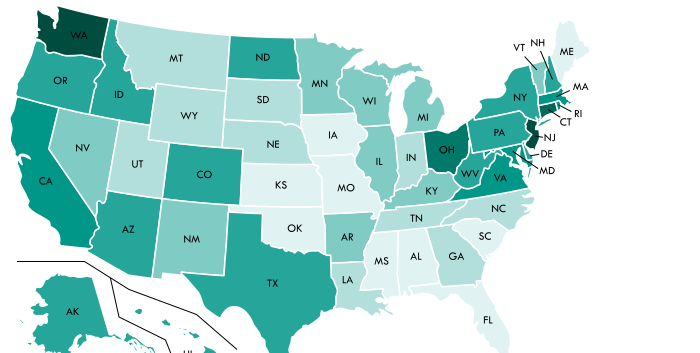
Most common states for media production specialists
| Rank | State | Population | # of jobs | Employment/ 1000ppl |
|---|---|---|---|---|
| 1 | District of Columbia | 693,972 | 304 | 44% |
| 2 | Iowa | 3,145,711 | 759 | 24% |
| 3 | Vermont | 623,657 | 152 | 24% |
| 4 | Wisconsin | 5,795,483 | 1,093 | 19% |
| 5 | Utah | 3,101,833 | 590 | 19% |
| 6 | Delaware | 961,939 | 187 | 19% |
| 7 | Nebraska | 1,920,076 | 355 | 18% |
| 8 | New Hampshire | 1,342,795 | 240 | 18% |
| 9 | Wyoming | 579,315 | 105 | 18% |
| 10 | Minnesota | 5,576,606 | 957 | 17% |
| 11 | North Dakota | 755,393 | 126 | 17% |
| 12 | Maine | 1,335,907 | 209 | 16% |
| 13 | South Dakota | 869,666 | 139 | 16% |
| 14 | Virginia | 8,470,020 | 1,257 | 15% |
| 15 | Massachusetts | 6,859,819 | 1,018 | 15% |
| 16 | Indiana | 6,666,818 | 1,001 | 15% |
| 17 | Kansas | 2,913,123 | 430 | 15% |
| 18 | Idaho | 1,716,943 | 263 | 15% |
| 19 | Oregon | 4,142,776 | 596 | 14% |
| 20 | Rhode Island | 1,059,639 | 149 | 14% |
Media Production Specialist job outlook: Expert opinions
Our panel of media production specialist experts
University of Cincinnati
San Jose State University
Maryville University of Saint Louis
Methodist University
University of Akron
Columbus State University
University of Illinois at Urbana-Champaign
University of Montevallo
University of the Pacific
College of New Jersey, The
East Stroudsburg University of Pennsylvania
University of San Francisco
University of Scranton
Elon University
Mount Saint Mary's University
What Media Production Specialist skills would you recommend for someone trying to advance their career?
Suzanne Boys PhD., APR: I encourage students to create a portfolio of work samples, including writing, research, and creative pieces. They can use this portfolio to show skills, potential, and the value they will add to a company. I also encourage students to pursue continued education and practical certifications after graduation (e.g., Google and LinkedIn offer free and low cost certifications). Adding those certifications to a resume can show skills, relevance, and work ethic. Joining professional associations (e.g., Public Relations Society of America, American Marketing Association, Together Digital) is also key. Many of those associations offer mentorship, professional development, and networking opportunities. Finally, it is important to put yourself forward for opportunities. Employees who take on projects and are unafraid of challenges create leverage for themselves in salary negotiations.
What general advice would you give to a Media Production Specialist?
Dr. Phillip Arceneaux: It can be a hectic job with responsibilities continually expanding. Some enjoy the challenges and the opportunity to develop new skills, while others may find the pace overwhelming. The variety of industries open to PR professionals allows them to work in sectors they are passionate about, making their work fulfilling.
What Media Production Specialist skills would you recommend for someone trying to advance their career?
Dr. Phillip Arceneaux: Every company needs to tell its story, making PR essential. New technologies like digital media and AI offer innovative ways to engage. PR professionals play a crucial role in assessing risks, managing crises, and repairing reputations. The diversity of sectors where PR can be applied makes the profession fulfilling and meaningful.
What will help Media Production Specialists increase their earning potential?
Dr. Mathew Cabot APR: A PR practitioner's day-to-day responsibilities can widely vary depending on the practitioner's role, including media relations, social media management, content creation, crisis and reputation management, research and data analytics, and employee communication. Regardless of the specific role, all public relations practitioners help organizations behave and communicate in ways that build trust between the organizations they represent and the stakeholders on whom their success or failure depends. A beginning practitioner could be involved in a variety of tasks, including media monitoring, social media management, research, writing, content creation, and event planning and support.
What general advice would you give to a Media Production Specialist?
Dr. Dustin York: As customers are becoming more and more reluctant to traditional advertising, PR is breaking through the noise. Businesses crave a good online reputation that attracts loyal customers, so PR skills are in high demand. Plus, it's a blend of writing, creativity, and tech-savviness - a hot commodity these days.
What will help Media Production Specialists increase their earning potential?
Dr. Dustin York: A PR pro's day is a juggling act of pitching stories to media, crafting content, planning events, and maybe even communicating an issue or crisis, but all their work comes down to some sort of storytelling. Newbies assist senior folks with projects, but some common tasks for entry-level pros include media listening and auditing.
What will help Media Production Specialists increase their earning potential?
Dr. Christiane Farnan Ph.D.: First, I would advise English majors to remember that "major" does not necessarily dictate "career." Many Siena alumni succeed in careers that are not considered typical for an English major - and these careers are not considered typical due to broad public misconception about what one can "do" with a degree in English. English majors enter the fields of business, technology, entertainment, higher education, medicine, law, public relations, teaching, and journalism. English majors have served as CEOs of XEROX, NBC, AVON, and Walt Disney. Vital government positions, including United States Senator and Secretary of the Treasury, have been filled with English majors. Second, I advise English majors to clearly articulate how their skills match the objectives of their employer. English majors are skilled in discerning the characteristics of their work environment, building and maintaining collaborative partnerships, identifying, analyzing, and responding to organizational needs, and leading teams to achieve workplace goals.
Dr. Leslie Rasmussen
Associate ProfessorWhat will help Media Production Specialists increase their earning potential?
Dr. Leslie Rasmussen: The exciting thing about working in PR is that it's never the same. You might be planning an event, writing news releases, developing social media strategies and content, managing campaigns, or working with the media, depending on the day. PR is also versatile - you can work in the auto industry, healthcare, politics, beauty, sports, entertainment... the possibilities are endless. No matter which path you take, the core skills we utilize in PR are writing, research, public speaking, organization, and creativity. How we use those skills will vary from day-to-day.
Sara Erlichman Ph.D.
Visiting Assistant Professor of Communication and MediaMethodist University
Public Relations, Advertising, And Applied Communication
What Media Production Specialist skills would you recommend for someone trying to advance their career?
Sara Erlichman Ph.D.: One of the top advice I see is that you document your successes with KPIs. Keep a Word file in your personal cloud documenting any and all positive feedback from colleagues and hard data that demonstrate successful results. Only you know exactly how you've impacted the company through your work, and no one is going to advocate for you as well as you can for yourself!
What will help Media Production Specialists increase their earning potential?
McKenna Vietmeier: When it comes to Public Relations, there are some fundamental skills that we will see persist: writing and strategic thinking. Excellent writing skills and the ability to strategize/problem solve continue to be the most requested qualifications we get from employers and many of our recent grads point to our PR Writing and PR Strategic Campaigns courses as the ones that best prepared them for their careers. However, in the next 3-5 years, PR students will also need to diversify their skillsets. Many employers now expect their PR person to be a one-stop shop for expertise in social media, graphic design, media relations, multimedia, SEO, marketing, and more. It will become increasingly important for students to think outside of the parameters of standard curriculum and seek out coursework that will help them become the well-rounded, adaptable professional that employers are looking for.
What will help Media Production Specialists increase their earning potential?
Dr. Tiffany McBride: As a new communications graduate, students must establish versatility, showcase the schooling and skills they have learned, and leverage any internships or industry-related employment, business, and community relations experience. Communications, specifically public relations and strategic communication, require strong written and vocal communication abilities; highlighting what you have accomplished both inside and outside the classroom will make you stand out from other applicants. It is also a good rule of thumb to keep up with industry trends and standards by networking with industry-related professionals and researching and studying the industry. One piece of advice I give my public relations students and any student taking my courses is to start early by creating an online portfolio of your communication projects and using professional networking sites, such as LinkedIn. Creating a professional or more industry-focused social media presence tells employers and those in the industry that you have researched what it takes to get into the field and are serious about your profession. Also, if the portfolio is comprehensive and created well, it offers a more holistic approach to what you, as a graduate, know how to do, not just what you learned from a textbook but real-life application. Although they may not be your dream job coming out of college, get internships or entry-level jobs to gain experience and network to open doors and gain insights for the future.
Marisa Peacock
LecturerUniversity of Illinois at Urbana-Champaign
Communication And Media Studies
What general advice would you give to a Media Production Specialist?
Marisa Peacock: Curiosity, multi-tasking, boundary setting, and the ability to write well will never fall out of favor!
PR requires a lot of on-going work, most of it behind the scenes. Knowing how to stay organized in chaos will help. Also, knowing how you need to handle stressful situations will help prevent burnout. When things get to be too much - figuring out what helps (going for a walk outside, putting down your devices for a few hours, working out, having coffee with a friend) will benefit your mental health in the long run. Emerging technologies will also be a factor, so be curious, adapt and find ways to evolve your brand/company's presence online.
What will help Media Production Specialists increase their earning potential?
Marisa Peacock: It's important to figure out how much it costs to keep you alive. Before job hunting, do the math. How much is rent, car, food, etc? Do you need a Starbucks coffee every morning or can you brew your own? Do you need health insurance (recent grads can stay on their parent's insurance until 26 in most cases)? Figure out that number and then add in buffer room so you can have some wiggle room or opportunities to save. That's your base salary. If you go below, you'll have to make concessions - some reasonable, some not. Use cost of living calculators to determine what salaries look like in other places. Remote and hybrid work is still available, so it's important to factor that in, especially if you're going to live in different locations than where you work.
When looking for jobs, don't underestimate your experience. Even if you haven't had PR-related internships, chances are you've demonstrated public relations skills that can translate well. If you worked in retail, for example, that's a lot of customer relations. If you worked front of house at a restaurant, you know how to engage a public. If you worked as a barista, you know how to meet deadlines, work in chaotic situations, and communicate with others.
Look for the skills that make you better at PR and then highlight those experiences on resumes, cover letters, and in interviews. These skills from different experiences may set you apart and make you eligible for more than just entry-level positions.
Dr. Emma Atwood
Associate Professor of EnglishUniversity of Montevallo
English Language And Literature
What general advice would you give to a Media Production Specialist?
Dr. Emma Atwood: Now more than ever, in a fast-paced media landscape, we need people who understand how effective arguments work; who understand how persuasion, logic, and emotion affect audiences; and who can think critically about complex issues and see these issues from multiple perspectives. Training in English, Philosophy, and Communication helps prepare future leaders to pursue truth as they enter this landscape and transform it for the better.
What will help Media Production Specialists increase their earning potential?
Ron Culp: Be patient. There is little to no negotiating room for internships and entry-level positions. Most firms have set starting salaries, so seeking a salary beyond your initial offer will not be well received unless you've already had several relevant internships and real-world experience. You have a bit more leverage if you have another job offer. Don't stress yourself out by feeling you have to seek a higher initial salary. Don't get off on the wrong foot over a few dollars. Get into the job, work hard, prove yourself and the money will come. You have a long career window to achieve your goals.
Kevin Faigle
Media Relations SpecialistWhat Media Production Specialist skills would you recommend for someone trying to advance their career?
Kevin Faigle: That's tough to answer. But one, try to see what other similar positions are being paid. There are plenty of websites where you can find salary ranges for positions and that may give a good basis for a starting point. Also, be sure to track everything you are good at and build that resume up. Sometimes a HR department will have a salary range in the job posting, and don't be afraid to ask for the higher amount or even negotiate. 100% of the questions you don't ask, the answer is no. If you are confident in your ability and confident in your background, then show that and push for a higher salary level.
What will help Media Production Specialists increase their earning potential?
Kevin Faigle: First and foremost, they need to be very adaptive and personable. They need to be able to build a relationship with the media, and outside sources. When you build trust with the media, you'll have a good relationship with them and it will be a win-win situation. Also, you need to become social media savvy. A lot of media relations positions are also responsible for social media accounts. Start paying attention to trends and find the best way to push your organization forward. I am also a big fan of people being good writers. We are in a day and age where writing is a lost art. But if you can be a good writer/communicator, you'll be ahead of most.
Mark Alberta
University of the Pacific
Communication And Media Studies
What Media Production Specialist skills would you recommend for someone trying to advance their career?
Mark Alberta: Above all, critical thinking will be something that remains universally relevant. But, more specific to Communications, adaptability to technology and an understanding of digital/visual communications will prove advantageous as we continue to see technology evolve. Social media, PR, advertising, filmmaking, podcasting all heavily rely on an awareness of today's digital culture and depend on media literacy. Keep an eye on culture's paradigm shifts, how we are now a 24/7 information-gathering culture, how we expect immediacy from content. It doesn't hurt to anticipate the future, such as getting familiar with A.I. technologies, Augmented/Virtual reality, etc...
Yachao Li
Assistant Professor of Communication Studies and Public HealthCollege of New Jersey, The
Public Health
What general advice would you give to a Media Production Specialist?
Yachao Li: Communication Specialist is an excellent profession to enter now for several reasons. First, the
role offers tremendous versatility, as communication skills are universally valuable across
industries and sectors. Communication specialists can work in various fields such as marketing,
public relations, corporate communication, nonprofit organizations, government agencies, and
more. This versatility opens a wide range of career paths and opportunities for growth, allowing
them to explore different areas and find the best fit for their interests and strengths.
In addition, there is a consistently high demand for skilled communication professionals in
today's competitive landscape. Effective communication is essential for organizations to
succeed, as they need to craft compelling messages, manage brand reputation, and engage
audiences across different channels. With the ever-increasing importance of digital platforms and
social media, the need for professionals who can navigate these spaces and deliver clear,
consistent, and impactful communication has never been greater. Communication specialists
possess the skills to help organizations achieve their communication goals, making them an
important asset in the job market.
Finally, the role of a communication specialist is constantly evolving given the rapid changes in
technology and consumer behavior. This dynamic nature of the profession ensures that they will
always have opportunities to learn and grow, adapting to new communication trends and
strategies. Whether it is mastering the art of storytelling, leveraging data-driven insights, or
harnessing the power of emerging platforms, a career as a communication specialist offers a
continuous learning curve that keeps this profession engaged and relevant.
What will help Media Production Specialists increase their earning potential?
Yachao Li: A communication specialist's day-to-day responsibilities are very diverse and dynamic, which
requires creativity, strategic thinking, and effective communication skills. Their daily tasks also
vary based on their specific role and the organization they work for.
For example, they may spend time researching industry trends, target audience preferences, and
competitor strategies, analyzing data to identify communication opportunities or challenges. In
addition, content creation is also a significant part of their role, involving writing articles, blog
posts, social media updates, press releases, or designing visual content such as infographics or
videos, as well as scripting speeches or presentations for executives. Moreover, communication
specialists often liaise with journalists, bloggers, and other media representatives, pitching
stories, arranging interviews, and managing press releases while maintaining media lists and
building relationships with key contacts.
Social media management is another crucial aspect, where they are responsible for managing
accounts, creating content calendars, engaging with followers, and monitoring conversations
related to their organization or brand. Furthermore, facilitating internal communication within
the organization is also part of their tasks. This includes drafting newsletters, organizing town
hall meetings, or managing intranet platforms to ensure employees are informed about company
updates, policies, and initiatives. During times of crisis or negative publicity, communication
specialists play a crucial role in managing the organization's reputation by developing crisis
communication plans, drafting statements, and coordinating responses across various channels.
Depending on the organization, communication specialists may also be involved in planning and
coordinating events such as product launches, press conferences, or industry conferences, which
include logistics management, promotion, and ensuring smooth execution. They often measure
the effectiveness of their communication efforts through metrics such as website traffic, social
media engagement, or media mentions, compiling reports to assess performance and identify
areas for improvement. Last, staying updated with the latest communication tools, technologies,
and best practices is crucial, which may involve reading industry publications, attending
workshops or webinars, and networking with peers to enhance their skills and knowledge.
What general advice would you give to a Media Production Specialist?
Cem Zeytinoglu Ph.D: Most of our alumni who became very successful after graduation continually recommend communication graduates to engage in meaningful and professional networking. In addition to knowledge, skills, and experience (like internships) obtaining and maintaining social capital is an important aspect of the communication field. For example, being an active member of a professional national organization such as PRSSA or others would be promising. Secondly, having an open mind about evaluating potential job opportunities is also important. Thi8s is important for two reasons. One, communication is a multifaceted professional field and there are many opportunities are available in all industries, including for-profit, non-profit, and governmental organizations. Also, communication opportunities can range from marketing and sales to public relations and consumer affairs, from media content to technology and production. Lastly learning from each experience and carrying new knowledge and skillset to the next opportunity is very valuable.
Dr. Zifei Chen
Associate Professor of Public Relations University of San FranciscoUniversity of San Francisco
Public Relations, Advertising, And Applied Communication
What Media Production Specialist skills would you recommend for someone trying to advance their career?
Dr. Zifei Chen: With the rapid development of technology such as generative AI, it will become even more important to understand how to use technology and tools effectively and *ethically* in today's public relations practice. It is also important to cultivate the soft skills of mindfulness, emotional intelligence, and empathic listening to navigate the ever increasingly fragmented media landscape, information overload, and polarized views.
Stacy Smulowitz Ph.D.
Associate Professor & Department Chair Department of Communication & MediUniversity of Scranton
Public Relations, Advertising, And Applied Communication
What Media Production Specialist skills would you recommend for someone trying to advance their career?
Stacy Smulowitz Ph.D.: Public Relations: It is hard to say what individuals will like and dislike about specific jobs. That is really a personal choice. Many PR pros enjoy the variety in their jobs and the people they get to work with and meet daily. They also enjoy seeing the value they provide to the organization and the people they serve.
Lee Bush
Professor of Strategic CommunicationsElon University
Public Relations, Advertising, And Applied Communication
What Media Production Specialist skills would you recommend for someone trying to advance their career?
Lee Bush: First and foremost is having cultural competence. As audiences become more diverse and support brands and organizations that align with their values, understanding and practicing diversity, equity, and inclusion in your day-to-day work is essential. Second is adapting to the use of artificial intelligence tools and doing so in an accurate and ethical manner. The PR profession is increasingly using AI tools to generate ideas, develop content, optimize media outreach, tailor content to specific audiences, and for data analytics and campaign monitoring. As these tools are rapidly evolving, PR professionals will need to stay on top of the latest technologies to be competitive in the industry.
Karen Fritschi
Coordinator, Journalism & New Media ProgramMount Saint Mary's University
Journalism
What Media Production Specialist skills would you recommend for someone trying to advance their career?
Karen Fritschi: Public Relations could be a good fit for people who are not only flexible and creative, but who want a job with lots of variety. Additionally, PR offers the potential to work with impactful organizations and non-profits who are shaping public perception and driving awareness for critical issues. Public Relations is not a 9 to 5 job, so if you're looking for a career with regular hours and a predictable schedule, PR isn't for you.