Explore jobs
Find specific jobs
Explore careers
Explore professions
Best companies
Explore companies
Job outlook for medical research scientists in the United States
Are medical research scientist jobs in demand?
Medical research scientist job and salary trends over time
Medical research scientist jobs over time
Medical research scientist job growth rate over time
| Year | # of jobs | % of population |
|---|---|---|
| 2021 | 28 | 0.00% |
| 2020 | 33 | 0.00% |
| 2019 | 33 | 0.00% |
| 2018 | 31 | 0.00% |
| 2017 | 29 | 0.00% |
Average medical research scientist salary over time
Medical research scientist salary by year
| Year | Avg. salary | Hourly rate | % Change |
|---|---|---|---|
| 2025 | $78,125 | $37.56 | +3.1% |
| 2024 | $75,803 | $36.44 | +4.7% |
| 2023 | $72,405 | $34.81 | +3.3% |
| 2022 | $70,083 | $33.69 | +1.9% |
| 2021 | $68,751 | $33.05 | --2.1% |
Medical research scientist jobs by state
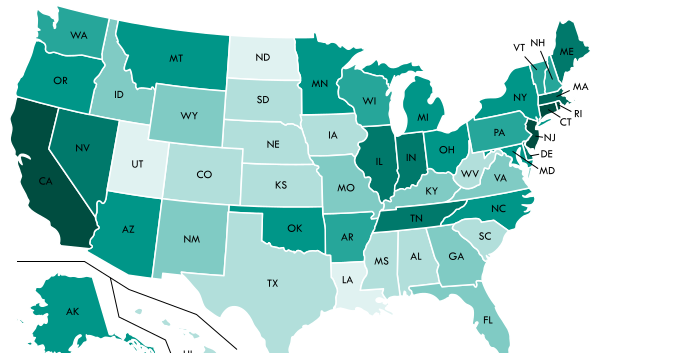
Most common states for medical research scientists
| Rank | State | Population | # of jobs | Employment/ 1000ppl |
|---|---|---|---|---|
| 1 | District of Columbia | 693,972 | 281 | 40% |
| 2 | Delaware | 961,939 | 345 | 36% |
| 3 | Minnesota | 5,576,606 | 1,837 | 33% |
| 4 | Virginia | 8,470,020 | 2,534 | 30% |
| 5 | New Mexico | 2,088,070 | 608 | 29% |
| 6 | Kansas | 2,913,123 | 788 | 27% |
| 7 | Illinois | 12,802,023 | 3,286 | 26% |
| 8 | Missouri | 6,113,532 | 1,616 | 26% |
| 9 | Vermont | 623,657 | 165 | 26% |
| 10 | Massachusetts | 6,859,819 | 1,727 | 25% |
| 11 | Idaho | 1,716,943 | 435 | 25% |
| 12 | New Hampshire | 1,342,795 | 303 | 23% |
| 13 | South Dakota | 869,666 | 201 | 23% |
| 14 | California | 39,536,653 | 8,853 | 22% |
| 15 | Georgia | 10,429,379 | 2,328 | 22% |
| 16 | Rhode Island | 1,059,639 | 232 | 22% |
| 17 | West Virginia | 1,815,857 | 366 | 20% |
| 18 | New Jersey | 9,005,644 | 1,723 | 19% |
| 19 | Oregon | 4,142,776 | 800 | 19% |
| 20 | North Dakota | 755,393 | 141 | 19% |
Most common cities for medical research scientists
| Rank | City | # of jobs | Employment/ 1000ppl | Avg. salary |
|---|---|---|---|---|
| 1 | Orlando | 1 | 0% | $63,301 |
| 2 | Washington | 1 | 0% | $66,969 |
Medical Research Scientist job outlook: Expert opinions
Our panel of medical research scientist experts
Northeastern State University
SUNY Stony Brook
Washburn University of Topeka
Pepperdine University
University of Hawaii at Manoa
Northwestern University
Santa Fe College
Southern Illinois University Carbondale
San Jose State University
Washington State University
Purdue University
Ohio Wesleyan University
University of Pittsburgh
University of Nebraska - Omaha
Western Washington University

Meredith College
What Medical Research Scientist skills would you recommend for someone trying to advance their career?
Dr. Taufika Williams PhD: Wet-laboratory skills will always be important, however, data interrogation is a key space of growth, as biotechnology research is being driven by big data. Seek education in scientific writing, computer programming, delivering scientific presentations, statistics and the analysis of large datasets.
What Medical Research Scientist skills would you recommend for someone trying to advance their career?
Dulanjani Wijayasekara Ph.D.: Research skills and data analysis for pharmaceutical and drug development companies, Biostatistics, Bioinformatics and Medical laboratory sciences
What general advice would you give to a Medical Research Scientist?
Dr. Vitaly Citovsky: One cannot get high salaries with a bachelor's degree in biology. To maximize your future salary you need to get a terminal degree such as PhD or MD. Alternatively one could go to law school. If you still want to begin working after BSc, look for industry jobs; these would be low-level technicians but make much more money than in academia.
Susan Bjerke
Associate Professor of BiologyWashburn University of Topeka
Biological And Physical Sciences
What will help Medical Research Scientists increase their earning potential?
Susan Bjerke: Some of the skills that will be important in the next 3-5 years will be general critical thinking skills and the ability to adapt to changing technology. Almost all science fields are increasingly dependent on technology, so being able to learn new skills and change the way you do things in your job will be important. Being an effective communicator, both in writing and orally, is an overlooked skill in the sciences and is always an important asset.
What will help Medical Research Scientists increase their earning potential?
Rachel Tan Ph.D.: Listen and be curious: ask questions (the why and how?), ask for opportunities, do extra readings outside of work. Aim for excellence: treat each assigned task as priority–go above and beyond. Connect: talk to colleagues, your boss, staff–be excited to learn from others. Be grateful: constantly reflect on the small details that led you to this point, for gratitude gives you foundation for joy during your career.
What Medical Research Scientist skills would you recommend for someone trying to advance their career?
Qing Li: AI will become more important and prevalent in the field in the next 3-5 years but laboratory experiments will continue to make new discoveries.
What will help Medical Research Scientists increase their earning potential?
Nathaniel Stern: Within academic physics, your potential can be maximized by doing impactful work in graduate school that matters to other people. The next step is to communicate this impact broadly, and then figure out how to take the next step in the field. That is a lot of steps, but if one can successfully do those things in graduate school, they can build the profile, community, and intellectual leadership to demand the highest salary. Outside of academic physics, the requirements are probably not that different, but I do not have explicit knowledge of them myself. So I would fall back on the standard goals of innovation and communication, which should help one succeed in any knowledge-related career.
What will help Medical Research Scientists increase their earning potential?
Meghan McGee-Lawrence Ph.D.: Cast a wide net! A huge variety of career paths can be pursued with a degree like this, including industry, academic research, healthcare, education, and more. It is a very versatile degree, and can be a foundation for a multitude of different professions. Talk to recent graduates from your program (as many as possible!) and see what they did with their degree – the more information you can collect, the better prepared you’ll be to seek out opportunities yourself. Take the time to figure out where your interests lie – and understand that you may have to try a few different paths out before you find the right one for you. The first position you land after graduation doesn’t have to be the job you perform for the next 30 years of your life – so use each opportunity as a learning experience to figure out what you’d really like to do long-term.
Luz Garcini PhD, MPH
Assistant ProfessorWhat will help Medical Research Scientists increase their earning potential?
Luz Garcini PhD, MPH: Build a unique niche and new skills (another language), disseminate your work via high impact networks/avenues, get mentoring in negotiation.
What will help Medical Research Scientists increase their earning potential?
Jason Ferrell: While technology is changing at a rapid pace and artificial intelligence will no doubt play an ever increasing role in life and science, I believe the foundations of success will not change. These include, 1. Being responsive and timely. 2. Possessing excellent written and oral communication skills. 3. Being a helpful team member. Regardless of skill set or expertise, these are three pillars of success.
What general advice would you give to a Medical Research Scientist?
Jeff Heslep: Find a starting job that gives you a wide range of work to perform. The more experience you can gain during the first few years will help you to hone your skills, decide what areas interest you the most, and give you the opportunity to choose. Learn as much as you can about the various equipment, analytical techniques, processes, and how to troubleshoot minor problems. Take the initiative and ask to learn how to use instruments you aren't familiar with. It is unlikely someone will deny you the opportunity to broaden your knowledge. Take every chance you have to network and get to know the people within your local biotechnology industry. Networking plays a major role in employment opportunities. Work on your written and verbal communication skills. Communicating well will help you stand out. Being able to effectively convey complex scientific concepts in such a way that anyone can understand it can be a powerful skill.
What general advice would you give to a Medical Research Scientist?
Jacob Nordman: Salary potential in my field of neuroscience almost always involves publications, awards, and technical acumen. Therefore, as I mentioned, it is important to start early looking for opportunities that can strengthen these areas. Another important aspect of getting high-profile, and thus high-paying, positions, is being able to tell a story with your research and career. Employers want to see that you have thought deeply and strategically about your career and where it’s going. This will allow them to believe you are a safe bet and worthy of their investment.
Dr. Harit Agroia
Adjunct Professor of Public HealthSan Jose State University
Health Services/Allied Health/Health Sciences
What will help Medical Research Scientists increase their earning potential?
Dr. Harit Agroia: The Health Science Researcher is a dynamic profession to enter into now given that the world has collectively experienced the significant impacts of the COVID-19 pandemic; the effects on social and behavioral patterns for which are largely unknown. From a clinical perspective, there are many opportunities to get involved in research that focuses on the impacts of long-COVID on physical and overall health especially among subsets of the population. The pandemic has also exacerbated health inequities for which there is definitely a need to conduct more qualitative research to hear the voices of impacted communities, the challenges they face, and what may be helpful ways that these challenges can be addressed. Aside from global pandemic related research, there are many other exciting aspects of entering into this profession such as to understand how artificial intelligence will play a role in improving individual and population-level health.
What will help Medical Research Scientists increase their earning potential?
Lindsey du Toit: Take every opportunity you can to learn, network, and build an effective team of people that bring a greater breadth and depth of skills and expertise to the work on which you will be focusing. Cultivate a life-long sense of intellectual curiosity and learning. Don’t be afraid to ask questions. Treat ignorance as an opportunity to learn. Questions demonstrate you want to understand the situation/problem effectively and that you are paying attention. Always demonstrate integrity in your work. It is one of the most valuable traits you can bring to your career. Be kind and supportive of your colleagues.
Yan Cong
Purdue University
Romance Languages, Literatures, And Linguistics
What Medical Research Scientist skills would you recommend for someone trying to advance their career?
Yan Cong: AI singularity, Artificial General Intelligence (AGI), et cetera are topics that trigger a lot of debate nowadays and they will be prevalent in the near future. Perspectives from humanities and linguistics would contribute to the ongoing debate and provide new opportunities for future innovative technologies that are linked to languages, linguistics and humanities.
What will help Medical Research Scientists increase their earning potential?
Chelsea Vadnie PhD: According to the U.S. Bureau of Labor Statistics, employment of medical scientists is expected to grow by 10% from 2022 to 2032. We will continue to need neuroscientists to uncover the biology underlying human behavior and health. Some of the most common causes of disability in the U.S. are diseases and disorders of the nervous system. Anxiety and depression climbed during the pandemic and mental health continues to be a major public health concern. With the aging population increasing, treatments and resources for neurodegenerative disorders will be crucial. Scientific discoveries and new technologies (e.g. brain organoids, brain cell-type characterization, brain-computer interfaces, generative AI, and in vivo imaging and manipulation tools) have and will continue to propel neuroscience forward and will create opportunities for future neuroscientists.
What will help Medical Research Scientists increase their earning potential?
Arjumand Ghazi Ph. D: Having an advanced degree such as a PhD and even a few years postdoc is a good way to start at a higher level. It often allows one to make up for the reduced earnings during the training periods while increasing long-term earnings.
Andrew Riquier Ph.D.
InstructorUniversity of Nebraska - Omaha
Neurobiology And Neurosciences
What general advice would you give to a Medical Research Scientist?
Andrew Riquier Ph.D.: Apply for the positions you want, even if you feel underqualified. I know plenty of people who have applied for jobs they didn't quite meet the requirements for, and got hired for other reasons. In my experience, many recent graduates choose to take time to strengthen their resumes by retaking classes, working jobs they don't particularly want to get experience, etc. There is some value in that, particularly if you have been unsuccessful attaining the position you want, or if you want to see if you even enjoy that type of work. But if you are confident in what you want to do, go for it; in the worst-case scenario, you are in the same position you would be if you hadn't applied, but now you have experience applying and have potentially gained a contact in the field.
What general advice would you give to a Medical Research Scientist?
Josh Kaplan Ph.D.: Being able to work with various computer coding languages and implementing free, open-source software, will be increasingly valuable in a work setting that involves research, data analysis, or program optimization. Many workplaces used to rely on expensive software, but can now be replaced by open source programs and used by those who are comfortable with common computer coding languages. This can save an employer loads of money without sacrificing performance outcomes or deliverables.
What Medical Research Scientist skills would you recommend for someone trying to advance their career?
Josh Kaplan Ph.D.: Demonstrating a skill set that is unique, such as experience with a rare technical research approach, or demonstrating that you can save your employer money by utilizing free resources, can be used to negotiate a higher salary.
Alexandra (Sasha) Ormond Ph.D.
Associate Professor of Chemistry, Director of Dual Degree EngineeringMeredith College
Department of Chemistry, Physics, and Geoscience
What skills stand out on Medical Research Scientist resumes?
Alexandra (Sasha) Ormond Ph.D.: When I help students revise their resumes, I have them focus on transferable skills that they gained through their experiences. It may not necessarily be what students do that is important to companies, but their learned experience that students can take and apply in their new job. Students need to add a metric to their descriptions and how they have made an impact on a project, a job position, an organization, etc.