Explore jobs
Find specific jobs
Explore careers
Explore professions
Best companies
Explore companies
Job outlook for medical technologist leads in the United States
Medical technologist lead job growth summary. After extensive research, interviews, and analysis, Zippia's data science team found that:
The projected medical technologist lead job growth rate is 16% from 2018-2028.
About 117,800 new jobs for medical technologist leads are projected over the next decade.
Medical technologist lead salaries have increased 7% for medical technologist leads in the last 5 years.
There are over 29,314 medical technologist leads currently employed in the United States.
There are 125,848 active medical technologist lead job openings in the US.
The average medical technologist lead salary is $68,094.
Are medical technologist lead jobs in demand?
Medical technologist lead job and salary trends over time
Medical technologist lead jobs over time
Medical technologist lead job growth rate over time
| Year | # of jobs | % of population |
|---|---|---|
| 2021 | 29,314 | 0.01% |
| 2020 | 29,998 | 0.01% |
| 2019 | 29,980 | 0.01% |
| 2018 | 29,539 | 0.01% |
| 2017 | 29,645 | 0.01% |
Average medical technologist lead salary over time
Medical technologist lead salary by year
| Year | Avg. salary | Hourly rate | % Change |
|---|---|---|---|
| 2026 | $68,094 | $32.74 | +2.8% |
| 2025 | $66,243 | $31.85 | --0.7% |
| 2024 | $66,721 | $32.08 | +2.5% |
| 2023 | $65,064 | $31.28 | +2.0% |
| 2022 | $63,810 | $30.68 | +0.9% |
Medical technologist lead jobs by state
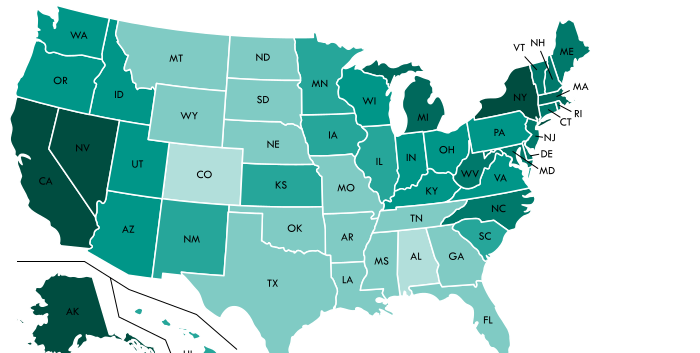
Most common states for medical technologist leads
| Rank | State | Population | # of jobs | Employment/ 1000ppl |
|---|---|---|---|---|
| 1 | Utah | 3,101,833 | 1,118 | 36% |
| 2 | Idaho | 1,716,943 | 599 | 35% |
| 3 | District of Columbia | 693,972 | 234 | 34% |
| 4 | South Dakota | 869,666 | 284 | 33% |
| 5 | New Mexico | 2,088,070 | 668 | 32% |
| 6 | Montana | 1,050,493 | 336 | 32% |
| 7 | Alaska | 739,795 | 221 | 30% |
| 8 | Arkansas | 3,004,279 | 792 | 26% |
| 9 | Minnesota | 5,576,606 | 1,298 | 23% |
| 10 | Nevada | 2,998,039 | 703 | 23% |
| 11 | Kansas | 2,913,123 | 641 | 22% |
| 12 | Nebraska | 1,920,076 | 422 | 22% |
| 13 | New Hampshire | 1,342,795 | 302 | 22% |
| 14 | North Dakota | 755,393 | 159 | 21% |
| 15 | Delaware | 961,939 | 192 | 20% |
| 16 | Vermont | 623,657 | 123 | 20% |
| 17 | Georgia | 10,429,379 | 2,019 | 19% |
| 18 | Illinois | 12,802,023 | 2,269 | 18% |
| 19 | Missouri | 6,113,532 | 1,119 | 18% |
| 20 | West Virginia | 1,815,857 | 318 | 18% |
Most common cities for medical technologist leads
| Rank | City | # of jobs | Employment/ 1000ppl | Avg. salary |
|---|---|---|---|---|
| 1 | Bay Shore | 1 | 4% | $85,515 |
| 2 | Bay City | 1 | 3% | $78,973 |
| 3 | Burbank | 2 | 2% | $79,287 |
| 4 | Biloxi | 1 | 2% | $56,538 |
| 5 | New Orleans | 2 | 1% | $57,396 |
| 6 | Santa Rosa | 2 | 1% | $96,443 |
| 7 | Alameda | 1 | 1% | $95,191 |
| 8 | Alexandria | 1 | 1% | $70,801 |
| 9 | Houston | 2 | 0% | $59,740 |
| 10 | Los Angeles | 2 | 0% | $78,826 |
| 11 | San Jose | 2 | 0% | $93,994 |
| 12 | Atlanta | 1 | 0% | $59,666 |
| 13 | Austin | 1 | 0% | $60,138 |
Medical Technologist Lead job outlook: Expert opinions
Our panel of medical technologist lead experts
Northern Michigan University
Bloomsburg University of Pennsylvania
University of Alabama in Huntsville
University of Arkansas for Medical Sciences
Medical University of South Carolina

Saint Cloud State University

Saint Cloud State University
University of Mary Hardin-Baylor

Kutztown University of Pennsylvania
Colby-Sawyer College

University of Minnesota

Indiana University of Pennsylvania
University of New Mexico
Arkansas State University - Jonesboro
Palm Beach State College

Georgia Southern University-Armstrong Campus
Martin Renaldi MT (ASCP), MPA
Assistant Professor / MLS Program DirectorNorthern Michigan University
Allied Health Diagnostic, Intervention, And Treatment Professions
What general advice would you give to a Medical Technologist Lead?
Martin Renaldi MT (ASCP), MPA: Experience. I have found through my time in the realm that an experienced lab tech is going to be highly sought after and henceforth will have optimal pay opportunities. As the word implies, experience can only be achieved through 'time in the lab' which means you have to put in your time to gather that resume boosting element, experience. Once that happens, then even more doors open up in the profession.
Ethan Kentzel MS, MLS ASCPcm
Program Director, Medical Laboratory Science and Phlebotomy ProgramsBloomsburg University of Pennsylvania
Biology
What Medical Technologist Lead skills would you recommend for someone trying to advance their career?
Ethan Kentzel MS, MLS ASCPcm: Obtaining your ASCP MLS certification is one way that you can increase your earning potential, as some hospitals pay more to people that have the certificate or license. Working in urban areas tend to pay more money, but may have higher costs of living. Some states require MLS to be licensed, and licensure states tend to pay more than certificate level states in the US. Students that work second or third shifts tend to have an increased likelihood of sign-on bonuses and shift differentials. If you communicate well, set clear expectations, and work well with your lab management team, you can always ask for additional tasks and responsibilities that would help you grow in your career. These extra responsibilities may help set you apart from your peers/colleagues when it comes time for promotions and raises.
Shelby McCarty MSNPA
Public Relations CoordinatorWhat general advice would you give to a Medical Technologist Lead?
Shelby McCarty MSNPA: Maximizing salary potential as a medical laboratory scientist requires a combination of skill development, pursual of advanced education, and proactive career management. As a graduate prepares to enter the job market, it is important to research salary trends in various locations and understand that salary can vary depending on geographic location. Multiple factors play a role in influencing salary: experience, education level, cost-of-living, shift work, among others. MLS graduates should use that first job to gain experience, building a strong foundation of practical skills. They may search for positions in high-demand areas, such as molecular diagnostics, where they can acquire specialized skills. On the other hand, gaining experience in all departments of the laboratory, can make a MLS more well-rounded, which is desirable for many MLS positions. The experience gained in a variety of departments provides a MLS the opportunity to take on a travel position, which has a higher earning potential. A MLS may consider pursuing an advanced degree or certification relevant to medical laboratory science, such as a graduate degree or specialty certifications like molecular biology, hematology, or blood banking. It is also important to look for opportunities to advance your career with the profession, such as management positions, supervisor roles, or opportunities in Laboratory Informatics. Advancing to higher-level positions often comes with increased salary potential. Lastly, build professional relationships with others in the medical laboratory profession by joining professional organizations or attending industry events. This allows you to stay connected with potential job opportunities and gain insights regarding career advancement.
Dr. Luis Rogelio Cruz-Vera
Associate ProfessorUniversity of Alabama in Huntsville
Department of Biological Sciences
What soft skills should all Medical Technologist Leads possess?
Dr. Luis Rogelio Cruz-Vera: Planification.
Lindsey Clark
Assistant ProfessorUniversity of Arkansas for Medical Sciences
Department of Laboratory Sciences
What soft skills should all Medical Technologist Leads possess?
Lindsey Clark: Laboratory scientists are like medical detectives-looking for clues that lead to diagnoses, which requires attention to detail, critical thinking, and problem-solving skills. These are some of the most important soft skills for laboratory scientists, time management, adaptability, and communication skills.
Helen Martin
Associate Professor, Division DirectorMedical University of South Carolina
Division of Physician Assistant Studies
What skills stand out on Medical Technologist Lead resumes?
Helen Martin: The degree must be from an accredited university.
What soft skills should all Medical Technologist Leads possess?
Helen Martin: Computer skills within a hospital system.
What skills will help Medical Technologist Leads earn the most?
Helen Martin: 4-year degree in laboratory science.
Patricia Ellinger
Medical Laboratory Science FacultySaint Cloud State University
Medical Laboratory Science
What skills stand out on Medical Technologist Lead resumes?
Patricia Ellinger: Note, we offer a four-year degree, so these individuals are Medical Laboratory Scientists (MLS). The Technician is the 2-year level.
-Oral and written communication with others in the lab, lab profession (doctors)
-Ability to work alone or in a group (teamwork)
-Ability to follow directions
-Problem solving
-Careful work: Precision, accuracy, reproducibility
-Ask questions when need help: Know when to ask for help, the data matters, ask to confirm a test result if in question, before sending out
-Ethical
-Time management
-Self-awareness of strengths and weaknesses
-Confidence without arrogance
-Leadership
What hard/technical skills are most important for Medical Technologist Leads?
Patricia Ellinger: -Careful work: Precision, accuracy, reproducibility
-Knowledge of quality control, ability to recognize when a test result looks wrong and what to do about it
What skills will help Medical Technologist Leads earn the most?
Patricia Ellinger: -Problem solving gives you the ability to see opportunities, to take on additional tasks or projects
-Careful work: Precision, accuracy, reproducibility
-Ability to work with others
-Work experience with the above and also furthering your education
-Work experience which enhance base knowledge and technical skills
-Educational
-MBA for some positions (depends on the size of the hospital), management
-MS/Ph.D. for some positions
-Depends on the size of the hospital
-Also, needed for an academic position, MS for some, others require PhD
Louise Millis
Medical Laboratory Science and Histotechnician Program Director, Associate Professor of BiologySaint Cloud State University
Medical Laboratory Science
What skills will help Medical Technologist Leads earn the most?
Louise Millis: -Problem solving gives you the ability to see opportunities, to take on additional tasks or projects
-Careful work: Precision, accuracy, reproducibility
-Ability to work with others
-Work experience with the above and also furthering your education
-Work experience which enhance base knowledge and technical skills
-Educational
-MBA for some positions (depends on the size of the hospital), management
-MS/Ph.D. for some positions
-Depends on the size of the hospital
-Also, needed for an academic position, MS for some, others require PhD
What's a good job out of college for Medical Technologist Leads?
Ruth Ann Murphy Ph.D.: -Graduate School in Chemistry! There is a shortage of graduate students in Chemistry so this is a great time to go. Chemistry is one of the few fields where they pay you to attend Graduate School. You can earn about $30k per year with benefits (!) while improving your employability! With an advanced degree such as a Master's (doable in as little as one year), one can then teach in colleges and universities. In Chemistry, you can go directly to a PhD program, bypassing the Master's degree. Those holding post-baccalaureate degrees earn on average more than those with a bachelor's degree.
-Environmental! Climate change is here and there is a need for scientists to deal with it as well as to keep the non-science sector of the public informed. You can work for an environmental company as some of our graduates do, or for an agency such as the EPA, or TCEQ (Texas Commission on Environmental Quality). I know a PhD Organic Chemist who headed the Austin, TX Air Quality program.
-Teaching Chemistry - High School, Middle School, etc. This can be done without any education courses, via Alternative Certification. The need for Chemistry teachers in Texas is critical! Students can get their student loans forgiven if they commit to teaching Chemistry in high school for a set period of time.
-Health professions. Health care careers are "recession-proof." The need for competent health care continues. With its critical thinking emphasis, a Chemistry major is great training for future physicians, dentists, pharmacists, physician assistants, and more.
-Pharmaceutical Research. Develop new and better medications!
-Forensic Science. There are great jobs for chemists with the Texas Department of Public Safety and other such agencies. I know some of these and the head of the Albuquerque, NM Crime Lab was at one time a PhD Chemist I know.
Dr. Justin Smoyer Ph.D.
Associate Professor of Experimental Physics & EngineeringKutztown University of Pennsylvania
Department of Physical Sciences
What experience really stands out on Medical Technologist Lead resumes?
Dr. Justin Smoyer Ph.D.: For physics students having additional skills such as proficiency in programming languages and/or research experience is a great way to stand out among their peers. If an employer is looking to hire someone with a physics degree, every applicant will have a physics degree. Where students can stand out is having additional sets of skills or experiences. Students should consider a question an employer may ask, "You have your physics degree and what?"
Will there be an enduring impact of the coronavirus pandemic on Medical Technologist Leads?
Chery Whipple Ph.D.: The pandemic has severely reduced and limited undergraduate students' ability to complete internships, travel for a semester abroad, and participate in project-based courses (especially those that work with the local community or travel to other parts of the country). It is these experiences that truly resonate with the student and allow them to apply the skills learned in class, make novel connections, network with other institutions, and collaborate directly with others. While much work can be accomplished through online platforms, it cannot completely substititue for the long-term connection achieved from meeting in-person.
The benefits of in-person communication, especially at small colleges, is immeasurable. So much is communicated non-verbally. As a freshman, it is in the first year where students meet and make lasting connections with fellow students and new professors. Over time, a class camaraderie develops, fostering confidence in individual students such that they are comfortable asking questions and contributing to class discussions. Moreover, in science classes, many essential skills are learned by conducting experiments in a laboratory; skills that cannot be achieved remotely. Since the pandemic will likely span at least three semesters, many of our incoming students will need to work diligently over the next two to three years to become competent in the foundational laboratory skills we expect from a student graduating with a B.S. in Biology, Chemistry, or Environmental studies.
Once the country is open, the competition for job openings, study abroad programs, and in-person internships will be fierce. Undergraduates, in particular, will be vying for the enriching leadership and research opportunities that help them determine their career path as well as to set them apart from other fellow applicants who are (or will be) applying to similar jobs and/or graduate school. Ultimately, it will become challenging for recent or soon-to-be graduates to really stand out and thus may increase the length of time it takes to find a job within their field of discipline.
What type of skills will young Medical Technologist Leads need?
Chery Whipple Ph.D.: The ability to be flexible and adaptable to new challenges has always been an asset to young graduates, however, in this quickly changing working environment it will be more important than ever. Being able to think critically, integrate information across disciplines, and collaborate with others will be essential skills. I think the pandemic has also shown that being able to rapidly learn and utilize new (and diverse) technology is not only a highly sought after skill, it is required.
What are the biggest trends we'll see in the Medical Technologist Lead job market given the pandemic?
Janice Conway-Klaassen Ph.D.: For medical laboratory sciences, the pandemic has highlighted our career and who we are. The public now has a greater awareness of our field, but it has also provided additional job opportunities to help with COVID-19 testing. Although many graduates in other fields are struggling to find employment during the pandemic, our graduates have not had any trouble finding a job. There does seem to be an increase in part-time or temporary positions being offered at the start, but most have been converted to full time, permanent within a few months of hire.
What Medical Technologist Lead skills would you recommend for someone trying to advance their career?
Benjamin Ford: Students taking a gap year should think about where they want to end up, both geographically and in terms of a career, and position themselves accordingly. That might mean moving to where they eventually want to live, taking a job to pay the bills, and volunteering with an organization to build local contacts. They should also work to develop the skills that will make them necessary in their intended career. The world became much more digital in the last nine months. We will likely return to many of our pre-pandemic physical practices, but aspects of our remote-everything existence will likely stick with us. Developing skills to be successful in a digital environment will be important.
What experience really stands out on Medical Technologist Lead resumes?
Dr. Bruce Huckell Ph.D.: In terms of archaeology, for employers in the governmental and private sectors, I think experience in field work and laboratory analysis is what is most desired when considering folks with bachelor's degrees. In those same employment settings, master's and doctoral graduates who have good writing skills need the knowledge of appropriate legal regulations and museum methods and the ability to organize and supervise workers. In the academic realm, where a doctoral degree is needed in most instances, skills in research, teaching, and pubic/professional service are the key realms in which experience must stand out.
Are there any particularly good places in the United States for Medical Technologist Leads to find work opportunities?
Dr. Stacy Walz Ph.D: This all depends on what a graduate is looking for: urban vs. rural, fast-paced vs. slower-paced, larger facility vs. smaller facility, 24/7/365 vs. M-F 8-5, etc. There is something available for everyone in this country right now in the field of CLS.
What type of skills will young Medical Technologist Leads need?
Dr. Alexandra Gorgevska Ph.D.: Graduates [of all ages] will continue to need hands-on skills, the ability to work both in the group and individual settings, and, most importantly, be curious and teachable. Soft skills have taken on greater importance over the years, so we provide ongoing events for outreach, scientific communication, interview preparation, etc., to help provide students with ways to improve and grow their soft skills.
We are seeing scientific communications transitioning from in-person to remote settings, and our students are excelling at rising to the challenges. South Florida has a diverse life science career field, and our students continue to be well prepared to enter the job market and succeed in their career paths.
Keith Belcher Ph.D.
Professor, Medical Laboratory Science Director, Medical Laboratory Science ProgramGeorgia Southern University-Armstrong Campus
Department of Diagnostic & Therapeutic Sciences
Are there any particularly good places in the United States for Medical Technologist Leads to find work opportunities?
Keith Belcher Ph.D.: Students graduating from the program must also pass a national board certification to be able to work in the profession. The examination is sponsored by the American Society of Clinical Pathologists (ASCP). Our program is running a three year average of a 90% pass rate on the exam (for first-time examinees) compared to a national average of around 78-82%. At this time, our students have a placement rate of 98%, so there are plenty of job opportunities available. Certified MLS graduates may choose to work in a variety of areas. Most will work in a hospital clinical setting or a specialty reference laboratory. Some may choose to enter into pharmaceutical research or forensic science. The COVID pandemic has brought to light the need for more Medical Laboratory Scientists. The job outlook and prospects for MLS graduates are excellent in any state within the U.S. MLS programs cannot turn out enough MLS graduates to meet current demands.