Explore jobs
Find specific jobs
Explore careers
Explore professions
Best companies
Explore companies
Job outlook for member services coordinators in the United States
Are member services coordinator jobs in demand?
Member services coordinator job and salary trends over time
Member services coordinator jobs over time
Member services coordinator job growth rate over time
| Year | # of jobs | % of population |
|---|---|---|
| 2021 | 3,237 | 0.00% |
| 2020 | 3,200 | 0.00% |
| 2019 | 3,336 | 0.00% |
| 2018 | 3,313 | 0.00% |
| 2017 | 3,270 | 0.00% |
Average member services coordinator salary over time
Member services coordinator salary by year
| Year | Avg. salary | Hourly rate | % Change |
|---|---|---|---|
| 2026 | $36,934 | $17.76 | +3.2% |
| 2025 | $35,778 | $17.20 | +1.5% |
| 2024 | $35,266 | $16.95 | +1.4% |
| 2023 | $34,792 | $16.73 | +1.3% |
| 2022 | $34,337 | $16.51 | +3.2% |
Member services coordinator jobs by state
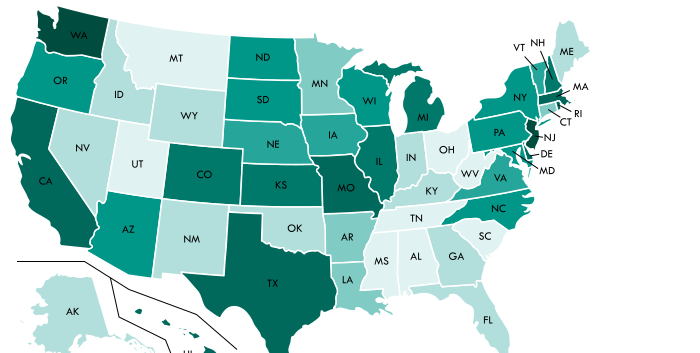
Most common states for member services coordinators
| Rank | State | Population | # of jobs | Employment/ 1000ppl |
|---|---|---|---|---|
| 1 | District of Columbia | 693,972 | 306 | 44% |
| 2 | Delaware | 961,939 | 374 | 39% |
| 3 | North Dakota | 755,393 | 298 | 39% |
| 4 | New Hampshire | 1,342,795 | 375 | 28% |
| 5 | South Dakota | 869,666 | 229 | 26% |
| 6 | Vermont | 623,657 | 150 | 24% |
| 7 | Washington | 7,405,743 | 1,718 | 23% |
| 8 | Minnesota | 5,576,606 | 1,274 | 23% |
| 9 | Alaska | 739,795 | 173 | 23% |
| 10 | Oregon | 4,142,776 | 902 | 22% |
| 11 | Idaho | 1,716,943 | 370 | 22% |
| 12 | New Mexico | 2,088,070 | 421 | 20% |
| 13 | West Virginia | 1,815,857 | 366 | 20% |
| 14 | Massachusetts | 6,859,819 | 1,331 | 19% |
| 15 | Iowa | 3,145,711 | 609 | 19% |
| 16 | Maine | 1,335,907 | 250 | 19% |
| 17 | Alabama | 4,874,747 | 840 | 17% |
| 18 | Oklahoma | 3,930,864 | 605 | 15% |
| 19 | Utah | 3,101,833 | 439 | 14% |
| 20 | Rhode Island | 1,059,639 | 145 | 14% |
Most common cities for member services coordinators
| Rank | City | # of jobs | Employment/ 1000ppl | Avg. salary |
|---|---|---|---|---|
| 1 | Casselberry | 1 | 4% | $28,789 |
| 2 | Appleton | 2 | 3% | $36,779 |
| 3 | Haltom City | 1 | 2% | $38,866 |
| 4 | La Quinta | 1 | 2% | $40,053 |
| 5 | Atlanta | 3 | 1% | $29,424 |
| 6 | Tallahassee | 2 | 1% | $28,695 |
| 7 | Columbus | 1 | 1% | $29,737 |
| 8 | Killeen | 1 | 1% | $39,422 |
| 9 | Indianapolis | 3 | 0% | $29,265 |
| 10 | Tucson | 2 | 0% | $36,053 |
| 11 | Boston | 1 | 0% | $39,479 |
| 12 | Buffalo | 1 | 0% | $33,771 |
| 13 | Cincinnati | 1 | 0% | $26,841 |
Member Services Coordinator job outlook: Expert opinions
Our panel of member services coordinator experts
Heidelberg University

Austin Community College
Coastal Carolina University
Paige Atterholt
Adjunct ProfessorHeidelberg University
Will there be an enduring impact of the coronavirus pandemic on Member Services Coordinators?
Paige Atterholt: I think now, being in year 2 of the pandemic, I think if anything there will be more jobs for graduates. Just looking through the jobs online, there are many opportunities for graduates to get a job. I think the older community retired when things got bad, which opened the door for the younger generation.
Will there be an enduring impact of the coronavirus pandemic on Member Services Coordinators?
Stuart Greenfield Ph.D.: According to the National Student Clearinghouse estimates for Fall 2018-Fall 2020, Nscresearchcenter, enrollment inf post-secondary institutions declined by 703.9K. Of this decline, 621.4K (88.3%) were attributed to Public 2-year institutions.
What soft skills should all Member Services Coordinators possess?
Stuart Greenfield Ph.D.: Given the changing demographics that the country has experienced, the entire education continuum must change. According to the Brookings Institution, Brookings, the non-Hispanic White population in the under 18 cohort since 2000 has declined.
As you'll note from the occupations that are projected to increase the greatest, most require face-to-face contact, so that soft-skills will be necessary. I would also expect that critical thinking skills will be needed as more responsibility will be required of front-line workers.
What general advice would you give to a Member Services Coordinator?
Matthew Gilbert: The unique circumstances caused by COVID-19 have impacted every area of our lives. New graduates will likely find themselves in a more challenging situation than was the case previously. Given this, I encourage graduates who are just beginning their careers to be ACES: adaptive, communicative, effective, and supportive. ACES is a slang term meaning being highly regarded; in the context of the suggested acronym, consider the following explanation.
Adaptive: Remain open to top unexpected opportunities. Venturing into a new normal requires flexibility and openness; this could mean taking a job that wasn't considered, but recognizing it could yield skills, connections, and experience that could be useful in future endeavors.
Communicative: Leverage LinkedIn to network professionally and politely for opportunities, but don't connect with someone and immediately ask for a job. Call your contacts and catch up without a specific agenda; you never know what ideas might emerge. Email individuals, you respect for insights and advice.
Effective: Make use of your time to learn new skills or acquire certifications that demonstrate the value you can add to an organization. Consider volunteering for a cause close to your heart; it makes you feel better, but you could connect personally and/or professionally with new people.
Supportive: Finding a job in a normal year is challenging enough, but in a pandemic, it's an entirely different experience. Keep in contact with your friends and fellow graduates; even a short message asking how they're doing or inviting them to a social distance coffee together could brighten a day you didn't know was dark for someone else.