Explore jobs
Find specific jobs
Explore careers
Explore professions
Best companies
Explore companies
Job outlook for middle school ministers in the United States
Are middle school minister jobs in demand?
Middle school minister job and salary trends over time
Middle school minister jobs over time
Middle school minister job growth rate over time
| Year | # of jobs | % of population |
|---|---|---|
| 2021 | 2,376 | 0.00% |
| 2020 | 2,406 | 0.00% |
| 2019 | 2,498 | 0.00% |
| 2018 | 2,448 | 0.00% |
| 2017 | 2,498 | 0.00% |
Average middle school minister salary over time
Middle school minister salary by year
| Year | Avg. salary | Hourly rate | % Change |
|---|---|---|---|
| 2026 | $46,111 | $22.17 | +1.9% |
| 2025 | $45,239 | $21.75 | +1.8% |
| 2024 | $44,436 | $21.36 | +1.5% |
| 2023 | $43,768 | $21.04 | +1.8% |
| 2022 | $43,010 | $20.68 | +1.5% |
Middle school minister jobs by state
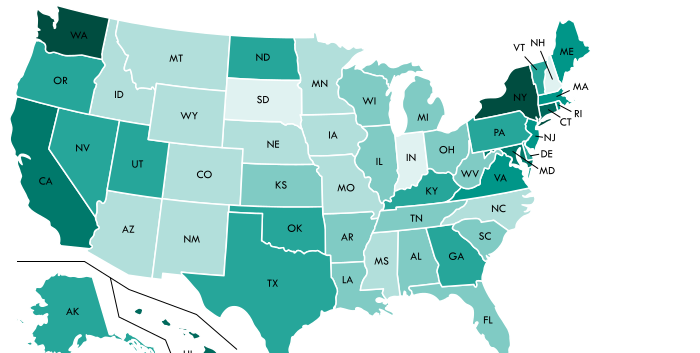
Most common states for middle school ministers
| Rank | State | Population | # of jobs | Employment/ 1000ppl |
|---|---|---|---|---|
| 1 | New Hampshire | 1,342,795 | 101 | 8% |
| 2 | Connecticut | 3,588,184 | 254 | 7% |
| 3 | District of Columbia | 693,972 | 51 | 7% |
| 4 | Illinois | 12,802,023 | 820 | 6% |
| 5 | Montana | 1,050,493 | 66 | 6% |
| 6 | Alaska | 739,795 | 42 | 6% |
| 7 | Minnesota | 5,576,606 | 265 | 5% |
| 8 | Oregon | 4,142,776 | 223 | 5% |
| 9 | Delaware | 961,939 | 48 | 5% |
| 10 | Wyoming | 579,315 | 29 | 5% |
| 11 | New Jersey | 9,005,644 | 338 | 4% |
| 12 | Arizona | 7,016,270 | 307 | 4% |
| 13 | Missouri | 6,113,532 | 261 | 4% |
| 14 | Colorado | 5,607,154 | 247 | 4% |
| 15 | Maryland | 6,052,177 | 221 | 4% |
| 16 | Kansas | 2,913,123 | 112 | 4% |
| 17 | New Mexico | 2,088,070 | 78 | 4% |
| 18 | Rhode Island | 1,059,639 | 45 | 4% |
| 19 | Vermont | 623,657 | 26 | 4% |
| 20 | Washington | 7,405,743 | 188 | 3% |
Middle School Minister job outlook: Expert opinions
Our panel of middle school minister experts
Duke University
Vanguard University of Southern California
Crowley's Ridge College
Clemson University
West Virginia Wesleyan College

California Baptist University
Memphis Theological Seminary

La Sierra University
Gardner-Webb University
Oral Roberts University
Prof. J. Smith
Professor of Historical TheologyDuke University
Theological And Ministerial Studies
What Middle School Minister skills would you recommend for someone trying to advance their career?
Prof. J. Smith: Leaders of religious communities should focus on the relationship between religion and science, discourse promoting civility and respect, and questions regarding human nature, personal freedom, and happiness.
What Middle School Minister skills would you recommend for someone trying to advance their career?
Rodolfo Estrada III: Remain receptive and open-minded, always ready to glean wisdom from those around you. It's essential to remember that a theology degree offers a starting point for engaging in a broader discourse spanning centuries of deliberation, dispute, and exchange. While we may not possess all the answers to people's inquiries, we've been equipped with the tools to find life's profoundest questions. Never lose one's love for people, and always have hope for a better future.
What general advice would you give to a Middle School Minister?
Josh Parnell: Public speaking skills have always been important in the religious field, and there is no sign that will change in the next 3-5 years. Conflict management is a skill that I believe will become more important and prevalent in the next 3-5 years as religious organizations, much like the society around them, become increasingly polarized.
What Middle School Minister skills would you recommend for someone trying to advance their career?
Josh Parnell: Networking is everything. Job opportunities in the religious field are primarily the result of good references from trusted individuals, not from objective qualifications. Network with as many respected individuals in the field as possible, beginning with your professors and college administrators. If possible, begin your career through an internship with a respected figure in the field, their endorsement will prove invaluable when you set out on your own.
What will help Middle School Ministers increase their earning potential?
Josh Parnell: There are two common career paths for graduates in religious studies: Ministry (clergy) and academia. Although there are notable exceptions, neither of those career paths typically pay very well; they are 'calling' professions that you do because you are passionate about the job, not because you are looking for financial advancement. So, I strongly advise graduates to develop a second career that they can use to reliably supplement their income.
Dr. Grant Carey
Associate Professor of Religious EducationWhat Middle School Minister skills would you recommend for someone trying to advance their career?
Dr. Grant Carey: We get multiple calls and emails each week looking for qualified people in this field. Right now there is a shortage of workers and this is a profession that can evolve based upon your skills and experience.
Daniel Wueste Ph.D.
Professor of PhilosophyClemson University
Department of Philosophy and Religion
Are there any particularly good places in the United States for Middle School Ministers to find work opportunities?
Daniel Wueste Ph.D.: It's difficult to be sanguine about opportunities in the field, as they require an advanced degree, and, at present, graduate school has lost much of its allure as anxiety about the pandemic's effects on higher education grows. However, because philosophy graduates have developed widely applicable/marketable skills in critical thinking, oral and written communication, analysis, and argumentation, they should do comparatively well even in a job market profoundly impacted by the pandemic.
How do you envision technology impacting Middle School Ministers in the next 5 years?
Daniel Wueste Ph.D.: Technology will impact the field (philosophy) as a topic for philosophical investigation (in ethics and social and political philosophy, for example), and as a force in changing the way higher education is delivered. With advances in artificial intelligence, it is likely to enhance the appeal of philosophy as an area of study, as AI aligns well with the philosophy of mind/cognitive science and epistemology.
Debra Dean Murphy Ph.D.
Associate ProfessorWest Virginia Wesleyan College
Philosophy and Religious Studies Department
How do you envision technology impacting Middle School Ministers in the next 5 years?
Debra Dean Murphy Ph.D.: Depending on the particular vocation religious studies major pursue after graduation, technology will have varying degrees of impact. For those entering various forms of ministry, technology is rapidly changing the game.
Will there be an enduring impact of the coronavirus pandemic on Middle School Ministers?
Greg Cochran Ph.D.: Yes, undoubtedly. Quantifying the lasting impact may not be possible right now; predicting the future is a notoriously difficult task. However, some trend lines were already in place, and thus, were accelerated by the COVID-19 disruption. For example, technology had already increased loneliness and isolation among various demographic groups. The response to this pandemic (lockdowns, distancing) only heightened such human isolation.
Graduates entering ministry will need to work extra hard to personalize their ministries. Along those same lines, many people will remain fearful of large, in-house gatherings, thus forcing a reconsideration of all aspects of facility-based ministry from nursery work, to adult Sunday school classes, to choir participation. About half of the pastors in the U.S. are expecting lower in-person attendance when services resume. Many challenges will persist relating to personal relationships, distancing, and isolation.
Are there any particularly good places in the United States for Middle School Ministers to find work opportunities?
Greg Cochran Ph.D.: The church-based ministry will abound-and may even increase-throughout the United States. While the less flexible ministries, and those with financial challenges, may not endure through this economic climate, many other churches will adapt and overcome. Graduates with clear convictions, lovingly related to other people, will continue to have work to do. Opportunities will abound because neither human nature nor the nature of human longings has changed. The churches will still possess a resonating message of love, justice, and truth for all kinds of people.
In southern California, for example, a church just this month-while restrictions remain in place--still baptized 1,000 new congregants. Church ministry has endured for 2,000 years. Nimble churches will still be looking for leaders in the next ten years. Probably the patterns will remain the same across the country: churches that adapt will thrive, others will face closing. And new churches will be planted.
Will there be an enduring impact of the coronavirus pandemic on Middle School Ministers?
Dr. Peter Gathje Ph.D.: Most of our graduates go into ministry either in a congregational setting or with a non-profit. So, yes, there will be an enduring impact. In congregational settings, people in ministry will be very likely to continue the "virtual" forms of worship, online Christian education, and other gatherings even as in-person worship resumes. The flexibility of virtual worship and the opportunity to participate from one's own home will be attractive to people even beyond the pandemic. Online adult theological education may supplement or even replace traditional Sunday school and Wednesday night offerings. Non-profits will also build upon the lessons learned during this time for virtual meetings, fundraising, and community programs.
John Webster Ph.D.
Professor of Theology and History of ChristianityLa Sierra University
Theology And Religious Vocations
What technology do you think will become more important and prevalent for Middle School Ministers in the next 3-5 years?
John Webster Ph.D.: We all want to get our lives back to 'normal.' But we will undoubtedly have to grapple with a 'new normal.' A new situation where we have to make technology (be it social media, digital forms of communication, etc.) a tool for more profound and better interpersonal connection rather than merely a stop-gap. We cannot unlearn 'Zoom.' We need to become proficient in using these new tools, while never letting them distort or control our understanding of what it means to be a genuinely good human being. We need to use technology to ensure that even when physical distancing is essential, it does not lead to social distancing. We are all in this together, and technology can help.
Scott Shauf Ph.D.
Professor of Religious Studies; Department ChairGardner-Webb University
Marketing
What Middle School Minister skills would you recommend for someone trying to advance their career?
Scott Shauf Ph.D.: Be open to God’s calling, especially to places you don’t feel comfortable going. There are many ways to serve in ministry, and God may call you to places and tasks you haven’t even thought of. Remember what you have learned, and always think critically and faithfully. Consider pursuing a Master of Divinity degree, for the church needs educated ministers. But whether you do or not, never stop learning.
Dr. Christopher Foster
Associate Professor of Biblical and Theological Studies, Graduate School of Theology andOral Roberts University
Biblical and Theological
Will there be an enduring impact of the coronavirus pandemic on Middle School Ministers?
Dr. Christopher Foster: On the one hand, the pandemic causes graduates who innovate to be even better assets to employers. On the other hand, those graduates who refuse to get out of the box and innovate might need to look elsewhere.
The virtual, streaming, and online component of ministry will likely remain for the foreseeable future. However, we are still in a stop-gap mode. Have we truly innovated? In light of 'Zoom fatigue,' the current virtual approach is unsustainable. We have not yet reached a "new normal." The enduring impact may not look like what we presently suppose.