Explore jobs
Find specific jobs
Explore careers
Explore professions
Best companies
Explore companies
Job outlook for mild disabilities teachers in the United States
Are mild disabilities teacher jobs in demand?
Mild disabilities teacher job and salary trends over time
Mild disabilities teacher jobs over time
Mild disabilities teacher job growth rate over time
| Year | # of jobs | % of population |
|---|---|---|
| 2021 | 316 | 0.00% |
| 2020 | 313 | 0.00% |
| 2019 | 323 | 0.00% |
| 2018 | 3,509 | 0.00% |
| 2017 | 3,350 | 0.00% |
Average mild disabilities teacher salary over time
Mild disabilities teacher salary by year
| Year | Avg. salary | Hourly rate | % Change |
|---|---|---|---|
| 2025 | $49,412 | $23.76 | +2.3% |
| 2024 | $48,280 | $23.21 | +2.2% |
| 2023 | $47,232 | $22.71 | +0.7% |
| 2022 | $46,905 | $22.55 | +0.8% |
| 2021 | $46,531 | $22.37 | +2.1% |
Mild disabilities teacher jobs by state
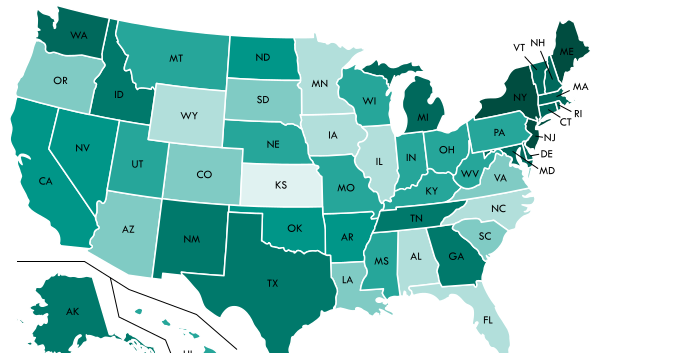
Most common states for mild disabilities teachers
| Rank | State | Population | # of jobs | Employment/ 1000ppl |
|---|---|---|---|---|
| 1 | District of Columbia | 693,972 | 123 | 18% |
| 2 | New Hampshire | 1,342,795 | 174 | 13% |
| 3 | New Jersey | 9,005,644 | 992 | 11% |
| 4 | Maryland | 6,052,177 | 692 | 11% |
| 5 | Colorado | 5,607,154 | 592 | 11% |
| 6 | Minnesota | 5,576,606 | 588 | 11% |
| 7 | Illinois | 12,802,023 | 1,292 | 10% |
| 8 | Massachusetts | 6,859,819 | 668 | 10% |
| 9 | New Mexico | 2,088,070 | 215 | 10% |
| 10 | Montana | 1,050,493 | 108 | 10% |
| 11 | Nebraska | 1,920,076 | 168 | 9% |
| 12 | Delaware | 961,939 | 91 | 9% |
| 13 | Virginia | 8,470,020 | 649 | 8% |
| 14 | Indiana | 6,666,818 | 527 | 8% |
| 15 | Kansas | 2,913,123 | 232 | 8% |
| 16 | Pennsylvania | 12,805,537 | 888 | 7% |
| 17 | Georgia | 10,429,379 | 695 | 7% |
| 18 | Missouri | 6,113,532 | 398 | 7% |
| 19 | South Carolina | 5,024,369 | 357 | 7% |
| 20 | Oklahoma | 3,930,864 | 284 | 7% |
Mild Disabilities Teacher job outlook: Expert opinions
Our panel of mild disabilities teacher experts
University of Alaska Anchorage
University of Minnesota - Twin Cities
University of Hawaii at Manoa
University of Utah
Saint Xavier University
University of Puerto Rico - Humacao
University of Michigan Dearborn
Longwood University
Adelphi University
Michigan State University
Saint Mary's College of California
Fort Hays State University
Appalachian State University
Gibraltar Public School
What general advice would you give to a Mild Disabilities Teacher?
Jennifer Lesh Ph.D.: Exercise discernment in your job selection: As a special education teacher, the range of positions available to you will be diverse and plentiful. Remember, a job interview is a two-way street. While school administrators will inquire about your qualifications, it’s equally important for you to evaluate the support and resources the school offers. Inquire about the school's induction programs for new teachers, mentorship opportunities, and the student-teacher ratio. Request a tour of the classrooms. It’s crucial that you feel a sense of belonging and alignment with both the environment and the team. The right fit for your initial teaching role can greatly enhance your capacity for resilience in this rewarding career. Never Stop Learning: Treat every day as an opportunity to learn something new. The most successful special educators are those who continue to grow their knowledge base and skill set long after formal education ends. Build Genuine Connections: Networking is more about building real relationships than accumulating contacts. Seek out educators as mentors whose work or path you admire and do are they are generally positive about teaching. Join a special education professional organization such as Council for Exceptional Children and get involved in the association at the local level. Maintain Work-Life Balance: It's crucial to find a balance that allows you to be productive at school while also taking care of your personal well-being. Burnout is real in the special education profession, and preventing it starts with recognizing the importance of your own health and happiness. Cultivate Your Personal Brand: Think about how you want to be perceived professionally as a special educator and make efforts to build your personal brand around those qualities. Whether it's through social media, blogging, or professional engagements, make sure your personal brand reflects your professional goals and values. Starting your career is the beginning of a lifelong journey of discovery, growth, and fulfillment. By staying curious, resilient, and connected, you'll set the stage for a rewarding and successful career.
What Mild Disabilities Teacher skills would you recommend for someone trying to advance their career?
Jennifer Lesh Ph.D.: Technological Proficiency: With the ongoing integration of technology in educational settings, teachers will need to be adept at using assistive technology to support students with special needs. This includes both hardware and software that facilitate communication, learning, and accessibility. Definitely include the use of generative AI in your teacher preparation practices for positive time saver! Data Literacy: Being able to collect, interpret, and apply data to tailor educational approaches to individual student needs will be crucial. Data-driven decision-making can help in creating effective IEPs (Individualized Education Programs) and monitoring student progress. Cultural Competency: As classrooms continue to diversify, understanding and respecting cultural differences and incorporating culturally responsive teaching methods will be essential. Collaboration and Teamwork: Special education often involves working closely with general education teachers, parents, and other professionals such as speech therapists or psychologists. Skills in collaboration and co-teaching will be vital. Emotional Intelligence: The ability to recognize and respond to students' emotional needs, as well as manage your own emotions, will be increasingly important in creating a supportive learning environment. Flexibility and Adaptability: With the fast pace of change in educational policies, practices, and student populations, special education teachers will need to be able to adapt their teaching styles and strategies quickly and effectively. Advocacy Skills: Being able to advocate for the rights and needs of students with disabilities will remain an important skill, including navigating the legal aspects of special education and working with families to ensure that students receive the services and support which they are entitled. Behavior Management: Developing strategies to effectively support positive behavior and address challenging behavior will continue to be a critical skill in the special education field. These skills will support a holistic and adaptive approach to special education, ensuring that educators are well-equipped to meet the evolving challenges and opportunities in the field.
Dr. Pamela Brillante
ProfessorWhat Mild Disabilities Teacher skills would you recommend for someone trying to advance their career?
Dr. Pamela Brillante: Understanding that disability is a natural part of the human experience, and that we all fall on some part of the continuum or spectrum of learning.
Being able to self-reflect on our own ableist views and change our mindset to believe that children are more alike than different.
Understanding a medical diagnosis doesn’t drive educational practices.
The need for initiative, persistence, creativity and problem solving in both ourselves and our students.
What will help Mild Disabilities Teachers increase their earning potential?
Dr. Pamela Brillante: View the profession as a puzzle you need to take time to solve. Never give up on a child. Given time and “outside of the box thinking” you will find what works. Understanding how someone learns is not black or white / right or wrong. We all do learn differently and it is our job as special educators to find that path for that specific child.
Krista James Ph.D.
Program Lead & Assistant Professor of Special EducationUniversity of Alaska Anchorage
Special Education And Teaching
What general advice would you give to a Mild Disabilities Teacher?
Krista James Ph.D.: Shop around to various school districts. Look at their salary scale but also at any signing bonuses they might offer.
What Mild Disabilities Teacher skills would you recommend for someone trying to advance their career?
Dr. Kimberly Coy: In the next 3-5 years, the skills that will be most important are the ability to be reflective of your practice. Teaching is an ever-evolving skill set for each person. Make sure you can look at your teaching and learn from it by being reflective and keeping your sense of wonder. Another skill will be the ability to understand that you are going to prepare students for jobs and challenges that have not been invented yet. Teach them the important skills of cultivating curiosity and adapting to change.
What general advice would you give to a Mild Disabilities Teacher?
Amy Kunkel Ph.D.: The need for good special education teachers is greater than ever before, thus graduates with a special education teaching license can often find teaching positions within their own communities. Take your time to look around at your options, ask questions about your caseload, and try to gauge the support provided by administration and the special education team you will be joining. Oftentimes our student teachers have multiple job offers prior to finishing up their student teaching semester. You want to choose an environment that feels welcoming and supportive.
One piece of advice that all new teachers should remember is the importance of self-care. Teaching is not an easy profession, and teachers teach because they love working with children and young adults. Special education teachers have a very unique passion, and it's helpful to always remember your reason for teaching. The kids will help you with this! I recommend new teachers keep a journal of their thoughts, keep their evenings and weekends work-free, and find time to nourish their hobbies and skills outside the classroom.
What will help Mild Disabilities Teachers increase their earning potential?
Amy Kunkel Ph.D.: To maximize your salary potential, first ask to see the hiring district’s salary schedule. Most districts operate on a “step and lane” system in which you receive higher pay for each year of service (step) and receive substantial raises for additional degrees earned (lane). For example, some districts will raise your salary for every 15 graduate credits you have earned, maximizing at a terminal degree. Teachers with a master’s degree + additional credits will earn substantially more than those without a master’s degree.
What general advice would you give to a Mild Disabilities Teacher?
Francesca Go Ph. D.: For a new Special Education teacher, the key, if possible, is to be well trained in individualizing instruction, making data-based decisions, knowing the law and students' rights, and understanding the importance of collaborating well with students and parents. A good teacher will know what the science and research say about what works and what does not, especially around instruction in areas like reading and mathematics. More broadly, what a new teacher needs, at the minimum, is empathy and understanding for the student and parents and a willingness to meet the student where they are in learning.
What Mild Disabilities Teacher skills would you recommend for someone trying to advance their career?
Francesca Go Ph. D.: Really, additional training and education will help you maximize your self-efficacy in the classroom as well as your salary potential. Doing things like getting a master's in Special Education can be especially helpful.
What general advice would you give to a Mild Disabilities Teacher?
Dr. Marija Čolić: People love being SPED teachers because of the profound impact they can have on students' lives. Watching students make progress, achieve their goals, and seeing the joy this brings to their families is incredibly rewarding. The profession offers a sense of purpose and the opportunity to make a meaningful difference every day.
What will help Mild Disabilities Teachers increase their earning potential?
Breda O’Keeffe Ph.D.: Before even starting your career in special education, look for programs and scholarships that provide financial support for your education and teaching license/credential. Because special education teachers are in high demand, many states, districts, and institutes of higher education provide financial incentives and supports for preservice teachers. Another option is to look for programs that provide loan forgiveness for working in high need areas (e.g., special education), schools (e.g., Title I schools), or districts. Graduating with low or no debt can help maximize your take-home pay as a teacher. Also, be aware that each state has its own teacher licensing/credentialing systems and that licenses/credentials do not always transfer directly when going from one state to another. If you know what state you will be teaching in, make sure your license/credential will be easily recognized in that state (or you may face additional educational requirements and costs). In addition, be aware that teacher salaries vary widely across states, across cities within states, and across different settings (e.g., private, public, preschool, K-12, etc.). In seeking preparation to become a special education teacher, you have many options that will ultimately affect your salary potential. Alternative routes to licensure which do not include the typical supports of a traditional teacher education program may be tempting, because they tend to be shorter and less expensive. Unfortunately, special education teachers prepared through these routes leave the field sooner and at higher rates than teachers provided with higher quality training at an institute of higher education (e.g., colleges and universities). Look for accredited programs that provide hands-on instruction and multiple supervised field experiences in the settings you will be teaching in, with high quality supervision and feedback (e.g., from a faculty member with teaching experience in your area), support for preparing for licensing/credentialing requirements, and instruction in evidence-based practices in academics, classroom management, intensive behavior supports, assessment, and special education law and policy. You will be more competitive when you start and more likely to persist, which will make the costs of your education worthwhile! When you are seeking a job, district salary schedules are posted on their respective websites. If salary is of utmost interest to you, start looking for high paying districts. Typically, charter and private schools do not have posted salary schedules, but if you are applying to those institutions, you should feel comfortable asking them to match the neighboring district pay. Some districts also offer additional compensation through incentive programs, “buying out” preparation periods, or other school-related duties. Don’t jump into committees and “extra duties” right away. Look for incentive programs specifically for high needs areas, such as special education. For example, in Utah, special education teachers can access the Teacher Salary Supplement Program (TSSP). This fund serves to reward and retain qualified educators in positions that have been identified as having staffing shortages. The state has also provided additional paid workdays outside of contract days to special education teachers to help prepare files and paperwork at the start or end of the school year. In addition, you can increase your pay by seeking further education such as a master’s degree or endorsements.
Margaret Carroll
Coordinator for Special Education ProgramsSaint Xavier University
Special Education And Teaching
What will help Mild Disabilities Teachers increase their earning potential?
Margaret Carroll: Most schools pay more for each year of experience and for additional professional education. While an increasing salary is desirable, I encourage new teachers to wait at least until they complete their first year of teaching before they begin to pursue an additional teaching credential or degree.
What Mild Disabilities Teacher skills would you recommend for someone trying to advance their career?
Maritere Cardona Matos Ed.D.: Being able to collaborate is essential in the academia as well as in the workplace. Educators need to cultivate students' abilities to work effectively in teams and communicate their ideas clearly both orally and in writing. Educators also need to develop students' awareness of what is happening around the world to help them develop empathy and values. We live in a world that is in constant movement, so students need to be able to adapt and manage time and stress.
Christopher Burke PhD
Professor Science EducationUniversity of Michigan Dearborn
Health/Medical Preparatory Programs
What Mild Disabilities Teacher skills would you recommend for someone trying to advance their career?
Christopher Burke PhD: The ability to connect with and engage diverse students.
The ability to contextualize learning across disciplines.
The ability to work collaboratively and to help your students learn to work collaboratively.
What will help Mild Disabilities Teachers increase their earning potential?
Christopher Burke PhD: Look for opportunities for leadership in both informal and formal roles.
Understand the contract and know how you move on the salary scale (credits? degrees?).
Know how a district compensates for extra pay/extra duty positions...but don't overwhelm with too many.
Know the condition of the market: Is it a "job seeker's market" or an "employer's hirer's market?" Turnover in positions can be cyclical and is effective by conditions such as economic circumstances. Sometimes one can be "choosier" than at other times based on demand.
Education-teaching and in leadership-is a relatively portable career. But levels of remuneration vary considerably across states and regions-and within states and regions. So...would, you be willing to consider a move? Usually moving to another state requires some work regarding transferability and recognition of credentials held in another state. But as demand increases, barriers to ease of relocation tend to decrease.
Dr. Audrey Church Ph.D.
Chair, Department of Education and Counseling; Professor of School LibrarianshipLongwood University
Education
What Mild Disabilities Teacher skills would you recommend for someone trying to advance their career?
Dr. Audrey Church Ph.D.: In the field of education, skills that will become even more important and prevalent are really at, what I would consider, opposite ends of a spectrum: at one end, interpersonal skills--strength and knowledge in the areas of social and emotional learning and trauma-informed teaching; at the other end, technology skills-refining and enhancing information literacy and digital literacy skills.
What general advice would you give to a Mild Disabilities Teacher?
Dr. Stephen Shore Ed.D.: On a day to day basis a special education teacher assures that all students under their care receive appropriate adjustments to the delivery of curriculum, different opportunities for processing information received, and options for the student to demonstrate mastery of material according to their abilities. Sometimes adjustments to the curriculum itself will be made. A person entering the field as a special educator does the very same thing, under the guidance of a mentor teacher who shares their educational experiences.
What Mild Disabilities Teacher skills would you recommend for someone trying to advance their career?
Dr. Stephen Shore Ed.D.: With increasing recognition of the wide diversity of how people think, increasing numbers of students are being identified as having special needs. An additional bonus is that the instructor becomes a better teacher overall since adjustments made on their students' behalf are actually just extensions of good teaching practice.
What will help Mild Disabilities Teachers increase their earning potential?
Dr. Stephen Shore Ed.D.: My sense is that special education teachers value their capacity to make real and meaningful positive changes in the lives of students they support. The most common dislike I hear from special education students include the mountains of paperwork and frustration when they are not provided sufficient support from their school systems to do their jobs effectively.
Dr. PJ Sedillo
Associate ProfessorWhat Mild Disabilities Teacher skills would you recommend for someone trying to advance their career?
Dr. PJ Sedillo: Patience
Creativity
Communication
Organization
Advocacy
What Mild Disabilities Teacher skills would you recommend for someone trying to advance their career?
Troy Mariage: Special education teachers are responsible for coordinating and providing direct services to students with Individualized Education Plans. They work with students with various disabilities such as Learning Disabilities, Autism, Speech and Language Disorders, and more. Special education teachers may provide early interventions, extra reading supports, access to the general education curriculum, transition services, direct instruction, co-teaching, consultation with general education teachers, and more.
What will help Mild Disabilities Teachers increase their earning potential?
Peter Alter Ph.D.: Good classroom and behavior management skills will serve you well. To do that, understanding the big ideas around Applied Behavior Analysis will really help.
Use technology to your best advantage. Depending on your age, you are either a digital native or a digital immigrant but you're going to have to get comfortable with technology because it will only become a bigger part of the education system (e.g. learning management systems, AI, digital communication, etc...).
Jerrie Brooks Ed.D.
Assistant Professor, Program Coordinator for Special Education High Incidence ProgramFort Hays State University
Special Education And Teaching
What Mild Disabilities Teacher skills would you recommend for someone trying to advance their career?
Jerrie Brooks Ed.D.: During the Covid-19 pandemic when schools closed, P-12 education was changed to include online instruction. I think virtual education in some form will continue. Teachers need the skills and instructional strategies to engage students, whether in the face-to-face classroom or a virtual environment.
What general advice would you give to a Mild Disabilities Teacher?
Jennifer Kurth: Being a special education teacher is a wonderful career - it offers lasting opportunities to make a difference and change lives. With this opportunity comes needs to build relationships with students and families to work towards effective collaboration and support. Special education is a team approach, and collaborating with others lets teachers leverage the skills and expertise of others as the team works towards the common goal of supporting the student in pursuing their goals. I would also recommend new teachers stay organized - special education involves a lot of important paperwork, so developing a system to keep track of this, without letting it feel like overwhelming, is essential. I recommend that teachers seek strengths in themselves but especially in their students. Identifying those strengths lets us leverage them in ways that enable students to thrive - so always find those unique skills and interests to build upon. Finally, take care of yourself. Teaching can be demanding, especially in special education. Jake sure to prioritize your self-care and maintain a healthy and sustainable work-life balance. You'll be better able to support your students when you are well rested and emotionally grounded - these will also be traits that facilitate your longevity in this great field!
What Mild Disabilities Teacher skills would you recommend for someone trying to advance their career?
Jennifer Kurth: I always recommend teachers pursue advanced degrees, including master's degrees. This is a sure way to increase a teacher's starting salary. It is also a good idea to engage in professional learning throughout your career to enhance your skills and knowledge - some districts offer salary incentives or bonuses for teachers who participate in these. Finally, I suggest that teachers research salary scales before accepting a job offer - some districts will offer higher starting salaries or better opportunities for salary advancement than others. It's a good reminder to a new teacher that during the interview, they are also interviewing their potential employer to make sure their compensation and opportunities are fair and that the districts offer support to teachers to enable them to be successful and secure in their careers.
Dr. Susan Hedges Ph.D.
Assistant ProfessorAppalachian State University
Department of Reading Education and Special Education
What skills stand out on Mild Disabilities Teacher resumes?
Dr. Susan Hedges Ph.D.: If I were hiring special educators in my district, I would look for those who have strong technology and organizational skills along with a solid foundation in special education assessment, law, and evidence-based practices. I would also look for someone who has demonstrated strong collaborative skills. Special educators are always collaborating and need to be extremely good at it. They need to work with classroom teachers, specialists, administrators, bus drivers, paraprofessionals, and most importantly families.
Are there any particularly good places in the United States for Mild Disabilities Teachers to find work opportunities?
Dr. Susan Hedges Ph.D.: Everywhere in the US, there is a need for highly trained special educators. The pay varies of course but so does the cost of living. I would encourage someone just starting out to find a location where they feel comfortable and start looking for a job.
Andrew Burgess
Special Education TeacherGibraltar Public School
Department of Special Education
Will there be an enduring impact of the coronavirus pandemic on Mild Disabilities Teachers?
Andrew Burgess: I believe that there will be. Education is usually a very fluid environment in the best of years, and this schoo yearl with COVID-19 will shape how online teaching is thought of. This school environment will shape any student teaching that a college student will be taking. The classroom is a very different landscape than it was one year ago.