Explore jobs
Find specific jobs
Explore careers
Explore professions
Best companies
Explore companies
Job outlook for molecular research technologists in the United States
Are molecular research technologist jobs in demand?
Molecular research technologist job and salary trends over time
Molecular research technologist jobs over time
Molecular research technologist job growth rate over time
| Year | # of jobs | % of population |
|---|---|---|
| 2021 | 823 | 0.00% |
| 2020 | 797 | 0.00% |
| 2019 | 820 | 0.00% |
| 2018 | 812 | 0.00% |
| 2017 | 915 | 0.00% |
Average molecular research technologist salary over time
Molecular research technologist salary by year
| Year | Avg. salary | Hourly rate | % Change |
|---|---|---|---|
| 2025 | $59,138 | $28.43 | +6.5% |
| 2024 | $55,531 | $26.70 | +5.6% |
| 2023 | $52,576 | $25.28 | +2.6% |
| 2022 | $51,256 | $24.64 | --0.5% |
| 2021 | $51,489 | $24.75 | --2.9% |
Molecular research technologist jobs by state
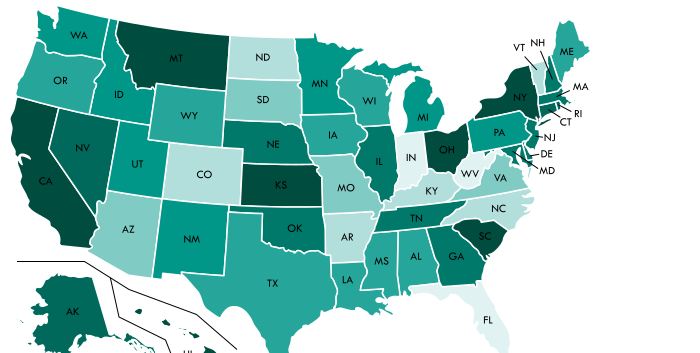
Most common states for molecular research technologists
| Rank | State | Population | # of jobs | Employment/ 1000ppl |
|---|---|---|---|---|
| 1 | Massachusetts | 6,859,819 | 2,244 | 33% |
| 2 | District of Columbia | 693,972 | 187 | 27% |
| 3 | Vermont | 623,657 | 143 | 23% |
| 4 | New Hampshire | 1,342,795 | 265 | 20% |
| 5 | Rhode Island | 1,059,639 | 205 | 19% |
| 6 | Colorado | 5,607,154 | 991 | 18% |
| 7 | Maryland | 6,052,177 | 1,017 | 17% |
| 8 | Oregon | 4,142,776 | 699 | 17% |
| 9 | South Dakota | 869,666 | 135 | 16% |
| 10 | North Dakota | 755,393 | 118 | 16% |
| 11 | Wyoming | 579,315 | 94 | 16% |
| 12 | Nebraska | 1,920,076 | 296 | 15% |
| 13 | Maine | 1,335,907 | 199 | 15% |
| 14 | Delaware | 961,939 | 145 | 15% |
| 15 | New Jersey | 9,005,644 | 1,242 | 14% |
| 16 | Virginia | 8,470,020 | 1,179 | 14% |
| 17 | Washington | 7,405,743 | 1,004 | 14% |
| 18 | Connecticut | 3,588,184 | 517 | 14% |
| 19 | Montana | 1,050,493 | 149 | 14% |
| 20 | Alaska | 739,795 | 99 | 13% |
Most common cities for molecular research technologists
| Rank | City | # of jobs | Employment/ 1000ppl | Avg. salary |
|---|---|---|---|---|
| 1 | Boston | 1 | 0% | $62,355 |
| 2 | Washington | 1 | 0% | $60,357 |
Molecular Research Technologist job outlook: Expert opinions
Our panel of molecular research technologist experts

Duquesne University
University of St Andrews

Montana State University
Elizabethtown College

East Tennessee State University
Christopher Newport University

University of Akron
Portland State University

Stonehill College

Christian Brothers University
University of Maryland
La Sierra University
Jan Levine
Professor of Law and Director, Legal Research & Writing ProgramDuquesne University
School of Law
What hard/technical skills are most important for Molecular Research Technologists?
Jan Levine: Understanding how to plan a research effort, knowing how to update research, so it is timely, finding materials online and in print (which is often ignored or downplayed), demonstrating a critical examination of sources (i.e., reading them closely and coming up with an independent professional assessment of the reliability and validity of the materials), and knowing to find and use non-legal sources of information to apply to a legal problem (including talking with experts, going beyond online and print research). Plus, good researchers know how to use librarians and secondary sources of the law to expand the scope of their work and to be more efficient in their research (both in time and cost). Finally, the ability to organize material is crucial to a well-conducted search for material.
Dr. Jeffrey Hughes
Deputy DirectorUniversity of St Andrews
Graduate School for Interdisciplinary Studies
What soft skills should all Molecular Research Technologists possess?
Dr. Jeffrey Hughes: The ability to communicate to academics and practitioners from out-with immediate disciplinary boundaries. The ability to listen to differing perspectives and work to understand differing perspectives through bridging knowledge gaps.
Dr. Walter Fleming Ph.D.
Department Head and ProfessorMontana State University
Department of Native American Studies
Will there be an enduring impact of the coronavirus pandemic on Molecular Research Technologists?
Dr. Walter Fleming Ph.D.: The pandemic has been particularly difficult for Native communities and other people of color, as well as people living in pockets of poverty. Many people in indigenous communities have passed away due to complications of COVID. Native communities have been hit particularly hard because of the already high health disparities, such as heart disease and diabetes. Much cultural knowledge has been lost because of the high toll among our Elders. It will no doubt take generations to recover from the loss of knowledge due to COVID 19, if at all. As they say, when an Elder dies, it is like a library has burned down.
Graduates in ethnic studies should be aware that these communities have many challenges and have already experienced historical trauma. The communities are looking to rebuild and reestablish their infrastructures and lifeways.
David Brown
Professor of HistoryElizabethtown College
History Department
What soft skills should all Molecular Research Technologists possess?
David Brown: It's critical to be able to work as a team. Empathy, understanding, a bit of diplomacy, and integrity - aside from the obvious need of technical competency - are highly valued. As always, motivation is terribly important and this can be conjoined with flexibility. If energy and attitude remain positive this will rub off on others and create an attractive dynamic that draws people in. Finally, the ability to make a decision and follow through with it is perhaps too little appreciated.
What certifications/licenses/courses can have the biggest impact for Molecular Research Technologists?
Paul Trogen Ph.D.: Some surveys suggest that as many as half of local government jobs may be filled by business graduates. One should take courses similar to what those business students study. One of our graduate students surveyed local governments, and found the skills most in demand included accounting, human resource management, budgeting, public relations, and risk management. The ability to use spreadsheets and communicate clearly with tables and graphs helps. Quantitative skills like linear programming, PERT/CPM, inventory models, and queuing theory will make you an indispensable problem solver. Some high demand niches that are unique to the public sector include geographic information systems (GIS), city planning, and economic development. Hard skills will increase your chances of landing an interview.
Janet Steven Ph.D.
Associate ProfessorChristopher Newport University
Organismal and Environmental Biology
What are the biggest trends we'll see in the Molecular Research Technologist job market given the pandemic?
Janet Steven Ph.D.: Clearly the pandemic will create a demand for biology graduates working in human health and health care. Not just as care providers like doctors and nurses, but also in epidemiology, public health policy, emergency planning, medical ethics, and many other allied fields.
What certifications/licenses/courses can have the biggest impact for Molecular Research Technologists?
Janet Steven Ph.D.: Some careers in biology do require specific certifications, but there are many fields where experience outside the classroom has the biggest impact on job prospects. Spending a summer or two working in the field you are interested in building both your resume and your network. Courses that apply subject matter to hands-on experiences and real-world decisions are also valuable.
What certifications/licenses/courses can have the biggest impact for Molecular Research Technologists?
Dr. Bill Lyons: Conflict Management/Transformation skills. Quantitative analysis skills. Writing skills. Creativity and imagination skills developed in the arts.
Will there be an enduring impact of the coronavirus pandemic on Molecular Research Technologists?
David Cadiz MBA, Ph.D.: Yes, I believe there will definitely be an enduring impact of the pandemic on graduates. First, depending on how quickly the new graduate is able to secure a job post-graduation. If a graduate is unable to get a job in the HR profession for an extended period of time, this could hold them back in terms of advancing their career because the HR profession deals with the ambiguities and sometimes unpredictable nature of human behavior; knowing how to manage these comes with experience. Second, a lot of graduates are going to face a different workplace, especially with work transitioning to be more virtual. We were starting to see organizations rethink the idea that everyone has to come into a central location to complete their work, and this trend has only increased during the pandemic. This means, that as an HR professional, you may be in a physically different location than your colleagues, and so trying to establish relationships and connecting with employees will need to be done through technology. Third, I think because the students have had to be so adaptable and resilient in order to complete their degree, this will translate into a long-term strength in terms of their ability to deal and manage the variety of situations that they will face once they are in the workforce.
What technology do you think will become more important and prevalent for Molecular Research Technologists in the next 3-5 years?
David Simon: Two closely related areas of technology will have a particularly large impact on the careers of young physicists in coming years: quantum technology and photonics.
With the surge in interest in quantum computation and related areas such as quantum cryptography, quantum communication, and quantum sensing, working knowledge of quantum mechanics has become a valuable asset for job seekers. In the past ten years, many start-up companies have appeared whose purpose has been to bring formerly exotic quantum protocols and quantum technologies to life in practical, real-world applications. Many tech giants like Apple, IBM, Microsoft, and Google have also recently founded initiatives along the same lines. So, these quantum technology companies have become a valuable source of potential jobs for new graduates who have a strong grounding in quantum mechanics, combined with either solid computational or experimental skills.
One other rapidly growing source of potential employment for new physics graduates in photonics, the science and application of light-based technologies. Photonics has an enormous range of applications that includes fiber-optic communication networks, self-driving cars, remote sensing for archeology, biomedical imaging, and remote detection of environmental hazards. Photonic devices are also one of the most promising platforms for the quantum technologies mentioned above, as well as being a key tool for many areas of fundamental science such as quantum optics and atomic physics. Non-academic jobs in photonics-related industries have been exploding in recent years, but the academic world has been slow to keep up: there is a widely recognized shortage of dedicated photonics programs at the undergraduate level. So, a student who graduates from a physics program with a strong background in optics and electronics is likely to find themselves with a wide variety of options in photonics-related careers.
Dr. Neal Palmer Ph.D.
Chair, Associate ProfessorChristian Brothers University
Department of History and Political Science
How do you envision technology impacting Molecular Research Technologists in the next 5 years?
Dr. Neal Palmer Ph.D.: History, like all fields, will surely move to more virtual forms of communication and internet-based work. I think history majors and professors will continue to become more creative and skilled in their use of technology to communicate, teach, and research. I expect professional historians will increasingly use virtual platforms to share their research and communicate with the general public. I expect history majors to enter the workforce with increased comfort, confidence, and knowledge regarding technology.
Crystal Sehlke
Program Director,University of Maryland
College of Behavioral and Social Sciences
Will there be an enduring impact of the coronavirus pandemic on Molecular Research Technologists?
Crystal Sehlke: Almost certainly, but the impact will endure longer in some interest fields than others; for example, the hospitality and travel industries, where the impact has been so devastating, will probably not recover quickly once the pandemic has subsided. However, many fields still need the skills our social science students possess, including their quantitative skills/tools, scientific inquiry, and critical thinking skills, and thus will still have options. The biggest problem will be graduates of 2020 competing head-to-head with graduates of 2021-much like traffic backing up on an overcrowded interstate. Graduates that pivot effectively to other fields will fare better than those who wait for conditions in the primary interest field to improve.
Will there be an enduring impact of the coronavirus pandemic on Molecular Research Technologists?
Friedbert Ninow Ph.D.: The pandemic will force us to recognize our vulnerabilities - issues like mental health, coping with physical distancing, acknowledging our fears and worries.
Maintaining social closeness in physical distancing will require us to focus on skill sets we have not emphasized that much before.