Explore jobs
Find specific jobs
Explore careers
Explore professions
Best companies
Explore companies
Job outlook for network design engineers in the United States
Network design engineer job growth summary. After extensive research, interviews, and analysis, Zippia's data science team found that:
The projected network design engineer job growth rate is 5% from 2018-2028.
About 18,200 new jobs for network design engineers are projected over the next decade.
Network design engineer salaries have increased 9% for network design engineers in the last 5 years.
There are over 101,204 network design engineers currently employed in the United States.
There are 80,300 active network design engineer job openings in the US.
The average network design engineer salary is $101,135.
Are network design engineer jobs in demand?
Network design engineer job and salary trends over time
Network design engineer jobs over time
Network design engineer job growth rate over time
| Year | # of jobs | % of population |
|---|---|---|
| 2021 | 101,204 | 0.03% |
| 2020 | 73,924 | 0.02% |
| 2019 | 40,405 | 0.01% |
| 2018 | 35,874 | 0.01% |
| 2017 | 36,746 | 0.01% |
Average network design engineer salary over time
Network design engineer salary by year
| Year | Avg. salary | Hourly rate | % Change |
|---|---|---|---|
| 2025 | $101,135 | $48.62 | +3.4% |
| 2024 | $97,803 | $47.02 | +2.3% |
| 2023 | $95,588 | $45.96 | +1.2% |
| 2022 | $94,482 | $45.42 | +1.8% |
| 2021 | $92,851 | $44.64 | +2.4% |
Network design engineer jobs by state
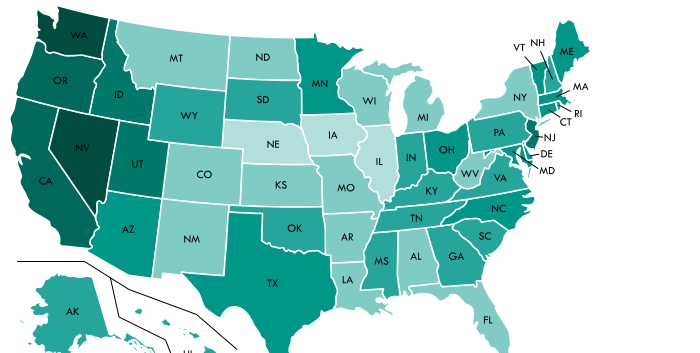
Most common states for network design engineers
| Rank | State | Population | # of jobs | Employment/ 1000ppl |
|---|---|---|---|---|
| 1 | District of Columbia | 693,972 | 536 | 77% |
| 2 | Virginia | 8,470,020 | 2,342 | 28% |
| 3 | Maryland | 6,052,177 | 1,419 | 23% |
| 4 | Massachusetts | 6,859,819 | 1,379 | 20% |
| 5 | Alaska | 739,795 | 151 | 20% |
| 6 | Colorado | 5,607,154 | 1,083 | 19% |
| 7 | Oregon | 4,142,776 | 738 | 18% |
| 8 | Vermont | 623,657 | 114 | 18% |
| 9 | Delaware | 961,939 | 160 | 17% |
| 10 | California | 39,536,653 | 6,009 | 15% |
| 11 | Washington | 7,405,743 | 1,142 | 15% |
| 12 | Utah | 3,101,833 | 480 | 15% |
| 13 | New Hampshire | 1,342,795 | 207 | 15% |
| 14 | Minnesota | 5,576,606 | 711 | 13% |
| 15 | North Dakota | 755,393 | 98 | 13% |
| 16 | Wyoming | 579,315 | 73 | 13% |
| 17 | Arizona | 7,016,270 | 834 | 12% |
| 18 | Alabama | 4,874,747 | 592 | 12% |
| 19 | Rhode Island | 1,059,639 | 132 | 12% |
| 20 | North Carolina | 10,273,419 | 1,137 | 11% |
Most common cities for network design engineers
| Rank | City | # of jobs | Employment/ 1000ppl | Avg. salary |
|---|---|---|---|---|
| 1 | Annapolis | 2 | 5% | $94,742 |
| 2 | Huntsville | 4 | 2% | $83,640 |
| 3 | Harrisburg | 1 | 2% | $90,906 |
| 4 | Pittsburgh | 2 | 1% | $87,922 |
| 5 | Newton | 1 | 1% | $96,916 |
| 6 | Springfield | 1 | 1% | $76,350 |
| 7 | Trenton | 1 | 1% | $104,311 |
| 8 | Baltimore | 2 | 0% | $94,771 |
| 9 | Washington | 2 | 0% | $94,269 |
Network Design Engineer job outlook: Expert opinions
Our panel of network design engineer experts
California State University - East Bay
Arizona State University

University of Washington

Bakersfield College
Portland State University
University of Colorado at Colorado Springs

Pennsylvania State University - Great Valley
Dr. Bobby Roohparvar Ph.D.
Professor of Computer Science and Computer EngineeringCalifornia State University - East Bay
Computer Systems Networking And Telecommunications
What general advice would you give to a Network Design Engineer?
Dr. Bobby Roohparvar Ph.D.: *The anxiety of AI is likely to change the landscape of computer networking, is a real threat but in my opinion, it won't eliminate the need for human network engineers. The focus will likely shift towards more strategic tasks, complex problem-solving, and leveraging AI tools to improve network efficiency and security.*
*Here again, I will explain in more detail about the expectation and future of Comp. Network Eng.*
* 1. AI Augments, Not Replaces: While AI can automate some network tasks, like data analysis and basic troubleshooting, it won't replace the need for human network engineers. It will increase the productivity for sure; Complex problem-solving, strategic decision-making, and human judgment are still crucial in network management. AI will likely become a valuable tool that assists network engineers in their tasks, making them more efficient.*
*2. Growing Demand: Our reliance on technology and data is constantly increasing. Businesses and organizations need secure, reliable networks to function. This necessitates a skilled workforce to design, implement, maintain, and secure these networks. The demand for qualified network engineers is expected to grow in the coming years.*
*In our technology horizon, I can see the quantum internet coming and I can see the demand for network engineering accelerate.*
*3. Diverse Skillset: A strong foundation in computer networking equips you with a versatile skillset. You'll understand network protocols, security concepts, and troubleshooting methodologies. These skills are valuable across the IT field and can be applied to areas like cloud computing, data center operations, or even cybersecurity. Data Centers for AI are becoming a huge opportunity for Comp Network Eng.*
What Network Design Engineer skills would you recommend for someone trying to advance their career?
Dr. Bobby Roohparvar Ph.D.: *Favor:*
*Variety: Each day presents new challenges and opportunities for problem-solving.*
*Demand: The field offers strong job growth and stability.*
*Impact: Your work ensures businesses and organizations remain connected and operational.*
*Learning: There's always something new to learn with emerging technologies.*
*Dislike:*
*Troubleshooting: Issues can be complex and take a lot of time to resolve.*
*On-call: Network problems can occur at any time, requiring on-call availability.*
*Pressure: Maintaining network uptime can be stressful, especially during critical periods.*
*Keeping Up-to-Date: Rapid technological changes necessitate continuous learning.*
What will help Network Design Engineers increase their earning potential?
Dr. Bobby Roohparvar Ph.D.: *Computer Networking Engineers are crucial in designing, building, maintaining, and troubleshooting complex networks. They need strong technical skills, analytical abilities, and strategic thinking to ensure smooth network operations.*
*A bit more detailed explanation of the Computer Networking Engineers responsibility:*
*Designing and Implementing Networks: This essential task involves creating new networks or significantly upgrading existing ones. It includes understanding organizational requirements, planning capacity, selecting the right hardware and software, and configuring these components for optimal performance and security.*
*Network Automation: Engineers automate routine tasks using scripting languages like Python or tools such as Cisco automation software. This automation not only saves time but also ensures consistent configurations.*
*Troubleshooting Complex Issues: They tackle intricate network problems by analyzing traffic patterns, identifying bottlenecks, optimizing performance, and resolving complex connectivity or security issues.*
*Staying Updated with Technology: As the networking field evolves rapidly, engineers must keep up with new technologies, emerging security threats, and best practices through conferences, online forums, and continuous learning.*
Laura Kier
Network Design and Administration InstructorWhat general advice would you give to a Network Design Engineer?
Laura Kier: Students graduating from the Computer Network Design and Administration program will enter the job market with a solid foundation in networking technologies. Above that they should also be able to develop and demonstrate excellent communication and interpersonal skills. Networking has a strong emphasis on teamwork and being able to communicate well with customers, co-workers and teammates is vital. Attaining certifications in Cisco, Linux, Windows, and security will also help the student stand out within the industry (classes in the program help to learn the knowledge needed to attain certifications). Students should participate in any local or online communities and groups to enhance skills and knowledge and find networking opportunities.
Philip Horton
Interim School Director, Clinical Assistant ProfessorArizona State University
The Design School, Herberger Institute for Design and the Arts
Will there be an enduring impact of the coronavirus pandemic on Network Design Engineers?
Philip Horton: I think there will be a few enduring impacts.
One impact is that there has been a bit of a slow down in the market for a number of firms, due to the economic impacts of the pandemic. But an imminent stimulus package will hopefully provide a fairly quick course correction there.
More enduring is that much of the professional world has learned to work remotely -- at-scale -- over the last year. So how we work and collaborate on projects will continue to transform beyond the pandemic.
Also, public spaces, offices, restaurants, and retail have all been impacted by the pandemic. Many have made tactical changes to the designs of their physical environments and to their services. These responses, and uncertainty about future public health concerns, will change the way we design spaces and services going forward.
Will there be an enduring impact of the coronavirus pandemic on Network Design Engineers?
Les Atlas: Most certainly an impact, a very strong impact. The best lesson for us is from the 1919 Spanish Flu pandemic. That strain of flu still circulates as a seasonal virus. Over 100 years laters, it is now considered a Phase 6 pandemic by the World Health Organization. While it is reduced due to current social distancing and mask wearing, the 1919 Spanish Flu virus still causes community-level outbreaks in multiple parts of the globe. Societal changes from this event of over 100 years ago are still with us.
In fact, they changed society. As is well-documented, after a high level of immunity was reached in the 1920's, the resulting labor shortage enabled workers to demand better living and working conditions, as well as better wages and public health care. As just one example of the societal changes due to the 1919 pandemic, the drop in the male labor force empowered male workers, and also changed the gender composition.
The aftermath of the 1919 pandemic was the start of women joining the labour force. In the United States, the proportion of women in the labour force rose from 18 per cent in 1900 to almost 21 per cent in 1920. In that same year, with the ratification of the 19th Amendment of the Constitution, the Congress of the United States guaranteed all American women the right to vote.
The current COVID-19 pandemic will certainly change the way we live, be it our mobility or the kinds of career options people have. After our current year-long experience in remote learning and work, will we go back to the inefficiencies of going to our office every work day? Or will remote work be acceptable, where one's residence will not be dependent upon the locations of employment. Will we avoid future hotspots of infection, choosing to instead reside and travel in areas where infection is decreasing? Will we prefer to travel on aircraft which are certified to be virus-free and frequent restaurants which are documented to be safer? Future marketing will likely make a sharp turn in this direction.
What type of skills will young Network Design Engineers need?
Les Atlas: With an expected increase in mobility, companies will have a larger pool of employees to search over and interview. Potentially orders of magnitude more. Searches for employees need not be regional. Thus, if a specific specialization is needed, the pool of applicants, which will likely come from a search over a large region, state-wide or larger, or even international.
Thus specializations will become more important, both in terms of depth and fit to the needs of an employer. Advanced graduate degrees will become more necessary. It seems very likely that filed which help understand data for epidemiology and disease forecasting and geographical hotspots will continue to be especially pertinent.
What general advice would you give to a Network Design Engineer?
Maryam Farahani: Thinking about the fields they want to experience or try. And to be intentional about their job search. The best advice is learning as much as they can about what company offers. Visualizing themselves in the next 5 years as a starting point. Do they want to travel a lot, or be in management positions? Do they want to be subject matter expert, or a hands-on engineer or technologist? Their goal may change as they progress in their career but having one makes a big difference in their career choices and keeping them on track.
Dr. Wayne Wakeland Ph.D.
Professor and Systems Science Program ChairPortland State University
Systems science program
What Network Design Engineer skills would you recommend for someone trying to advance their career?
Dr. Wayne Wakeland Ph.D.: For analyst positions, I think that employers want to hire people with strong data analysis skills, which, of course, includes statistics, but also big data, machine learning (algorithms), computer-based modeling, and programming. And, in addition to these apparently rather specialized skills, there is growing recognition that a talent for thinking, communicating, and problem-solving in a very general sense, and being able to cope with/address complexity, is also quite important.
Dr. T.S. Kalkur
Department ChairUniversity of Colorado at Colorado Springs
Electrical and Computer Engineering Department
Will there be an enduring impact of the coronavirus pandemic on Network Design Engineers?
Dr. T.S. Kalkur: Yes, students complained that, while they are earning an online degree, they aren't learning as much.
What experience really stands out on Network Design Engineer resumes?
Nil Ergin Ph.D.: Knowledge of analytical skills, methods, and tools for analysis, design, and management of complex systems and experience working with interdisciplinary teams are essential for systems engineering professionals. Experience in applying systems thinking and design thinking approaches to understanding organization, technical, and non-technical factors that influence the design and performance of complex systems stands out on resumes.