Explore jobs
Find specific jobs
Explore careers
Explore professions
Best companies
Explore companies
Job outlook for network/server administrators in the United States
Network/server administrator job growth summary. After extensive research, interviews, and analysis, Zippia's data science team found that:
The projected network/server administrator job growth rate is 5% from 2018-2028.
About 18,200 new jobs for network/server administrators are projected over the next decade.
Network/server administrator salaries have increased 9% for network/server administrators in the last 5 years.
There are over 252,992 network/server administrators currently employed in the United States.
There are 167,546 active network/server administrator job openings in the US.
The average network/server administrator salary is $78,919.
Are network/server administrator jobs in demand?
Network/server administrator job and salary trends over time
Network/server administrator jobs over time
Network/server administrator job growth rate over time
| Year | # of jobs | % of population |
|---|---|---|
| 2021 | 252,992 | 0.08% |
| 2020 | 317,337 | 0.09% |
| 2019 | 222,375 | 0.07% |
| 2018 | 114,478 | 0.03% |
| 2017 | 117,225 | 0.04% |
Average network/server administrator salary over time
Network/server administrator salary by year
| Year | Avg. salary | Hourly rate | % Change |
|---|---|---|---|
| 2026 | $78,919 | $37.94 | +3.4% |
| 2025 | $76,319 | $36.69 | +2.3% |
| 2024 | $74,591 | $35.86 | +1.2% |
| 2023 | $73,727 | $35.45 | +1.8% |
| 2022 | $72,454 | $34.83 | +2.4% |
Network/server administrator jobs by state
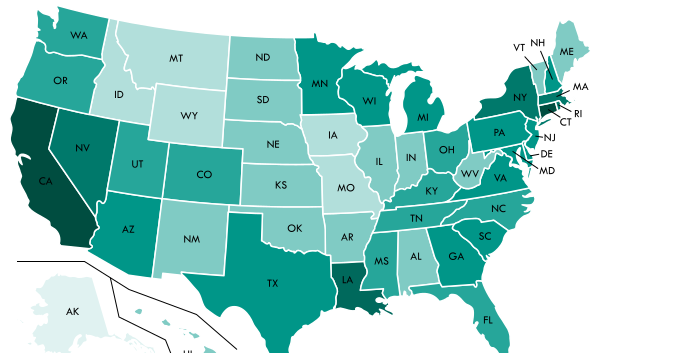
Most common states for network/server administrators
| Rank | State | Population | # of jobs | Employment/ 1000ppl |
|---|---|---|---|---|
| 1 | District of Columbia | 693,972 | 538 | 78% |
| 2 | Virginia | 8,470,020 | 3,096 | 37% |
| 3 | Colorado | 5,607,154 | 2,054 | 37% |
| 4 | Maryland | 6,052,177 | 2,074 | 34% |
| 5 | New Hampshire | 1,342,795 | 370 | 28% |
| 6 | Alaska | 739,795 | 203 | 27% |
| 7 | Wyoming | 579,315 | 157 | 27% |
| 8 | Utah | 3,101,833 | 787 | 25% |
| 9 | Delaware | 961,939 | 236 | 25% |
| 10 | Vermont | 623,657 | 153 | 25% |
| 11 | Massachusetts | 6,859,819 | 1,652 | 24% |
| 12 | Alabama | 4,874,747 | 1,034 | 21% |
| 13 | Montana | 1,050,493 | 224 | 21% |
| 14 | Rhode Island | 1,059,639 | 219 | 21% |
| 15 | North Carolina | 10,273,419 | 2,045 | 20% |
| 16 | Oregon | 4,142,776 | 825 | 20% |
| 17 | West Virginia | 1,815,857 | 369 | 20% |
| 18 | Georgia | 10,429,379 | 2,030 | 19% |
| 19 | South Carolina | 5,024,369 | 941 | 19% |
| 20 | Connecticut | 3,588,184 | 697 | 19% |
Most common cities for network/server administrators
| Rank | City | # of jobs | Employment/ 1000ppl | Avg. salary |
|---|---|---|---|---|
| 1 | East Windsor | 1 | 4% | $79,703 |
| 2 | Rock Island | 1 | 3% | $68,492 |
| 3 | Dothan | 1 | 1% | $71,138 |
| 4 | Germantown | 1 | 1% | $78,569 |
| 5 | Irvine | 1 | 0% | $93,062 |
| 6 | Jacksonville | 1 | 0% | $72,052 |
| 7 | San Antonio | 1 | 0% | $78,111 |
| 8 | San Juan | 1 | 0% | $54,216 |
| 9 | Washington | 1 | 0% | $78,338 |
Network/Server Administrator job outlook: Expert opinions
Our panel of network/server administrator experts
University of South Alabama
University of Nebraska - Omaha
Stevens Institute of Technology
Massachusetts Maritime Academy
Worcester Polytechnic Institute

University of Washington

Bakersfield College
Portland State University

Ohio University

Wesleyan College
University of Colorado at Colorado Springs

Tarleton State University

University of Illinois at Chicago

Springfield College

University of Hawai'i West O'ahu

University of New Hampshire

DePaul University

Texas A&M University - Kingsville
What general advice would you give to a Network/Server Administrator?
Sean Walker: Model Based Systems Engineering (MBSE) and Artificial Intelligence (AI) are going to be incredibly important in Systems Engineering over the next 3-5 years. MBSE has already become quintessential to the practice of Systems Engineering, which is why it has become a staple of our Master's and Doctoral programs. AI, of course, is changing almost every technical field and will be important to Systems Engineers as well. For Systems Engineers, the challenge will be understanding how and when to apply AI to solve systemic problems. Of course, both of these elements must be applied with an understanding of sociotechnical systems concerns. An engineer with the skills to apply MBSE and AI without losing sight of the humans in the system will be highly sought after.
What Network/Server Administrator skills would you recommend for someone trying to advance their career?
Sean Walker: To maximize your salary, it is really essential to learn the tools and methods associated with Systems Engineering while also maintaining a sense of creativity. Employers are not only looking for engineers with the ability to apply specific tools but also the ability to think creatively to solve complex systems problems. I often encourage my students to maintain their creative hobbies so that they don't lose those skills. But, more immediately, gaining a graduate education in Systems Engineering can help any engineer increase their earning potential.
What will help Network/Server Administrators increase their earning potential?
Sean Walker: I think the best advice for a new Systems Engineer, or really any engineer, is to be observant. One of the best things you can do when starting to apply the theoretical aspects that you've learned in school to your new career is to watch and listen to how experienced Systems Engineers practice in the field. This doesn't mean that you can't offer ideas or perspectives that are new, but that there will be challenges in your field that - due to the breadth of Systems Engineering - may not have been covered in your education.
What general advice would you give to a Network/Server Administrator?
Dr. Joseph Oluwole: The ability to build and sustain relationships with staff for climate and culture and with parents for family and community relations, all to support the holistic success of students.
What Network/Server Administrator skills would you recommend for someone trying to advance their career?
Dr. Joseph Oluwole: Gain as much leadership experience as possible before taking your first job by volunteering for various roles, opportunities, and committees at your school. Additionally, pursuing a doctorate (whether an Ed.D. or Ph.D.) could be very helpful in maximizing your salary potential.
What will help Network/Server Administrators increase their earning potential?
Dr. Joseph Oluwole: My general advice is to seek out administrator and professor mentors who can provide a sounding board and encouragement through the emotional roller coaster that administration can be. I cannot overstate the importance of supportive mentors to the success of a new graduate beginning as an administrator. Even the State of New Jersey, for instance, recognizes the importance of mentoring and created a formal program for new assistant principals and principals to seek support from experienced mentors under the state's New Jersey Leaders to Leaders (NJL2L) program.
What general advice would you give to a Network/Server Administrator?
Janice Garnett Ed.D.: Negotiate based on research, develop a career development plan, focus on enhancing performance, professional growth, and continuous learning.
What Network/Server Administrator skills would you recommend for someone trying to advance their career?
Janice Garnett Ed.D.: New leaders must balance their vision with the realities and priorities of the school and/or school district. In other words, begin by developing an entry plan to learn and understand existing budget(s), staffing, community, and other priority needs of the school and/or district. Include in the plan how you will focus on relationships to build trust and rapport with all stakeholders. A communication plan with transparent messages and ample active listening will be key. The educational landscape constantly evolves, calling for continuous learning through professional development, networking, and mentorship.
What will help Network/Server Administrators increase their earning potential?
Janice Garnett Ed.D.: Being a future-ready leader, Utilizing data-driven decision-making, Leading culturally responsive schools, Leading learning through instructional leadership, Championing Social-Emotional Learning (SEL).
What general advice would you give to a Network/Server Administrator?
Anthony Barrese: Pursue opportunities to broaden your experience across systems engineering, development, integration and test, field sales support and professional services positions. Generalist experience becomes invaluable with career advancement. Running a team is much more feasible for leaders who understand the process behind the work their reports deliver.
What Network/Server Administrator skills would you recommend for someone trying to advance their career?
Anthony Barrese: There are many paths leading to increased salary potential. Rapidly developing a deep understanding of customer environments and needs can be one of those, but is often not sufficient on its own. Cultivating strong communication skills, building relationships across the business and distinguishing yourself as a leader will all position you for career advancement and the compensation increases that go along with that.
What will help Network/Server Administrators increase their earning potential?
Anthony Barrese: The ability to listen to the customer is the most critical skill. Deeply understanding the needs of the end user ensures business success. In addition, digital engineering environments and digital twin technology in particular, will become increasingly important. These tools enable gains in efficiency and promote enhanced quality.
What general advice would you give to a Network/Server Administrator?
Mark Whalen P.E.: A system engineer designs, develops, and manages complex technical systems across a large variety of industries. This can include defining solutions to system-level problems, plus allocating requirements, technologies and team member tasking at a project level, as well as communicating complex ideas and systems to key stakeholders.
An entry-level system engineer will typically apply advanced mathematical techniques to solve system-level technical problems, as well as installing, testing, and troubleshooting complex operating systems
What Network/Server Administrator skills would you recommend for someone trying to advance their career?
Mark Whalen P.E.: Many system engineers enjoy working across all technologies at a higher organizational level, and interacting with all types of technologists to manage and implement complex technical systems.
Many system engineers can feel challenged by their lack of depth of understanding of particular technologies compared to technical specialists.
What will help Network/Server Administrators increase their earning potential?
Mark Whalen P.E.: There are many complex systems in existence or being developed that require knowledge and experience across many different technologies. Also, system engineering careers can often lead to managerial positions like becoming a project manager, operations manager or chief engineer.
What general advice would you give to a Network/Server Administrator?
Don Gelosh Ph.D.: Systems Engineering is a contact sport. As a systems engineer you are expected to be a leader.
Successful systems engineers are those who get out of their office and engage with other
engineers and technicians who work on complex systems. On any given day, systems engineers
could be working on a team, possibly leading that team, in one of the several phases of the
design and development effort. They may be working with stakeholders to determine their
requirements for the complex system or they may be working with validation test engineers to
determine if the complex system will satisfy the stakeholders needs.
While it would be expected that you are very knowledgeable in a few discipline areas, such as
electrical, mechanical or chemical engineering, you are not expected to be an expert in all
areas. However, you would be expected to know the experts in those fields and others and
how they should be involved in the overall development process. You would be expected to
understand the many processes of systems engineering and how each process contributes to
the success of the complex system.
You would also be expected to thoroughly understand any other systems and the operational
environment that will interface and interact with your system. As a systems engineer, you
would be expected to understand the big picture of the complex system.
What Network/Server Administrator skills would you recommend for someone trying to advance their career?
Don Gelosh Ph.D.: Being a systems engineer provides you with many opportunities to learn and grow. Systems engineers
have the opportunity to learn all they can about a specific engineering discipline field of choice (i.e.,
electrical, mechanical, chemical, power, etc.). Systems engineers are also expected to learn in general
what engineers and technicians in other disciplines do on a daily basis. Systems engineers should talk to
other systems engineers about their daily activities as much as possible. Systems engineers should learn
how to lead people and manage resources; they should learn how to both lead and serve on teams.
Systems engineers should prepare themselves through education, training, and experience for
opportunities to grow and take on new responsibilities.
One dislike may be the long hours in dealing with the challenges of developing complex systems.
However, if you enjoy this type of work, the rewards of leading and managing the creation of successful
systems will be worth the effort it takes.
What will help Network/Server Administrators increase their earning potential?
Don Gelosh Ph.D.: There is a great demand for those who can understand the big picture as well as knowing the
smallest detail in the development and delivery of complex systems. It is very important that
everyone involved in the engineering of complex systems works from the same requirements
and understands the intended operational environment. Systems engineers facilitate this
common understanding of the target system, interconnected systems and the operational
environment.
Today's advanced technology and systems that utilize that technology are increasingly
becoming more complex and more challenging to develop and deliver. This requires a different
type of engineer, one who has both in-depth technical knowledge and leadership skills.
Systems engineers who understand these requirements and can deliver successful complex
systems will always be in demand.
Laura Kier
Network Design and Administration InstructorWhat general advice would you give to a Network/Server Administrator?
Laura Kier: Students graduating from the Computer Network Design and Administration program will enter the job market with a solid foundation in networking technologies. Above that they should also be able to develop and demonstrate excellent communication and interpersonal skills. Networking has a strong emphasis on teamwork and being able to communicate well with customers, co-workers and teammates is vital. Attaining certifications in Cisco, Linux, Windows, and security will also help the student stand out within the industry (classes in the program help to learn the knowledge needed to attain certifications). Students should participate in any local or online communities and groups to enhance skills and knowledge and find networking opportunities.
What Network/Server Administrator skills would you recommend for someone trying to advance their career?
Laura Kier: Computer Networking is a dynamic field with a wide variety of opportunities in many different industries. Some skills that will be more important in general are skills in software defined networking and automation. Skills in the DevOps field will be necessary, as well as skills leveraging AI tools. Cybersecurity is always important and using AI tools to enhance security and monitoring is necessary.
What will help Network/Server Administrators increase their earning potential?
Laura Kier: Learn to present your skills well from the interview and into your career. Those communication skills count! Industry certifications like CCNA matter. They help you demonstrate a willingness to grow and learn beyond what was required for your degree. Be willing to take on new challenges with your new job and keep learning new skills. It is really important for graduates to understand that talented IT professionals can move up quickly in a company, but they often must start at the bottom to showcase their technical and soft skills. Because of that, they should not shy away from entry level jobs if there is potential for growth.
What type of skills will young Network/Server Administrators need?
Les Atlas: With an expected increase in mobility, companies will have a larger pool of employees to search over and interview. Potentially orders of magnitude more. Searches for employees need not be regional. Thus, if a specific specialization is needed, the pool of applicants, which will likely come from a search over a large region, state-wide or larger, or even international.
Thus specializations will become more important, both in terms of depth and fit to the needs of an employer. Advanced graduate degrees will become more necessary. It seems very likely that filed which help understand data for epidemiology and disease forecasting and geographical hotspots will continue to be especially pertinent.
Will there be an enduring impact of the coronavirus pandemic on Network/Server Administrators?
Les Atlas: Most certainly an impact, a very strong impact. The best lesson for us is from the 1919 Spanish Flu pandemic. That strain of flu still circulates as a seasonal virus. Over 100 years laters, it is now considered a Phase 6 pandemic by the World Health Organization. While it is reduced due to current social distancing and mask wearing, the 1919 Spanish Flu virus still causes community-level outbreaks in multiple parts of the globe. Societal changes from this event of over 100 years ago are still with us.
In fact, they changed society. As is well-documented, after a high level of immunity was reached in the 1920's, the resulting labor shortage enabled workers to demand better living and working conditions, as well as better wages and public health care. As just one example of the societal changes due to the 1919 pandemic, the drop in the male labor force empowered male workers, and also changed the gender composition.
The aftermath of the 1919 pandemic was the start of women joining the labour force. In the United States, the proportion of women in the labour force rose from 18 per cent in 1900 to almost 21 per cent in 1920. In that same year, with the ratification of the 19th Amendment of the Constitution, the Congress of the United States guaranteed all American women the right to vote.
The current COVID-19 pandemic will certainly change the way we live, be it our mobility or the kinds of career options people have. After our current year-long experience in remote learning and work, will we go back to the inefficiencies of going to our office every work day? Or will remote work be acceptable, where one's residence will not be dependent upon the locations of employment. Will we avoid future hotspots of infection, choosing to instead reside and travel in areas where infection is decreasing? Will we prefer to travel on aircraft which are certified to be virus-free and frequent restaurants which are documented to be safer? Future marketing will likely make a sharp turn in this direction.
What experience really stands out on Network/Server Administrator resumes?
Les Atlas: The most obvious experience, in terms of being timely, is work with the science and data interpretation from the current pandemic. Epidemiology and statistics, computer science, and data science for data from the COVID-19 epidemic and similar public health data will remain on the forefront. In the many other areas of technology, having up to date skills, with advanced degrees, combined with the ability to work anywhere in the world, not by traveling, but instead remotely, will likely fit most future positions.
What are the biggest trends we'll see in the Network/Server Administrator job market given the pandemic?
Maryam Farahani: In my opinion, technology will play a much bigger role in our day-to-day life compared to the pre-pandemic world. Artificial intelligence and robotics will have a boost in employment numbers. Companies like Amazon, Walmart, Targets and etc, will need more IT and technology specialists to meet their customer's need for online shopping and supplying/delivering products to their customers. Jobs like programmers, data analysts, and technology support positions will have a rise in response to the change in the market due to pandemic.
For so many of the jobs, the need for a physical office is under question now, many employees are working from home and managing/coordinating their projects virtually. This will change the job market forever and job seekers need to learn new skills to adjust to this change.
Right now, healthcare-related job opportunities are growing in response to the rising need. In addition to doctors and nurses, there will be needs for management roles, accountants, technology supports, and lab technicians in health care industry.
What Network/Server Administrator skills would you recommend for someone trying to advance their career?
Maryam Farahani: The best approach is researching skills and technologies required in their field of education or their field of work. Specially if there are simulation software/skills presented in their schools (related to their field of work/study), they should not miss the opportunity to learn them. These type of trainings are much less expensive in school and help them to standout in the pool of candidates in current competitive job market. Plus the hiring companies will save time/money for training the trained candidates, and it gives the trained candidates higher chance of employment.
What general advice would you give to a Network/Server Administrator?
Maryam Farahani: Thinking about the fields they want to experience or try. And to be intentional about their job search. The best advice is learning as much as they can about what company offers. Visualizing themselves in the next 5 years as a starting point. Do they want to travel a lot, or be in management positions? Do they want to be subject matter expert, or a hands-on engineer or technologist? Their goal may change as they progress in their career but having one makes a big difference in their career choices and keeping them on track.
Dr. Wayne Wakeland Ph.D.
Professor and Systems Science Program ChairPortland State University
Systems science program
What are the biggest trends we'll see in the Network/Server Administrator job market given the pandemic?
Dr. Wayne Wakeland Ph.D.: Obviously, there is and will continue to be increased receptivity to (and necessity of) working remotely. This is likely to benefit some job seekers. On the other hand, the weakened economy, which may take years to recover, means that less jobs are/will be available, and, therefore, the competition for attractive jobs will be intense.
What general advice would you give to a Network/Server Administrator?
Dr. Wayne Wakeland Ph.D.: Develop a thoughtful combination of technical skills/expertise and qualitative resources/assets/prowess. Purely technical savvy can go a long way, but it is not enough. Employers are eager to hire well-rounded, easy to work with employees and leaders who can go deeper technically as required.
What Network/Server Administrator skills would you recommend for someone trying to advance their career?
Dr. Wayne Wakeland Ph.D.: For analyst positions, I think that employers want to hire people with strong data analysis skills, which, of course, includes statistics, but also big data, machine learning (algorithms), computer-based modeling, and programming. And, in addition to these apparently rather specialized skills, there is growing recognition that a talent for thinking, communicating, and problem-solving in a very general sense, and being able to cope with/address complexity, is also quite important.
What are the biggest trends we'll see in the Network/Server Administrator job market given the pandemic?
Greg Kessler Ph.D.: I think the biggest trends we are likely to see include an increased acceptance and reliance upon online and virtual immersive technologies. Previously, only a handful of faculty felt comfortable using technologies beyond the simplest tools. Now that we are forced to interact with one another online more and more, people will want to be able to feel more like they are sharing a space with others. This would be supported by simulated immersive technologies such as virtual reality. While VR is somewhat familiar to people now, it will likely take on more diverse forms. These will also incorporate a variety of artificial intelligence that can help by performing automated assessments and providing automated feedback to students as they interact with content. If you think of movies like Ready Player One, you can imagine the kind of thing I am referring to.
What skills stand out on Network/Server Administrator resumes?
Greg Kessler Ph.D.: I am not sure that there are any particular skills that stand out on resumes, but familiarity with instructional design principles should be considered to be very valuable. I also think that knowledge of multimedia principles, social media, and various forms of virtual and immersive experiences. Also, knowledge of AI and the other things I referred to in the trends above.
Are there any particularly good places in the United States for Network/Server Administrators to find work opportunities?
Greg Kessler Ph.D.: There is no single location with more opportunities. In fact, there is a need for these skills everywhere in the country and world for that matter. There is a huge demand for graduates from programs like ours.
What are the biggest trends we'll see in the Network/Server Administrator job market given the pandemic?
Virginia Wilcox: I believe in regard to Education we'll see a higher need for candidates who can fluidly and confidently teach in both a virtual as well as a face-to-face platform.
This will go FAR beyond simply knowing HOW to run a virtual class, set up assignments, create and grade assignments, and communicate that with families.
There will be an even stronger need for these new hires to be:
-confident in building trusting communities of learners,
-strong in planning, presenting, and teaching lessons that engage learners who are screen/virtual platform weary,
-consistent in holding high expectations and establishing levels of accountability that hold students responsible for their own choices, actions, and decisions remotely,
-respectful of the diverse and varied households they will be virtually 'entering' each day by valuing the privacy of families and honoring parenting choices rather than judging.
I believe most Educational Preparation Programs are already shifting to ensure these areas are embedded in the flow of the current courses.
It will not be enough to simply convey your content virtually any longer.
What Network/Server Administrator skills would you recommend for someone trying to advance their career?
Virginia Wilcox: If someone needs to take a gap year, I would suggest they volunteer in an area where children are present and not venture too far away from the REAL WORLD experiences of dealing with diverse and various ages of children consistently. It is very easy to 'forget' the daily ups and downs teachers (well anyone in the field of Education really) experience and to recall only the good or the bad...so you either can't wait to get back and then get blindsided by a bad day or you only recall the bad and have no desire to ever return. Neither of those is realistic experiences as they pertain to what educators experience daily, so take the gap year but go read at a library to kids frequently, coach a rec team, work at summer camp, anything that gets you in front of children (either face to face or virtually) on a regular basis.
What general advice would you give to a Network/Server Administrator?
Virginia Wilcox: Go into this knowing every single person you encounter was once in your shoes...new, confused, anxious, worried, etc.
The quickest way to make a friend is to ask for help. Everyone (even the most hardened) likes feeling needed and/or appreciated.
So...even if it's as minor as asking for advice on what color to use on the bulletin board or as major as asking for ideas on how to engage an unruly student...
ASK someone not only will you get the assistance you need, you will make their day...AND...you may find that you've made an invaluable step toward a new friendship.
Dr. T.S. Kalkur
Department ChairUniversity of Colorado at Colorado Springs
Electrical and Computer Engineering Department
Will there be an enduring impact of the coronavirus pandemic on Network/Server Administrators?
Dr. T.S. Kalkur: Yes, students complained that, while they are earning an online degree, they aren't learning as much.
What type of skills will young Network/Server Administrators need?
Dr. T.S. Kalkur: They should be have the fundamentals down: good computer skills, knowledge of software tools used in design, good communication skills. They should also have a team spirit and internship experience before graduation.
What experience really stands out on Network/Server Administrator resumes?
Dr. T.S. Kalkur: Internship experience and tools used in design.
Dr. Jacqueline Abernathy
Assistant ProfessorTarleton State University
Public Administration
What general advice would you give to a Network/Server Administrator?
Dr. Jacqueline Abernathy: My advice to graduates would be this: do not sell yourself short by taking a job at a lower level than you have to or a job that does not fully utilize your education. Otherwise, why did you spend the time and money, and effort to get your degree? I think many graduates assume that having a degree in a job where it is not required (but preferred) makes them more valuable as employees. I think the opposite is true. I think it devalues their worth to an organization and just makes them cheaper and more replaceable, especially when employers know that they can pay someone less to do the same job if they run into a budget crunch.
If having a degree is considered a plus for a job rather than a necessity, it actually makes their degree less valuable as a perk than if it were a requirement. If a degree is necessary to do a job, then the time, effort, and expense obtaining it was worthwhile because it was necessary to do that job, and also, the employer knows that they have to compensate employees for those costs. There is nothing wrong with working your way up, paying your dues, etc. but starting at a lower rung just makes a longer, harder climb to the top. They may have upward mobility more than somebody without a degree, but they will be compensated less than they are worthwhile waiting for something better to manifest. I would exhort graduates to start as high as they can and not settle for underemployment. Find a job where your knowledge, skills, and abilities are put to complete use, and the degree you earned to get those assets is not wasted or unfairly compensated.
What Network/Server Administrator skills would you recommend for someone trying to advance their career?
Dr. Jacqueline Abernathy: I think this piggybacks a little bit on what I said above on finding a way to distinguish oneself from the competition. Anything done during a gap year would hopefully yield some knowledge, skill, or ability that can be listed as a bullet point on their resume that others may not have. Suppose a student just wants to travel to China for a while and see the Great Wall. "Back-packed in the Orient" would not be a resume bullet but "conversational in Mandarin" would be. To a lesser extent, "Cultural competency with Chinese colleagues and associates" would be, and if asked, the student could explain their familiarity with Chinese customs and etiquette came from extensive time abroad. That might give the students an advantage in certain jobs, but just being able to speak another language could be a job in itself, like as a translator. Whatever a student does during a gap year, ideally, they should walk away with a skill that someone will pay for.
Unfortunately, because of economic realities, a lot of students just take the year off to work and they work in a job where a year of experience won't necessarily count for much (if anything) when they graduate with their expected degree. This goes for both high school graduates and college graduates taking a break before their next degree. I've read the arguments about the benefits of taking a gap year, but aside from students that are on a waiting list for a prestigious program who just have time to kill, I personally find the concept of a gap year to be ill-advised as a general rule, more so between an undergraduate degree and masters or masters and doctorate. Often times the pitfalls outweigh the benefits at any stage. It just presents an opportunity for life to get in the way of something a student knows they want to do, or it delays it. Someone fresh out of high school taking a gap year to get a skill that they think will benefit them in their career after graduation might find themselves in a completely different career by the time they graduate. And university graduates who plan to further their education- taking a break or just working for a while before graduate school can put them at a disadvantage. Taking a break makes graduate school potentially harder once they have gotten used to living without that stress, the transition back to a student can be unnecessarily difficult than if they went straight through.
Those who start their career with a bachelor's degree when they know they need more than can make life choices and financial commitments that are very difficult to keep in grad school. Perhaps they financed a car or became invested in a project they don't want to abandon but would have easier with a master's degree. Or they start a family and now have to juggle caring for and providing for their family with getting the next degree they need when caring for family would have likely been easier if they had an advanced degree. My bachelor's degree was in social work and many of my classmates decided that they just wanted to work for a while before attending grad school, only to find their return to school delayed and all of the experience they gain with that license not translating into an advantage after they graduated and were looking for a job with the higher license. Essentially many of them just had to play catch-up to those that went straight through and started their career at a higher level. Starting at one level when you know that you need the next level can just be lost time, especially since starting with a bang would only put off working for two years to get the next degree.
I had classmates that intended to go back after a year or two, but by the time they intended to return, they fell in love, got married, had beautiful babies, and all of these blessings meant that they couldn't walk away from a job and health insurance to study full-time. This meant it was harder and took far longer and increased their time working for lower pay, whereas if they hadn't taken a break, they would be working full-time at a higher pay with no classes to juggle. I'm not suggesting that people put off life until school is done or delay marriage, children, or buying a home in favor of going back to school if that is their next step in life, only that they can't assume that it'll be easy to just pick up where they left off if they choose to wait.
Less fortunate things can happen as well, like health crises and caregiving, developing an illness, or having to care for aging parents. These things would have been easier if they have chosen to go straight through. These are some reasons why I think taking a gap year is risky. But if anybody wants to take a gap year, I would be conscientious not to commit to anything that would delay returning to school or not make up for that time by giving them a competitive edge. Otherwise, a year off can easily turn into a decade and it can just add up to lost time.
What are the biggest trends we'll see in the Network/Server Administrator job market given the pandemic?
Dr. Jacqueline Abernathy: I think one of the most significant changes to the job market is how the pandemic forced employers to do business virtually if they wanted to do business at all. For non-essential businesses, they had to find a way for employees to work at home if they wanted employees to keep working. This means that jobs that were originally considered location-bound were found to be done remotely, some with little to no modifications.
What this means is that some employers have reconsidered the costs of maintaining physical office space for workers that could telecommute and would rather work at home. Instead of paying rent and utilities for all employees to work in cubicles, they could export those costs to the employee using the spare bedroom they pay for, and home internet, phone, power, the water they pay for themselves. This cost-saving epiphany could affect employers and jobseekers alike in several ways. If a job can be done from anywhere, it means that those who are interested in a job can apply regardless of where they live.
This means a wider pool of talent for employers to choose from instead of just those willing to live within commuting distance. It also means more potential opportunities for jobseekers that might not be willing or able to relocate. But there is a downside, and that is that it increases competition for available jobs. The labor pool is no longer limited to those with skills and experience in a metro area, so those seeking a job are no longer just up against other locals anymore. This means those on the job market might have a more difficult job finding ways to set themselves apart. I think it means more opportunities, potentially, but greater challenges getting hired and a need to find ways to make themselves more marketable than they may have needed to be when labor pools were shallower.
What type of skills will young Network/Server Administrators need?
James R. Thompson Ph.D.: Graduates with communication and data analysis skills will be able to command a premium in the public administration job market. Communication skills include written and oral communication and mastery of new technologies that facilitate the creation of relationships across sectors and between governments and citizens. Data analysis includes, in particular, a facility in the interpretation of large data sets.
Will there be an enduring impact of the coronavirus pandemic on Network/Server Administrators?
James R. Thompson Ph.D.: The coronavirus pandemic has made apparent the vital role the government plays in addressing society's larger problems. It will attract new people to the field of public administration and strengthen the commitment of those already in the field to their careers.
What experience really stands out on Network/Server Administrator resumes?
James R. Thompson Ph.D.: Employers in the public and nonprofit sectors look for an ongoing commitment to public service on prospective employees. This can take different forms, such as previous employment with a public or nonprofit organization, volunteer activities, or a higher degree in public administration or public policy. Such activities signal to the employer that the prospect understands and is committed to public service as a calling.
What are the biggest trends we'll see in the Network/Server Administrator job market given the pandemic?
Eileen Cyr Ed.D.: The pandemic's financial ramifications will impact state and district budgets, and schools will likely be required to do more with fewer resources. This could potentially trickle down to personnel cuts. Even with this possibility, I believe that there will be an abundance of job opportunities related to early retirement and the predicted exodus from the profession.
In one form or another, virtual teaching is here to stay. I live in New England and believe that we will never have another "snow day." Teachers will need to provide lesson plans that can be carried out both in person and virtually. I believe that it is likely that students who are out sick due to minor illness will be required to attend virtually.
What Network/Server Administrator skills would you recommend for someone trying to advance their career?
Eileen Cyr Ed.D.: The pandemic, the polarization of the election, and the Black Lives Matter movement have reinforced today's educators' need to understand how to create a safe learning environment and build a school community. I would encourage students in a gap year to educate themselves on Social Emotional Learning (SEL) and Family and Community Engagement (FACE). This can be accomplished via independent research, participation in MOOCs, and service projects.
What general advice would you give to a Network/Server Administrator?
Eileen Cyr Ed.D.: Use every resource at their disposal to increase their understanding of SEL and FACE. Build a resume that provides evidence of their ability to thrive in both a virtual and face to face classroom. Be prepared to engage with online platforms like Zoom, Nearpod, Jamboard, Padlet, and google slides.
Breathe - the airline advice of putting on your oxygen mask before assisting others is 100% applicable to today's teachers.
What type of skills will young Network/Server Administrators need?
Dr. Mary F. Heller: Young graduates will need to emerge into the profession as. . .
-Caring and flexible individuals who understand how to design and deliver developmentally appropriate and culturally relevant pedagogy to our diverse student populations.
-Technologically savvy teachers can use a state of the art computer software and Internet platforms to support teaching and learning.
-Life-long learners who are not hesitant to reach out to others through professional development or graduate work keep current in their respective fields.
What experience really stands out on Network/Server Administrator resumes?
Dr. Mary F. Heller: Items that stand out on resumes of graduates coming into the profession include but are not limited to. . .
-an earned baccalaureate degree from a state-accredited teacher preparation program housed in a regionally approved university.
-in addition to a general education teaching license, additional licenses in a high need area such as Special Education, English --Language Learners, and STEM (Math, Science, Technology)
-experience teaching in several grade levels or in multiple disciplines
-documented community service
-leadership skills as evidence in community service or undergraduate student government
-membership in professional organizations, such as the National Education Association (NEA)
Will there be an enduring impact of the coronavirus pandemic on Network/Server Administrators?
Dr. Mary F. Heller: Based on recent conversations with undergraduate teacher candidates and alumni, follow are examples of the impact they have felt teaching and learning during the Pandemic:
The Pandemic has ...
-Heightened their awareness of the inequities (e.g., access to technology, hardware, software, the Internet, etc.) among students and their families of all cultures in Hawaii.
Reminded them daily of the importance of being flexible in meeting our diverse student populations' needs, Pre-K-12.
-Instilled a sense of gratitude for the positive, caring attitudes and support of peers, mentors, and university professors, as everyone strives to succeed under these difficult circumstances.
Marc Lessard
ProfessorUniversity of New Hampshire
Physics and Astronomy Department and Space Science Center
Will there be an enduring impact of the coronavirus pandemic on Network/Server Administrators?
Marc Lessard: I think there might be a lag in some fields, but the need for good engineers in today's world will remain strong. Certainly, I would expect no long-term concerns. The world will always need new technology!
This is especially true for engineering-physics graduates, who are often trained to provide more of a "systems" perspective in their problem-solving strategies. Being able to see the "big picture", to understand what challenges need to be addressed and how to solve them, is a fundamentally important skill.
What type of skills will young Network/Server Administrators need?
Marc Lessard: This is a very good and important question. Graduates who can address complex problems in creative ways will be the most successful. This might sound obvious, but there seems to be a trend developing where younger engineers tend to want to follow written procedures or instructions for solving problems.
What is more valuable, of course, is being able to use a broad-based background to provide new and creative solutions, or at least to suggest new ideas and engage in discussions to further develop those ideas. The cliche of "thinking outside the box" will always be important.
What experience really stands out on Network/Server Administrator resumes?
Marc Lessard: Students who have been significantly involved in research projects have a distinct advantage over those who haven't. Those who began such work (which is typically paid) as sophomores or juniors often will have played a significant role in these real-world research efforts, which can be very different than what might be tackled as part of a capstone project.
Written and oral presentation skills are also essential!
What are the biggest trends we'll see in the Network/Server Administrator job market given the pandemic?
Dr. Anna Frank: Health care! Not just once the individual is sick, but prevention. No one wants to be at a "higher" risk for catching viruses. The public realizes that health is in their control. In response to the pandemic, more and more individuals go outside for physical activity or use their extra time to get healthy. Walking trails are packed, bikes for children were out of stock this summer, and purchasing home fitness equipment is rising. Professionals are needed to guide the public to new programming, access to facilities, and knowledge in the broad wellness area. Specifically, I think there is a better appreciation for the value of leisure time, recreation, and taking care of ourselves. Our health care systems know this and are supporting efforts to engage in activities that make their clients healthier.
Are there any particularly good places in the United States for Network/Server Administrators to find work opportunities?
Dr. Anna Frank: This was on ZipRecruiter-outdoor jobs.
Try the Top Five
If location isn't a factor in your outdoor job search, then consider heading to one of the top five states who offer the most employment opportunities to be had under the sun (and stars). Those are:
1. California
2. Florida
3. Texas
4. New York
5. North Carolina
What skills stand out on Network/Server Administrator resumes?
Dr. Anna Frank: First, a degree from a highly respected university. Our graduates have been highly sought after. Experience working with a variety of individuals in a variety of settings is significant. Future professionals must then be committed to social justice, how are explicit in supporting the health and recreational needs of ALL individuals, not just those who can purchase a Peloton.
Austin McCoy
Director of Javelina Engineering Student Success CenterTexas A&M University - Kingsville
Engineering Department
What are the biggest trends we'll see in the Network/Server Administrator job market given the pandemic?
Austin McCoy: -Adapting to the virtual setting
Remote work is becoming more of an option for employees.
What skills stand out on Network/Server Administrator resumes?
Austin McCoy:
-Internship/co-op experience -Research experience
-Good leadership skills and involvement on campus and in the community and activities where the individual works as part of a team.
-Well written resume can tell a lot about the technical writing skill; a resume needs to be clean and comfortable to read; recruiters can find what they are looking for easily.
-Less is sometimes more because students sometimes will put more information on a resume than is pertinent to the position applying for.
Are there any particularly good places in the United States for Network/Server Administrators to find work opportunities?
Austin McCoy: -I think that if enough effort is put into looking for a job, there is an ability to find a job in just about any location
-The ABC's of job searching: Any job, Better job, Career job