Explore jobs
Find specific jobs
Explore careers
Explore professions
Best companies
Explore companies
Job outlook for network/telecom engineers in the United States
Network/telecom engineer job growth summary. After extensive research, interviews, and analysis, Zippia's data science team found that:
The projected network/telecom engineer job growth rate is 5% from 2018-2028.
About 18,200 new jobs for network/telecom engineers are projected over the next decade.
Network/telecom engineer salaries have increased 9% for network/telecom engineers in the last 5 years.
There are over 14,588 network/telecom engineers currently employed in the United States.
There are 53,546 active network/telecom engineer job openings in the US.
The average network/telecom engineer salary is $81,302.
Are network/telecom engineer jobs in demand?
Network/telecom engineer job and salary trends over time
Network/telecom engineer jobs over time
Network/telecom engineer job growth rate over time
| Year | # of jobs | % of population |
|---|---|---|
| 2021 | 14,588 | 0.00% |
| 2020 | 12,931 | 0.00% |
| 2019 | 5,317 | 0.00% |
| 2018 | 5,661 | 0.00% |
| 2017 | 5,797 | 0.00% |
Average network/telecom engineer salary over time
Network/telecom engineer salary by year
| Year | Avg. salary | Hourly rate | % Change |
|---|---|---|---|
| 2026 | $81,302 | $39.09 | +3.4% |
| 2025 | $78,623 | $37.80 | +2.3% |
| 2024 | $76,843 | $36.94 | +1.2% |
| 2023 | $75,954 | $36.52 | +1.8% |
| 2022 | $74,642 | $35.89 | +2.4% |
Network/telecom engineer jobs by state
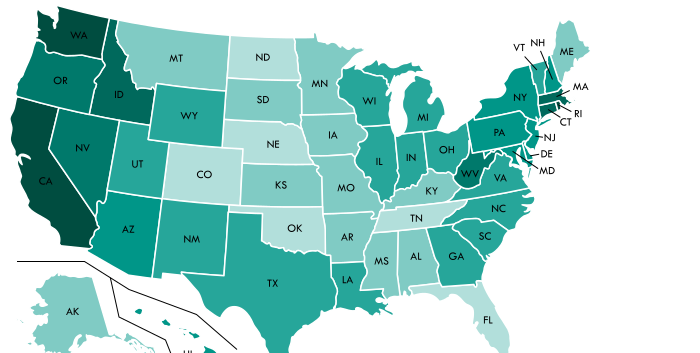
Most common states for network/telecom engineers
| Rank | State | Population | # of jobs | Employment/ 1000ppl |
|---|---|---|---|---|
| 1 | District of Columbia | 693,972 | 533 | 77% |
| 2 | Virginia | 8,470,020 | 2,094 | 25% |
| 3 | Maryland | 6,052,177 | 1,496 | 25% |
| 4 | Colorado | 5,607,154 | 1,059 | 19% |
| 5 | Alaska | 739,795 | 115 | 16% |
| 6 | Massachusetts | 6,859,819 | 914 | 13% |
| 7 | Delaware | 961,939 | 123 | 13% |
| 8 | Utah | 3,101,833 | 370 | 12% |
| 9 | Vermont | 623,657 | 75 | 12% |
| 10 | Washington | 7,405,743 | 847 | 11% |
| 11 | California | 39,536,653 | 3,860 | 10% |
| 12 | Oregon | 4,142,776 | 434 | 10% |
| 13 | New Hampshire | 1,342,795 | 134 | 10% |
| 14 | Alabama | 4,874,747 | 458 | 9% |
| 15 | Hawaii | 1,427,538 | 129 | 9% |
| 16 | North Carolina | 10,273,419 | 782 | 8% |
| 17 | Arizona | 7,016,270 | 540 | 8% |
| 18 | New Mexico | 2,088,070 | 157 | 8% |
| 19 | Rhode Island | 1,059,639 | 83 | 8% |
| 20 | Wyoming | 579,315 | 49 | 8% |
Most common cities for network/telecom engineers
| Rank | City | # of jobs | Employment/ 1000ppl | Avg. salary |
|---|---|---|---|---|
| 1 | Fremont | 5 | 2% | $121,810 |
| 2 | Melbourne | 1 | 1% | $65,096 |
| 3 | Dallas | 1 | 0% | $79,882 |
| 4 | Jacksonville | 1 | 0% | $65,131 |
| 5 | Plano | 1 | 0% | $79,614 |
Network/Telecom Engineer job outlook: Expert opinions
Our panel of network/telecom engineer experts
California State University - East Bay
Northwood University

Albertus Magnus College

University of Indianapolis

Bakersfield College
Portland State University
University of Colorado at Colorado Springs

University of New Hampshire

Indiana University Bloomington

Kennesaw State University

Pennsylvania State University - Great Valley
Dr. Bobby Roohparvar Ph.D.
Professor of Computer Science and Computer EngineeringCalifornia State University - East Bay
Computer Systems Networking And Telecommunications
What general advice would you give to a Network/Telecom Engineer?
Dr. Bobby Roohparvar Ph.D.: *The anxiety of AI is likely to change the landscape of computer networking, is a real threat but in my opinion, it won't eliminate the need for human network engineers. The focus will likely shift towards more strategic tasks, complex problem-solving, and leveraging AI tools to improve network efficiency and security.*
*Here again, I will explain in more detail about the expectation and future of Comp. Network Eng.*
* 1. AI Augments, Not Replaces: While AI can automate some network tasks, like data analysis and basic troubleshooting, it won't replace the need for human network engineers. It will increase the productivity for sure; Complex problem-solving, strategic decision-making, and human judgment are still crucial in network management. AI will likely become a valuable tool that assists network engineers in their tasks, making them more efficient.*
*2. Growing Demand: Our reliance on technology and data is constantly increasing. Businesses and organizations need secure, reliable networks to function. This necessitates a skilled workforce to design, implement, maintain, and secure these networks. The demand for qualified network engineers is expected to grow in the coming years.*
*In our technology horizon, I can see the quantum internet coming and I can see the demand for network engineering accelerate.*
*3. Diverse Skillset: A strong foundation in computer networking equips you with a versatile skillset. You'll understand network protocols, security concepts, and troubleshooting methodologies. These skills are valuable across the IT field and can be applied to areas like cloud computing, data center operations, or even cybersecurity. Data Centers for AI are becoming a huge opportunity for Comp Network Eng.*
What Network/Telecom Engineer skills would you recommend for someone trying to advance their career?
Dr. Bobby Roohparvar Ph.D.: *Favor:*
*Variety: Each day presents new challenges and opportunities for problem-solving.*
*Demand: The field offers strong job growth and stability.*
*Impact: Your work ensures businesses and organizations remain connected and operational.*
*Learning: There's always something new to learn with emerging technologies.*
*Dislike:*
*Troubleshooting: Issues can be complex and take a lot of time to resolve.*
*On-call: Network problems can occur at any time, requiring on-call availability.*
*Pressure: Maintaining network uptime can be stressful, especially during critical periods.*
*Keeping Up-to-Date: Rapid technological changes necessitate continuous learning.*
What will help Network/Telecom Engineers increase their earning potential?
Dr. Bobby Roohparvar Ph.D.: *Computer Networking Engineers are crucial in designing, building, maintaining, and troubleshooting complex networks. They need strong technical skills, analytical abilities, and strategic thinking to ensure smooth network operations.*
*A bit more detailed explanation of the Computer Networking Engineers responsibility:*
*Designing and Implementing Networks: This essential task involves creating new networks or significantly upgrading existing ones. It includes understanding organizational requirements, planning capacity, selecting the right hardware and software, and configuring these components for optimal performance and security.*
*Network Automation: Engineers automate routine tasks using scripting languages like Python or tools such as Cisco automation software. This automation not only saves time but also ensures consistent configurations.*
*Troubleshooting Complex Issues: They tackle intricate network problems by analyzing traffic patterns, identifying bottlenecks, optimizing performance, and resolving complex connectivity or security issues.*
*Staying Updated with Technology: As the networking field evolves rapidly, engineers must keep up with new technologies, emerging security threats, and best practices through conferences, online forums, and continuous learning.*
Professor David Sanford
Associate Professor an Department Chair (MIS, CS, CYB MGT, IS CYB)Northwood University
Computer And Information Sciences
What general advice would you give to a Network/Telecom Engineer?
Professor David Sanford: Workers like that they are challenged to solve problems and lead technological innovations.
They appreciate the diversity of projects
They enjoy the need for continuous improvement and education
Many see the global impact of their work.
They also desire and appreciate the need for versatile skills
A competitive salary is also an item that employees like
Workers dislike that the work can be stressful
Dealing with tight deadlines and/ or cybersecurity concerns.
This is a positive and a negative: The need to constantly stay up to date with technology can be a bit overwhelming for some.
There may be times of isolation, and
The unexpected system failures can be frustrating as they often require extra hours or the need to be on-call.
The multiple responsibilities and managing repetitive tasks are also issues workers point out in this field.
In short, the workplace offers exciting opportunities but comes with its fair share of pressures and challenges. Different people have different experiences based on their roles and personal preferences.
David Garaventa
Director, Computer Information Systems and Cybersecurity Programs, Assistant Professor, CISAlbertus Magnus College
Business Administration and Management Department
What skills stand out on Network/Telecom Engineer resumes?
David Garaventa: The skills/attributes required across a variety of jobs in the IT fields.
Dr. Katie Greenan Ph.D.
Assistant ProfessorUniversity of Indianapolis
Department of Communication
What are the biggest trends we'll see in the Network/Telecom Engineer job market given the pandemic?
Dr. Katie Greenan Ph.D.: Research shows the job market continuing to shrink. Remote work will continue to normalize beyond the pandemic. The technology field was vast prior to the pandemic and will be even larger post pandemic. The same is true for the healthcare industry. What they have in common is communication, and communication never goes out of style. In order to succeed in any career - to keep a job - an individual must know how to write, speak, listen, and get along with others whether face-to-face or virtually.
What certifications/licenses/courses can have the biggest impact for Network/Telecom Engineers?
Dr. Katie Greenan Ph.D.: Enrolling in an online public speaking course is practical since much of our work is virtual. It's important to practice delivery skills via technology and learn how to gesture effectively from the waist up, provide eye contact to connect with the audience, and position the camera and lighting. Companies can bring in consultants to train employees. This course would benefit every professional across all industries. It would also be valuable to recent graduates interviewing for jobs.
What's a good job out of college for Network/Telecom Engineers?
Dr. Katie Greenan Ph.D.: There are two types. The first is electronic media. Companies are constantly seeking employees who can fill entry-level jobs in social media and marketing. I'm seeing more and more job advertisements for social media influencers, too. I suggest recent graduates visit a handful of companies' websites and search "jobs." Chances are they'll find openings. Second, with the new administration in Washington, D.C., there is policy-related work that can provide recent graduates with entry-level jobs. After working in the political arena and gaining unparalleled experience, one thing will lead to the next, and they can go anywhere.
What general advice would you give to a Network/Telecom Engineer?
Maryam Farahani: Thinking about the fields they want to experience or try. And to be intentional about their job search. The best advice is learning as much as they can about what company offers. Visualizing themselves in the next 5 years as a starting point. Do they want to travel a lot, or be in management positions? Do they want to be subject matter expert, or a hands-on engineer or technologist? Their goal may change as they progress in their career but having one makes a big difference in their career choices and keeping them on track.
Dr. Wayne Wakeland Ph.D.
Professor and Systems Science Program ChairPortland State University
Systems science program
What Network/Telecom Engineer skills would you recommend for someone trying to advance their career?
Dr. Wayne Wakeland Ph.D.: For analyst positions, I think that employers want to hire people with strong data analysis skills, which, of course, includes statistics, but also big data, machine learning (algorithms), computer-based modeling, and programming. And, in addition to these apparently rather specialized skills, there is growing recognition that a talent for thinking, communicating, and problem-solving in a very general sense, and being able to cope with/address complexity, is also quite important.
Dr. T.S. Kalkur
Department ChairUniversity of Colorado at Colorado Springs
Electrical and Computer Engineering Department
What experience really stands out on Network/Telecom Engineer resumes?
Dr. T.S. Kalkur: Internship experience and tools used in design.
Marc Lessard
ProfessorUniversity of New Hampshire
Physics and Astronomy Department and Space Science Center
What type of skills will young Network/Telecom Engineers need?
Marc Lessard: This is a very good and important question. Graduates who can address complex problems in creative ways will be the most successful. This might sound obvious, but there seems to be a trend developing where younger engineers tend to want to follow written procedures or instructions for solving problems.
What is more valuable, of course, is being able to use a broad-based background to provide new and creative solutions, or at least to suggest new ideas and engage in discussions to further develop those ideas. The cliche of "thinking outside the box" will always be important.
Dr. Ariful Azad Ph.D.
Director of Graduate Studies for the Dept. of Intelligent Systems Engineering, Assistant Professor of Intelligent Systems EngineeringIndiana University Bloomington
Department of Intelligent Systems Engineering
What general advice would you give to a Network/Telecom Engineer?
Dr. Ariful Azad Ph.D.: Look for a job that you would enjoy doing, even if it takes some time to find such a position. Internships are great to explore various options.
What experience really stands out on Network/Telecom Engineer resumes?
Adeel Khalid Ph.D.: It is the age of diversity. A graduate can stand out when their resume shows a broad portfolio of experiences. In addition to a solid academic record, students who demonstrate that they can take on challenging tasks and work beyond a degree's basic requirements are more likely to be successful. I advise students to get involved in various activities, including undergraduate research projects, student design competitions, student organizations, internships, co-ops, etc. All of these should be highlighted on the resume. When a recruiter sees an overview of a student that shows relevant work experience in the form of work-study, internships, or co-op or research, their resume automatically comes to the top of the pile.
Will there be an enduring impact of the coronavirus pandemic on Network/Telecom Engineers?
Nil Ergin Ph.D.: The pandemic disrupts all systems. With disruptions, new forms of services, delivery formats, and jobs will emerge. One overall result of the epidemic is that tech companies consider allowing employees to work remotely, beyond the end of the pandemic. Emerging work from the home norm will enable companies to hire a diverse and distributed workforce and compete for technical talent nationwide. This will also create a demand for IT capabilities and create a network of shared workspaces. Graduates need to diversify their skill sets to adapt and be agile to new forms of change.