Explore jobs
Find specific jobs
Explore careers
Explore professions
Best companies
Explore companies
Job outlook for operations research managers in the United States
Are operations research manager jobs in demand?
Operations research manager job and salary trends over time
Operations research manager jobs over time
Operations research manager job growth rate over time
| Year | # of jobs | % of population |
|---|---|---|
| 2021 | 218 | 0.00% |
| 2020 | 171 | 0.00% |
| 2019 | 175 | 0.00% |
| 2018 | 167 | 0.00% |
| 2017 | 161 | 0.00% |
Average operations research manager salary over time
Operations research manager salary by year
| Year | Avg. salary | Hourly rate | % Change |
|---|---|---|---|
| 2025 | $74,064 | $35.61 | +2.8% |
| 2024 | $72,014 | $34.62 | --0.1% |
| 2023 | $72,121 | $34.67 | +0.5% |
| 2022 | $71,749 | $34.49 | +1.1% |
| 2021 | $70,963 | $34.12 | +1.6% |
Operations research manager jobs by state
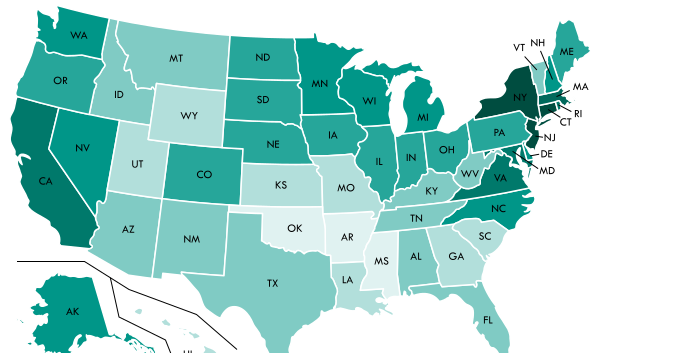
Most common states for operations research managers
| Rank | State | Population | # of jobs | Employment/ 1000ppl |
|---|---|---|---|---|
| 1 | District of Columbia | 693,972 | 351 | 51% |
| 2 | New Hampshire | 1,342,795 | 604 | 45% |
| 3 | Minnesota | 5,576,606 | 2,185 | 39% |
| 4 | Delaware | 961,939 | 332 | 35% |
| 5 | Montana | 1,050,493 | 353 | 34% |
| 6 | South Dakota | 869,666 | 296 | 34% |
| 7 | Wyoming | 579,315 | 195 | 34% |
| 8 | Nebraska | 1,920,076 | 643 | 33% |
| 9 | Pennsylvania | 12,805,537 | 4,131 | 32% |
| 10 | North Carolina | 10,273,419 | 3,265 | 32% |
| 11 | Indiana | 6,666,818 | 2,142 | 32% |
| 12 | Rhode Island | 1,059,639 | 335 | 32% |
| 13 | Georgia | 10,429,379 | 3,224 | 31% |
| 14 | Iowa | 3,145,711 | 975 | 31% |
| 15 | Maine | 1,335,907 | 414 | 31% |
| 16 | Kansas | 2,913,123 | 860 | 30% |
| 17 | Vermont | 623,657 | 185 | 30% |
| 18 | Tennessee | 6,715,984 | 1,934 | 29% |
| 19 | Missouri | 6,113,532 | 1,749 | 29% |
| 20 | Oregon | 4,142,776 | 1,213 | 29% |
Most common cities for operations research managers
| Rank | City | # of jobs | Employment/ 1000ppl | Avg. salary |
|---|---|---|---|---|
| 1 | West Lafayette | 3 | 7% | $80,988 |
| 2 | Ridgefield | 1 | 4% | $129,869 |
| 3 | San Fernando | 1 | 4% | $96,500 |
| 4 | Lawndale | 1 | 3% | $94,645 |
| 5 | Marlborough | 1 | 3% | $113,551 |
| 6 | Marietta | 1 | 2% | $57,271 |
| 7 | Boston | 4 | 1% | $113,203 |
| 8 | Alhambra | 1 | 1% | $95,170 |
| 9 | Goodyear | 1 | 1% | $69,405 |
| 10 | Pomona | 1 | 1% | $94,432 |
| 11 | Rochester | 1 | 1% | $87,487 |
| 12 | Houston | 4 | 0% | $67,472 |
| 13 | Los Angeles | 2 | 0% | $95,332 |
| 14 | Phoenix | 1 | 0% | $69,517 |
| 15 | San Francisco | 1 | 0% | $113,606 |
Operations Research Manager job outlook: Expert opinions
Our panel of operations research manager experts
Susquehanna University
Murray State University

Pennsylvania State University - Greater Allegheny
Tiffin University
Brandeis University
Pepperdine University, Seaver College

Sam Houston State University

Zicklin School of Business at Baruch College - City University of New York

Farmingdale State College
SUNY Potsdam

The City College of New York
Belmont University

Sonoma State University
Orfalea College of Business
Lauren Smith
Lecturer of Management & MarketingSusquehanna University
Business Administration, Management And Operations
What general advice would you give to an Operations Research Manager?
Lauren Smith: Lauren Smith advises graduates to actively engage in a dual pursuit of entrepreneurship and traditional corporate roles, emphasizing the importance of gaining diverse experiences.
What Operations Research Manager skills would you recommend for someone trying to advance their career?
Lauren Smith: Lauren Smith suggests that maximizing salary potential at the start of a career can be achieved by acquiring experience in different facets of business, such as entrepreneurship, corporate roles, and operational management.
Dr. Ben Littlepage
ProfessorMurray State University
Educational Administration And Supervision
What will help Operations Research Managers increase their earning potential?
Dr. Ben Littlepage: Salary is maximized when leaders are sought after. Leaders who pursue meaningful experiences and remain 'market ready' are viewed as an asset to any organization. Leaders must carefully consider where the field is moving and respond.
What Operations Research Manager skills would you recommend for someone trying to advance their career?
Dr. Kim Roberts: Business professionals lead organizations by focused efforts that revolve around products/services, processes, and people. Business professionals work to ensure the firm's products and/or services meet customer expectations, with an eye toward an ever-changing market. They manage processes that produce or support the firm's products. This requires the ability to analyze data to make informed decisions, to drive continuous improvement, and to solve problems through critical thinking. Successful business professionals must also create climates that promote teamwork and foster collaboration.
Bernie Cerasaro
Assistant Teaching ProfessorPennsylvania State University - Greater Allegheny
Business Department
What skills stand out on Operations Research Manager resumes?
Bernie Cerasaro: Skills employers would be looking for would be functional skills and interpersonal skills. Functional skills should stand out on a resume and be aligned to the business job in question. For example, if focused on marketing positions, marketing skills such as data analytics, market research, consumer behavior, global marketing, and professional selling skills would be areas for which employers would be looking. If the job market is looking for someone in accounting, then functional skills that would stand out would be intermediate financial accounting skills and courses on taxation and auditing. For those seeking positions in project management or supply chain management, skills that would stand out would encompass subject matter such as project management, portfolio management, operations planning and control, purchasing and materials management, and knowledge of ERP type systems and other business processes.
Skill sets can be enhanced via various types of certification. For example, those interested in accounting might pursue a CPA (Certified Public Accountant) license, which requires 150 credits. As most universities require 120 credits for a bachelor's degree in business, a CPA would require just an additional 30 credits, which students can start accumulating while still at college. Project management certification is also an opportunity to enhance the aforementioned skills and would certainly stand out on an applicant's resume. The Project Management Institute (PMI) promotes PMP certification, which validates that you are highly skilled in soft skills to lead project teams and have the required technical aspects of managing projects. Some universities are working with the PMI to have PMI-approved courses. Approved courses are used toward the PMP training hours required to sit for the exam. For example, Penn State University has received approval for two such courses, Portfolio Management and Organizations and Project Planning and Resource Management.
Due to the high rate of interaction with the global marketplace and the complexity of international business, managers are looking more closely at applicants who have some familiarity with global markets and international culture, such as applicants who may have study abroad experience, traveled internationally, speak a foreign language or have lived or worked in another country.
Dr. Bonnie Tiell
Professor of Sport ManagementTiffin University
School of Business
What skills stand out on Operations Research Manager resumes?
Dr. Bonnie Tiell: Experience and proven record of accomplishments, achievements, and added value to an organization (e.g., demonstration of increasing market shares, sales quotas, membership acquisition, etc.).
Aldo Musacchio Ph.D.
Professor, Program Director of the MBABrandeis University
Brandeis International Business School
What skills stand out on Operations Research Manager resumes?
Aldo Musacchio Ph.D.: I think experiences or experiential learning in which they worked in teams with real companies using the hard skills that the market values. Summer internships doing data analytics or business development at a startup stand out. But also working on field projects at your school with a company in which you can display that you used your data analytics or digital marketing skills goes far.
Will there be an enduring impact of the coronavirus pandemic on Operations Research Managers?
Steven Bauer: The coronavirus has accelerated the transformation to a digital world, and this effect will continue after the pandemic is behind us. Graduates will need to be able to navigate a hybrid business environment, with in-person and virtual meetings, interactions and platforms. There will also be increased opportunities to be entrepreneurial and innovative in the digital area. In addition, graduates will have to become more skilled at navigating a global environment since greater digitization will draw countries closer to each other.
What soft skills should all Operations Research Managers possess?
Steven Bauer: The new hybrid world will make leading teams more challenging. This reality will put a premium on interpersonal skills. When the NASA astronaut, Richard Arnold, spoke at Pepperdine in 2019, he mentioned that team building was the single most important ability undergraduates could develop to become a good astronaut. The same holds for graduates wanting to go into business, particularly in the post coronavirus era. As part of their skills in this area, graduates will also need to be able and committed to addressing issues in the areas of diversity, equity and inclusion.
What certifications/licenses/courses can have the biggest impact for Operations Research Managers?
Steven Bauer: Business Analytics is becoming increasingly important across all functions in order to be able to identify and capture value. Thus a certification in this area, e.g., in Python, is particularly impactful. As far as courses, students should make sure they gain an exposure to all aspects of the business world, e.g., marketing, management, finance, accounting, strategic planning, law, etc., in order to prepare them for the wide array of challenges they will face.
Carliss Miller Ph.D.
Assistant Professor of ManagementSam Houston State University
Department of Management & Marketing
What are the biggest trends we'll see in the Operations Research Manager job market given the pandemic?
Carliss Miller Ph.D.: Flexible working arrangements were considered a perk or benefit, but given the pandemic more and more jobs will be designed with flexible work arrangements in mind. We will continue to see trends in the labor market with a push towards personal services (e.g. virtual assistants, professional organizers) and professional services. There will also continue to be a demand for knowledge work. More and more, employers are looking to hire applicants that can provide concrete evidence of being "Day 1" ready.
Employers will focus more on identifying prospects with certain "soft skills" which were a nice-to-have pre-pandemic, but are now critical for organizational survival. These skills include: critical thinking, agility, ability to adapt to change, resilience, virtual team effectiveness, crisis management, emotional intelligence, empathy, and inclusive leadership. Additionally, data analysis and interpretation is a highly sought after skill even for jobs that historically did not require analytical ability.
What certifications/licenses/courses can have the biggest impact for Operations Research Managers?
Carliss Miller Ph.D.: Any certifications/licenses/courses that specifically relate to the job function, industry, desired skills of a job, or the individuals' desired career trajectory will have a major impact on attracting job prospects. For example, for someone seeking a sales position, courses that target professional selling, CRM, data management and analysis, sales forecasting, strategic management, business communications, social media marketing, leadership and project management would be beneficial.
What's a good job out of college for Operations Research Managers?
Carliss Miller Ph.D.: Good jobs out of college are those that offer structured training, development, and job rotation. While some college students identified their career at age 5 and never veered away, some are still figuring out what they want to do after college. A job opportunity that recognizes the potential of new talent, willing to invest in training and development, and provides opportunities for new employees to experience different job functions enables new graduates to gain a realistic job preview that pays and allows them to identify an opportunity within the company that best aligns with skills and interests. Positions that are for a specific job function but have an apprenticeship model, like a "sales trainee" position, are also great for career stepping stones right out of college.
Dr. Mary Kern Ph.D.
Associate ProfessorZicklin School of Business at Baruch College - City University of New York
Narendra P. Loomba Department of Management
What's a good job out of college for Operations Research Managers?
Dr. Mary Kern Ph.D.: - Any job where you have an opportunity to learn is a good job. Ideally, I hope to see my students working in organizations that prioritize professional development opportunities and mentoring relationships, as these provide the opportunities and feedback critical for growth.
Xu Zhang Ph.D.
ChairFarmingdale State College
Department of Economics
What are the biggest trends we'll see in the Operations Research Manager job market given the pandemic?
Xu Zhang Ph.D.: There are a few trends in the current job maket.
- Slow recovery. Based on the December job market reports released by the U.S. Bureau of Labor Statistics, the job market slowly recovered since April, but about 44% of the prepandemic jobs have not been gained back. Between March and April, about 22.16 million jobs were lost. The U.S. labor market started to revive in May, and since then until December the market experienced 23.32 million job gains, roughly 56% of pre-pandemic level. The unemployment rate decreased gradually from April (14.8%) to December (6.7%), but still almost twice its pre-pandemic level in February (3.5%). Additionally, although the number of unemployed persons dropped from 23.11million in April to 10.74 million in December 2020, there is still a huge gap compared to 5.72 million in February.
- Uneven impacts by industries. While overall economy was hard hit by the pandemic, the job losses disproportionally impacted industry sectors. Service industries such as educational service, elective healthcare, arts, entertainment, recreation, accommodation and food services, have been hurt the most due to social distancing. Other job losses in retail service sector were related to a boom on online shopping. In addition, teenagers experienced record high unemployment rate which is associated with lack of experiences and working in hard-hit service industries.
- More employers embracing remote work. The perception of remote work has totally changed during the pandemic. After experiencing sudden changes to remote work and managing the obstacles working at home, more and more workers and employers embrace remote work, which would expand the layouts of job hunting and talent search to larger geographic areas.
What skills stand out on Operations Research Manager resumes?
Xu Zhang Ph.D.: I believe the most important attributes employers seek on a resume remain the same-problem solving skills, team work skills, analytical/quantitative skills, verbal and written communication skills. However, given the pandemic or any other unexpected shock to work environment, how to quickly and efficiently adapt to new work modes can be a very valuable attribute standing out on resume.
What skills stand out on Operations Research Manager resumes?
Karen Kus: Employers hiring candidates with a history degree are seeking transferable skills that can be applied in various roles and settings. These skills include writing, communication, research, organization, computer-based skills, and problem-solving. The best thing a candidate can do to increase marketability is to elaborate on how they obtained or utilized those skills, rather than simply listing them. Employers need to have an understanding of how you made use of your skill and what results came from your actions. Make these skills shine on your resume by giving them substance.
What type of skills will young Operations Research Managers need?
Prabal Kumar De Ph.D.: I think the necessary skills remain the same. One modification that would stay is greater virtual engagement. Therefore, newly essential skills such as acing a virtual interview, making a mark during a Zoom meeting, or managing or being a valuable part of a remote working group would be useful long after the immediate threats from the COVID-19 crisis be gone.
Nina Woodard
Senior Career Development SpecialistBelmont University
Office of Career & Professional Development
What are the biggest trends we'll see in the Operations Research Manager job market given the pandemic?
Nina Woodard: The pandemic hasn't impacted all areas of the entertainment industry in the same way. Anything related to live events and touring has been placed on an extended pause, which has been very difficult for graduates hoping to work in those fields. On an encouraging note, consumers will always find a way back to live experiences, so that segment of the industry will absolutely recover; the timing is just still a bit unknown. Other areas such as record or publishing companies have held steady. And, digital marketing and content creation companies are as busy, if not busier, than they've ever been as artists seek alternative ways to stay connected to their fans. Technology has intersected with entertainment in exciting, creative ways that will continue even as some of the more traditional avenues become available again. For many companies, ideas that started as pivots are now vibrant components of their long-term strategies.
The way we work may have also permanently changed. Companies have realized that remote working is a truly viable option for most businesses. While maintaining company culture, and the social nature of an entertainment-based organization, may still require some level of in-person interaction, it seems likely that many organizations may continue with remote/hybrid office models.
What Operations Research Manager skills would you recommend for someone trying to advance their career?
Nina Woodard: For entertainment, digital marketing and content creation skills are critical. Even if a role isn't specifically connected to digital marketing, social media is almost always involved in most entry-level roles. We strongly encourage students and recent graduates to learn basic graphic design platforms, video editing and audio editing. Learning how to maximize impact on social media platforms such as YouTube, Instagram or TikTok is also a worthy investment of time. There's a wide range of self-paced training resources online, many available for free or at reduced costs for students.
What general advice would you give to an Operations Research Manager?
Nina Woodard: Any job search strategy comes down to a combination of education, experience and relationships. Many students and graduates have mistakenly believed that that gaining experience or networking isn't an option during this season, but that's simply not the case. We encourage our job seekers to build their strategy and then identify ways to translate certain elements into the virtual realm. Most companies are now offering remote internships, which allows students to explore options without physical limitations. We've also found industry professionals to be extremely accessible and willing to connect with students/recent grads for a quick Zoom chat or phone call. Anyone working in entertainment is there because someone helped them along the way. Most people are genuinely eager to repay that favor by investing in others just beginning the professional journey.
Craig Nathanson Ph.D.
Adjunct LecturerSonoma State University
School of Business & Economics
What type of skills will young Operations Research Managers need?
Craig Nathanson Ph.D.: I see the essential human skills gaining importance to build a new post-covid work life. These include creativity, leading and working in teams, writing, speaking, being self-aware, and lowering bias and networking; career branding as critical areas for graduates to focus on now.
What experience really stands out on Operations Research Manager resumes?
Craig Nathanson Ph.D.: Most important on resumes to only show accomplishments you are proud of and reflect measurable success and completion of past work. These accomplishments should be a snapshot of what we have done and can do in the future. The most important two lines of a resume are in the objectives, to list what the person is seeking. These two lines give the reader a quick view of what the person wants.
Now is a great time to start the new year to build a portable work portfolio to represent an alignment of what a person is excited about and enjoys in their work.
Eric Olsen
Professor, Industrial Technology and PackagingOrfalea College of Business
Industrial Technology & Packaging
What general advice would you give to an Operations Research Manager?
Eric Olsen: Times of change are also times of great opportunities. We are going to need new technical solutions to address problems we are just learning about. You have to lean into the issues. Don't be a technologist - be a problem solver. That is why we also emphasize soft skills like lean six sigma, teamwork, and change management.