Explore jobs
Find specific jobs
Explore careers
Explore professions
Best companies
Explore companies
Job outlook for oracle developers in the United States
Oracle developer job growth summary. After extensive research, interviews, and analysis, Zippia's data science team found that:
The projected oracle developer job growth rate is 21% from 2018-2028.
About 284,100 new jobs for oracle developers are projected over the next decade.
Oracle developer salaries have increased 10% for oracle developers in the last 5 years.
There are over 72,909 oracle developers currently employed in the United States.
There are 84,654 active oracle developer job openings in the US.
The average oracle developer salary is $98,645.
Are oracle developer jobs in demand?
Oracle developer job and salary trends over time
Oracle developer jobs over time
Oracle developer job growth rate over time
| Year | # of jobs | % of population |
|---|---|---|
| 2021 | 72,909 | 0.02% |
| 2020 | 36,146 | 0.01% |
| 2019 | 23,557 | 0.01% |
| 2018 | 40,682 | 0.01% |
| 2017 | 38,514 | 0.01% |
Average oracle developer salary over time
Oracle developer salary by year
| Year | Avg. salary | Hourly rate | % Change |
|---|---|---|---|
| 2026 | $98,645 | $47.43 | +3.4% |
| 2025 | $95,395 | $45.86 | +2.3% |
| 2024 | $93,235 | $44.82 | +1.8% |
| 2023 | $91,588 | $44.03 | +1.7% |
| 2022 | $90,050 | $43.29 | +1.9% |
Oracle developer jobs by state
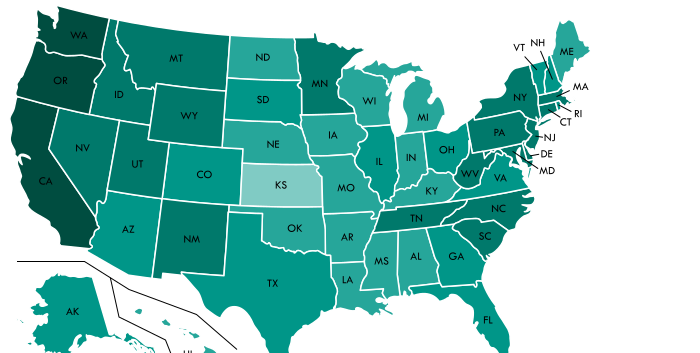
Most common states for oracle developers
| Rank | State | Population | # of jobs | Employment/ 1000ppl |
|---|---|---|---|---|
| 1 | District of Columbia | 693,972 | 484 | 70% |
| 2 | Vermont | 623,657 | 198 | 32% |
| 3 | Virginia | 8,470,020 | 1,923 | 23% |
| 4 | Rhode Island | 1,059,639 | 216 | 20% |
| 5 | Utah | 3,101,833 | 575 | 19% |
| 6 | New Hampshire | 1,342,795 | 237 | 18% |
| 7 | Montana | 1,050,493 | 181 | 17% |
| 8 | Maryland | 6,052,177 | 945 | 16% |
| 9 | Wyoming | 579,315 | 91 | 16% |
| 10 | Pennsylvania | 12,805,537 | 1,809 | 14% |
| 11 | Washington | 7,405,743 | 1,005 | 14% |
| 12 | Massachusetts | 6,859,819 | 965 | 14% |
| 13 | Colorado | 5,607,154 | 794 | 14% |
| 14 | Oregon | 4,142,776 | 562 | 14% |
| 15 | Nebraska | 1,920,076 | 260 | 14% |
| 16 | Idaho | 1,716,943 | 246 | 14% |
| 17 | Delaware | 961,939 | 135 | 14% |
| 18 | North Dakota | 755,393 | 105 | 14% |
| 19 | North Carolina | 10,273,419 | 1,332 | 13% |
| 20 | Minnesota | 5,576,606 | 733 | 13% |
Most common cities for oracle developers
| Rank | City | # of jobs | Employment/ 1000ppl | Avg. salary |
|---|---|---|---|---|
| 1 | Annapolis | 2 | 5% | $97,483 |
| 2 | Rockville | 2 | 3% | $97,258 |
| 3 | Dover | 1 | 3% | $96,936 |
| 4 | Bethesda | 1 | 2% | $97,264 |
| 5 | Delano | 1 | 2% | $118,704 |
| 6 | Diamond Bar | 1 | 2% | $110,231 |
| 7 | Atlanta | 4 | 1% | $86,973 |
| 8 | Bridgeport | 1 | 1% | $98,184 |
| 9 | Burbank | 1 | 1% | $111,204 |
| 10 | Cambridge | 1 | 1% | $95,312 |
| 11 | Davenport | 1 | 1% | $85,809 |
| 12 | Edison | 1 | 1% | $95,066 |
| 13 | Detroit | 3 | 0% | $84,125 |
| 14 | Boston | 2 | 0% | $95,376 |
| 15 | Chicago | 2 | 0% | $89,161 |
| 16 | Anchorage | 1 | 0% | $91,330 |
| 17 | Birmingham | 1 | 0% | $82,572 |
| 18 | Colorado Springs | 1 | 0% | $87,646 |
| 19 | Denver | 1 | 0% | $87,130 |
Oracle Developer job outlook: Expert opinions
Our panel of oracle developer experts
Nova Southeastern University
Texas A&M University San Antonio
Mount St. Joseph University
University of Richmond
Idaho State University
Southeastern Louisiana University

University of New Haven

Murray State University

Washington University in St. Louis
North Dakota State University
What Oracle Developer skills would you recommend for someone trying to advance their career?
Dr. Frank Mitropoulos Ph.D.: Maximizing your salary potential as a new graduate with a Computer Applications degree involves strategic positioning, skill enhancement, and effective negotiation. Following are a few strategies to help increase your salary now and in the future: Specialize in High-Demand Areas: Identify and specialize in high-demand areas that generally offer higher salaries. Build a Strong Portfolio: Develop a portfolio that showcases your skills. A compelling portfolio can strengthen your position during salary negotiations. Develop Soft Skills: While technical skills are essential, soft skills like problem-solving, communication, and leadership hold equal significance. Enhancing these skills can give you an edge in negotiations. Do your Homework and Negotiate: Some industries and locations offer higher salaries. Decide what type of industry you want to focus on and do the background research needed to determine whether your skills will help as leverage. Use your portfolio, certifications, and skill set to strengthen your position. Be ready to articulate your value and how you can contribute to the company's success.
What will help Oracle Developers increase their earning potential?
Dr. Frank Mitropoulos Ph.D.: As we look toward the future of careers in Computer Applications, several skills stand out for their growing importance. These skills revolve around specific technologies that are expected to continue to grow and evolve. Technologies related to Cloud Computing, Artificial Intelligence (AI), Cybersecurity, and Data Science are quickly evolving and being applied across the technology sector. Cloud Computing: Given the widespread adoption of Cloud services, Cloud computing expertise is indispensable. Understanding how to leverage platforms like Azure, AWS, and Google Cloud is crucial to developing scalable, efficient solutions that meet business needs. Artificial Intelligence: AI and Machine Learning are transforming the world. Skills in these areas to solve real-world problems will be even more critical in the future. Cybersecurity: Digital threats are becoming more sophisticated. Safeguarding data, networks, and systems will require encryption, intrusion detection, development, and regulation skills. Data Science: Skills in Data Science will be increasingly sought after as businesses embrace data-driven decision-making. Extracting meaningful insights from extensive datasets and effectively communicating these findings will be essential. Soft skills: Finally, soft skills such as teamwork, problem-solving, and effective communication cannot be overlooked. Adapting, communicating, and leading will be essential for success.
MARLA KRAMER
Assistant Vice President of Marketing and CommunicationsWhat will help Oracle Developers increase their earning potential?
MARLA KRAMER: It is unlikely that software development will be fully automated in the near future. Writing correct and efficient applications is a skill set that will only grow as we invent more ways to improve the quality of our lives. As more and more commerce and critical services migrate onto the internet, IS development will require a deeper knowledge of cybersecurity, data analytics, and cloud computing. According to the U.S. Bureau of Labor Statistics (BLS), Information Security Analysis jobs are expected to grow by 32% over the next 10 years. The BLS estimates Software Developers, Quality Assurance and Testing will grow by 25% over the next decade.
Right now, however, software development is going through a lull because of competition from abroad. Being an expert in at least two popular programming languages, having a solid theoretical foundation, and being able to innovate is pivotal. Artificial Intelligence is being deployed to solve some problems now, thanks to the powerful computers we have today. Learning to effectively use AI frameworks as part of your application development will add a lot of value to your skillset.
Izzat Alsmadi
Associate ProfessorTexas A&M University San Antonio
Computer Science
What general advice would you give to an Oracle Developer?
Izzat Alsmadi: Computing fields are unique that they have a very large spectrum of possible jobs.
New graduates should be open and flexible to seek opportunities beyond a narrow focus that they may have in mind.
The degree itself is a great start but in most cases will not be enough and you have to seek own training in new software, tools, etc.
Certificates can be also important for some particular sub-disciplines (e.g. cyber security)
Rebecca Allen
Mount St. Joseph University
Special Education And Teaching
What general advice would you give to an Oracle Developer?
Rebecca Allen: AI, for sure. I have heard it said that AI might not replace humans, rather humans who know how to use AI well may replace humans who don't.
Ahmed Temani
Senior InstructorUniversity of Richmond
Computer/Information Technology Administration And Management
What Oracle Developer skills would you recommend for someone trying to advance their career?
Ahmed Temani: This one I'm not sure how to answer as it is too broad. I would say work hard and do quality work, but that seems obvious.
What Oracle Developer skills would you recommend for someone trying to advance their career?
Nikyra Capson: Don't be afraid of being rejected. If they see a job they want, apply. Even if they don't think they'll get it, still apply. The worst thing that could happen is being told no. Not applying is an automatic no, so they might as well try.
Dr. Ghanssan Alkadi Ph.D.
Professor of Computer ScienceSoutheastern Louisiana University
Department of Computer Science
What skills stand out on Oracle Developer resumes?
Dr. Ghanssan Alkadi Ph.D.: Working on Software projects that involve team communication, Agile Process, and working with either the MERN, MEAN, or .Net stacks.
What are the biggest trends we'll see in the Oracle Developer job market given the pandemic?
Christopher Martinez Ph.D.: I always tell students to practice for an interview by thinking about how they will answer behavior questions such as how to do your work on a team, how you lead a team, how you learn from a failure, etc. This year I would add a new question to this list, and that is how you work remotely. Students should consider how they work with classmates to find a remote work style that works for them. They should explore how to work with Slack or Microsoft Teams to communicate and organize their team. I think we will see that remote work is a trend that will remain with us for the foreseeable future so students should work to become more comfortable with this new work style.
What's a good job out of college for Oracle Developers?
Christopher Martinez Ph.D.: The best job you can have out of college is a job you have passion for and will set you up to advance your career. If you have always wanted to work in aerospace, then you should seek out that field from the start. I hate to see students settle for a job because of pay or because they feel they can move to their dream field later.
Dr. Matthew Tennyson Ph.D.
Associate Professor of Computer ScienceMurray State University
Computer Science and Information Systems
What certifications/licenses/courses can have the biggest impact for Oracle Developers?
Dr. Matthew Tennyson Ph.D.: A bachelor's degree in computer science is extremely valuable. It has been and continues to be one of the most valuable college degrees a student can pursue. I really think all areas of computing are in demand, but web and mobile computing might be one of the strongest. Some employers do like to see extra certifications in addition to the bachelor's degree. There are literally hundreds of certifications available in the computing industry. They all vary in the required amount of time, effort, and money. I think anything that can set a candidate apart from other candidates is valuable, and that includes any certification. I would not recommend investing thousands of dollars into additional certifications after completing a bachelor's degree, but I don't think it's a bad idea for students to pursue one of the free or lower-cost certifications that are available - especially those students who might not have strong internship experience, extracurricular activities, projects, etc. to put on their resumes. I think anything DevOps related or cloud-based like Amazon's AWS or Microsoft's Azure are especially valuable right now.
What general advice would you give to an Oracle Developer?
Dr. Tao Ju: They are not in this alone. The opportunities are out there, but it is up to them to be proactive and take ownership of their career. They should become familiar with and use all of the resources available to them-alumni, faculty and career advisors, job search sites, mentoring programs, career fairs, professional associations, and networking events. Take advantage of their existing network and seek out ways to make further connections. Keep an eye on trends, follow news, and research companies. Dream big but be flexible. In this time of constant transition and change, graduates who can shift their plans to the conditions of the job market will have less stress and more success. Talk with companies they've never heard of and explore careers they've never considered. They might be surprised at what they find and where it leads them. Lastly, remain confident and positive. They've worked hard to get to this point and they can be rest assured that their choice to pursue engineering will pay off in the short and long run.
What experience really stands out on Oracle Developer resumes?
Dr. Simone Ludwig: Capstone experience, Internship or Co-op experience, and working on a research project will stand out on a resume.