Explore jobs
Find specific jobs
Explore careers
Explore professions
Best companies
Explore companies
Job outlook for pastoral counselors in the United States
Are pastoral counselor jobs in demand?
Pastoral counselor job and salary trends over time
Pastoral counselor jobs over time
Pastoral counselor job growth rate over time
| Year | # of jobs | % of population |
|---|---|---|
| 2021 | 428 | 0.00% |
| 2020 | 422 | 0.00% |
| 2019 | 428 | 0.00% |
| 2018 | 412 | 0.00% |
| 2017 | 392 | 0.00% |
Average pastoral counselor salary over time
Pastoral counselor salary by year
| Year | Avg. salary | Hourly rate | % Change |
|---|---|---|---|
| 2026 | $44,254 | $21.28 | +1.9% |
| 2025 | $43,432 | $20.88 | +1.3% |
| 2024 | $42,876 | $20.61 | +1.6% |
| 2023 | $42,191 | $20.28 | +1.6% |
| 2022 | $41,544 | $19.97 | +1.7% |
Pastoral counselor jobs by state
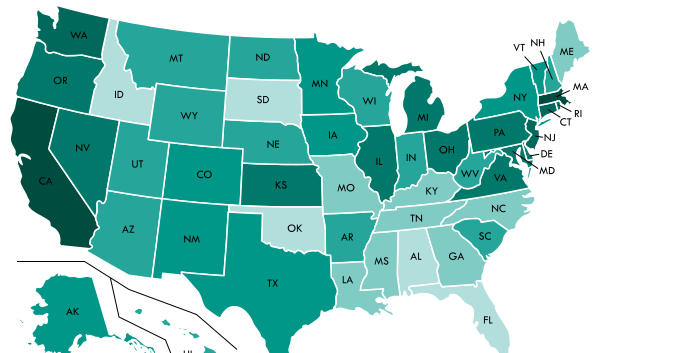
Most common states for pastoral counselors
| Rank | State | Population | # of jobs | Employment/ 1000ppl |
|---|---|---|---|---|
| 1 | District of Columbia | 693,972 | 89 | 13% |
| 2 | Connecticut | 3,588,184 | 221 | 6% |
| 3 | Delaware | 961,939 | 59 | 6% |
| 4 | Pennsylvania | 12,805,537 | 577 | 5% |
| 5 | Massachusetts | 6,859,819 | 326 | 5% |
| 6 | Montana | 1,050,493 | 57 | 5% |
| 7 | Alaska | 739,795 | 37 | 5% |
| 8 | North Dakota | 755,393 | 35 | 5% |
| 9 | Wyoming | 579,315 | 29 | 5% |
| 10 | Illinois | 12,802,023 | 472 | 4% |
| 11 | Georgia | 10,429,379 | 376 | 4% |
| 12 | New Jersey | 9,005,644 | 323 | 4% |
| 13 | Arizona | 7,016,270 | 310 | 4% |
| 14 | Washington | 7,405,743 | 296 | 4% |
| 15 | Maryland | 6,052,177 | 255 | 4% |
| 16 | Colorado | 5,607,154 | 233 | 4% |
| 17 | Minnesota | 5,576,606 | 205 | 4% |
| 18 | Iowa | 3,145,711 | 126 | 4% |
| 19 | New Hampshire | 1,342,795 | 57 | 4% |
| 20 | Vermont | 623,657 | 25 | 4% |
Pastoral Counselor job outlook: Expert opinions
Our panel of pastoral counselor experts
Judson University
Western Illinois University

Pacific Christian College of Ministry and Biblical Studies
Anabaptist Mennonite Biblical Seminary
California State University San Marcos
Montclair State University

Faulkner University

Southern Methodist University

Carolina Christian College
American University

Virginia Polytechnic Institute and State University

Ohio University

Angelo State University
Oral Roberts University
Rider University
What Pastoral Counselor skills would you recommend for someone trying to advance their career?
Rev. Elliott Anderson: The best way to maximize your salary in pastoral ministries is to not focus on it. Find a job in ministry you love and allow the financial returns to follow a strong work ethic, a recognition and acceptance of your current role, and a consideration of further ones that have more earning potential, but only as they fit the man or woman you are and want to be. One of the biggest mistakes in ministry is leaving a job we love and are effective in to simply earn more money in a different role that we don't like, that doesn't fit our spiritual gifts or experience, and where we quickly lose our joy in the faith and our joy in our pastoral roles.
What will help Pastoral Counselors increase their earning potential?
Rev. Elliott Anderson: Listening. We must return to men and women of faith who are exceptional listeners with steady eye contact, nonverbal acceptance, open posture, warm and welcoming smiles and sincere holistic empathy. And after we set the baseline of foundational engagement, we must be active listeners which includes validation and affirmation of the person regardless of our views of their strengths, weaknesses, successes, failures, gifts, and sin. Too many Pastors, like to hear our own understanding of wisdom which often blocks the one we are ministering to from gaining the wisdom for themselves. Listening is a skill we can develop and even master, but very few people, even within the listening professions, like Pastors and Ministers, learn to do it well or intentionally focus on becoming an outstanding listener.
Leigh Ann Tipton-Fisler, PhD, BCBA
Associate Professor and Program Coordinator of Specialist in School Psychology and Clinical/ Community Mental Health Graduate ProgramsWestern Illinois University
Clinical, Counseling And Applied Psychology
What general advice would you give to a Pastoral Counselor?
Leigh Ann Tipton-Fisler, PhD, BCBA: - The best I can give to graduates is to focus on taking small steps at first. Often the first year in the field can be exciting and overwhelming at the same time. The system we work in (the helping profession broadly) often has a lot of challenges, and new professionals want to re-envision a path for changes. This is tangible, but at first, it is important to understand the roles and functions in the workplace before flipping everything upside down. I suggest taking one small change at a time in an area that is important to you and build relationships and trust with your professional colleagues before overloading yourself with the new job and new goals.
What will help Pastoral Counselors increase their earning potential?
Leigh Ann Tipton-Fisler, PhD, BCBA: - I think skills in using and being familiar with artificial intelligence (AI) will be important in our field now and in the upcoming five years. The capabilities of the open AI sources has exponentially grown smarter in just the past year. The tools accessible are revolutionizing the way people write reports, generate recommendations, capture clinical notes, and even summarize and synthesize information. It is technology that we must learn to understand after the point of graduate training where we can apply our professional decision-making skills and theoretical knowledge to the information input/output of this great technology.
Dion Porter Ph.D.
Associate Professor and Department Chair Coordinator-Online Educational Specialist ProgramsWhat general advice would you give to a Pastoral Counselor?
Dion Porter Ph.D.: Strong counseling and empathy skills of course are important, but also one must possess strong interpersonal skills that will assist them in relating and collaborating well with other people. It is very important that one possess the right personality as well as character in order for them to become an effective and competent counselor. They also need to have strong multicultural counseling skills in order to effectively and efficiently counsel persons from diverse backgrounds, cultures and nationalities. Finally, one must possess the skills associated with professionalism related to their personal mannerisms, speech and communication, dress and interpersonal awareness. Of course for anyone to be competitive in this day and age, they will need to be well versed and trained in the specific technology and social-media tools needed to effectively perform the proper functions of their job.
Dr. Robbie Phillips
Professor of Biblical Studies, Chair, Undergraduate Ministry ProgramPacific Christian College of Ministry and Biblical Studies
What hard/technical skills are most important for Pastoral Counselors?
Dr. Robbie Phillips: Administrative leadership. Administration might connect you to technology and also project management.
What soft skills should all Pastoral Counselors possess?
Dr. Robbie Phillips: This would be dominated by relational skills, interpersonal communication skills, general people skills, and conflict resolution.
Leah Thomas Ph.D.
Assistant Professor of Pastoral Care and Contextual EducationAnabaptist Mennonite Biblical Seminary
Church and Ministry
What skills stand out on Pastoral Counselor resumes?
Leah Thomas Ph.D.: The question of what "stands out" differs by the values of the particular denomination and those of the local church within that denomination. For example, a Mennonite Church would likely be looking for someone with skills in conflict resolution and peacebuilding, but this could also differ depending on the needs of the local church community. A congregation in the United Methodist Church might privilege different skills, such as visionary leadership.
What soft skills should all Pastoral Counselors possess?
Leah Thomas Ph.D.: In my students, I encourage the development of soft skills such as deep listening, empathy, authenticity, flexibility, integrity, trustworthiness, and a collaborative leadership style. These skills exist alongside commitments to ongoing spiritual formation, self and theological reflection and reflexivity, ongoing education and supervision, and care of the self's physical, emotional, intellectual, and spiritual parts.
What hard/technical skills are most important for Pastoral Counselors?
Leah Thomas Ph.D.: In terms of the hard/technical skills that aid pastors/ministers in carrying out their responsibilities, these would include skills of crisis intervention, conflict resolution & peacebuilding, knowledge and praxis related to racial justice and reconciliation, and knowledge of (and techniques for) addressing some of the following situations: trauma and grief, conflicts in the family (including pre-marital, marital and family interventions), addictions and situations of sexual abuse. In all of this, attention to the intercultural dimension of pastoral caregiving is also extremely important. Clinical Pastoral Education training can also provide some of these "hard" and "soft" skills.
What skills will help Pastoral Counselors earn the most?
Leah Thomas Ph.D.: I often say that people who enter pastoral ministry "don't do it for the money"! Indeed, many have left or bypassed lucrative careers to follow a call from God into ministry. Salaries differ by denomination and by geographic location. Those who go into chaplaincy in a large hospital and/or have private pastoral counseling practices may make more money than congregational ministers. But many who enter ministry also adopt a "bi-vocational" ministry, holding more than one job so that they can afford to do ministry.
Madeline Lee Ph.D.
Associate ProfessorCalifornia State University San Marcos
Department of Social Work
What technical skills for a Pastoral Counselor stand out to employers?
Madeline Lee Ph.D.: There are technical skills that may stand out to employers, but as social workers, I think those technical skills together with "soft skills," can make an applicant really stand out to employers; social workers can combine their research skills with evidence-informed care and organizational quality improvement efforts, while being able to lead, build relationships, and think critically. In the midst of the ongoing coronavirus pandemic, our graduates will need to be able to fluidly navigate between employing telehealth methods to performing their work safely in-person when engaging and helping clients. To be effective, social workers will also need to understand the reverberating effects of the deep-seated roots of racism in our country and be willing to honestly confront and address those issues in whatever role they assume. Social workers are needed now more than ever.
What type of skills will young Pastoral Counselors need?
Dr. Michael Hannon Ph.D.: New graduates do need a requisite set of skills to be effective school counselors. However, those skills mean nothing without a requisite set of dispositions while demonstrating those skills. Students and their families deserve school counselors to be effective communicators and listeners, possess empathy, know how to use school and other sources of data to support student success, have knowledge about federal and state laws governing school counseling practice, and be calculated risk takers. The dispositions, though, are equally important. New graduates have to balance being teachable and confident. They have to be willing to learn, be challenged constructively, and be willing to learn more.
New school counselors have to be unapologetically curious and willing to ask difficult questions. School counselors work to facilitate experiences that yield the desired outcomes for serving students and their families (e.g., access to rigorous courses, reducing disparate disciplinary practices) in ways that are responsive, informed, and valued by those stakeholders. New school counselors have to possess a leadership disposition; one that allows them to assume responsibility when things go right and when they go wrong. Finally, they have to be optimists and believe in the possibilities that exist when students get the range of services they deserve. Their perspectives must be strength-based and acknowledge all of the different forms of knowledge their students and school community members bring to the building and classroom every day.
What experience really stands out on Pastoral Counselor resumes?
Dr. Michael Hannon Ph.D.: The kinds of experiences that really stand out on resumes are those that demonstrate their added value. School counselors, like all school personnel, are tasked with providing evidence that students are better as a result of their work with them. School counselors must show how the range of school counseling services provided (e.g., individual counseling, small group counseling, career development interventions, individual advising, etc.) help students experience success. I encourage those looking for jobs to meticulously document the processes and outcomes that inform why they implement their programs and services. That way, potential employers clearly understand the value new school counselors will add to the school community and support student wellness.
Steve Wages Ph.D.
Director, Cloverdale Center for Youth and FamilyFaulkner University
Cloverdale Center for Youth & Family
What Pastoral Counselor skills would you recommend for someone trying to advance their career?
Steve Wages Ph.D.: I recommend they use this time to fill in the gaps, no pun intended, in their program of studies by expanding their knowledge base. All educational programs have gaps in the training, content areas which are not addressed adequately. For example, my counseling program was highly regarded, yet I had little to no content related to aging studies, parenting, or personal finances, etc. Further, the content of counseling programs is problem-centered or remedial, conceptually focused on tertiary prevention.
Consequently, graduates are not exposed to a large body of research and literature related to human development, individual wellness, and family strengths which would greatly inform and enhance their assessment and intervention strategies employed in counseling. I believe the more we can do to strengthen our understanding of healthy individual and family wellness, the better equipped we will be to address unhealthy relationships and family dynamics. Put another way, being well grounded in primary and secondary prevention will further equip the pastoral counselor's efforts at intervention. Again, use this time to acquire relevant knowledge and content that most counseling programs do not address extensively.
What are the biggest trends we'll see in the Pastoral Counselor job market given the pandemic?
Steve Wages Ph.D.: According to the Bureau of Labor Statistics, the pre-pandemic projections for employment of mental health counselors, including pastoral counselors, for 2019-2020 were very strong with growth being much faster than the average for all occupations. A recent report by the Barna Research Group compared pre-pandemic levels of relational, mental, and emotional health to the results of surveys of relational health, stress, and anxiety associated with the coronavirus, political, and racial tensions.
As expected, relational, emotional, and mental health struggles have been greatly amplified which will only serve to increase the need or demand for the services provided by pastoral counselors. However, it has also been reported that urban churches are experiencing a 15-25% decline in giving with rural churches reporting even greater declines. Consequently, budgets are being streamlined for sustainability which will likely have a negative impact on the hiring of pastoral counselors, at least full-time, in this employment sector. Because the need for pastoral counseling is so great, graduates should think strategically about how they market their services.
For example, my church community cannot afford a full-time pastoral counselor, but is looking to contract with a group in private practice who are serving the needs of multiple congregations. Graduates may need to look at joining such a group of pastoral counselors who provide counseling services on a contract basis. Further, I believe the economic stimulus may create additional jobs in other employment sectors for pastoral counselors.
Are there any particularly good places in the United States for Pastoral Counselors to find work opportunities?
Dr. Jill DeTemple Ph.D.: We're not a field (read here as industry), so this question doesn't exactly pertain. Our graduates end up all over the country and in international work, from Los Angeles to the Rio Grande Valley, to New York, to Chicago, to Ulan Bator.
What type of skills will young Pastoral Counselors need?
Dr. Andrew Wood: For Biblical Studies, it is vital that graduates have a genuine relationship with Jesus, that they are people of humility and integrity, desire to be lifelong learners, and have open minds to new things they learn that may challenge their original assumptions. They need to have a strong work ethic, organizational, and time management skills to work on their own productively and with integrity.
Are there any particularly good places in the United States for Pastoral Counselors to find work opportunities?
Dr. Andrew Wood: Many of the smaller churches across the country need part-time pastors. Our graduates could potentially find opportunities to pastor more than one rural church at the same time or to work part-time at a church as a "tentmaker," supporting themselves with a second job, as some of our missionaries and urban ministers do. Some larger churches and colleges are eager to diversify their staff, creating some unique opportunities for people of color from Carolina Christian College to minister in a way that bridges ethnic divides.
Will there be an increase or decrease in demand for Pastoral Counselors in the next 5 years?
Dr. Michelle Newton-Francis Ph.D.: The upheaval of the pandemic sees graduates entering the worst job market in more than a decade. Still, some forecasters say it is slowly getting better. I encourage graduates to remain flexible in their thinking and search strategies. For example, many companies will expand their remote positions, opening opportunities for jobs they may not have previously considered due to geographic location. Pandemic or not, graduates may not obtain their "dream job" right away and should also consider opportunities that build transferable skills. Pandemic or not, job searching should always be treated like a full-time job. It is just more challenging and competitive right now. Networking is vital and remains one of the most viable ways to get a job. To create networks, students should take advantage of virtual or socially distanced internships, which build contacts and skills. Students and alumni often overlook their college career centers, which offer invaluable services (and connections), including virtual career fairs and meetings with potential employers.
Are there any particularly good places in the United States for Pastoral Counselors to find work opportunities?
Dr. Thomas Dearden Ph.D.: Graduates will have the opportunity to shape the future and help solve problems. Numerous organizations are attempting to solve social issues and environmental challenges. The world needs, and subsequently, employment is available for passionate graduates ready to invest their energy into solving problems.
What type of skills will young Pastoral Counselors need?
Dr. Thomas Dearden Ph.D.: Indeed, the way we work is changing. The skills that young graduates will need are diverse. Transferable skills and soft skills will certainly be marketable. These include traditional crafts such as communication, but I also think the world expects more empathy from its employees. Young graduates with an understanding of racism, sexism, and environmental responsibility will become increasingly important.
How do you envision technology impacting Pastoral Counselors in the next 5 years?
Christine Suniti Bhat: The pandemic has already altered the way in which school counselors are engaging with their students. The importance of learning management systems and dynamic tools to interact with students online will continue to grow. School counselors will have to be prepared to deliver individual services as well as group and class interventions using technologies such as Zoom or Microsoft Teams.
This is something that we would not have anticipated five years ago. School counselors may also have to address issues related to isolation, loneliness, and excessive screen time, along with some of the issues that are related to the misuse of technology such as cyberbullying and sexting. Prevention (before problems arise) and intervention (addressing issues after they arise) are both important. Overall, health and wellness in relation to the use of technology will become more important.
Lesley Casarez Ph.D.
Director, Quality Enhancement Plan Program Coordinator, M.S. Professional School Counseling Associate Professor, Curriculum and InstructionAngelo State University
Department of Curriculum and Instruction
What technology do you think will become more important and prevalent for Pastoral Counselors in the next 3-5 years?
Lesley Casarez Ph.D.: Graduates will need to learn to use technology in which virtual platforms are taking place and web conferencing platforms. Numerous platforms are being used, so the particular platform itself is not as crucial as being well-versed in how virtual education differs from face-to-face environments. Typically, the instructional role in online learning is more of a facilitator, as the educator guides the students to think critically, integrate, and apply new knowledge. This may be difficult for educators who would rather stand in front of a classroom and pass on their knowledge through lecture-based formats. Additionally, being well-versed in various web conferencing platforms will benefit graduates, as they move into a career that is currently requiring communication in virtual environments.
Dr. Bill Buker
Associate Dean and Professor of Professional CounselingOral Roberts University
Theology
What general advice would you give to a Pastoral Counselor?
Dr. Bill Buker: In response to your first question, my general advice to graduates beginning their career in theological and ministerial studies, is to be aware of the manifold and diverse opportunities for meaningful ministry in today's world due, in no small part, to Covid-19. While traditional forms of ministry may be limited, new and creative ways of connecting are emerging. In the context of this current pandemic, the inherent human quest for meaning has people asking the big questions. In their attempts to make sense of what is happening in the world, people are open to discussions and reflections on which theology has much to contribute. Engaging in such conversations, by becoming caring and competent listeners, not only opens doors for ministry, it constitutes ministry. However, I would add this reminder that listening well to the struggles of others goes far beyond what theological and ministerial graduates have learned in the classroom. It has everything to do with who they are as persons, which means that their spiritual formation will be the critical variable as they seek to incarnate Jesus in their contexts of ministry.
Will there be an enduring impact of the coronavirus pandemic on Pastoral Counselors?
Dr. Bill Buker: In response to your third question regarding the possibility of an enduring impact of the coronavirus pandemic on graduates, I think it's impossible to walk through such a challenging and unprecedented experience without lasting effects. While I can't predict what all of these might entail, I hope, that in discovering the positive and creative outcomes that will emerge out of this pandemic, one effect will be increased trust in God's redemptive activity's Spirit in the world. I'm hopeful that our theology and ministry graduates will recognize the importance of following the Spirit's leading and will intentionally seek to keep in step with what the Spirit is doing, so that they can be collaborative partners with God in the unfolding of his redemptive story.
Juleen Buser Ph.D.
Professor and Director, School Counseling and Coaching ProgramsRider University
Graduate Education
What general advice would you give to a Pastoral Counselor?
Juleen Buser Ph.D.: Counseling Services (school counseling concentration) and an MA in Clinical Mental Health Counseling (we have a CMHC concentration and a Dance Movement Therapy concentration in this program). The general advice I would give to graduates starting positions in the counseling field would be to understand the critical importance of the work of helping professionals. Counselors optimally provide a safe space for clients to discuss their fears, worries, anxieties, joys, traumas, insecurities, accomplishments, etc. This ability to be an empathic, listening, accepting presence will be even more crucial for clients in our current situation.