Explore jobs
Find specific jobs
Explore careers
Explore professions
Best companies
Explore companies
Job outlook for personal advocates in the United States
Personal advocate job growth summary. After extensive research, interviews, and analysis, Zippia's data science team found that:
The projected personal advocate job growth rate is 12% from 2018-2028.
About 52,400 new jobs for personal advocates are projected over the next decade.
Personal advocate salaries have increased 13% for personal advocates in the last 5 years.
There are over 8,207 personal advocates currently employed in the United States.
There are 70,768 active personal advocate job openings in the US.
The average personal advocate salary is $36,577.
Are personal advocate jobs in demand?
Personal advocate job and salary trends over time
Personal advocate jobs over time
Personal advocate job growth rate over time
| Year | # of jobs | % of population |
|---|---|---|
| 2021 | 8,207 | 0.00% |
| 2020 | 8,239 | 0.00% |
| 2019 | 8,332 | 0.00% |
| 2018 | 8,082 | 0.00% |
| 2017 | 7,913 | 0.00% |
Average personal advocate salary over time
Personal advocate salary by year
| Year | Avg. salary | Hourly rate | % Change |
|---|---|---|---|
| 2026 | $36,577 | $17.59 | +2.6% |
| 2025 | $35,662 | $17.14 | +3.9% |
| 2024 | $34,329 | $16.50 | +1.9% |
| 2023 | $33,688 | $16.20 | +4.1% |
| 2022 | $32,356 | $15.56 | +3.2% |
Personal advocate jobs by state
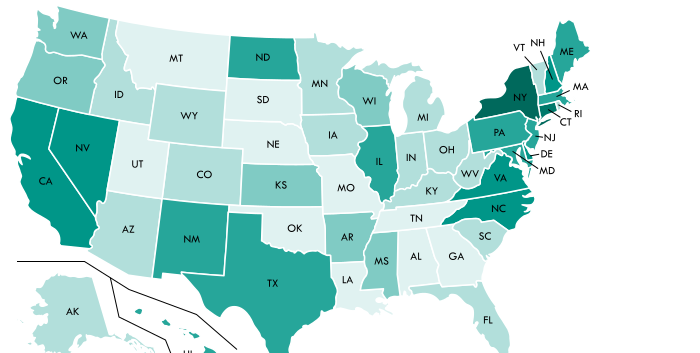
Most common states for personal advocates
| Rank | State | Population | # of jobs | Employment/ 1000ppl |
|---|---|---|---|---|
| 1 | Connecticut | 3,588,184 | 279 | 8% |
| 2 | Massachusetts | 6,859,819 | 383 | 6% |
| 3 | Pennsylvania | 12,805,537 | 608 | 5% |
| 4 | Michigan | 9,962,311 | 490 | 5% |
| 5 | Arizona | 7,016,270 | 316 | 5% |
| 6 | Minnesota | 5,576,606 | 306 | 5% |
| 7 | Colorado | 5,607,154 | 259 | 5% |
| 8 | Oregon | 4,142,776 | 187 | 5% |
| 9 | Iowa | 3,145,711 | 151 | 5% |
| 10 | Nebraska | 1,920,076 | 91 | 5% |
| 11 | North Dakota | 755,393 | 38 | 5% |
| 12 | District of Columbia | 693,972 | 32 | 5% |
| 13 | Illinois | 12,802,023 | 531 | 4% |
| 14 | Ohio | 11,658,609 | 484 | 4% |
| 15 | North Carolina | 10,273,419 | 406 | 4% |
| 16 | Indiana | 6,666,818 | 297 | 4% |
| 17 | Washington | 7,405,743 | 272 | 4% |
| 18 | Wisconsin | 5,795,483 | 253 | 4% |
| 19 | Maryland | 6,052,177 | 216 | 4% |
| 20 | Kansas | 2,913,123 | 127 | 4% |
Personal Advocate job outlook: Expert opinions
Our panel of personal advocate experts
Saint Xavier University
Western Illinois University
University of Maryland
University of Illinois at Urbana-Champaign

Carolina Christian College

Virginia Polytechnic Institute and State University
Kent State University

Angelo State University
What general advice would you give to a Personal Advocate?
Kristen Toole: Remember that this is a marathon, not a sprint. Personal and professional development are
lifelong processes that are never really finished. So, it is essential to pace yourself and establish a
foundation of healthy practices from the outset. Creating habits and routines in the beginning
with the end in mind can be a good strategy for success and sustainability.
Keep work-life balance and boundaries in mind from the start because breaking bad habits can
be tricky once established. Think about where you ultimately want to be and build toward that
future one step at a time. Also, it is okay if plans change! You never know where open-
mindedness and willingness to learn may take you.
What will help Personal Advocates increase their earning potential?
Emily Yowell Ph.D.: Psychologists should be aware of what others in their field are making for similar positions. It is important to ask for what your work is worth in an initial position to assure raises are based on a solid starting salary. Newer psychologists may also consider asking for an early review that prompts an early conversation around potential raises, bonus, or other job benefits.
Leigh Ann Tipton-Fisler, PhD, BCBA
Associate Professor and Program Coordinator of Specialist in School Psychology and Clinical/ Community Mental Health Graduate ProgramsWestern Illinois University
Clinical, Counseling And Applied Psychology
What general advice would you give to a Personal Advocate?
Leigh Ann Tipton-Fisler, PhD, BCBA: - The best I can give to graduates is to focus on taking small steps at first. Often the first year in the field can be exciting and overwhelming at the same time. The system we work in (the helping profession broadly) often has a lot of challenges, and new professionals want to re-envision a path for changes. This is tangible, but at first, it is important to understand the roles and functions in the workplace before flipping everything upside down. I suggest taking one small change at a time in an area that is important to you and build relationships and trust with your professional colleagues before overloading yourself with the new job and new goals.
What experience really stands out on Personal Advocate resumes?
Richard Shin Ph.D.: In the most basic sense, graduates who have experiences and skills on their resumes that set them apart from their cohort tend to stand out to employers. What sorts of extra leadership, advocacy, skill development, etc. opportunities have the applicant pursued outside of the program requirements of a counseling program? Everyone will have internship experiences because those are required. However, not everyone will have an example of a brief intervention that you developed and executed, which was focused on addressing the lack of representation of Black and Indigenous students in AP classes in your local high school. Initiating impactful efforts like this will definitely make you stand out.
What type of skills will young Personal Advocates need?
Brian Ogolsky Ph.D.: Critical thinking skills are crucial in science disciplines. Graduates need to be the right consumers of research because there is a lot of false information floating around. They need to be able to understand and critique science, methods, and data. Independence and creativity are also crucial. Employees are becoming more dependent on specific guidelines, tasks, and directives, but to thrive and move up the ranks, it is critical to come up with new and exciting ideas and take risks.
What type of skills will young Personal Advocates need?
Dr. Andrew Wood: For Biblical Studies, it is vital that graduates have a genuine relationship with Jesus, that they are people of humility and integrity, desire to be lifelong learners, and have open minds to new things they learn that may challenge their original assumptions. They need to have a strong work ethic, organizational, and time management skills to work on their own productively and with integrity.
What type of skills will young Personal Advocates need?
Dr. Thomas Dearden Ph.D.: Indeed, the way we work is changing. The skills that young graduates will need are diverse. Transferable skills and soft skills will certainly be marketable. These include traditional crafts such as communication, but I also think the world expects more empathy from its employees. Young graduates with an understanding of racism, sexism, and environmental responsibility will become increasingly important.
Dr. Janice Byrd Ph.D.
ProfessorKent State University
School of Lifespan Development and Educational Sciences
Are there any particularly good places in the United States for Personal Advocates to find work opportunities?
Dr. Janice Byrd Ph.D.: COVID-19 and racial violence are global phenomena that cause many mental health challenges for students globally. Schools are scrambling to identify solutions to address the social/emotional needs of their students. Some are investing in curriculum related to Social Emotional Learning, Trauma-Informed Schools, or seeking anti-racism experts to join their staff in conversations.
This emphasis is also illustrated in funding opportunities that have been advertised for schools and school-based researchers to consider innovative ways to address the increased stress our students are under, given the ongoing issues mentioned. While COVID-19 will hopefully, one day, decrease, the impact will be present for decades. As for racial violence against Black and Brown people, this oppression has/continues to harm communities across generations.
I implore schools to lean on school counselors as trained leaders to guide responses to these crises and support students. Due to budget constraints at the moment, we may see a decrease in job postings, but once the economy begins to heal, we will need more school counselors - not less. School counseling graduates awaiting employment should extend their knowledge about instructional based technology that may aid in their facilitation of counseling tasks, examine their bias/stereotypical thinking so they do not harm their BIPOC students, and create toolkits of information that may inform how they foster the development of anti-racist cultures in K-12 settings.
We all must remember that students do not perform well academically if they are not mentally/emotionally healthy or do not feel safe. Because COVID, the mental health challenges that have arisen due to the pandemic, and race-based violence, which causes mental health challenges for many, are global pandemics, school counselors face similar barriers to finding jobs across the nation. In time, given proper professional advocacy by school counselors, we will be acknowledged as leaders in the plight to heal students, schools, and communities.
Lesley Casarez Ph.D.
Director, Quality Enhancement Plan Program Coordinator, M.S. Professional School Counseling Associate Professor, Curriculum and InstructionAngelo State University
Department of Curriculum and Instruction
What technology do you think will become more important and prevalent for Personal Advocates in the next 3-5 years?
Lesley Casarez Ph.D.: Graduates will need to learn to use technology in which virtual platforms are taking place and web conferencing platforms. Numerous platforms are being used, so the particular platform itself is not as crucial as being well-versed in how virtual education differs from face-to-face environments. Typically, the instructional role in online learning is more of a facilitator, as the educator guides the students to think critically, integrate, and apply new knowledge. This may be difficult for educators who would rather stand in front of a classroom and pass on their knowledge through lecture-based formats. Additionally, being well-versed in various web conferencing platforms will benefit graduates, as they move into a career that is currently requiring communication in virtual environments.