Explore jobs
Find specific jobs
Explore careers
Explore professions
Best companies
Explore companies
Job outlook for personnel technicians in the United States
Are personnel technician jobs in demand?
Personnel technician job and salary trends over time
Personnel technician jobs over time
Personnel technician job growth rate over time
| Year | # of jobs | % of population |
|---|---|---|
| 2021 | 1,369 | 0.00% |
| 2020 | 1,197 | 0.00% |
| 2019 | 1,170 | 0.00% |
| 2018 | 1,097 | 0.00% |
| 2017 | 1,023 | 0.00% |
Average personnel technician salary over time
Personnel technician salary by year
| Year | Avg. salary | Hourly rate | % Change |
|---|---|---|---|
| 2025 | $39,836 | $19.15 | +2.5% |
| 2024 | $38,851 | $18.68 | +1.7% |
| 2023 | $38,198 | $18.36 | +0.9% |
| 2022 | $37,865 | $18.20 | +2.0% |
| 2021 | $37,131 | $17.85 | +1.4% |
Personnel technician jobs by state
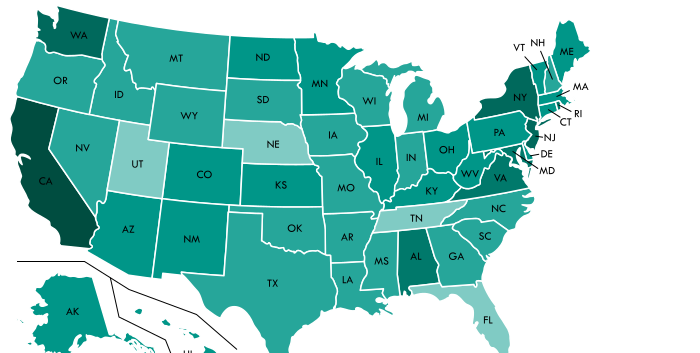
Most common states for personnel technicians
| Rank | State | Population | # of jobs | Employment/ 1000ppl |
|---|---|---|---|---|
| 1 | District of Columbia | 693,972 | 120 | 17% |
| 2 | Maine | 1,335,907 | 168 | 13% |
| 3 | Alaska | 739,795 | 96 | 13% |
| 4 | Delaware | 961,939 | 104 | 11% |
| 5 | Vermont | 623,657 | 71 | 11% |
| 6 | Massachusetts | 6,859,819 | 648 | 9% |
| 7 | Minnesota | 5,576,606 | 482 | 9% |
| 8 | New Hampshire | 1,342,795 | 118 | 9% |
| 9 | Missouri | 6,113,532 | 459 | 8% |
| 10 | Colorado | 5,607,154 | 435 | 8% |
| 11 | Iowa | 3,145,711 | 254 | 8% |
| 12 | Nebraska | 1,920,076 | 146 | 8% |
| 13 | Montana | 1,050,493 | 80 | 8% |
| 14 | Illinois | 12,802,023 | 873 | 7% |
| 15 | North Carolina | 10,273,419 | 763 | 7% |
| 16 | Georgia | 10,429,379 | 741 | 7% |
| 17 | Virginia | 8,470,020 | 565 | 7% |
| 18 | Maryland | 6,052,177 | 421 | 7% |
| 19 | Connecticut | 3,588,184 | 253 | 7% |
| 20 | Kansas | 2,913,123 | 194 | 7% |
Most common cities for personnel technicians
| Rank | City | # of jobs | Employment/ 1000ppl | Avg. salary |
|---|---|---|---|---|
| 1 | Redford | 1 | 2% | $35,668 |
| 2 | Tallahassee | 1 | 1% | $30,763 |
Personnel Technician job outlook: Expert opinions
Our panel of personnel technician experts
Carthage College
Marshall University
Washington State University- Vancouver

Grand Valley State University

Zones, LLC

Indiana University - Purdue University Indianapolis

The University of Memphis
Dr. Stephanie Mitchell
Professor of HistoryCarthage College
History
What general advice would you give to a Personnel Technician?
Dr. Stephanie Mitchell: A better question to ask yourself is: How much money do I need to give a life with dignity to myself and the people I love who will depend on my salary? Then, how can I earn that much money? A quick look at different fields will give you a sense of average salaries in different parts of our economy, and that kind of information should be a variable to incorporate as you pursue your vocational exploration and discernment. It's not the only variable, but it's an important one. Others include whether you are good at that kind of work, whether you enjoy it, and whether you think it serves the common good, which is another way of asking whether you think you would find the work meaningful. At Carthage, we know that earning enough money is an important part of living a good life, but it isn't the only part. A purposeful life is the one you will find is worth living.
Ralph McKinney Ph.D.
Associate Professor of ManagementMarshall University
Health And Medical Administrative Services
What general advice would you give to a Personnel Technician?
Ralph McKinney Ph.D.: When starting a career, as noted above, an individual needs to have a clear career plan that considers
how to balance the relationship between work and life. Planning helps individuals identify their
strengths and weaknesses along with their desires and expectations. By understanding your strengths
and weaknesses, you can better communicate your value as an employee. Likewise, understanding your
desires and expectations provides a general basis for negotiating a compensation package. It may not
necessarily be about maximizing the salary, but maximizing your needs and your long-term goals. For
example: You may be able to negotiate more paid time off rather than negotiating a higher salary.
Increasing your salary throughout your career means that you have value as an employee and that the
employer knows your contributions and your value. This means that you must be seen and heard. The
easiest way to be seen and heard is to showcase your efforts and accomplishments through feedback
sessions. As an employee, use the feedback sessions to illustrate your work as well as your efforts to
build your knowledge and skills. If a manager is unaware of your efforts, how can you be rewarded?
Additional credentials help build value and illustrate your commitment to the profession. Determine
which credentials are important to your career. Is it a master's degree or micro-credentials? How do
these fit within your plan? Perhaps the extra time off can be used to take educational courses. If an
employer is paying for education, this is a benefit that has exceptional value beyond the immediate
salary. The extra education can provide for greater upward mobility within the organization.
Adriana Thomas
Advisor, Internship Coordinator, InstructorWashington State University- Vancouver
Department of Human Development
What skills stand out on Personnel Technician resumes?
Adriana Thomas: Organization. Students are often interested in administrative work, supporting a company and employees (the company may be working with clients, so the HR department is supporting them in that work), policies.
What soft skills should all Personnel Technicians possess?
Adriana Thomas: People skills. Communication, collaboration.
What skills will help Personnel Technicians earn the most?
Adriana Thomas: Leadership skills. Drive, ambition, and commitment to a company. Students may start in an entry-level position and then are often promoted over time.
Dan Wiljanen Ph.D.
Affiliate of Practice Professor, SHRM Student Chapter AdviserGrand Valley State University
Seidman College of Business
What hard/technical skills are most important for Personnel Technicians?
Dan Wiljanen Ph.D.: Knowledge of the HR Discipline
-Personnel and Human Resources - Knowledge of principles and procedures for personnel recruitment, selection, training, compensation and benefits, labor relations and negotiation, and personnel information systems.
-Administration and Management - Knowledge of business and management principles involved in strategic planning, resource allocation, human resources modeling, leadership technique, production methods, and coordination of people and resources.
-Law and Government - Knowledge of laws, government regulations, and executive orders.
-Education and Training - Knowledge of principles and methods for training design, implementation, and evaluation.
Technology Skills
-Enterprise resource planning ERP software
-Human resources software - Human Resource Information Systems (HRIS)
-Office suite software
-Project management software
-Web page creation and editing software
-Word processing software
What soft skills should all Personnel Technicians possess?
Adrianne Keeler: Soft skills that all graduates should possess and make sure they display during the interview process are public speaking/presentation skills (and specifically the ability to speak and present to various levels of audiences), persuasion/hunting/competitive mentality (especially when targeting working for sales organizations like Zones! We want to know that this soft skill set is natural for you!), coachability (graduates are going to have to learn and retain a lot of information, and are bound to need coaching- are they going to take it?), and lastly a flexible positive attitude. (These times demand flexibility in the workplace, things are pivoting all the time! And the ability to remain positive is key to success with both internal and external customers.)
What's a good job out of college for Personnel Technicians?
Mike Polites: In my opinion, "good" is a relative word. Before the pandemic I had a job speaking to 500 incoming freshmen and their parents twice a week during the summer as part of college orientation. To me, that's a good (great! fun!) job. Other people may think that is their worst nightmare gettting in front of that many people. A good job is one that brings someone joy, doing something they are developing a passion for (which can take time), one that pays a liveable wage, and one that is personally fulfilling. Obviously, this picture will look different for different students/graduates. When students ask me about this I alway remind them of two things: 1) internships and informational interviews are a great way to gain insight into jobs/careers that might be a good fit, 2) the likelyhood of staying not only at your first job after college but even staying with your first career, for the rest of your life, are highly unlikely. People change majors, jobs, and even entire careers/fields frequently. To that end, if you wind up "settling" for a job after college because you need to pay the rent, and after a year or two you realize it's not your thing, you can look for something that is a better fit. Just be mindful of job-hopping every couple years as that becomes a bit of a red flag to future employers. To quote the late Neil Peart, drummer and lyrisist for my favorite band Rush: "Change aren't permanant. But Change is."
What Personnel Technician skills would you recommend for someone trying to advance their career?
Dr. Lindsey Feldman Ph.D.: It is all about networking. Sounds cliché, but it is true! Stay connected with your professors, TAs, and fellow graduates. You can see what fields and careers your graduating classmates are finding, and talk to them about their journeys and what they like/don't like about particular career fields. Before you graduate, if you can help a professor on a research project, that is a great way to make contacts and start out in jobs with higher earning potential. After you graduate, stay connected using job networking sites, social media, and alumni events. You'll be shocked at who you meet and what opportunities might arise by staying in touch!