Explore jobs
Find specific jobs
Explore careers
Explore professions
Best companies
Explore companies
Job outlook for physical sciences instructors in the United States
Are physical sciences instructor jobs in demand?
Physical sciences instructor job and salary trends over time
Physical sciences instructor jobs over time
Physical sciences instructor job growth rate over time
| Year | # of jobs | % of population |
|---|---|---|
| 2021 | 1,130 | 0.00% |
| 2020 | 1,098 | 0.00% |
| 2019 | 1,148 | 0.00% |
| 2018 | 1,165 | 0.00% |
| 2017 | 1,138 | 0.00% |
Average physical sciences instructor salary over time
Physical sciences instructor salary by year
| Year | Avg. salary | Hourly rate | % Change |
|---|---|---|---|
| 2026 | $70,130 | $33.72 | +2.0% |
| 2025 | $68,781 | $33.07 | +2.2% |
| 2024 | $67,286 | $32.35 | +1.9% |
| 2023 | $66,003 | $31.73 | +2.0% |
| 2022 | $64,731 | $31.12 | +1.5% |
Physical sciences instructor jobs by state
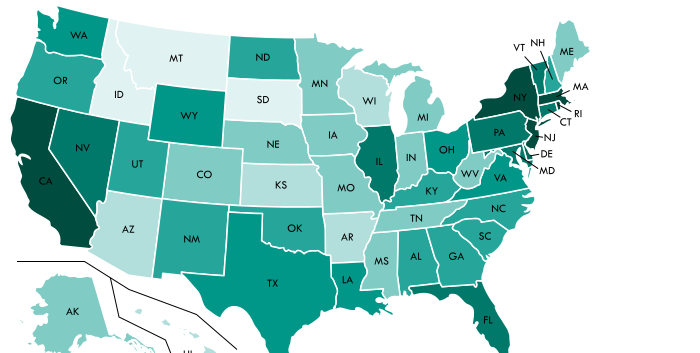
Most common states for physical sciences instructors
| Rank | State | Population | # of jobs | Employment/ 1000ppl |
|---|---|---|---|---|
| 1 | Vermont | 623,657 | 142 | 23% |
| 2 | Wyoming | 579,315 | 110 | 19% |
| 3 | Massachusetts | 6,859,819 | 1,138 | 17% |
| 4 | Alaska | 739,795 | 124 | 17% |
| 5 | Rhode Island | 1,059,639 | 166 | 16% |
| 6 | Delaware | 961,939 | 149 | 15% |
| 7 | South Dakota | 869,666 | 134 | 15% |
| 8 | Colorado | 5,607,154 | 771 | 14% |
| 9 | South Carolina | 5,024,369 | 723 | 14% |
| 10 | Iowa | 3,145,711 | 398 | 13% |
| 11 | Nebraska | 1,920,076 | 246 | 13% |
| 12 | West Virginia | 1,815,857 | 242 | 13% |
| 13 | Montana | 1,050,493 | 139 | 13% |
| 14 | Virginia | 8,470,020 | 1,052 | 12% |
| 15 | Maryland | 6,052,177 | 723 | 12% |
| 16 | New Mexico | 2,088,070 | 259 | 12% |
| 17 | Maine | 1,335,907 | 163 | 12% |
| 18 | North Dakota | 755,393 | 88 | 12% |
| 19 | District of Columbia | 693,972 | 83 | 12% |
| 20 | Connecticut | 3,588,184 | 393 | 11% |
Most common cities for physical sciences instructors
| Rank | City | # of jobs | Employment/ 1000ppl | Avg. salary |
|---|---|---|---|---|
| 1 | Spring Hill | 1 | 1% | $77,296 |
Physical Sciences Instructor job outlook: Expert opinions
Our panel of physical sciences instructor experts

Wright State University

Lafayette College
Franklin and Marshall College

Kent State University

University of West Georgia

Boise State University
University of Colorado Denver
Horacio Ferriz Ph.D.
Professor of Applied Geology and HydrogeologyWhat will help Physical Sciences Instructors increase their earning potential?
Horacio Ferriz Ph.D.: Take some of your basic requirements for a Teaching Credential in your junior and senior years at college (Adolescent Psychology, Foundations of Secondary Education), and make sure to log some hours helping a local STEM teacher in the classroom.
What Physical Sciences Instructor skills would you recommend for someone trying to advance their career?
Horacio Ferriz Ph.D.: Hopefully you have it real clear in your mind that you want to pursue a career in Science Education, at the Elementary or Middle School level. If you have your sights on becoming a High School teacher you would be much better off pursuing a traditional major in Geology, Physics, Chemistry, or Biology. Physical Science would also be a good platform to pursue a career as a Science Journalist.
How would you rate the starting salaries for Physical Sciences Instructors, as well as the prospects for salary advancement?
Dr. Karla Huebner Ph.D.: Salaries are generally low, but now and then, artists and art historians can make good incomes--don't expect to.
What technology do you think will become more important and prevalent for Physical Sciences Instructors in the next 3-5 years?
Karina Skvirsky: That's hard to predict! I believe Facebook will become dated, and no one under 30 will be using it in the future.
What general advice would you give to a Physical Sciences Instructor?
David McMahan Ph.D.: Keep open to possibilities beyond the narrow range of what your diploma lists as your major or minor. Whatever job you get trained for today, in 10-20 years, it may be very different. Or it may not exist. Focus on obtaining and maintaining flexibility, critical thinking, creativity, and passion for learning. Being an interesting person is as vital as any credential.
Are there any particularly good places in the United States for Physical Sciences Instructors to find work opportunities?
Dr. Jay Dorfman: There are certainly some states with teacher shortages, but that is often because those states' political or economic climates make them less desirable as a place for teachers to work. If teachers' teaching conditions and salaries were improved, there would be more people interested in entering the profession. That said, I typically tell students that the broader their search for a job can be, the more likely they are to find a good fit.
What type of skills will young Physical Sciences Instructors need?
Ye Chen Ph.D.: Graduates with educational technology (Ed Tech) degrees commonly work as instructional designers, technology/media specialists, trainers, e-learning developers in k12 school, university, military, company, or government. The skills employers usually want in Ed Tech graduates include:
- Instructional design skills for analyzing instructional needs and designing & developing effective instructional solutions.
- Technical skills in utilizing technology to develop and implement instruction. At the same time, they are expected to understand how to integrate technology into instructional settings in a pedagogically meaningful way.
- Communication skills are essential as their work roles heavily rely on effective communication with content experts, clients, trainees/students, etc. throughout the instructional design process
Dr. Lori Gray
Associate Professor: Director of Music EducationBoise State University
Department of Music Education
What type of skills will young Physical Sciences Instructors need?
Dr. Lori Gray: For the past several years, it has been clear that employers are seeking graduates with 21st Century Learning Skills (critical thinking, creativity, communication, and collaboration). The four Cs of 21st Century Learning frequently come up during reference calls on my end and interviews for our recent graduates.
I would add that graduates need a strong work ethic, an understanding of professionalism and respect in the workplace, and self-awareness and an understanding of personal needs and limitations both at work and in their personal lives. In these current living conditions during a global pandemic (COVID-19), graduates also need resilience, perseverance, adaptability, and flexibility. These are all skills I would want for our Music Education majors to cultivate, as the climate in K-12 Education is ever-changing. However, I believe these are all skills that would be useful in any new career path.
Are there any particularly good places in the United States for Physical Sciences Instructors to find work opportunities?
Joshua French Ph.D.: With employers increasingly allowing their employees to work from him, particularly in knowledge-driven jobs such as statistics, the physical location of a job won't be as important in the future. However, you can expect that the majority of jobs will still be in larger cities with large tech and corporate presence. In the immediate future, states allowing companies more flexibility in operating normally will see a relative increase in the number of statistics jobs, as companies will be able to increase the amount of business performed in those areas.