Explore jobs
Find specific jobs
Explore careers
Explore professions
Best companies
Explore companies
Job outlook for physician extenders in the United States
Are physician extender jobs in demand?
Physician extender job and salary trends over time
Physician extender jobs over time
Physician extender job growth rate over time
| Year | # of jobs | % of population |
|---|---|---|
| 2021 | 887 | 0.00% |
| 2020 | 836 | 0.00% |
| 2019 | 801 | 0.00% |
| 2018 | 765 | 0.00% |
| 2017 | 729 | 0.00% |
Average physician extender salary over time
Physician extender salary by year
| Year | Avg. salary | Hourly rate | % Change |
|---|---|---|---|
| 2025 | $244,718 | $117.65 | +2.8% |
| 2024 | $238,080 | $114.46 | +3.4% |
| 2023 | $230,339 | $110.74 | +3.6% |
| 2022 | $222,386 | $106.92 | +3.3% |
| 2021 | $215,218 | $103.47 | +3.4% |
Physician extender jobs by state
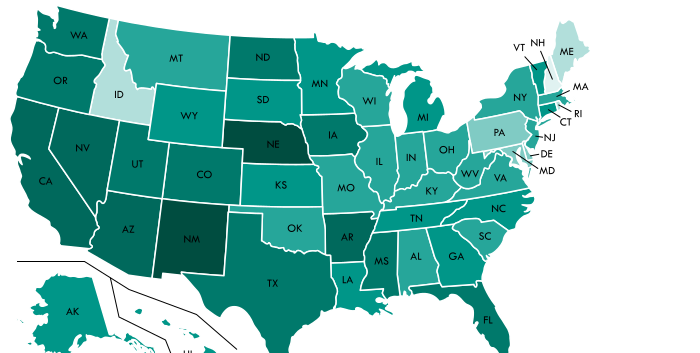
Most common states for physician extenders
| Rank | State | Population | # of jobs | Employment/ 1000ppl |
|---|---|---|---|---|
| 1 | South Dakota | 869,666 | 232 | 27% |
| 2 | Vermont | 623,657 | 168 | 27% |
| 3 | New Hampshire | 1,342,795 | 332 | 25% |
| 4 | North Dakota | 755,393 | 153 | 20% |
| 5 | Alaska | 739,795 | 137 | 19% |
| 6 | New Mexico | 2,088,070 | 366 | 18% |
| 7 | Montana | 1,050,493 | 169 | 16% |
| 8 | Wisconsin | 5,795,483 | 842 | 15% |
| 9 | Rhode Island | 1,059,639 | 158 | 15% |
| 10 | Wyoming | 579,315 | 80 | 14% |
| 11 | Massachusetts | 6,859,819 | 922 | 13% |
| 12 | South Carolina | 5,024,369 | 661 | 13% |
| 13 | West Virginia | 1,815,857 | 239 | 13% |
| 14 | Arizona | 7,016,270 | 818 | 12% |
| 15 | Indiana | 6,666,818 | 778 | 12% |
| 16 | Minnesota | 5,576,606 | 685 | 12% |
| 17 | Connecticut | 3,588,184 | 415 | 12% |
| 18 | Iowa | 3,145,711 | 371 | 12% |
| 19 | Nebraska | 1,920,076 | 230 | 12% |
| 20 | Oregon | 4,142,776 | 441 | 11% |
Most common cities for physician extenders
| Rank | City | # of jobs | Employment/ 1000ppl | Avg. salary |
|---|---|---|---|---|
| 1 | Des Moines | 1 | 0% | $277,468 |
Physician Extender job outlook: Expert opinions
Our panel of physician extender experts

University of Central Arkansas
Western New Mexico University

University of Hawai'i at Hilo
College of William and Mary
Appalachian State University
Arizona State University

Alice Lloyd College
The University of Tennessee
University of Delaware

Longwood University

University of Indianapolis
Kim Eskola
Senior Clinical Instructor - Exercise ScienceUniversity of Central Arkansas
Exercise and Sport Science
What soft skills should all Physician Extenders possess?
Kim Eskola: Interpersonal communication skills, critical thinking skills, creativity.
What skills will help Physician Extenders earn the most?
Kim Eskola: Ability to work with diverse groups and in various settings.
What skills stand out on Physician Extender resumes?
Kim Eskola: Experience in prescriptions and advanced assessments (ECG, metabolic testing, high-tech equipment). Hands-on experience in one on one training with a diverse population.
What hard/technical skills are most important for Physician Extenders?
Kim Eskola: Proficient in assessing basic resting measurements (HR, RBP, anthropometric measures); proficient in body composition techniques and basic assessments (cardiovascular, muscular endurance, muscular strength). Experience working one on one or in small groups.
Garrett Peltonen
Assistant Professor of KinesiologyWestern New Mexico University
Sports, Kinesiology, And Physical Education/Fitness
What soft skills should all Physician Extenders possess?
Garrett Peltonen: There are many soft skills that are relevant to the field of kinesiology. Creativity and critical thinking are both important as Kinesiologists aims to improve health and performance through the application of current knowledge. Similarly, communication skills are important as we aim to disseminate our findings and ultimately promote physical activity. Leadership and empathy are also important as many Kinesiology provides exercise interventions for individuals aiming to improve their health.
Ozan Atalağ Ph.D.
Associate Professor, and Chair Kinesiology & Exercise ScienceUniversity of Hawai'i at Hilo
Kinesiology and Exercise Sciences Department
What soft skills should all Physician Extenders possess?
Ozan Atalağ Ph.D.: Exercise science is mostly about bettering humans through physical activity. So, we're dealing with humans on every level. Nowadays, we get stuck on our phones for hours and almost forget to interact in person. Anyone who can openly communicate, connect and relate to the other person by listening effectively and anyone who can be present during the interactions would have the upper hand.
What skills will help Physician Extenders earn the most?
Ozan Atalağ Ph.D.: Again, this would be dependent on the profession chosen. For example, in the fitness industry, I would argue that social media and online skills, in general, might help a person make a difference in their career whereas, for professions in the medical field such as exercise physiologist, a physical therapist, etc. it would be prior experience.
Michael Deschenes Ph.D.
Professor of Kinesiology and Health Sciences, Chair of Kinesiology and Health Sciences, Chancellor Professor of Health SciencesCollege of William and Mary
Kinesiology & Health Sciences
What skills will help Physician Extenders earn the most?
Michael Deschenes Ph.D.: Generally speaking, clinical skills used in therapeutic settings are likely to garner the highest salaries, e.g., physical therapy, occupational therapy, nursing, physician assistant. Skills used in academia, such as teaching and research, are also well compensated.
N. Travis Triplett Ph.D.
Professor of Exercise Science, Exercise Science Undergraduate Program DirectorAppalachian State University
Department of Health and Exercise Science
What soft skills should all Physician Extenders possess?
N. Travis Triplett Ph.D.: Kinesiology is a people-oriented field, so good people skills are a must. Careers in kinesiology often focus on the health aspects of fitness and not just peak or sports performance, so exercise recommendations must be based on science and need to fit the individual. Being able to obtain essential information from a client in a non-threatening and respectful manner is important. Also, being a sincere motivator is critical.
What hard/technical skills are most important for Physician Extenders?
N. Travis Triplett Ph.D.: Having a thorough understanding of the scientific aspects of exercise and training is essential, and the ability to perform various tests of physical performance safely and correctly. Also, kinesiology graduates may be expected to understand the business or legal aspects of the fitness industry and apply those, so a good understanding of basic concepts in those areas is very helpful.
What will help Physician Extenders increase their earning potential?
Dr. Randolph Nesse: People do not go into this field to earn more than others, they go into it because they are fascinated and because they want to help contribute to the growth of a whole new field with vast potential for improving human health.
James Craft Ph.D.
Doctor of Chiropractic, Assistant Professor of KinesiologyAlice Lloyd College
Natural Science and Mathematics Department
What general advice would you give to a Physician Extender?
James Craft Ph.D.: Stay passionate. Love what you do and love doing it. The passion will drive all the other necessary things that are needed to begin a new career. When you learn and understand your personal why then that is the foundation of a successful career. Seek opportunities, don't hesitate to ask for advice, and stand strong and work hard. There will be mountains and valleys but the passion will give you the energy to keep going.
Rob Hardin Ph.D.
ProfessorThe University of Tennessee
Kinesiology, Recreation, & Sport Studies Department
What are the biggest trends we'll see in the Physician Extender job market given the pandemic?
Rob Hardin Ph.D.: The job market will definitely be tightening as a result of the pandemic as organizations will assess exactly what their personnel needs are. The concept of what is a traditional work week has changed as the work-from-home trend continues. Employees will seek out opportunities to continue to work from home, and organizations will look to maximize efficiency with employees. There are obviously jobs that do not allow people to work from home, but employees and employers will seek out opportunities to make sure time is used efficiently.
What Physician Extender skills would you recommend for someone trying to advance their career?
Rob Hardin Ph.D.: Recent graduates should continue to develop soft skills. The ability to communicate effectively in regards to oral, written, and visual communications will always be skills that professionals need. Recent graduates should continue to develop those skills through online training, hands-on training, job shadowing, and workshops. Developing communication skills is not unlike developing sports skills - practice. Recent graduates should practice their interpersonal and group communication skills as well as their writing skills. Consider every one-on-one encounter an opportunity to develop interpersonal communication skills, and take advantage of every opportunity to develop writing skills.
What are the biggest trends we'll see in the Physician Extender job market given the pandemic?
Brittany Overstreet Ph.D.: Kinesiology refers to studying the principles of mechanics and anatomy about human movement (Merriam-Webster Dictionary). It is a broader term that can be applied to many jobs/careers, including Exercise Physiologist, Strength and Conditioning Coach, Personal Trainer, Clinical Exercise Physiologist, etc. It can be hard to put all of these career paths under one umbrella as individuals in these fields work in very different settings, with diverse populations, and require varied training to be a qualified professional.
Hardly to anyone's surprise, I believe the most significant trend we will see in the field, due to the COVID19 pandemic, is technology use. Using and transforming exercise programs and research projects to be accessed virtually will be critical for kinesiology. Specifically, I think online platforms that provide examples of exercises, instructions for participants, and demonstrate proper techniques will be of great need to professionals. Furthermore, I predict that activity trackers (there are many on the market now!) will become even more popular as individuals rely more on themselves to collect data and track outcomes to report to professionals, compared to collecting this data in person. Lastly, I believe that social media will play an essential role in connecting clients, provide a personal touch to the virtual world, and assist with maintenance/enrollment of exercise/research programs.
Given that exercise is a highly useful tool to improve/maintain health and wellbeing, trained professionals will be in high demand over the next five years. However, it will be critical for individuals to seek out highly qualified professionals as they would in any other health-related field. Thus, I foresee education and certifications becoming even more important than they currently are. As the area continues to grow, the criteria to become a professional are becoming more specific. Accredited education and training will be of great importance for students wishing to work in this field over the next decade.
Michael Mucedola Ph.D.
Department ChairLongwood University
Department of Health, AT, Rec & Kinesiology
What type of skills will young Physician Extenders need?
Michael Mucedola Ph.D.: While numerous skills can assist a new graduate as they navigate the upcoming workforce, some proven skills from the past will still serve them well. Working hard, perseverance, positive attitude, effective communication, problem-solving, critical thinking, and so on can help lay a pathway for students to enter the workforce. Skills related to technology, adaptability, being trained in multiple areas, and not becoming complacent are all keys. The ability to spot value and opportunity is vital, and being cognizant that everyone has to start somewhere. If a person is willing to relocate and live anywhere, there is a job available.
Dr. Michael Diacin Ph.D.
Associate Professor of KinesiologyUniversity of Indianapolis
Department of Kinesiology
Are there any particularly good places in the United States for Physician Extenders to find work opportunities?
Dr. Michael Diacin Ph.D.: Because these areas are going to be ranging from slow to stand-still for the foreseeable future, these areas will not be adding new labor to their workforces. In the short term, graduates in these fields should give some thought to entering industries that deal with the distribution of goods. Massive distribution centers need qualified management to keep these operations running efficiently. Although these students don't supply chain majors, management skills are transferable; therefore, students from these majors could still be assets to these operations.
How do you envision technology impacting Physician Extenders in the next 5 years?
Dr. Michael Diacin Ph.D.: Because the service industry is less technology-driven and more driven by the experience customers receive, there wouldn't be a particular computer program to learn, for example. That doesn't mean that employees can remain ignorant of technological tools and expect their businesses to survive. Since there will be fierce competition for a smaller pool of consumers, the use of social media platforms will be used. Even more than just knowing how to post content on social media platforms, the critical aspect will be what you're posting, in order to convince the consumer to spend their money with you rather than elsewhere.