Explore jobs
Find specific jobs
Explore careers
Explore professions
Best companies
Explore companies
Job outlook for principal design engineers in the United States
Principal design engineer job growth summary. After extensive research, interviews, and analysis, Zippia's data science team found that:
The projected principal design engineer job growth rate is 3% from 2018-2028.
About 9,800 new jobs for principal design engineers are projected over the next decade.
Principal design engineer salaries have increased 8% for principal design engineers in the last 5 years.
There are over 8,972 principal design engineers currently employed in the United States.
There are 120,887 active principal design engineer job openings in the US.
The average principal design engineer salary is $134,300.
Are principal design engineer jobs in demand?
Principal design engineer job and salary trends over time
Principal design engineer jobs over time
Principal design engineer job growth rate over time
| Year | # of jobs | % of population |
|---|---|---|
| 2021 | 8,972 | 0.00% |
| 2020 | 9,865 | 0.00% |
| 2019 | 10,347 | 0.00% |
| 2018 | 10,516 | 0.00% |
| 2017 | 10,358 | 0.00% |
Average principal design engineer salary over time
Principal design engineer salary by year
| Year | Avg. salary | Hourly rate | % Change |
|---|---|---|---|
| 2025 | $134,300 | $64.57 | +1.9% |
| 2024 | $131,839 | $63.38 | +2.8% |
| 2023 | $128,255 | $61.66 | +0.5% |
| 2022 | $127,606 | $61.35 | +3.0% |
| 2021 | $123,897 | $59.57 | +1.0% |
Principal design engineer jobs by state
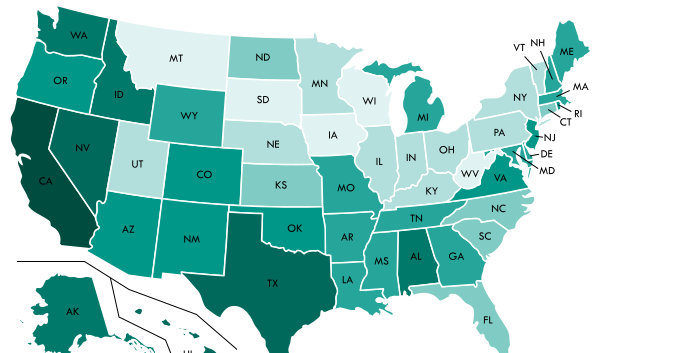
Most common states for principal design engineers
| Rank | State | Population | # of jobs | Employment/ 1000ppl |
|---|---|---|---|---|
| 1 | District of Columbia | 693,972 | 594 | 86% |
| 2 | Oregon | 4,142,776 | 1,447 | 35% |
| 3 | Virginia | 8,470,020 | 2,727 | 32% |
| 4 | New Hampshire | 1,342,795 | 407 | 30% |
| 5 | Maryland | 6,052,177 | 1,612 | 27% |
| 6 | Colorado | 5,607,154 | 1,461 | 26% |
| 7 | Massachusetts | 6,859,819 | 1,725 | 25% |
| 8 | Minnesota | 5,576,606 | 1,422 | 25% |
| 9 | Montana | 1,050,493 | 245 | 23% |
| 10 | Delaware | 961,939 | 224 | 23% |
| 11 | Arizona | 7,016,270 | 1,517 | 22% |
| 12 | California | 39,536,653 | 8,183 | 21% |
| 13 | Washington | 7,405,743 | 1,571 | 21% |
| 14 | North Carolina | 10,273,419 | 1,804 | 18% |
| 15 | Utah | 3,101,833 | 554 | 18% |
| 16 | Vermont | 623,657 | 115 | 18% |
| 17 | Wyoming | 579,315 | 102 | 18% |
| 18 | Connecticut | 3,588,184 | 621 | 17% |
| 19 | Idaho | 1,716,943 | 293 | 17% |
| 20 | North Dakota | 755,393 | 127 | 17% |
Most common cities for principal design engineers
| Rank | City | # of jobs | Employment/ 1000ppl | Avg. salary |
|---|---|---|---|---|
| 1 | Hagerstown | 2 | 5% | $121,391 |
| 2 | Redondo Beach | 3 | 4% | $158,349 |
| 3 | Santa Clara | 4 | 3% | $168,422 |
| 4 | Irvine | 4 | 2% | $157,320 |
| 5 | Cambridge | 2 | 2% | $123,220 |
| 6 | Lowell | 2 | 2% | $123,061 |
| 7 | San Jose | 12 | 1% | $168,224 |
| 8 | Tucson | 6 | 1% | $125,673 |
| 9 | Denver | 4 | 1% | $124,968 |
| 10 | Seattle | 4 | 1% | $141,882 |
| 11 | Atlanta | 3 | 1% | $118,834 |
| 12 | Chandler | 3 | 1% | $126,604 |
| 13 | Huntsville | 2 | 1% | $132,922 |
| 14 | San Francisco | 4 | 0% | $169,016 |
| 15 | Boston | 2 | 0% | $123,253 |
| 16 | Chicago | 2 | 0% | $102,648 |
| 17 | Colorado Springs | 2 | 0% | $125,758 |
Principal Design Engineer job outlook: Expert opinions
Our panel of principal design engineer experts
Gonzaga University
Stevens Institute of Technology
California State University - Fresno
University of Michigan - Ann Arbor
University of Alabama at Birmingham
San Diego State University

Fairfield University
University of Utah
Xavier University

Murray State University

The University of Texas at Austin

Carnegie Mellon University
Arizona State University

East Tennessee State University

Old Dominion University

University of Nebraska–Lincoln

Liberty University

Rose-Hulman Institute of Technology
Northern Michigan University
What Principal Design Engineer skills would you recommend for someone trying to advance their career?
Steven Schennum Ph.D. P.E.: The most important skill is the ability to learn new things, and especially to unlearn things you “know” after evidence demonstrates that these things are not true. Learn how to analyze information. Your intuition, simulations, and results should all be in alignment. If they are not, then dig deeper. Learn the terminology and jargon specific to your company and your projects. Spend time reading. Don’t be afraid to ask questions. Don’t be intimidated by new software.
What Principal Design Engineer skills would you recommend for someone trying to advance their career?
Min Song: Communication skills and innovative thinking skills. As emerging technologies continue to be complex and multidisciplinary, it’s important to be able to communicate with professionals in diverse disciplines. Taking robotics, for example, the electrical engineer must be able to work with mechanical and biomechanical engineers, computer engineers, software engineers, artificial intelligence experts, cognitive scientists, system engineers, etc. A person will be able to generate innovative ideas only if the person has a complete and comprehensive understanding of the entire system and can work well with other individuals with a range of expertise.
What will help Principal Design Engineers increase their earning potential?
Aaron Stillmaker Ph.D.: To maximize your salary I always tell my students to make sure to research what the average entry engineer in that specialty and location makes, which is easy both by researching online and talking with colleagues. Make sure to apply to many positions at the same time and ideally get interviews around the same time. Ideally if you get multiple companies that want to hire them, they can use the job offers to compete with each other. I also always tell students to ideally not say a desired number first, and no matter what the hiring manager offers them they should ask for more. If the number is below average, they have a strong hand to ask for more, but even with a good offer, I always suggest students ask for 10% more than what was offered. The worst thing they can say is no, and hold firm on the offer, so they have nothing to lose.
What Principal Design Engineer skills would you recommend for someone trying to advance their career?
Todd Allen: - analyzing systems, including technical and social implications, of engineering solutions
What will help Principal Design Engineers increase their earning potential?
Todd Allen: -work hard to develop professional networks
- get the details right
- the way you present is as important as your technical knowledge
What Principal Design Engineer skills would you recommend for someone trying to advance their career?
Arie Nakhmani: Electrical Engineering has always (from its inception) been a good profession to enter, but now it is better than ever. Now everything is becoming Electrical Engineering, and the world cannot survive without it even for a few days. Electrical Engineering is the most necessary profession for the survival of modern society.
What will help Principal Design Engineers increase their earning potential?
Asad Salem Ph.D: Cultivate a well-rounded skill set, encompassing interpersonal, communication, teamwork, work ethics, and self-learning capabilities, to propel your career forward. Foster a curious mindset, actively seek feedback, and confront challenges with confidence. In a dynamic professional landscape, prioritize adaptability and continuous learning. Strike a harmonious balance between a solid technical foundation and crucial soft skills, such as effective communication and teamwork. Stay abreast of industry developments, take a proactive stance, and seek mentorship for effective career navigation. Develop a robust technical base while valuing soft skills, staying informed about industry trends, taking initiative, and securing mentors to guide you through your career journey.
What general advice would you give to a Principal Design Engineer?
Asad Salem Ph.D: To optimize your engineering salary potential, meticulously delve into industry salary benchmarks. Beyond excelling in your academic pursuits, acquire hands-on experience through research, internships, or co-op opportunities. Exhibit relevant skills and project accomplishments, consider pursuing advanced areas of expertise or certifications, and approach job offers with confidence during negotiations. Moreover, augment this strategy by actively engaging in networking, staying attuned to market inclinations, and showcasing a willingness to take on demanding projects. By emphasizing your dedication and proactively contributing, you can fortify your commitment and bolster your long-term earnings prospects in the dynamic field of engineering.
What will help Principal Design Engineers increase their earning potential?
Dr. Arif Engin: Electrical engineers solve problems by skillfully applying mathematics and science. Electrical engineering classes are challenging at college, and electrical engineers must embrace lifelong learning to remain at the top of their skills. In the end, seeing the results of their work in a finished product is a rewarding experience.
What general advice would you give to a Principal Design Engineer?
Dr. Harvey Hoffman: Graduates need to be flexible and open to taking on new projects, exploring new industries, perhaps non-traditional areas where they see growth, while building and maintaining their networking relationships. Go where the demand is for the role you seek. I hate to use a cliche, but remember that your engineering career is a journey that may take you in many directions. Be open to change.
A professional in any field must continue to learn. Your engineering degree gave you the necessary tools. You must engage in lifelong learning to increase your knowledge and improve your skills and competencies to set yourself apart.
Florian Solzbacher
Department Chair, Professor, Elect & Computer EngineeringUniversity of Utah
Electrical and Computer Engineering Department
What skills stand out on Principal Design Engineer resumes?
Florian Solzbacher: Examples of having applied the knowledge gained in their studies to practical examples of solving engineering problems that require the combination of skills and at least some understanding of system engineering aspects are important signals that graduating engineers are ready to be productive in a real-world setting are always important. Obviously, participating in projects that address current "hot topic" problems, e.g., in robotics, AI/machine learning, power systems, biomedical applications, or that resonate with specific problems an employer is currently working on, will raise a student's profile.
Supplemental skills, such as Entrepreneurial or business training, can enhance and differentiate a student's resume. This shows that an engineer is not solely focused on the core technical engineering skills but does have an understanding of the driving forces and their interaction in a real-world business setting, that are not only part of the design requirements for a product (e.g., design to cost), but also often drive the selection of technical solution paths, after all, every development and product has to make business sense. Imagine two young engineers proposing a solution to their manager for a new product: one maybe even over-exceeds the technical requirements, but the development and/or manufacturing and servicing effort and cost is significantly higher than a colleagues solution that may only just about reach the requirements, or maybe even compromise on some specifications, but that is far cheaper to develop, make and service and that may allow entering a far larger market- chances are very high that the business may decide to go for the "inferior" solution from a technical point of view, that is, however, the better product. This supplemental skill set is a significant competitive advantage to have as an engineer.
What skills will help Principal Design Engineers earn the most?
Florian Solzbacher: The ability to solve problems efficiently and effectively (i.e., fast and cost-effective) really is critical to companies: every month delay in completion delays revenue and income, which may even dwarf the additional engineering cost. Significantly increased development cost also raises the cost of the product, impacting margins. Developments that come with significant after-sales service and support costs also have to be considered.
From experience, there are, of course, "expert tracks" in many companies that allow an engineer to reach very high compensation levels because they are one of a few who solve specific complicated problems. In some cases, this can go all the way to below board level. In most cases, however, management skills (personnel, projects, budgets) lead to tracks that eventually increase management of engineering activities and decrease the active engineering. In recent years, more and more high-tech companies have moved to have engineers lead the entire business as CEO.
Starting your own business is another path to high incomes, but associated with significant risks, and initially possibly much lower income than a job at an established company.
Interpersonal skills - which do not often come easy to engineers who tend to be focused on solving technical problems - must also never be underestimated because so much in solving real-world problems requires communication and balancing competing needs and resources. And we all stand and fall with the team and the people that make up the team. Long term, an engineering leader who is able to coalesce a strong team around a target objective and motivate his team and who is able to mediate inter-team challenges tends to be far more successful than managers who ignore those aspects.
Dr. Heidrun Schmitzer
Professor and ChairXavier University
Department Of Physics
What skills stand out on Principal Design Engineer resumes?
Dr. Heidrun Schmitzer: Programming languages, numerical design and simulation tools, knowledge of various measurement equipment.
What soft skills should all Principal Design Engineers possess?
Dr. Heidrun Schmitzer: Communication, teamwork.
What hard/technical skills are most important for Principal Design Engineers?
Dr. Heidrun Schmitzer: Depends on the engineering career, but in general, an ability to know how to use design software, measurement/testing, and analysis equipment, in addition to prototyping and fabrication tools
What skills will help Principal Design Engineers earn the most?
Dr. Heidrun Schmitzer: Problem-solving, troubleshooting, independent learner.
Bryant Harrison
InstructorMurray State University
Design Engineering Technology
What soft skills should all Principal Design Engineers possess?
Bryant Harrison: Engineers are constantly working with a variety of people on a project. These people could be other engineers in the same department or other departments, managers, stakeholders, and customers. The ability to communicate both on a technical and non-technical level with these people is likely the most important soft skill for a design engineer.
What skills will help Principal Design Engineers earn the most?
Bryant Harrison: We constantly tell students that they must have the full package of hard and soft skills to succeed. Those students who master their soft skills and are constantly expanding hard skills will be the most capable of getting the pay they seek.
What skills stand out on Principal Design Engineer resumes?
Bryant Harrison: Design Engineers should be able to think creatively and be prepared to use software to solve problems. Students who have acquired certifications in design software have shown some level of aptitude toward using that software to create and design engineering solutions.
Sanjay Banerjee Ph.D.
ProfessorThe University of Texas at Austin
Department of Electrical & Computer Engineering
What's a good job out of college for Principal Design Engineers?
Sanjay Banerjee Ph.D.: Electrical Engineering is one of most sought after degrees. Starting salaries for undergrads are over 70k$ per year. They work in electronics circuit and system design, wireless communication systems and computers.
What will help Principal Design Engineers increase their earning potential?
Sanjay Banerjee Ph.D.: Getting a graduate degree like a Masters or PhD.
What's a day at work look like for a Principal Design Engineer?
John Dolan: Many companies are starting employees in virtual mode, then moving them to the company's geographical location at a later time. So, in some cases graduating students may stay put in the city where they studied for some time before joining their company in a different part of the country. Since a lot of robotics work can be done in simulation and software, the actual content of work for many jobs is not drastically affected by coronavirus restrictions, though virtual meetings are not the same as face-to-face ones. However, ultimately you have to build and physically test robots. The good news it that a lot of such testing is done outdoors, where coronavirus restrictions are not as onerous.
Philip Horton
Interim School Director, Clinical Assistant ProfessorArizona State University
The Design School, Herberger Institute for Design and the Arts
Will there be an enduring impact of the coronavirus pandemic on Principal Design Engineers?
Philip Horton: I think there will be a few enduring impacts.
One impact is that there has been a bit of a slow down in the market for a number of firms, due to the economic impacts of the pandemic. But an imminent stimulus package will hopefully provide a fairly quick course correction there.
More enduring is that much of the professional world has learned to work remotely -- at-scale -- over the last year. So how we work and collaborate on projects will continue to transform beyond the pandemic.
Also, public spaces, offices, restaurants, and retail have all been impacted by the pandemic. Many have made tactical changes to the designs of their physical environments and to their services. These responses, and uncertainty about future public health concerns, will change the way we design spaces and services going forward.
What certifications/licenses/courses can have the biggest impact for Principal Design Engineers?
Philip Horton: Interdisciplinarity is key. Here at ASU, we are focusing on "architecture plus..." An emerging professional who wants to better understand financing and development should consider getting their professionally accredited architecture degree, plus a degree or certificate in real estate development. The same could be said for architecture plus construction management, public health, sustainability, urban planning, and more. We believe this will not only help position an emerging professional for a job, but position them to advance and transform the future of professional practice.
How have salaries changed over time for Principal Design Engineers?
Philip Horton: Like a lot of fields, salaries in architecture had been stagnant for years following the 2008 Great Recession. But like a lot of fields, salaries were rising remarkably in the years running up to the pandemic. And in spite of some of the economic uncertainty of the past year, it appears that salaries will continue to steadily rise as we move forward from this pandemic.
Jared Wilson
Assistant Professor and Faculty CoordinatorEast Tennessee State University
Surveying and Mapping
Are there any particularly good places in the United States for Principal Design Engineers to find work opportunities?
Jared Wilson: Within the field of land surveying and related employment opportunities, work is available. However, in my experience, work may not be in the exact location a person wishes to live. So, a move may be necessary, or potentially traveling to where the work is located. Should a graduate, or person for that matter, want to work, work is available.
What experience really stands out on Principal Design Engineer resumes?
Michel Audette Ph.D.: I am not in Human Resources, so I cannot speak from that perspective, but I suspect that a resume that can describe in a few words not only some meaningful projects undertaken by the engineer, but through a few well-crafted sentences, convey that this engineer has an important role in a design project and possesses real expertise rather than just the ability to insert buzzwords in a sentence. I once heard Elon Musk say in describing who he hired for Tesla, that a true expert can describe a problem at several scales; I like that definition. It takes more than buzzword-level expertise to do that.
I also believe that employers are looking for certain industry-standard tools, such as GIT software revision control or MS TEAMs, as well as relevant open-source tools that relate to that specific area of the company in question. I am convinced that they also value any leadership qualities that they can ascertain from a resume, where a candidate makes the case for having a formative impact on the outcome of a project. Not a blowhard, made-for-TV, hierarchical take on leadership, but the ability to take a high-level view of the state of a project, parse it in terms of what the bottlenecks or pitfalls are, find a technical solution collegially, as well as rally and motivate collaborators to see those critical areas through.
Will there be an enduring impact of the coronavirus pandemic on Principal Design Engineers?
Michel Audette Ph.D.: My take on this is what I've seen with my wife's work in industry, which suggests that the industrial landscape is going to be increasingly equipped for, and open to, remote work. I think that the implication for graduates is that they may need to be flexible about working within a geographically distributed team. If company deciders feel that someone is worth employing because of a unique skill set, then they would typically be more willing to hire that person even if unable to make it to work regularly, if that is feasible given the nature of the work; some work, such as hardware testing or industrial production, may not lend itself to remote contributions.
Nonetheless, for those areas that accommodate geographically distributed activity, such as software development, graduates can expect to interact with team members all over the US, possibly all over the world, if someone is deemed unique enough to hire despite living abroad. This places a high premium on the ability and willingness to work in a heterogeneous team, where not only will members look different, but also have myriad accents in their English, which will also impose a certain adaptability and tolerance to team members.
A related impact could also be that global hiring will make it easier for multi-national companies to hire a portion of their talent in countries where wages are lower and motivate US-based engineers to seek out graduate degrees in order to increase their competitiveness and employability at US salaries.
Dr. Sohrab Asgarpoor
Associate Dean for Undergraduate Programs, Professor of Electrical and Computer EngineeringUniversity of Nebraska–Lincoln
College of Engineering
How do you envision technology impacting Principal Design Engineers in the next 5 years?
Dr. Sohrab Asgarpoor: Adopting new technology should be an exciting (and expected) reality for those with an engineering degree. The virtual space will continue to grow as folks seek jobs and work online more. But what holds paramount, no matter what particular technological changes arise, is the ability to adapt-and to demonstrate that critical aptitude in their application documents and through their interviews, always highlighting those moments they've done so and articulating their propensity for learning.
What experience really stands out on Principal Design Engineer resumes?
Robert Rich: -Certification such as green belt, black-belt, machine learning, Lean Manufacturing, and APICS supply chain/inventory
-Specialized undergraduate research projects that go deep into various leading-edge topics like integrating AI with manufacturing and logistics
-Consulting experience/real projects within areas of undergraduate research
How do you envision technology impacting Principal Design Engineers in the next 5 years?
Robert Rich: Many industrial, logistics, and financial decisions require artificial intelligence solutions to remain competitive in the global marketplace.
Dr. Galen Duree
Head of the Department of Physics and Optical Engineering and ProfessorRose-Hulman Institute of Technology
Department of Physics and Optical Engineering
What Principal Design Engineer skills would you recommend for someone trying to advance their career?
Dr. Galen Duree: It again depends on what the graduate sees as their next step - graduate school or a job with a company or lab. If the next step is graduate school, the graduate should investigate what they are interested in pursuing and then where the best school is to get the experience that the graduate thinks he or she wants.
General reading about technologies or reading available articles about subjects the graduate is interested in will help generate questions they can ask potential graduate schools. This time would also be a chance to improve areas where the graduate may feel weak while an undergraduate. Many online resources can help them brush up on week background topics. Do not worry about transfer credits because that is usually not helpful in graduate school, but improve knowledge and experience in areas where the graduate feels weak. If the graduate has identified a graduate school and program to study in, the graduate school might have some recommendations about what to review. All of this will help improve success in graduate school.
If the next step is a job with a company or lab, taking courses to improve communication will help. Many technically competent or even technically brilliant people struggle with effective communication. Techniques about writing reports, making oral presentations, or communicating technical information will help improve success. The gap year also provides time to investigate technologies that the graduate wants to be involved in and the companies or labs in those areas.
Once the graduate has identified areas of interest and companies or labs that the graduate might want to work for, they can be contacted to either answer questions or point the graduate in a direction for further investigation.
In either case, a gap year can provide a chance to refine the graduate's choice for the next steps and help them prepare other skills overlooked during the undergraduate years.
What technology do you think will become more important and prevalent for Principal Design Engineers in the next 3-5 years?
Dr. Galen Duree: People with knowledge, even introductory experience, in quantum effects, quantum computing, optics in general (communication, measurements, imaging, illumination, detection), material science and engineering, biotechnology, and nanotechnology, will be in high demand.
What experience really stands out on Principal Design Engineer resumes?
Dr. Galen Duree: It depends on what you are applying for. If you are working on product development, then internships or co-ops provide a definite advantage. If you are working on developing new ways of doing things, research experiences in academia or companies are advantageous. Either case, this shows a certain maturity in your career path - you have participated in an activity related to the career you are currently pursuing.
Will there be an enduring impact of the coronavirus pandemic on Principal Design Engineers?
Michael Rudisill: It depends on what you really mean by enduring, but for all practical purposes, once the pandemic has passed, the economy will return, and anyone in the engineering field who wants a job will have many opportunities. Obviously, the short-term effect can be brutal for new graduates as jobs are not as plentiful as "usual"-but in the long term, those that persevere will end up in great careers. In some ways, it will be harder on the senior engineers who haven't stayed employed, as they are missing out on years when their income should be the highest. New graduates are missing relatively low earning years, so the long-term effects should not be as bad looking at lifetime earnings.
How do you envision technology impacting Principal Design Engineers in the next 5 years?
Michael Rudisill: Technology will continue to advance-which will increase the need for trained engineers. Even areas such as sales that not many people would think would be looking for engineers when dealing with technologically advanced products need people who understand how the product works, perform, etc.-in other words-trained engineers.
What technology do you think will become more important and prevalent for Principal Design Engineers in the next 3-5 years?
Michael Rudisill: Impossible to pick a technology - but in general, renewable energies, electric cars; in that area, will undoubtedly continue to grow. And even with some public resistance, I think we will continue to see more expert systems, artificial intelligence systems, etc.; everywhere from self-driving cars to security systems.
How would you rate the starting salaries for Principal Design Engineers, as well as the prospects for salary advancement?
Michael Rudisill: From what we've seen, salaries haven't been reduced, even though demand is down. I would expect wages and salary progression to remain strong as the need for engineering will only continue to grow.