Explore jobs
Find specific jobs
Explore careers
Explore professions
Best companies
Explore companies
Job outlook for principal hardware engineers in the United States
Principal hardware engineer job growth summary. After extensive research, interviews, and analysis, Zippia's data science team found that:
The projected principal hardware engineer job growth rate is 5% from 2018-2028.
About 3,700 new jobs for principal hardware engineers are projected over the next decade.
Principal hardware engineer salaries have increased 4% for principal hardware engineers in the last 5 years.
There are over 21,689 principal hardware engineers currently employed in the United States.
There are 88,049 active principal hardware engineer job openings in the US.
The average principal hardware engineer salary is $131,734.
Are principal hardware engineer jobs in demand?
Principal hardware engineer job and salary trends over time
Principal hardware engineer jobs over time
Principal hardware engineer job growth rate over time
| Year | # of jobs | % of population |
|---|---|---|
| 2021 | 21,689 | 0.01% |
| 2020 | 19,030 | 0.01% |
| 2019 | 19,962 | 0.01% |
| 2018 | 17,865 | 0.01% |
| 2017 | 19,636 | 0.01% |
Average principal hardware engineer salary over time
Principal hardware engineer salary by year
| Year | Avg. salary | Hourly rate | % Change |
|---|---|---|---|
| 2026 | $131,734 | $63.33 | +2.0% |
| 2025 | $129,156 | $62.09 | +2.3% |
| 2024 | $126,269 | $60.71 | --0.5% |
| 2023 | $126,842 | $60.98 | +0.0% |
| 2022 | $126,798 | $60.96 | +3.0% |
Principal hardware engineer jobs by state
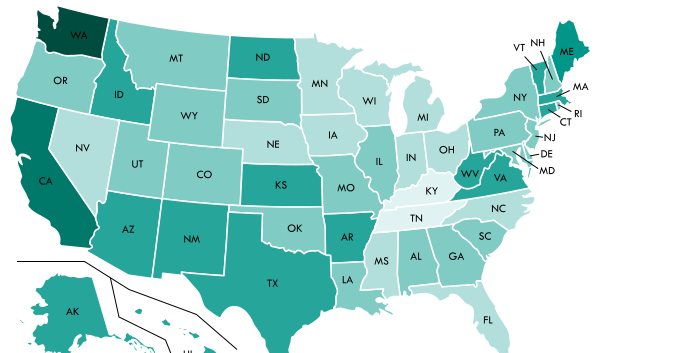
Most common states for principal hardware engineers
| Rank | State | Population | # of jobs | Employment/ 1000ppl |
|---|---|---|---|---|
| 1 | District of Columbia | 693,972 | 236 | 34% |
| 2 | Washington | 7,405,743 | 1,776 | 24% |
| 3 | Massachusetts | 6,859,819 | 1,642 | 24% |
| 4 | Virginia | 8,470,020 | 1,836 | 22% |
| 5 | Rhode Island | 1,059,639 | 233 | 22% |
| 6 | Vermont | 623,657 | 140 | 22% |
| 7 | Oregon | 4,142,776 | 787 | 19% |
| 8 | Colorado | 5,607,154 | 982 | 18% |
| 9 | New Hampshire | 1,342,795 | 235 | 18% |
| 10 | Maryland | 6,052,177 | 1,022 | 17% |
| 11 | Delaware | 961,939 | 155 | 16% |
| 12 | Arizona | 7,016,270 | 969 | 14% |
| 13 | Minnesota | 5,576,606 | 680 | 12% |
| 14 | Montana | 1,050,493 | 128 | 12% |
| 15 | Wyoming | 579,315 | 67 | 12% |
| 16 | California | 39,536,653 | 4,407 | 11% |
| 17 | New Jersey | 9,005,644 | 993 | 11% |
| 18 | Illinois | 12,802,023 | 1,251 | 10% |
| 19 | Connecticut | 3,588,184 | 353 | 10% |
| 20 | Idaho | 1,716,943 | 170 | 10% |
Most common cities for principal hardware engineers
| Rank | City | # of jobs | Employment/ 1000ppl | Avg. salary |
|---|---|---|---|---|
| 1 | Billerica | 5 | 12% | $128,806 |
| 2 | Chamblee | 1 | 4% | $109,900 |
| 3 | Andover | 1 | 3% | $128,757 |
| 4 | Boulder | 2 | 2% | $112,186 |
| 5 | Livonia | 2 | 2% | $96,873 |
| 6 | Marietta | 1 | 2% | $109,863 |
| 7 | Poway | 1 | 2% | $151,541 |
| 8 | Huntsville | 1 | 1% | $114,471 |
| 9 | Palmdale | 1 | 1% | $155,063 |
| 10 | Aurora | 1 | 0% | $112,037 |
| 11 | Austin | 1 | 0% | $129,517 |
| 12 | Baltimore | 1 | 0% | $116,854 |
| 13 | Fremont | 1 | 0% | $164,027 |
| 14 | Saint Paul | 1 | 0% | $101,440 |
| 15 | San Antonio | 1 | 0% | $129,883 |
| 16 | San Diego | 1 | 0% | $151,427 |
Principal Hardware Engineer job outlook: Expert opinions
Our panel of principal hardware engineer experts
Gonzaga University
Stevens Institute of Technology
California State University - Fresno
University of Alabama at Birmingham
San Diego State University

Old Dominion University

University of Central Florida

University of Arkansas, Fayetteville
What Principal Hardware Engineer skills would you recommend for someone trying to advance their career?
Steven Schennum Ph.D. P.E.: The most important skill is the ability to learn new things, and especially to unlearn things you “know” after evidence demonstrates that these things are not true. Learn how to analyze information. Your intuition, simulations, and results should all be in alignment. If they are not, then dig deeper. Learn the terminology and jargon specific to your company and your projects. Spend time reading. Don’t be afraid to ask questions. Don’t be intimidated by new software.
What Principal Hardware Engineer skills would you recommend for someone trying to advance their career?
Min Song: Communication skills and innovative thinking skills. As emerging technologies continue to be complex and multidisciplinary, it’s important to be able to communicate with professionals in diverse disciplines. Taking robotics, for example, the electrical engineer must be able to work with mechanical and biomechanical engineers, computer engineers, software engineers, artificial intelligence experts, cognitive scientists, system engineers, etc. A person will be able to generate innovative ideas only if the person has a complete and comprehensive understanding of the entire system and can work well with other individuals with a range of expertise.
What general advice would you give to a Principal Hardware Engineer?
Aaron Stillmaker Ph.D.: I highly encourage students starting to look for jobs to get their resume polished both by talking with a trusted professor and taking advantage of career centers at their university. I always suggest that students highlight fascinating projects on their resumes that highlight their knowledge base without having to list skills, and they need to be ready to talk intelligibly about those projects. I would make sure to prepare for interviews by brushing up on design course material that are taught in the courses most closely pertaining to the specialty they are interviewing for. I also suggest they contact professors they have a good relationship with to ask them to reach out to their contacts in the field, as many professors have connections in the industry and are happy to help their good students attain good jobs.
What Principal Hardware Engineer skills would you recommend for someone trying to advance their career?
Arie Nakhmani: Electrical Engineering has always (from its inception) been a good profession to enter, but now it is better than ever. Now everything is becoming Electrical Engineering, and the world cannot survive without it even for a few days. Electrical Engineering is the most necessary profession for the survival of modern society.
What will help Principal Hardware Engineers increase their earning potential?
Dr. Arif Engin: Electrical engineers solve problems by skillfully applying mathematics and science. Electrical engineering classes are challenging at college, and electrical engineers must embrace lifelong learning to remain at the top of their skills. In the end, seeing the results of their work in a finished product is a rewarding experience.
Will there be an enduring impact of the coronavirus pandemic on Principal Hardware Engineers?
Michel Audette Ph.D.: My take on this is what I've seen with my wife's work in industry, which suggests that the industrial landscape is going to be increasingly equipped for, and open to, remote work. I think that the implication for graduates is that they may need to be flexible about working within a geographically distributed team. If company deciders feel that someone is worth employing because of a unique skill set, then they would typically be more willing to hire that person even if unable to make it to work regularly, if that is feasible given the nature of the work; some work, such as hardware testing or industrial production, may not lend itself to remote contributions.
Nonetheless, for those areas that accommodate geographically distributed activity, such as software development, graduates can expect to interact with team members all over the US, possibly all over the world, if someone is deemed unique enough to hire despite living abroad. This places a high premium on the ability and willingness to work in a heterogeneous team, where not only will members look different, but also have myriad accents in their English, which will also impose a certain adaptability and tolerance to team members.
A related impact could also be that global hiring will make it easier for multi-national companies to hire a portion of their talent in countries where wages are lower and motivate US-based engineers to seek out graduate degrees in order to increase their competitiveness and employability at US salaries.
Maria Jacob
ProfessorUniversity of Central Florida
Department of ECE
Will there be an enduring impact of the coronavirus pandemic on Principal Hardware Engineers?
Maria Jacob: Well, this is a somewhat difficult question, since it's hard to predict what is going to happen.
Given the current research, everything seems to indicate that even with the vaccine, we won't be able to come back to what we were used to for a long time.
This will mean, work and classes from home for some time. Although I see and enjoy some of the advantages of staying at home (that go from clothing to saving money on gas), I feel we are losing some of the human contact we were used to. Of course, we have software like Zoom or Meet that helps us to communicate with others, but this virtuality is just simply different. For example, some students do just fine, and others can't deal with the fact that they have to write their questions over a chat. More than that, some students have family making everything more difficult.
There are other aspects that also impact the knowledge the new graduates have at the time of start working. For example, we as professors also have to take into account that we are living special circumstances and that some students may find this new system more difficult. Then, sometimes is easy to overcompensate and be more lenient with some things. If we are not careful this could lead to students graduating having less knowledge in some topics, where students pass a class not knowing certain topics that they should.
Robert Saunders P.E.
Assistant Department HeadUniversity of Arkansas, Fayetteville
Electrical Engineering Department
What Principal Hardware Engineer skills would you recommend for someone trying to advance their career?
Robert Saunders P.E.: Project management and/or leadership training, either at the university they graduated from, or a good online source. Either or both of these would demonstrate the proactive attitude of the student. And get involved in something; community service groups, design a project, anything that shows you are pushing forward professionally and personally, not just sitting at home.