Explore jobs
Find specific jobs
Explore careers
Explore professions
Best companies
Explore companies
Job outlook for process coordinators in the United States
Process coordinator job growth summary. After extensive research, interviews, and analysis, Zippia's data science team found that:
The projected process coordinator job growth rate is 12% from 2018-2028.
About 52,400 new jobs for process coordinators are projected over the next decade.
Process coordinator salaries have increased 9% for process coordinators in the last 5 years.
There are over 67,679 process coordinators currently employed in the United States.
There are 43,071 active process coordinator job openings in the US.
The average process coordinator salary is $50,124.
Are process coordinator jobs in demand?
Process coordinator job and salary trends over time
Process coordinator jobs over time
Process coordinator job growth rate over time
| Year | # of jobs | % of population |
|---|---|---|
| 2021 | 67,679 | 0.02% |
| 2020 | 7,556 | 0.00% |
| 2019 | 27,807 | 0.01% |
| 2018 | 69,581 | 0.02% |
| 2017 | 65,780 | 0.02% |
Average process coordinator salary over time
Process coordinator salary by year
| Year | Avg. salary | Hourly rate | % Change |
|---|---|---|---|
| 2026 | $50,124 | $24.10 | +2.5% |
| 2025 | $48,896 | $23.51 | +1.5% |
| 2024 | $48,186 | $23.17 | +2.6% |
| 2023 | $46,950 | $22.57 | +1.9% |
| 2022 | $46,081 | $22.15 | +2.6% |
Process coordinator jobs by state
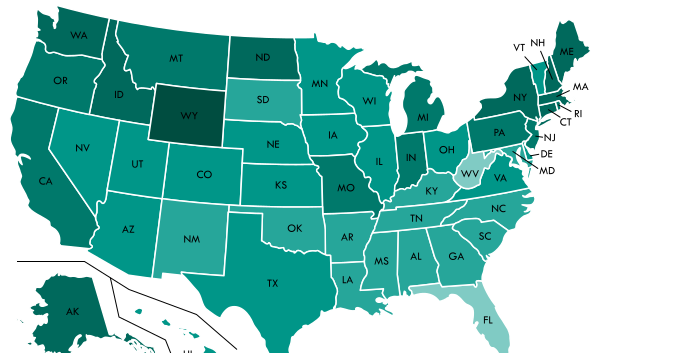
Most common states for process coordinators
| Rank | State | Population | # of jobs | Employment/ 1000ppl |
|---|---|---|---|---|
| 1 | Delaware | 961,939 | 233 | 24% |
| 2 | Maine | 1,335,907 | 246 | 18% |
| 3 | North Dakota | 755,393 | 137 | 18% |
| 4 | District of Columbia | 693,972 | 120 | 17% |
| 5 | Idaho | 1,716,943 | 275 | 16% |
| 6 | West Virginia | 1,815,857 | 268 | 15% |
| 7 | New Mexico | 2,088,070 | 299 | 14% |
| 8 | Alabama | 4,874,747 | 644 | 13% |
| 9 | South Dakota | 869,666 | 116 | 13% |
| 10 | Massachusetts | 6,859,819 | 772 | 11% |
| 11 | Oklahoma | 3,930,864 | 421 | 11% |
| 12 | New Hampshire | 1,342,795 | 132 | 10% |
| 13 | Rhode Island | 1,059,639 | 78 | 7% |
| 14 | Virginia | 8,470,020 | 528 | 6% |
| 15 | Indiana | 6,666,818 | 384 | 6% |
| 16 | Wisconsin | 5,795,483 | 342 | 6% |
| 17 | Utah | 3,101,833 | 184 | 6% |
| 18 | Kansas | 2,913,123 | 171 | 6% |
| 19 | Nebraska | 1,920,076 | 108 | 6% |
| 20 | Vermont | 623,657 | 36 | 6% |
Most common cities for process coordinators
| Rank | City | # of jobs | Employment/ 1000ppl | Avg. salary |
|---|---|---|---|---|
| 1 | Lehi | 2 | 3% | $53,523 |
| 2 | Southfield | 2 | 3% | $60,044 |
| 3 | Saint Louis | 5 | 2% | $57,441 |
| 4 | Cambridge | 2 | 2% | $65,457 |
| 5 | Alpharetta | 1 | 2% | $46,082 |
| 6 | Castro Valley | 1 | 2% | $65,845 |
| 7 | Daytona Beach | 1 | 2% | $42,318 |
| 8 | Tampa | 2 | 1% | $43,011 |
| 9 | Boca Raton | 1 | 1% | $42,796 |
| 10 | Centennial | 1 | 1% | $57,066 |
| 11 | Phoenix | 4 | 0% | $51,805 |
| 12 | San Diego | 4 | 0% | $53,840 |
| 13 | Detroit | 2 | 0% | $60,024 |
| 14 | Sacramento | 2 | 0% | $66,037 |
| 15 | Baton Rouge | 1 | 0% | $50,916 |
| 16 | Boston | 1 | 0% | $65,508 |
| 17 | Charlotte | 1 | 0% | $46,861 |
| 18 | Colorado Springs | 1 | 0% | $56,681 |
Process Coordinator job outlook: Expert opinions
Our panel of process coordinator experts
Connecticut College
Heidelberg University

Austin Community College
Wichita State University
Marshall University
What certifications/licenses/courses can have the biggest impact for Process Coordinators?
Julia Kushigian Ph.D.: A 4-year degree with a major in Hispanic Studies, a certificate from an International Studies Center (at Connecticut College the Center for International Studies in the Liberal Arts with an ACTFL ranking of Advanced, a local or global internship in the foreign language and/or foreign culture, nationally recognized ACTFL cerntification, translation licensing.
How have salaries changed over time for Process Coordinators?
Julia Kushigian Ph.D.: As demand has increased, salaries have risen tremendously to try and keep pace. In fields like education, business, health care, government, social services, service related employment, law, etc., salaries have improved year over year to stay competitive.
What are the biggest trends we'll see in the Process Coordinator job market given the pandemic?
Julia Kushigian Ph.D.: The exciting trends for students graduating in Hispanic Studies and for those already in the job market are the potential benefits of a remote learning anticipated years ago through pedagogical tools designed by those in language, literature and culture. The interactive formulas, ability to engage participants and broaden the definition of language learning to include cultural studies of a variety of professional fields were already in the works and Covid was the impetus to move even faster. We know from a variety of studies, including a major report by the American Council of Teachers of Foreign Languages, for example, that 9 out of 10 U.S. employers rely on employees with language skills other than English. Spanish being in high demand is the most sought after language. Of course, beyond the more obvious benefits of being bilingual ("Why Bilinguals are Smarter" NYT 2012) are the less obvious of being adept at solving certain mental problems, thriving in ambiguity, flexibility with unknowns and the potential to stave off dementia later in life.
Paige Atterholt
Adjunct ProfessorHeidelberg University
What's a good job out of college for Process Coordinators?
Paige Atterholt: A good job out of college is a job that you feel passionate about because I believe your happiness comes first. Being in the world of education, a good job in my eyes is a job that you enjoy going to every day, want to make an impact, and enjoy the time you have with your students.
What will help Process Coordinators increase their earning potential?
Paige Atterholt: There are many ways a teacher can increase their earning potential. This can be done through continuing education, maybe looking at a Masters or more to move up on the pay scale. Teachers can advise student council, tutoring, or even look at coaching to earn more money. There's vast opportunities in the world of education! Schools always need teachers who are well-rounded.
Will there be an enduring impact of the coronavirus pandemic on Process Coordinators?
Paige Atterholt: I think now, being in year 2 of the pandemic, I think if anything there will be more jobs for graduates. Just looking through the jobs online, there are many opportunities for graduates to get a job. I think the older community retired when things got bad, which opened the door for the younger generation.
Will there be an enduring impact of the coronavirus pandemic on Process Coordinators?
Stuart Greenfield Ph.D.: According to the National Student Clearinghouse estimates for Fall 2018-Fall 2020, Nscresearchcenter, enrollment inf post-secondary institutions declined by 703.9K. Of this decline, 621.4K (88.3%) were attributed to Public 2-year institutions.
What certifications/licenses/courses can have the biggest impact for Process Coordinators?
Stuart Greenfield Ph.D.: According to the Bureau of Labor Statistics' Occupation Outlook, half the twenty fastest jobs, BLS, require only a high school diploma. The three fastest-growing jobs, Care Aides, Fast-food workers, and Cooks, only require a high school diploma.
The health care sector has been and will continue to be the fastest-growing sector in the economy. Many of these occupations require certifications. The health care sector's growth should provide community colleges an area for growth as they can provide health care training at an affordable cost.
The Philadelphia Fed has a tool, Philadelphiafed, that shows what training/skills are required for job seekers to improve their earnings.
What soft skills should all Process Coordinators possess?
Stuart Greenfield Ph.D.: Given the changing demographics that the country has experienced, the entire education continuum must change. According to the Brookings Institution, Brookings, the non-Hispanic White population in the under 18 cohort since 2000 has declined.
As you'll note from the occupations that are projected to increase the greatest, most require face-to-face contact, so that soft-skills will be necessary. I would also expect that critical thinking skills will be needed as more responsibility will be required of front-line workers.
Sonja Armbruster
Health Sciences EducatorWichita State University
Department of Public Health Sciences
What's a day at work look like for a Process Coordinator?
Sonja Armbruster: The pandemic has re-defined what it even means to have a "day at work". I'm writing this response from my home office. Work in public health jobs can involve so many kinds of roles and responsibilities. The only thing I can guarantee is that the successful person seeking a career in public will be constantly curious and constantly learning. There are many public health jobs that are clearly defined with a set of protocols and software and office time that is scripted. Many more public health jobs require learning something new about community members, community partners, the system (including the department/organization one works for), the latest science and political realities that enable and constrain public health work. A day at work will involve continuously learning and seeking to understand new connections.
Will there be an enduring impact of the coronavirus pandemic on Process Coordinators?
Sonja Armbruster: Absolutely. For most of my 20-year career in public health, my colleagues and I have been frustrated by the fact that most people have no idea what public health is. At least now, most people have some understanding of some aspects of the field of public health. Particularly, people see that policy development, assessing community needs, community engagement and addressing equity are all core responsibilities of this field. After 9/11/2001 and the anthrax events, new preparedness dollars flowed into public health, and over times those funding streams slowly eroded again. Over the next few years, it is reasonable to expect increased funding to support public health. This article from The Nation's Health would be a good resource to learn more: www.thenationshealth.org
What technical skills for a Process Coordinator stand out to employers?
Sonja Armbruster: The technology of this moment may change in the next moment. The capacity to quickly learn new systems and processes is a critical skill. In large-part, this requires a willingness to say yes, and perhaps a willingness to make mistakes and try again. Successful new-graduates are coachable. None of us is as smart as all of us. New grads need to seek coaching and feedback from others. Older co-workers may have wisdom to share, or they may be missing a perspective or skill needed - and either way, new grads can learn so much by watching and paying attention. One of the most valuable skills one can hone is the approach to the work. New responsibilities are an opportunity to grow in the job, not a burden. While you likely won't see this on a normal "technical skills" list, stand-out employees have a healthy willingness to "go-figure-it-out" and then consult with one's supervisor or team rather than waiting to be told what to do or having a narrowly defined "job-jar". GFIO.
Dr. E.Del Chrol
Chair of Humanities, Professor of ClassicsMarshall University
Humanities Department
What certifications/licenses/courses can have the biggest impact for Process Coordinators?
Dr. E.Del Chrol: The courses that are most useful for employers are those that encourage writing, especially when it requires the student to conceive of and execute a large, complex project. If your major has a capstone project or Senior thesis option (and not just examination), take it. Secondarily, upper division courses that draw connections between the classical world and today are vital, especially with professors who aren't stupid. It's easy to say "Today is just like the fall of Rome!", you hear that all the time. But which fall of Rome? The one that created the long-enduring empire in 27 BCE? Or the final death in the West in 476CE (which doesn't include the Eastern empire in Constantinople)? Being able to recognize patterns as well as specificity of a historical moment is of vital importance to navigating our fraught times. That level of cultural awareness is infinitely adaptable to work that one does at a job, even a complex one. Finally, courses that tackle rhetoric are key, since, as Aristotle says, politics is the queen of disciplines. Everything is politics, and being able to navigate that is key.
Will there be an enduring impact of the coronavirus pandemic on Process Coordinators?
Dr. E.Del Chrol: I have three big fears about potential impacts of the pandemic on grads, and one hopeful one. I'm a believer in the old saying that goes the true judge of one's character is what one does when nobody is watching. Since students aren't under the same scrutiny as they would in a class of students, I am worried about the reward system some may have developed. So, first, if a student cheated on exams because they took it by themselves, not only does that undermine their education but may encourage cheating to get ahead. Second, it's easy to lose focus in a Zoom or Teams meeting or class. I myself more often than I should check my phone when I should be listening to some administrator or other delivering projections. Attention and focus is a skill, and when there's no obvious penalty to checking Insta during a proof, the ability to do deep and rewarding work with true focus is further diminished. Third, I'm concerned that the pandemic is reinforcing the digital divide. A student who has to share a space or a computer or bandwidth is going to have a harder time performing as well as someone who doesn't. The one thing I hope will come out of this is more people able to do their work in a space and a time of their choosing, and that folks won't be compelled to go sit under fluorescent lights in a cubicle 5 days a week. Learning to work creatively and independently is a skill and one that is sometimes ground out of our students by 19th century work-spaces. Fingers crossed we can develop flexibility thanks to the necessity.