Explore jobs
Find specific jobs
Explore careers
Explore professions
Best companies
Explore companies
Job outlook for process development scientists in the United States
Process development scientist job growth summary. After extensive research, interviews, and analysis, Zippia's data science team found that:
The projected process development scientist job growth rate is 17% from 2018-2028.
About 20,800 new jobs for process development scientists are projected over the next decade.
Process development scientist salaries have increased 14% for process development scientists in the last 5 years.
There are over 4,933 process development scientists currently employed in the United States.
There are 112,423 active process development scientist job openings in the US.
The average process development scientist salary is $101,098.
Are process development scientist jobs in demand?
Process development scientist job and salary trends over time
Process development scientist jobs over time
Process development scientist job growth rate over time
| Year | # of jobs | % of population |
|---|---|---|
| 2021 | 4,933 | 0.00% |
| 2020 | 5,616 | 0.00% |
| 2019 | 5,869 | 0.00% |
| 2018 | 5,728 | 0.00% |
| 2017 | 5,503 | 0.00% |
Average process development scientist salary over time
Process development scientist salary by year
| Year | Avg. salary | Hourly rate | % Change |
|---|---|---|---|
| 2026 | $101,098 | $48.60 | +3.1% |
| 2025 | $98,093 | $47.16 | +4.7% |
| 2024 | $93,696 | $45.05 | +3.3% |
| 2023 | $90,691 | $43.60 | +1.9% |
| 2022 | $88,968 | $42.77 | --2.1% |
Process development scientist jobs by state
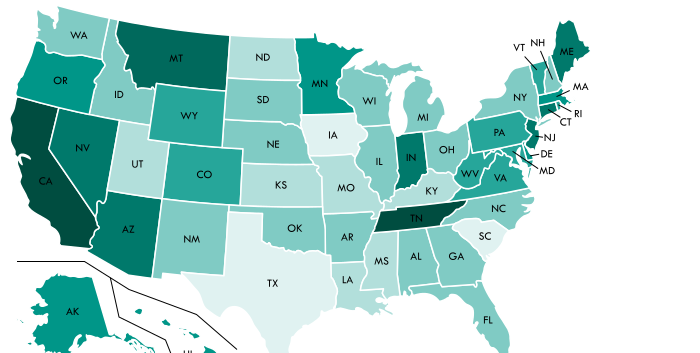
Most common states for process development scientists
| Rank | State | Population | # of jobs | Employment/ 1000ppl |
|---|---|---|---|---|
| 1 | Massachusetts | 6,859,819 | 2,347 | 34% |
| 2 | North Dakota | 755,393 | 214 | 28% |
| 3 | Minnesota | 5,576,606 | 1,491 | 27% |
| 4 | Montana | 1,050,493 | 288 | 27% |
| 5 | South Dakota | 869,666 | 239 | 27% |
| 6 | District of Columbia | 693,972 | 181 | 26% |
| 7 | Alaska | 739,795 | 183 | 25% |
| 8 | Delaware | 961,939 | 229 | 24% |
| 9 | New Mexico | 2,088,070 | 484 | 23% |
| 10 | Nebraska | 1,920,076 | 415 | 22% |
| 11 | Kansas | 2,913,123 | 579 | 20% |
| 12 | Pennsylvania | 12,805,537 | 2,416 | 19% |
| 13 | Arizona | 7,016,270 | 1,234 | 18% |
| 14 | Missouri | 6,113,532 | 1,105 | 18% |
| 15 | Maryland | 6,052,177 | 1,103 | 18% |
| 16 | Wisconsin | 5,795,483 | 1,048 | 18% |
| 17 | Iowa | 3,145,711 | 577 | 18% |
| 18 | Georgia | 10,429,379 | 1,811 | 17% |
| 19 | Indiana | 6,666,818 | 1,128 | 17% |
| 20 | New Hampshire | 1,342,795 | 224 | 17% |
Most common cities for process development scientists
| Rank | City | # of jobs | Employment/ 1000ppl | Avg. salary |
|---|---|---|---|---|
| 1 | Waltham | 4 | 6% | $96,099 |
| 2 | Andover | 2 | 6% | $95,856 |
| 3 | Cambridge | 6 | 5% | $96,099 |
| 4 | Thousand Oaks | 6 | 5% | $118,901 |
| 5 | Framingham | 3 | 4% | $96,164 |
| 6 | Gaithersburg | 3 | 4% | $88,830 |
| 7 | Billerica | 1 | 2% | $95,953 |
| 8 | Camarillo | 1 | 1% | $119,348 |
| 9 | Carlsbad | 1 | 1% | $114,685 |
| 10 | Pasadena | 1 | 1% | $117,828 |
| 11 | South San Francisco | 1 | 1% | $129,776 |
| 12 | San Diego | 3 | 0% | $114,028 |
| 13 | Boston | 2 | 0% | $96,127 |
| 14 | Baltimore | 1 | 0% | $89,174 |
| 15 | Durham | 1 | 0% | $84,102 |
| 16 | Fremont | 1 | 0% | $129,407 |
| 17 | Indianapolis | 1 | 0% | $109,629 |
| 18 | Santa Ana | 1 | 0% | $116,324 |
Process Development Scientist job outlook: Expert opinions
Our panel of process development scientist experts
Purdue University
Washington State University
Purdue University
University of Pittsburgh
University of Nebraska - Omaha
Quinnipiac University

Won Institute

Stephen F. Austin State University

Drexel University

University of New Hampshire
University of California, Berkeley

Rutgers University
Arizona State University

University of Illinois at Urbana-Champaign

Villanova University
California State University San Marcos

North Carolina State University
Bradley University

Creighton University

The College of New Jersey
What general advice would you give to a Process Development Scientist?
Nikhilesh Chawla: Prioritize your education. Having a Bachelor’s is great but you will be able to do much more interesting work AND have a higher salary with a Master’s or PhD.
What Process Development Scientist skills would you recommend for someone trying to advance their career?
Nikhilesh Chawla: Make sure you are passionate about what you do. Great careers should not feel like a ‘job’. Try to learn as much as you can, be curious, and engaged. Networking with folks in your field and choosing 1-2 or mentors to help guide you would be good too.
What will help Process Development Scientists increase their earning potential?
Lindsey du Toit: Take every opportunity you can to learn, network, and build an effective team of people that bring a greater breadth and depth of skills and expertise to the work on which you will be focusing. Cultivate a life-long sense of intellectual curiosity and learning. Don’t be afraid to ask questions. Treat ignorance as an opportunity to learn. Questions demonstrate you want to understand the situation/problem effectively and that you are paying attention. Always demonstrate integrity in your work. It is one of the most valuable traits you can bring to your career. Be kind and supportive of your colleagues.
Yan Cong
Purdue University
Romance Languages, Literatures, And Linguistics
What will help Process Development Scientists increase their earning potential?
Yan Cong: Develop some in-demand skills such as programming or generating content from text models via prompt engineering, et cetera. Get experience and extra income via paid summer internships.
What will help Process Development Scientists increase their earning potential?
Arjumand Ghazi Ph. D: Having an advanced degree such as a PhD and even a few years postdoc is a good way to start at a higher level. It often allows one to make up for the reduced earnings during the training periods while increasing long-term earnings.
Andrew Riquier Ph.D.
InstructorUniversity of Nebraska - Omaha
Neurobiology And Neurosciences
What general advice would you give to a Process Development Scientist?
Andrew Riquier Ph.D.: Apply for the positions you want, even if you feel underqualified. I know plenty of people who have applied for jobs they didn't quite meet the requirements for, and got hired for other reasons. In my experience, many recent graduates choose to take time to strengthen their resumes by retaking classes, working jobs they don't particularly want to get experience, etc. There is some value in that, particularly if you have been unsuccessful attaining the position you want, or if you want to see if you even enjoy that type of work. But if you are confident in what you want to do, go for it; in the worst-case scenario, you are in the same position you would be if you hadn't applied, but now you have experience applying and have potentially gained a contact in the field.
Lisa Cuchara Ph.D.
Professor of Biomedical SciencesQuinnipiac University
Microbiological Sciences And Immunology
What Process Development Scientist skills would you recommend for someone trying to advance their career?
Lisa Cuchara Ph.D.: The first and foremost would be Critical Thinking. We live in a world where facts can be easily acquired, sometimes even by asking Siri/Alexa/ChatGPT/Google/etc. But critical thinking is timeless and priceless. I can ask anyone on the street what xyz is and they can look it up, but can they provide advice or interpret.
Also being a good steward towards science and being willing and able to communicate not just with peers as we are trained, but also with the public, the politicians, the board members. John Holdren*, stated that Scientists should be tithing at least 10 percent of their time to public service ... including activism. In the ever growing science denialism that is happening in our country being able to communicate science with the public is important. As Peter Hotaz states, "Anti-science propaganda is "killing Americans in unprecedented numbers,""
*Holdren is an American scientist who served as the senior advisor to President Barack Obama on science and technology issues through his roles as assistant to the president for science and technology, director of the White House Office of Science and Technology Policy, and co-chair of the President's Council of Advisors on Science and Technology and a Research Professor in Harvard University's Kennedy School of Government
What will help Process Development Scientists increase their earning potential?
Lisa Cuchara Ph.D.: Be passionate! Be curious! When I write a letter of recommendation I write a little about the obligatory "IQ" elements, how well their exam/assignment/course grade were, then I speak to their EQ, are they kind, helpful, respectful, considerate, etc. and I try to include an example of something that I witnessed regarding EQ. But the majority of the letter discussing PQ and CQ, their passion quotient and their curiosity quotient. A can write a much much better LOR for a student with high PQ and CQ than I can for one with just good grades. What have they read and what do they do in their spare time (and don't say that you can't afford a hobby, you can't afford not to have a hobby or an outlet, otherwise stress takes too much of a toll. Some of my most memorable student conversations are conversations that involved their curiosity, like a conversation about Bonnie Bassler's quorum sensing. Make sure that as you go through life you embrace Einstein's quote 'There are only two ways to live your life. One is as though nothing is a miracle. The other is as though everything is a miracle.'
The second piece of advice is: Know what you know, know what you don't know, be willing to admit what you don't know, and don't be afraid to ask questions, but try not to ask questions about simple things that one can easily look up as that indicates laziness rather than inquisitiveness.
The third piece of other advice would be to never give up. As "Nothing in this world can take the place of persistence. Talent will not: nothing is more common than unsuccessful men with talent. Genius will not; unrewarded genius is almost a proverb. Education will not: the world is full of educated derelicts. Persistence and determination alone are omnipotent." Calvin Coolidge
What general advice would you give to a Process Development Scientist?
Lisa Cuchara Ph.D.: Practice both public speaking (presentations, journal clubs, research meetings) as much as possible and also practice "elevator speeches".
Do more than the minimum. Is there a conference you can present at, a journal club you can be involved in, an ASM branch or student chapter to participate in.
Rev. Grace Song
Won Buddhist Studies Department ChairWon Institute
What skills stand out on Process Development Scientist resumes?
Rev. Grace Song: -High degree of emotional intelligence
-Ability to facilitate discussion and various meditation exercises
-Experience teaching online and offline
-High level of cultural humility
What soft skills should all Process Development Scientists possess?
Rev. Grace Song: -Clear communicator
-Good time management skills
-Ability to resolve conflicts
-Self-aware
-Values collaboration
What hard/technical skills are most important for Process Development Scientists?
Rev. Grace Song: -Comfortable using tech (eg. zoom)
-Certificated mindfulness instructor
-Experience running retreats/workshops
What skills will help Process Development Scientists earn the most?
Rev. Grace Song: -Teaching experience
-Published works on mindfulness
What are the biggest trends we'll see in the Process Development Scientist job market given the pandemic?
Darrell Fry: Hiring among chemists and biochemists will remain stronger as compared to the average unemployment rate during the pandemic, in part because chemists and biochemists produce "essential" items. However, connecting with an employer will be more difficult. Traditional avenues for employers and potential employees to make contact, such as the biannual National American Chemical Society Meeting, have been radically changed during the pandemic. Moreover, travel for potential employees to the job site for an interview are problematic.
What certifications/licenses/courses can have the biggest impact for Process Development Scientists?
Darrell Fry: Earning a degree from an University that takes time and effort to be accredited by either the American Chemical Society (ACS) and/or the American Society for Biochemistry and Molecular Biology(ASBMB) ensures the graduate will have marketable skills. Chemistry is a broad field, and there are numerous niches that a candidate can find; however, each niche has specialized skills. Younger chemists profit from being well read and having several mentors. Together, the candidate and their mentors, can build a marketable skill sets.
How have salaries changed over time for Process Development Scientists?
Darrell Fry: According to the American Chemical Society (ACS) salary survey, salaries have increased over the past 15 years.
What are the biggest trends we'll see in the Process Development Scientist job market given the pandemic?
Dr. Richard Knight Ph.D.: Based on a relatively small Materials Science and Engineering (MSE) class size (20-30 students), there appear to be an increased number of graduating students going into industrial rotational programs (Greene Tweed, J&J, etc.), and also of post-baccalaureate students pursuing graduate school opportunities, mostly PhD programs. Some employers offer financial support for graduate studies, such as a part-time technical MS or an MBA. These trends are likely to grow as employers seek to invest in new hires in order to add technical and business skills and also to retain new hires.
Jobs at larger, well established, companies are likely more attractive to current graduating students since they offer longer term job security than jobs in smaller companies. Startups are perceived as riskier, especially by students with loan repayments to make,
Drexel is a co-op school, and the majority of MSE majors complete three 6-month co-op jobs in industry during their 5-years of study, thus graduating with 18 months of hands-on, experiential learning. For the MSE class of 2020, 7 out of 9 students who had jobs prior to graduation reported them as being jobs with a previous co-op employer. Employers clearly value the relationships developed during co-op when hiring into full-time positions.
In terms of expectations from employers, undergraduate students with hands-on laboratory/research experience also tend to do well when seeking employment. Approximately 50 % of Drexel MSE undergraduates engage in undergraduate research during their studies, and some have co-author opportunities on journal publications.
Adaptability, flexibility and the ability to pivot quickly due to changing circumstances are also important skills. During the COVID-19 pandemic, with courses being taught largely remotely, Drexel students have been able to select a Pass/No-Pass option for grades as an alternative to the standard letter grade earned. While this obviously allows students protects a good CUM GPA it may not accurately reflect to prospective employers how well, or poorly, students have performed in their classes given that in many cases the Pass grade for a class can be as low as 50%. Students who have quickly adapted and embraced remote instruction and online learning, as imperfect as these may be, have, in general, done well and maintained good GPAs.
As ever, good written and oral communication skills are highly valued by employers, and can, to an extent, compensate for slight deficiencies in other areas. Enhanced "soft skills" will become increasingly important for new graduates, especially written skills. Employers are typically looking to hire graduates who will "fit in" with their existing corporate structures, and become good "team players".
Student mental health issues have increased noticeably during the pandemic, and are unlikely to abruptly cease upon graduation, so employers will need to become increasingly aware of and provide increased resources and support for new hires as they adjust/adapt to the working environment. One area of particular concern are students who receive ADA Accommodations (e.g. extra time on quizzes and exams, reduced distraction testing environments, etc.) in college. How well are these being handled in industrial environments? Are Universities doing enough to prepare students for the transition?
What certifications/licenses/courses can have the biggest impact for Process Development Scientists?
Dr. Richard Knight Ph.D.: MSE majors, at least at Drexel, typically do not complete the Fundamentals of Engineering (FE) exam while in college. In the last 5 or 6 years only one student has done this. Few graduating students enter into careers in the Product Liability or Expert Witness areas for which PE licensure would be necessary. A small number of students have taken classes relating to lean manufacturing/Six-Sigma techniques, which are increasingly important in industry.
A significant number of MSE majors do, however, pursue a broad range of minors in addition to their MSE major. Popular minors include Chemistry, Business, Nuclear Engineering, and other Engineering disciplines.
How have salaries changed over time for Process Development Scientists?
Dr. Richard Knight Ph.D.: Starting salaries for MSE program graduates have increased steadily over time. Pandemic era starting salaries for 2020 and 2021 appear to be holding up reasonably well compared to previous years. For MSE majors who graduated in 2020, and for whom only their final term was impacted by the pandemic, more than 60% reported starting salaries in the $80-90k range. In contrast, MSE majors graduating in 2021, for whom the majority of their senior year was remote/online, and who already have a job, report starting salaries in the $75-80k range, somewhat lower. Over time, more packages include incentives such as signing bonuses, relocation expenses, assistance with finding accommodation, and competitive benefits packages.
What are the biggest trends we'll see in the Process Development Scientist job market given the pandemic?
Stephanie Whitney: I expect quite the rebound in civil engineering, especially if some sort of infrastructure bill gets passed.
What certifications/licenses/courses can have the biggest impact for Process Development Scientists?
Stephanie Whitney: For our students, having the FE exam under their belt along with our ABET-accredited degree is key.
How have salaries changed over time for Process Development Scientists?
Stephanie Whitney: In general, they've been steadily trending upwards. Covid caused a decrease last year, but I suspect there will be a quick rebound.
What are the biggest trends we'll see in the Process Development Scientist job market given the pandemic?
Dennis Baldocchi: We received 130 applications for a plant ecology position, with 70 who are postdocs. So supply is surely outpacing demand. We got a lot of people interested in below ground processes, so if there is a trend, connecting below ground is becoming more possible and more important. With all the dna sequencing we are starting. Another cohort is working on the Earth System modeling connection to Ecology and how ecosystems are responding to land use change, changing climate etc
How have salaries changed over time for Process Development Scientists?
Dennis Baldocchi: I think 9-month appointments at Univ are vastly under paying these talented people, who I am sure do better at National Labs and Industry.
What are the biggest trends we'll see in the Process Development Scientist job market given the pandemic?
Jay Tischfield: In terms of the largest number of jobs, companies are hiring people familiar with medium and large-scale lab automation, quality assurance protocols and data
What technical skills for a Process Development Scientist stand out to employers?
Jay Tischfield: Computational and data analysis skills. Quantitative analysis of biological data.
How have salaries changed over time for Process Development Scientists?
Jay Tischfield: Salaries have increased for newish graduates with some experience.
What are the biggest trends we'll see in the Process Development Scientist job market given the pandemic?
Patricia Rankin: The pandemic has shown both the promise of remote work and the potential downsides. I anticipate that there will be more flexibility in the working arrangements in situations were this is possible (Zoom meetings will substitute for some meetings that formerly required travel, people may plan their working days to be on-site or off-site (home)). Some people may decide they want careers that allow this flexibility.
What certifications/licenses/courses can have the biggest impact for Process Development Scientists?
Patricia Rankin: Experience with computing/computational physics is important (but also pretty standard for any physics degree). Work in a lab can help show ability to work independently/problem solve.
How have salaries changed over time for Process Development Scientists?
Patricia Rankin: Salaries have been trending up - but there is a wide range and it depends on the level you look at e.g Bachelor's degrees or PhD's . If you have a PhD you earn more on average but the range is also larger (the AIP has some good statistics here e.g. https://www.aip.org/taxonomy/term/152 ). Physicists are generally at the higher end of pay scales and competitive with most engineering fields (not computer science). Physics graduates are problem solvers with excellent quantitative skills that puts them in high demand which helps protect salaries.
Will there be an enduring impact of the coronavirus pandemic on Process Development Scientists?
Paul Braun Ph.D.: In general no. The demands for highly educated workers remains strong, and while the details of the nature of the work may change, the demand for graduates with strong technical backgrounds remains robust.
What's a good job out of college for Process Development Scientists?
Paul Braun Ph.D.: Most students in our major are able to find the career opportunities they desire.
What will help Process Development Scientists increase their earning potential?
Paul Braun Ph.D.: A strong grounding in technology and the science underpinning technology is always important, as is the ability to lead teams of high performing individuals.
Dr. Joey Neilsen
Assistant ProfessorVillanova University
Physics Department
What are the biggest trends we'll see in the Process Development Scientist job market given the pandemic?
Dr. Joey Neilsen: I think the biggest trend is going to be that employers, whether in the private sector or in academia, are likely to be more selective. This means they will be looking for additional distinguishing factors beyond completion of a particular degree program, such as internships or research experience. At Villanova, we strongly encourage our students to get involved in our research: it's great for developing analytical and professional skills, but it also helps students build career networks that can turn into letters of recommendation or job prospects down the line. Given newer uncertainties in the market, I think students should make sure to take advantage of any research opportunities they can. But Physics majors generally have strong employment prospects, and roughly 95% of Physics Bachelor's degree recipients are employed one year after graduation, according to the American Institute of Physics.
What technical skills for a Process Development Scientist stand out to employers?
Dr. Joey Neilsen: I think programming skills and data analysis/statistics are especially valuable right now, while data science is so big. Our students take a year of Computational Physics in Python, and we integrate Python into some of our upper-level courses and labs as well. Our recent graduates, both in academia and the private sector, report using those skills on a regular basis. Two other skills that US Physics graduates report using regularly are technical problem solving and technical writing. This makes lots of sense from an employer perspective: you want to hire people who can identify and solve problems and then clearly explain the solution to your team. This is a great reason to let those lab reports shine!
How have salaries changed over time for Process Development Scientists?
Dr. Joey Neilsen: Salaries for new Physics graduates are rising fairly steadily. For example, US Physics majors from the class of 2013-2014 reported making between about $42,000 and about $65,000 per year while working in private sector STEM jobs (that's the middle 50% of salaries). For 2017-2018 (the most recent years where national data are available), that same range is more like $50,000 to $70,000 per year.
Will there be an enduring impact of the coronavirus pandemic on Process Development Scientists?
Jacqueline Trischman Ph.D.: The most important attribute companies are looking for in our graduates this year is adaptability. Students who have been successful in the classroom and lab AND in the Zoom environment are highly sought after in our local industries. In fact, our local life science economy is booming as we have test kits, antibody treatments, and vaccines all being manufactured in San Diego County. Graduates are expected to transition easily between working in a COVID-safe environment on-site and working productively at a home office. Being open to trying new ways of working, maintaining a positive attitude, and handling adversity well will all rise to more importance in interviews this year.
What's a good job out of college for Process Development Scientists?
Jacqueline Trischman Ph.D.: Research Scientist positions are the typical positions our students find, but there are sales, quality control, and production positions as well. Students who know what these jobs entail and know how their personalities work well in the position they seek will do well in finding a good job right after graduation. Students can increase their earning potential by seeking out a mentor in industry to help them know their unique talents, what they could and should ask for in their interviews, and know how to plan for the next step the moment they walk in the door.
Erin Krupa Ph.D.
Assistant ProfessorNorth Carolina State University
Science, Technology, Engineering, and Mathematics Education
Will there be an enduring impact of the coronavirus pandemic on Process Development Scientists?
Erin Krupa Ph.D.: I believe there will be an enduring impact of the coronavirus pandemic on our 2020 graduates. In such a short time, the pandemic has transformed the workforce and the way business is conducted. Most of the jobs our graduates are seeking have virtual interviews and this can mean accepting a job without ever having seen the jobsite, company, or future colleagues in-person. Many jobs have also, for the moment, transformed time and space, meaning that graduates do not necessarily have to move for a job or work in a specific location during the pandemic. The boundaries of work and home have been blurred, which gives graduates more flexibility in applying for jobs outside of the region they live in. Employers are starting to find that remote work does not reduce employee productivity, and can improve it in some cases, so remote work will become a continuing trend with many companies. I believe the pandemic will impact different sectors differently, but science and technology innovation is now at the forefront of our society. From developing vaccines to supporting the technology needs of a nation online, STEM graduates will be in demand to solve real-world problems to get us out, and prevent, future pandemics. I believe the effects of the pandemic on society will eventually fuel growth in the STEM market.
What experience really stands out on Process Development Scientist resumes?
Dr. Jose Lozano Ph.D.: Research and internships, and any activity that demonstrates that the individual is a team worker and can collaborate in interdisciplinary activities.
What are the biggest trends we'll see in the Process Development Scientist job market given the pandemic?
April Buschelman: Teacher shortage was an issue before the pandemic, and I see this increasing tenfold in the next year. I get weekly notices or requests for graduates that could fill roles in different schools and districts, some are immediate, and others are for the next semester.
Besides only needing more teachers, I think there will be a great demand for teachers with instructional technology concentrations. The pandemic highlighted the need to think outside the traditional brick and mortar "box" of school systems. While newer teachers are being educated in ways to use technology in the classroom, it's rare students are being educated to make the technology the classroom.
One final trend to be aware of is educator burnout and the need for self-preservation. I could see (and hope we will see) schools and districts focusing on the educators' mental health. Inservice days could become more laid back and focus on mental well-being as much as the newest trends and requirements. If we want students to have the best experience and education with school, we need to focus on the educators' mental and physical well-being first.
What technology do you think will become more important and prevalent for Process Development Scientists in the next 3-5 years?
April Buschelman: I think virtual learning and working from home are here to stay. I see many more classes being offered online with a mixture of synchronous and asynchronous class sessions. Homeschooling across the country has doubled due to the pandemic, and parents would love to have the option of still having their child(ren) on track and "in" school without needing to plan every piece of the curriculum. A remote option that allows students to come into the school for portions of the day for specials or electives gives parents a great choice. This option would also enable secondary students to work during the day to support themselves or their families.
One other technology that will become more prevalent is the virtual lessons taught through animated videos rather than an actual teacher. Similar to corporate training or the online curriculum alternatives out there, I see this as an option for schools struggling to hire teachers.
Will there be an increase or decrease in demand for Process Development Scientists in the next 5 years?
April Buschelman: I think there will be a definite increase in graduates in the next five years. This pandemic is causing many educators to leave the field due to the strain of teaching with multiple restrictions and requirements placed on them to keep everyone safe and healthy. Teachers are split with their desire to be teachers and help students and the teacher's desire to stay healthy and safe. Some are choosing to leave the profession instead and creating this new demand. It will be interesting to see what the future will hold!
Janet Gray Ph.D.
Professor and Department ChairThe College of New Jersey
Women’s, Gender, and Sexuality Studies
What are the biggest trends we'll see in the Process Development Scientist job market given the pandemic?
Janet Gray Ph.D.: Future trends in the job market will depend on some significant degree in public policy and funding changes following the 2020 elections. I would expect public health, health care, mental health, public policy, social work, social advocacy, and other social service forms to continue to be growing fields. The recent legalization of drugs for medicinal and recreational use in several states will open up new employment areas related not only to distribution but also to policy and social services, as addiction care replaces incarceration. STEM skills will be essential across employment sectors as people continue to depend on remote access for a wide range of needs and activities.
What technology do you think will become more important and prevalent for Process Development Scientists in the next 3-5 years?
Janet Gray Ph.D.: WGSS graduates enter every employment sector, so technological trends for our graduates will follow various sectors' directions. Among the most common careers for WGSS graduates are law, social work, and education. The capacity to work remotely and do so effectively--may depend more on having access to sound technology and good training, and devising more effective ways to use the tools available, than on any new technology becoming available.
Will there be an increase or decrease in demand for Process Development Scientists in the next 5 years?
Janet Gray Ph.D.: I think an increase, though not dramatic. WGSS majors graduate with a capacity to analyze and strategize about a wide range of social justice issues, including racial justice, LGBTQ rights, immigration rights, and disability rights, in addition to gender equity. Very few employers require a degree specifically in WGSS. Still, many employers value the skills students gain through their major, and I would expect social justice skills to be increasingly in demand across employment sectors in the coming years. Most WGSS majors take second majors as well, and their combined majors give them an edge in a broad range of fields--including mental health, public health, law, education, politics, business, and government.