Explore jobs
Find specific jobs
Explore careers
Explore professions
Best companies
Explore companies
Job outlook for process/product engineers in the United States
Process/product engineer job growth summary. After extensive research, interviews, and analysis, Zippia's data science team found that:
The projected process/product engineer job growth rate is 10% from 2018-2028.
About 30,600 new jobs for process/product engineers are projected over the next decade.
Process/product engineer salaries have increased 6% for process/product engineers in the last 5 years.
There are over 158,261 process/product engineers currently employed in the United States.
There are 117,110 active process/product engineer job openings in the US.
The average process/product engineer salary is $84,709.
Are process/product engineer jobs in demand?
Process/product engineer job and salary trends over time
Process/product engineer jobs over time
Process/product engineer job growth rate over time
| Year | # of jobs | % of population |
|---|---|---|
| 2021 | 158,261 | 0.05% |
| 2020 | 158,047 | 0.05% |
| 2019 | 158,685 | 0.05% |
| 2018 | 150,073 | 0.05% |
| 2017 | 140,706 | 0.04% |
Average process/product engineer salary over time
Process/product engineer salary by year
| Year | Avg. salary | Hourly rate | % Change |
|---|---|---|---|
| 2025 | $84,709 | $40.73 | +1.1% |
| 2024 | $83,823 | $40.30 | +1.1% |
| 2023 | $82,890 | $39.85 | +1.4% |
| 2022 | $81,785 | $39.32 | +1.9% |
| 2021 | $80,290 | $38.60 | +1.0% |
Process/product engineer jobs by state
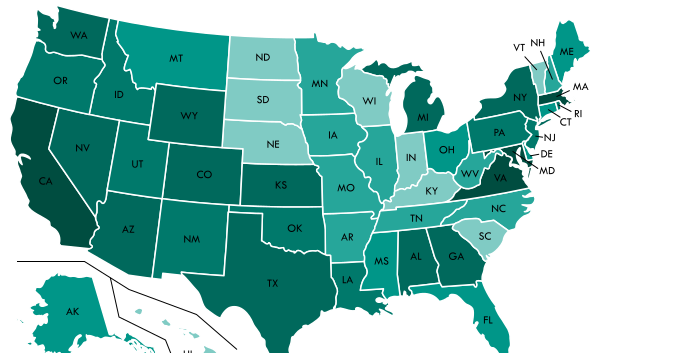
Most common states for process/product engineers
| Rank | State | Population | # of jobs | Employment/ 1000ppl |
|---|---|---|---|---|
| 1 | District of Columbia | 693,972 | 251 | 36% |
| 2 | Colorado | 5,607,154 | 1,577 | 28% |
| 3 | Maryland | 6,052,177 | 1,465 | 24% |
| 4 | Massachusetts | 6,859,819 | 1,594 | 23% |
| 5 | Wisconsin | 5,795,483 | 1,319 | 23% |
| 6 | North Dakota | 755,393 | 171 | 23% |
| 7 | Arizona | 7,016,270 | 1,514 | 22% |
| 8 | Nebraska | 1,920,076 | 418 | 22% |
| 9 | Georgia | 10,429,379 | 2,139 | 21% |
| 10 | Pennsylvania | 12,805,537 | 2,598 | 20% |
| 11 | Iowa | 3,145,711 | 638 | 20% |
| 12 | Ohio | 11,658,609 | 2,179 | 19% |
| 13 | Indiana | 6,666,818 | 1,284 | 19% |
| 14 | New Hampshire | 1,342,795 | 252 | 19% |
| 15 | Delaware | 961,939 | 181 | 19% |
| 16 | Wyoming | 579,315 | 112 | 19% |
| 17 | Michigan | 9,962,311 | 1,766 | 18% |
| 18 | Kansas | 2,913,123 | 535 | 18% |
| 19 | Maine | 1,335,907 | 234 | 18% |
| 20 | Texas | 28,304,596 | 4,730 | 17% |
Most common cities for process/product engineers
| Rank | City | # of jobs | Employment/ 1000ppl | Avg. salary |
|---|---|---|---|---|
| 1 | Cary | 1 | 1% | $75,580 |
| 2 | Newton | 1 | 1% | $98,829 |
| 3 | Portland | 1 | 1% | $78,940 |
| 4 | Atlanta | 1 | 0% | $90,109 |
Process/Product Engineer job outlook: Expert opinions
Our panel of process/product engineer experts
University of New Mexico
Arizona State University at the Polytechnic Campus
San Jose State University
North Carolina State University
Marshall University
Worcester Polytechnic Institute
University of Wisconsin - Green Bay

North Dakota State University

Cincinnati State Technical & Community College

Grand Valley State University

South Dakota School of Mines and Technology

North Dakota State University
University of Denver

Weber State University

University of Arkansas

California State Polytechnic University - Pomona

University of Delaware
Southern Illinois University Edwardsville
What general advice would you give to a Process/Product Engineer?
Jamie Gomez: Chemical engineers are instrumental in designing processes that produce a wide array of products across industries such as pharmaceuticals, energy, food and beverages, and materials science. They engage in both research and development (R&D;) to innovate new products and applied engineering to refine existing processes. By leveraging data analysis software and machine learning, they enhance efficiency and validate processes through advanced modeling. They also ensure safety and regulatory compliance using cutting-edge monitoring systems and predictive analytics. Collaborating with cross-functional teams, chemical engineers foster innovation, embrace diverse perspectives, and solve complex problems effectively. For those new to the field, the initial focus is on comprehensive training and learning, often guided by experienced engineers. New chemical engineers support senior engineers with data collection, preliminary analysis, and documentation, gaining invaluable hands-on experience with laboratory equipment and industrial processes. This foundational experience is crucial for honing essential skills such as process design, data analysis, project management, teamwork, and effective communication with diverse audiences, all of which are applicable to any project in their career.
What will help Process/Product Engineers increase their earning potential?
Jamie Gomez: Chemical engineers thrive on tackling complex problems and embracing diverse projects, which offer ample opportunities for innovation and career growth. Their work profoundly impacts society, particularly in advancing sustainable technologies. However, the profession can be demanding, with high workloads, regulatory hurdles, and safety challenges. Ethical considerations must also be carefully balanced with industrial growth. Senior chemical engineering students transitioning from capstone design projects often find the experience stressful but invaluable. These projects mirror real-world engineering scenarios and equip them with practical skills like problem-solving, collaboration, innovation, and adaptability. Additionally, they gain an understanding of the economic aspects of engineering projects, learning to assess cost-effectiveness and financial feasibility. These competencies are crucial for career success, offering versatility and a wide range of professional opportunities.
Jerry Gintz CMfgE
Teaching ProfessorArizona State University at the Polytechnic Campus
Manufacturing Engineering
What general advice would you give to a Process/Product Engineer?
Jerry Gintz CMfgE: When entering a career in manufacturing engineering, consider starting as a technician to gain experience with the company before transitioning into engineering. This will allow you to build confidence and better understand the production systems you will be responsible for as an engineer.
What Process/Product Engineer skills would you recommend for someone trying to advance their career?
Jerry Gintz CMfgE: From a manufacturing engineering perspective, the most important skills an engineer will need is the ability to understand, design, assemble, and deploy production capable systems. This includes an expertise with computer-aided engineering tools to assist in the design and verification of engineered systems before a company expends capital on the equipment.
What will help Process/Product Engineers increase their earning potential?
Jerry Gintz CMfgE: From a manufacturing engineering perspective, compensation is normally tied to capability so the more relevant skills a candidate has entering the workforce the higher compensation they can expect to receive. This is especially true in manufacturing given the shortage of qualified engineering talent available for hire. Additionally, consider focusing on industrial automation as a resource to aid efficient production. Manufacturing is always looking to increase efficiency and a foundational knowledge of industrial automation systems will serve you well as you build a career in manufacturing engineering.
What general advice would you give to a Process/Product Engineer?
J. Richard Elliott Professor Emeritus: The lovely thing about deciding to major in chemical engineering is that it is the “undecision.” Chemical engineering degree-holders can be (patent) lawyers, doctors (it has the highest admission RATE of any major), petroleum producers and refiners, corrosion specialists, polymer processors, cancer researchers, machine learning engineers for additive manufacturing (3D printing), computer chipmakers, cancer researchers, CEOs, professors, wastewater bioengineers, food engineers, ... There are probably many more but this is just off the top of my head. About the admission RATE to med school, CHEs don’t apply if they aren’t pretty sure they’ll get in because they have so many other options. The RATE is the fraction of those who apply who get in. About 45% of Biomed engineers go to med school and 45% go to grad school. The number of Biomeds may be more, but their RATE is only ~50%. Running petroleum refineries (for gasoline, Exxon, BP, Shell…) and chemical production plants (for ethylene, ethanol-gasohol, … Dow, Dupont, BASF, Lubrizol…) are probably the most obvious careers, but they represent maybe only 50% of where CHEs go nowadays. Many UA CHEs get the corrosion specialization and work for oil companies but also work for the Dept of Defense. There was a glut of CHEs in the early 80s when Reagan shut down Carter’s clean fuel initiative. That glut sent CHEs scurrying into many fields and they have kept their fingers in all these pies. In Akron Ohio, polymer companies like PolyOne, Goodyear (and other tire companies), AL Shulman, ... pick up about 25% of UAs graduates. Smucker’s in Orrville also picks up a steady number who become food engineers. My wife started with BP in tertiary oil recovery (briefly, using “soap” to wash the oil of rocks deep in the ground). Then she worked with Ferro to develop a smart washing machine that would synthesize peroxide bleach on the spot. Then she worked for a company that makes non-skid strips for showers and stairs and skateboards. She ended her career working for the largest bottle-grade polyester company in the world, trying to solve the polyester recycle problem. My oldest daughter did her PhD-CHE developing a diagnostic for pre-eclampsia that cut false positives in half. Her post-doc was focused on auto-immune diseases and now she works in the front office of a CA “unicorn” as the associate director of business development. My younger daughter started her career exploring arthritis as an auto-immune disease then she worked for Caribou (one of Doudna’s startups) working on allogeneic CAR T-cell technology using CRISPR-CAS9. Then she worked on similar cancer treatments with natural killer cells and autologous CAR T-cell therapy. My son-in-law is a PhD CHE working on machine learning at LLNL (he met my older daughter in grad school). Computer chips are manufactured by a process involving chemical vapor deposition, polymeric photoresists, and chemical etching; all are chemical engineering processes. Gordon Moore of “Moore’s law” was a CHE. Many CEOs of companies like Exxon, Dow, etc have been CHEs. One of my best (CHE) friends has developed a process to enhance wastewater treatment to perform 5x more treatment in the same volume. The digestion of sewage involves bacteria, making It more properly a biochemical engineering problem, not a civil engineering problem.
What Process/Product Engineer skills would you recommend for someone trying to advance their career?
J. Richard Elliott Professor Emeritus: It’s always a good time to major in CHE because the broad background makes it feasible to pivot into whatever field is in demand when you expect to graduate.
What Process/Product Engineer skills would you recommend for someone trying to advance their career?
Christopher Lew: Chemical engineering is a multidisciplinary, technology-driven field that offers a broad set of skills and knowledge. Graduates have many career opportunities to choose from in various industries. The profession is dynamic, well-compensated, and allows for success and growth.
What will help Process/Product Engineers increase their earning potential?
Christopher Lew: People like the broad range of career opportunities, the ability to address complex challenges, and the potential for success and growth in various fields. Dislikes may include the complexity of the field and the varied responsibilities that require a unique way of thinking and problem-solving.
Dr. Gregory Buckner Alumni Distinguished Undergraduate Professor
Alumni Distinguished Undergraduate ProfessorNorth Carolina State University
Manufacturing Engineering
What general advice would you give to a Process/Product Engineer?
Dr. Gregory Buckner Alumni Distinguished Undergraduate Professor: Experience with robotics and automation, additive manufacturing, and CNC machining processes. Understanding the emerging roles of data analytics and artificial intelligence in process optimization and quality control.
What Process/Product Engineer skills would you recommend for someone trying to advance their career?
Dr. Gregory Buckner Alumni Distinguished Undergraduate Professor: One way to maximize your salary potential is to continue the formal education process by taking graduate engineering or business courses. Many employers reimburse the tuition expenses, and with the increasing availability of online courses you can earn a master's degree in engineering or an MBA one course at a time.
What will help Process/Product Engineers increase their earning potential?
Dr. Gregory Buckner Alumni Distinguished Undergraduate Professor: I'd encourage students to embrace new technical challenges and opportunities to learn and collaborate in an industrial setting, which can be quite different from the academic setting. I'd emphasize the importance of developing communication and team working skills, and building professional relationships. I'd also encourage students to join professional societies related to their field and keep updated on new manufacturing trends.
Michael Buechler
Professor Manufacturing TechnologyWhat general advice would you give to a Process/Product Engineer?
Michael Buechler: I counsel my students to know their worth and know the job market. Most important is starting out in a position that challenges you and provides training for future wage and skill growth. Many graduates can get caught in a job that pays the bills but may not provide a path to the next career step. Be ambitious and seek to attain the advanced skills quickly but keep in mind the field is complex and there is a lot to learn. If you are in a high wage position but it does not provide the training or room for advancement it might not be the best career option.
What Process/Product Engineer skills would you recommend for someone trying to advance their career?
Michael Buechler: Model based definition, highly technical computer skills, 5 axis & familiarity with macros is going to be the future of advanced manufacturing. It is paramount that high skill individuals START with as much set-up experience as possible. In order to command 100k + as a programmer you need to know the correct inputs and physics of the manufacturing program you are making
What will help Process/Product Engineers increase their earning potential?
Michael Buechler: I would suggest beginning career individuals maintain an open mind as to where their carrer leads, they may find interest in areas of manufacturing not previously known or explored by them. Also work especially hard early in your career and try and find an employer that gives you the best opportunity to grow professionally and learn new skills.
Dr. Yousef Sardahi
Associate Professor of Mechanical EngineeringMarshall University
Engineering
What Process/Product Engineer skills would you recommend for someone trying to advance their career?
Dr. Yousef Sardahi: In the next 3-5 years, several skills are expected to become increasingly important in the mechanical engineering field:
Advanced Computational Skills: Proficiency in simulation and modeling software (like ANSYS, SolidWorks, or MATLAB) will be crucial as these tools become more integral in designing and testing complex systems.
Robotics and Automation: With industries moving towards automation, skills in robotics, automated systems, and knowledge of AI integration will be highly sought after.
Additive Manufacturing and 3D Printing: Expertise in 3D printing and additive manufacturing techniques will be valuable as these technologies revolutionize product development and manufacturing processes.
Renewable Energy Technologies: As the world shifts towards sustainable energy sources, mechanical engineers with knowledge in solar, wind, and other renewable energy technologies will be in high demand.
Data Analysis and IoT: Skills in data analytics and understanding the Internet of Things (IoT) will be important as more mechanical systems are connected and produce large amounts of data.
Materials Science: Knowledge in advanced materials, such as composites or smart materials, will be crucial for developing more efficient and sustainable products and systems.
Systems Engineering and Integration: The ability to understand and integrate various subsystems within a larger system will be key, especially in complex projects.
Project Management and Leadership: As projects become more complex, skills in project management and leadership will be essential for overseeing projects and leading teams effectively.
Interdisciplinary Collaboration: The ability to work effectively across disciplines, understanding aspects of electrical engineering, computer science, and even business, will be increasingly important.
Communication and Soft Skills: Strong communication skills, both for technical and non-technical audiences, along with teamwork and problem-solving skills, will always be invaluable in the engineering field.
Jianyu Liang
Director of Materials and Manufacturing Engineering Program, Department of Mechanical and Materials Engineering, WPIWorcester Polytechnic Institute
Materials Engineering
What general advice would you give to a Process/Product Engineer?
Jianyu Liang: At the start of your career, actively engaging in the manufacturing professional communities to develop an in-depth understanding of the current high-demand areas and the trends in the industry will help you position yourself in high-demand areas. This proactive approach allows you to make informed decisions on obtaining relevant certifications or advanced education, tailoring your skill set to meet the evolving needs of the industry. Proactively engaging in projects and practices to grow your experience. Building a strong professional network and finding mentors in the industry can provide guidance, expose you to new opportunities, and offer insights on navigating your career path effectively. Embracing continuous learning and staying abreast of technological advancements in manufacturing, such as automation, robotics, and digital manufacturing technologies, will ensure you remain a valuable asset to employers. Demonstrating flexibility and a willingness to adapt to new methods and technologies can set you apart in a competitive job market.
What Process/Product Engineer skills would you recommend for someone trying to advance their career?
Jianyu Liang: For manufacturing engineers, the next 3-5 years promise significant evolution due to advancements in technology and changes in manufacturing processes. Here are some skills that are expected to become more important and prevalent in the field: proficiency in automation and robotics, advanced data analysis and data-driven optimization, digital twin technology, additive manufacturing and 3D printing, application of artificial intelligence and machine learning in manufacturing, cybersecurity for manufacturing systems, and supply chain management.
What will help Process/Product Engineers increase their earning potential?
Jianyu Liang: Get Your Hands Dirty: There's no substitute for hands-on experience. The lessons learned through direct involvement are invaluable, offering insights and skills that theoretical knowledge alone cannot provide. Embrace every opportunity to participate in projects, volunteer for tasks, and experiment within your role. This proactive approach not only accelerates your learning but also showcases your work ethic and dedication to potential mentors and leaders.
Be Mindful and Intentional in Your Job: While immersing yourself in your work, adopt a reflective practice. Actively seek feedback and analyze your experiences. This intentional approach to learning from every task helps to grow your skills rapidly.
Be Open-Minded and Adaptable: The landscape of nearly every industry is rapidly evolving, particularly with the integration of automation and artificial intelligence (AI). These technologies are not just changing the way we work; they are reshaping the skills and roles in demand. Stay open to new ideas, technologies, and methodologies. Continuous learning and adaptability are key to remaining relevant and thriving in a tech-driven workplace. Attend workshops, webinars, and courses on emerging technologies and trends in your field to keep your skills sharp and your perspective fresh.
Cultivate a Professional Network: Building relationships within your industry is crucial. Networking isn't just about finding job opportunities; it's about learning from peers, gaining insights into industry trends, and establishing a support system. Attend industry conferences, join professional organizations, and engage in communities related to your field. These connections can provide guidance, mentorship, and support as you navigate your career path.
Uises Gonzalez-Valle
Assistant ProfessorUniversity of Wisconsin - Green Bay
Mechanical Engineering Related Technologies/Technicians
What will help Process/Product Engineers increase their earning potential?
Uises Gonzalez-Valle: The beginning of professional life is not simple independent of the career path that you follow and ME and MET can have their own complications. However, some good advice would be to develop independence and adaptability which are key traits of an engineer, and always keep yourself updated with the most recent technological developments. If you are independent and adaptable, you have all the skills to learn and further your professional development. In addition, I would say it is essential to start building a network, including peers and mentors. Having a strong network of peers and mentors helps you significantly to progress in your professional line. From day-to-day to daily changing decisions, having a strong network to support would significantly help in building your professional path. Lastly, I would say that having a good Work-life balance is vital too, since our personal life is as important as our professional life. Remember, we should work to live instead of live to work.
Dr. David Grewell Ph.D.
Department Chair and ProfessorNorth Dakota State University
Industrial and Manufacturing Engineering Department
What skills will help Process/Product Engineers earn the most?
Dr. David Grewell Ph.D.: Good communication and leadership skills that are embedded in their curriculum enable IE's to quickly move up the corporate ladder and become the CEO of the nation's leading companies.
Mike DeVore Ph.D.
Professor & Program ChairCincinnati State Technical & Community College
Mechanical Engineering Technology
What hard/technical skills are most important for Process/Product Engineers?
Mike DeVore Ph.D.: -Computer-Aided Design
-Knowledge of manufacturing processes
-A good mathematics foundation
-Technical communication
-Problem solving
What are the biggest trends we'll see in the Process/Product Engineer job market given the pandemic?
Diane LaFreniere: The pandemic has created an enormous opportunity for students to understand the need for adaptability, positivity, and team work. For engineering students, this translates to a broader skillset with the depth and breadth of exposure to transition to interdisciplinary engineering roles that require a strong initiative and willingness to contribute in an individual and group capacity. For employees, this will require an increased awareness and desire to improve computer-related and communication skills to adapt to a flexible or remote work schedule, as well as assume greater responsibility in diverse capacities. For employers, this translates toward revised position descriptions and career paths and recruitment strategies to seek candidates who are equipped to navigate new directions and pivot into a variety of roles within the organization. At Grand Valley State University, we emphasize the need for a strong engineering core with greater specialization for students approaching graduation. The mandatory co-op program and senior capstone experience equips the students with the technical skillset necessary for interdisciplinary engineering teamwork, along with the essential skills necessary to conduct themselves professionally and become future engineering leaders.
What soft skills should all Process/Product Engineers possess?
Diane LaFreniere: All engineering graduates should possess solid time and organizational management skills, as well as the ability to professionally conduct themselves in a team environment that promotes collaboration and inclusivity and a strong initiative to understand the importance of acquiring and applying new knowledge, using appropriate learning strategies. Given the increased focus on professional skills, one of the major objectives of the GVSU engineering co-op program is to ensure that all students understand the significance of an essential skillset, which is necessary for future professional growth and development, as well as career pivoting with changing interests or demand. At GVSU, we have seen an increased interest in employer-sponsored education aimed at talent development that builds technical and professional expertise, with a focus on a growth mindset, as well as project management, ethics, communications, and teamwork. The GVSU co-op program and senior capstone experience provide a unique opportunity for continuous industrial collaboration to build a strong professional skillset through online modules, curricular projects, classroom instruction, and industry-sponsored project work that reinforce discipline-specific industry work.
How have salaries changed over time for Process/Product Engineers?
Diane LaFreniere: Given the increased demand for engineering professionals, the salaries have steadily increased with graduating seniors securing positions with base salaries of $65K+. The starting salaries vary slightly depending upon engineering discipline. Students with a greater depth/breadth of knowledge base and experience often receive base offers of $75-80K or more. At Grand Valley, students often review and compare the cost of living when assessing an offer, as the base salary and future salary increases must be considered in connection with local living expenses. In light of the recent health crisis, more candidates are evaluating the standard/cost of living, in addition to the salary, and making decisions accordingly.
What are the biggest trends we'll see in the Process/Product Engineer job market given the pandemic?
William Cross Ph.D.: The biggest job market trends given the pandemic are working from home, and slightly delayed hiring - in Metallurgical Engineering at SD Mines, it took about 9-12 months for our Spring 2020 graduates to be hired to levels that took less than three months pre-pandemic, although eventually most of our graduates have been placed. The Fall 2020 graduates have seen a similar delay.
I expect some of the work from home will remain into the future, but do not expect the delayed hiring to extend for too much longer. I also expect that in some fields the pandemic has accelerated trends towards greater automation of job functions.
What soft skills should all Process/Product Engineers possess?
William Cross Ph.D.: The soft skills that all graduates should possess are primarily in communication - speaking/writing clearly, and listening/reading comprehension - and in teamwork skills. Being able to function in a variety of roles on a team is very important to success in many jobs.
How have salaries changed over time for Process/Product Engineers?
William Cross Ph.D.: This of course depends on the time range to which the question refers. Over the last 4-5 years salaries have been rather flat on average going by SD Mines graduates in Metallurgical Engineering, although this is working off a rather high baseline. SD Mines has been recognized as the top engineering schools in the nation for return on investment, and Metallugical Engineering has an above average starting salary for SD Mines at around $65,000/year.
Andriy Voronov
ProfessorNorth Dakota State University
Coatings and Polymeric Materials Department
Will there be an enduring impact of the coronavirus pandemic on Process/Product Engineers?
Andriy Voronov: Since pandemic is not over yet, there may be only a guess on how significant this impact can be. I think answering this question resonates with more general one, namely, "Will our life after COVID-19 be the same as before?" We all want to be positive about that but are just not certain. Moreover, I think in some professional aspects in most fields, changes are unavoidable. Working from home, attending virtual conferences, taking part in Zoom meetings, even virtual get together with colleagues will most probably remain to be a new post-pandemic working routine, by all advantages and disadvantages this may bring to most recent graduates. Speaking about materials science, I hope and do believe that there will be global and impactful factors other than coronavirus pandemic, such as novel materials trends, technological innovations etc., to take into account for graduates.
What certifications/licenses/courses can have the biggest impact for Process/Product Engineers?
Andriy Voronov: I think most graduate programs in materials science offer opportunities for interdisciplinary research and educational activities. Their philosophy is to educate and prepare job prospects by providing advanced aspects of work, including extensive collaborations between departments, programs, institutions or with industrial partners. Offering specialized trainings in various areas, graduate programs aim to merge basic and applied research within the certain field. With this said, quit often graduate programs work also with leading industrial scientists who help to provide to the graduates new and practical directions to become competitive at the job market. Answering your question more specifically, graduate programs do target as complementary and comprehensive education as possible. It will be interesting to hear from graduates what courses they took have the biggest impact for them, as well as if they need any additional certifications/licenses and which specifically.
How have salaries changed over time for Process/Product Engineers?
Andriy Voronov: Being materials scientist means being able to do lot of things starting from fundamental research on material properties and characterization up to developing entirely new formulations and modify them to make new products suitable for new applications. One should be prepared to work in research lab, but also in pilot plants, as well as in manufacturing facilities. As for the soft skills, those are critical thinking, problem solving, communication, written and oral, including ability to communicate science to scientists, but also nonscientific audience, also flexibility and adaptability in (always) willing to learn. Although not a soft skill, but rather technical one, do not forget about fundamental knowledge and understanding of materials specifics and properties one works with.
Dr. Matt Howard Gordon Ph.D.
Professor & Chair, Mechanical & Materials EngineeringUniversity of Denver
Department of Mechanical & Materials Engineering
Will there be an enduring impact of the coronavirus pandemic on Process/Product Engineers?
Dr. Matt Howard Gordon Ph.D.: I think so. At least for a couple years.
What will help Process/Product Engineers increase their earning potential?
Dr. Matt Howard Gordon Ph.D.: I stress outside the class experiences - internships, undergraduate research, and/or study abroad. I believe all help with earning potential. And maybe students should consider getting their PE.
What's a good job out of college for Process/Product Engineers?
Dr. Matt Howard Gordon Ph.D.: I think any technical job is a good job for engineers. You build experience, ideally in an area of interest, making it easier to get your next job.
What will help Process/Product Engineers increase their earning potential?
Dr. A. Tye Gardner Ph.D.: Getting a master's degree goes a long way to making candidates stand out and improving earnings. My recommendation is to tailor your MS degree to the specific field you're interested in working in, because employers really want to see candidates that are passionate about the field, and very few people survive a graduate degree without at least a little passion. Available salary data indicates that if you choose an affordable program (let's just say Weber State University), it takes only a few years to pay off the added cost, increases starting salaries, and dramatically improves long-term earning potential. Moreover, you can find electrical engineers with MBAs at C-level positions all over the country. It turns out being an EE makes you a good candidate for business leadership.
What technical skills for a Process/Product Engineer stand out to employers?
Rick Wise Ph.D.: Materials Science and Engineering graduates with MS and/or PhD degrees are expected to have a working knowledge of materials characterization equipment and how to interpret measurement results. Most will have an in-depth knowledge of materials used in a particular field (electronics, photonics, nanomaterials, energy, biological, etc.), in the fabricatoin/processing of those materials, and how to control and optimize the properties to meet the desired application. Especially valued is the capability to combine that knowledge with creativity to bring about innovations which help solve problems and create markets.
Jonathan Puthoff
Associate ProfessorCalifornia State Polytechnic University - Pomona
Chemical and Materials Engineering
What are the biggest trends we'll see in the Process/Product Engineer job market given the pandemic?
Jonathan Puthoff: I predict a reconsideration of what "attendance" means in a workplace. Knowledge workers have always had some leeway to work from home, but workplaces that have found near-universal remote collaboration congenial may consciously move toward that model. Workers who are afforded more options to work from home should consider carefully the level of support that their employer provides for doing this and should be prepared to negotiate over the exact terms.
What skills stand out on Process/Product Engineer resumes?
Jonathan Puthoff: Collaboration and communication skills. I also think that students should graduate knowing at least one field-specific software design tool or package, as well as some evidence that they can learn more on the job. Finally, workplaces are more diverse in terms of the generations, ethnicities, and genders represented than they have been at any time in the past, so students who have a wide variety of out-of-classroom experiences (and presumably make more considerate colleagues) could do well to highlight those.
Are there any particularly good places in the United States for Process/Product Engineers to find work opportunities?
Jonathan Puthoff: I always encourage students to look as far afield as their personal circumstances and skill set can accommodate. Geography is a relatively minor constraint in a world with well-developed travel and telework options. I also anticipate that early- and mid-career relocation will be an option or requirement at some point for most tech workers. For these reasons, I think that associating particular opportunities with particular regions might not be a good strategy in an entry-level job search. Graduates should rather identify opportunities and ask "Can I see myself working in this region for the opening years of my career?", understanding that the location will likely change depending on factors both internal and external to their employer.
What are the biggest trends we'll see in the Process/Product Engineer job market given the pandemic?
Ajay Prasad: Medical devices, pharmaceuticals, and most consumer goods are still strong. The pandemic is also unlikely to slow the demand in areas like artificial intelligence, robotics, and virtual reality. While more manufacturing jobs are believed to return to the U.S., this likely will drive innovation for the automation of manufacturing processes. Going forward, demand is likely to be strong in infrastructure, renewable energy, automotive, and aerospace industries.
What experience really stands out on Process/Product Engineer resumes?
Dr. Mingshao Zhang: Internship and Co-op (Cooperative Education) experiences that related to the industry.