Explore jobs
Find specific jobs
Explore careers
Explore professions
Best companies
Explore companies
Job outlook for program advisors in the United States
Are program advisor jobs in demand?
Program advisor job and salary trends over time
Program advisor jobs over time
Program advisor job growth rate over time
| Year | # of jobs | % of population |
|---|---|---|
| 2021 | 2,165 | 0.00% |
| 2020 | 2,135 | 0.00% |
| 2019 | 2,166 | 0.00% |
| 2018 | 2,086 | 0.00% |
| 2017 | 1,983 | 0.00% |
Average program advisor salary over time
Program advisor salary by year
| Year | Avg. salary | Hourly rate | % Change |
|---|---|---|---|
| 2025 | $55,656 | $26.76 | +1.9% |
| 2024 | $54,622 | $26.26 | +1.3% |
| 2023 | $53,923 | $25.92 | +1.6% |
| 2022 | $53,061 | $25.51 | +1.6% |
| 2021 | $52,247 | $25.12 | +1.7% |
Program advisor jobs by state
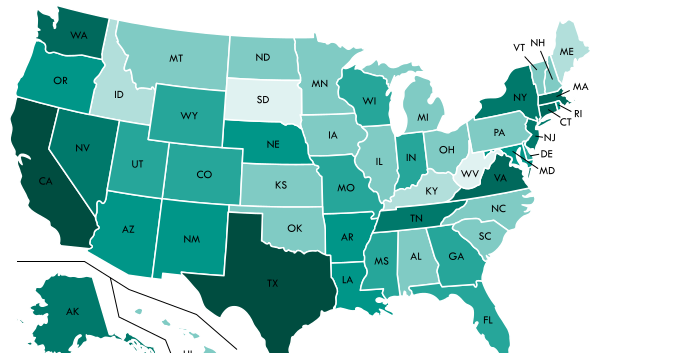
Most common states for program advisors
| Rank | State | Population | # of jobs | Employment/ 1000ppl |
|---|---|---|---|---|
| 1 | North Dakota | 755,393 | 239 | 32% |
| 2 | District of Columbia | 693,972 | 179 | 26% |
| 3 | Connecticut | 3,588,184 | 777 | 22% |
| 4 | Delaware | 961,939 | 216 | 22% |
| 5 | Utah | 3,101,833 | 656 | 21% |
| 6 | Rhode Island | 1,059,639 | 219 | 21% |
| 7 | New Hampshire | 1,342,795 | 268 | 20% |
| 8 | Minnesota | 5,576,606 | 1,014 | 18% |
| 9 | Colorado | 5,607,154 | 1,012 | 18% |
| 10 | Wisconsin | 5,795,483 | 1,003 | 17% |
| 11 | South Dakota | 869,666 | 144 | 17% |
| 12 | Arizona | 7,016,270 | 1,029 | 15% |
| 13 | Nebraska | 1,920,076 | 285 | 15% |
| 14 | Idaho | 1,716,943 | 250 | 15% |
| 15 | Maine | 1,335,907 | 198 | 15% |
| 16 | Illinois | 12,802,023 | 1,830 | 14% |
| 17 | Oregon | 4,142,776 | 598 | 14% |
| 18 | Montana | 1,050,493 | 144 | 14% |
| 19 | Iowa | 3,145,711 | 412 | 13% |
| 20 | New Mexico | 2,088,070 | 278 | 13% |
Most common cities for program advisors
| Rank | City | # of jobs | Employment/ 1000ppl | Avg. salary |
|---|---|---|---|---|
| 1 | Rosemead | 2 | 4% | $78,757 |
| 2 | Annapolis | 1 | 3% | $61,185 |
| 3 | Washington | 6 | 1% | $74,480 |
| 4 | Chula Vista | 2 | 1% | $77,195 |
| 5 | Tallahassee | 2 | 1% | $55,488 |
| 6 | Cedar Rapids | 1 | 1% | $49,159 |
| 7 | Los Angeles | 4 | 0% | $78,795 |
| 8 | Atlanta | 2 | 0% | $58,690 |
| 9 | Baltimore | 2 | 0% | $61,212 |
| 10 | Anchorage | 1 | 0% | $68,557 |
| 11 | Austin | 1 | 0% | $78,957 |
| 12 | Baton Rouge | 1 | 0% | $60,056 |
| 13 | Birmingham | 1 | 0% | $50,521 |
| 14 | Boston | 1 | 0% | $71,794 |
| 15 | Chicago | 1 | 0% | $54,111 |
| 16 | Des Moines | 1 | 0% | $49,437 |
Program Advisor job outlook: Expert opinions
Our panel of program advisor experts
Lake Superior State University
California State University - Los Angeles

High Point University
Seattle University
East Tennessee State University
American University
Dr. Sally Childs
Faculty/Advisor Parks and Recreation DegreeLake Superior State University
Exercise & Sport Science departmen
What are the biggest trends we'll see in the Program Advisor job market given the pandemic?
Dr. Sally Childs: The documented demand for outdoor recreation opportunities has been steadily increasing since the National Park Service was established in 1916. The Outdoor Recreation Industry is the nation's 4th largest economic engine, outpaced only by health care-related industries. The recommended CDC protocols for combating the spread of COVID compliment the opportunities available through outdoor recreation settings (parks) and/or activities. During the summer of 2020, many parks and some specific outdoor recreation sites were so crowded that visitor restrictions needed to be implemented. Outdoor recreation equipment sales spiked in such a way that demand frequently exceeded supply, both in relatively inexpensive items, such as kayaks, and in big ticket items such as travel trailers and boats. I am absolutely convinced that this demand for outdoor recreation opportunities and outdoor recreation sites (parks, state and national forests, and other undeveloped nature based areas) is going to continue far into the future. The COVID protocols stimulated people to pursue outdoor opportunities, not only for the physical activities, but to escape the enforced isolation of the shelter at home directives, to facilitate alternative family based experiences, to provide a spiritual and emotional renewal, and to simply offer people an opportunity to experience an environment that seemed to function quite within the range of "normal" despite COVID. Consequently, I believe that the need and the demand for people seeking careers in all aspects of the outdoor recreation industry; everything from instructors and guides in a wide variety of endeavors and settings, to marketing and sales in the private sector, to resource managers and facilitators in the public sector, will continue to expand. A recent graduate in an outdoor recreation field who has recently acquired the knowledge base and skill set necessary to provide safe yet stimulating outdoor recreation experiences, who can adequately and appropriately answer questions, recommend and maintain equipment, and or has the ability to manage and protect the resource base, all while encouraging human access, is going to be able to find employment. COVID further stimulated growth in an already expanding industry.
What soft skills should all Program Advisors possess?
Dr. Sally Childs: Some of the most essential skills that will be necessary for professionals in this field to be successful are frequently identified as "soft skills." These skills are often difficult to quantify. Regardless of the setting, professionals working in this field need to be very comfortable working with all people of all ages and abilities. Communication skills are essential; active listening, patience, tolerance, and being able to present a non-threatening, non-judgemental demeanor has a strong positive impact on being able to successfully respond to visitor/client needs and wants. Problem solving is essential. Being task oriented but concurrently, being able to easily deviate from routine is important. Professionals in this field frequently need to make decisions without having immediate access to supervisors. These people need to be very aware of agency goals, policies and protocols and be confident in their ability to independently represent these through their behavior and the behavior that they encourage/enforce in others. The "hard skills" that are required will depend in part on the particular job/agency/setting. Computer and IT skills will be essential for everyone, although there certainly will be a fair amount of latitude regarding the degree of expertise required. Basic construction skills; plumbing, framing, concrete, and electrical will be an asset for anyone working in a park or an area that has been even moderately developed for outdoor recreation purposes. Mechanical skills, everything from small engine repair all the way to vehicle upkeep and maintenance will also be a skill set which is in demand. A basic understanding of the requirements for maintaining a healthy resource base; forestry, watersheds, ecosystems, wildlife habitat, will also be necessary for professionals managing everything from campgrounds to wilderness areas. Many Parks have a strong historical and or cultural component. Facilitation and Interpretation skills will be needed if the professional chooses this portion of the Parks and Recreation continuum. If the professional is intent on becoming an instructor or guide, then whatever technical skills are associated with "best practices" in that particular activity will be essential. It is also likely that they would be expected to be credentialed in Wilderness First Aid, and other backcountry "survival and safety" skills. Law enforcement skills are also in demand in parks and recreation settings.
What will help Program Advisors increase their earning potential?
Dr. Sally Childs: As with most professional fields, parks and recreation and outdoor recreation providers seek potential employees with a strong history of experience in the precise area they are hiring for. Fortunately, this is an industry that actually seeks out a young, enthusiastic, and relatively unskilled labor force for many of the entry level positions. An interested and dedicated individual can start working in a variety of outdoor recreation settings while they are still in high school. That seasonal work can continue through college, and by the time that person completes their college degree, they will not only have the academic credentials, but they will also have acquired a strong resume of job/career related experience and possibly, a history of agency affiliation. This period of time, as a student is matriculating through their college degree, becomes the time for the prospective professional to experiment and engage in self study. The parks and recreation/outdoor recreation spectrum is so expansive and diverse that it may take several different seasonal placements, working in a variety of areas of responsibility, in order to discover the best fit for the "perfect" career.
What are the biggest trends we'll see in the Program Advisor job market given the pandemic?
Dr. Ambika Raj Ph.D.: Given the pandemic, the biggest trend we are seeing in the job market for the field of curriculum and instruction is the need for qualified teachers who are comfortable teaching on an online platform. Last May, some colleges and universities included technology training such as a ACUE micro-credential in online teaching, promoting engaged and active online learning etc. These are nationally accredited credentials. And teachers/students who have taken these are at a definite advantage.
Another trend that we are seeing – everyone who has a computer and computer skills are offering classes of one sort or the other – they realize they can set up “office” simply by opening their computer. I know of at least a few teenagers who have done this with great success. High school seniors offering to teach/coach younger students, dance, music, theater, PE teachers having a side business teaching classes in the weekends online.
Currently, LAUSD in looking for qualified substitute teachers because schools have opened up in the larger LA area and only a few students can attend at a time. So in order to manage the days and not burnout teachers, many substitute teachers are being hired.
What certifications/licenses/courses can have the biggest impact for Program Advisors?
Dr. Ambika Raj Ph.D.: Certainly certifications that say that you have an online credential have the most impact. Our College has a wonderful online teaching program that they offer to students. Last summer we saw a rise in the number of applicants who wanted to become teachers - both in the credential as well as bachelors/masters programs.
How have salaries changed over time for Program Advisors?
Dr. Ambika Raj Ph.D.: Unfortunately, salaries have not changed significantly at all. The pandemic has made all teachers/professors and instructors jobs triple - but the compensation is about the same. In fact, I would say many of the schools furloughed their teachers.
William (Bill) Gentry Ph.D.
Assistant Vice PresidentHigh Point University
Career and Professional Development
What will help Program Advisors increase their earning potential?
William (Bill) Gentry Ph.D.: Philosophy majors are employable in a variety of fields such as education, law, ethics, business, religious-affiliated areas, community services, government, and communications to name a few. A 538 article in 2015 showed that philosophy majors have the fourth-highest median earnings for those with only undergraduate degrees. The Winter 2020 National Association of Colleges and Employers (NACE) salary survey indicated philosophy majors have the highest mean and median salary across all humanities majors and is comparable to other majors as well. To increase their earning potential, we encourage our students to focus on life skills that can separate themselves from all the others who are applying to the job. How can you showcase pertinent life skills that philosophy majors are known for - such as resiliency, the flexibility and capacity for growth, analytical, organizational and research skills like idea generation, problem formulation and problem solving, persuasion, and communication skills - on your brand documents like your resume, cover letter, LinkedIn, or in interviews? Specifically, how can you display that you have learned and developed those skills inside and outside the classroom in strong bullet points on your resume or in your cover letter? How can you clearly articulate how you've displayed or enhanced those skills through your classwork, internships, jobs, volunteer work, or other experiences in answering interview questions like "Tell me about yourself" or "What are your strengths?" or "Tell me about a time you had to influence others?" A GPA will likely get your foot in the door, but the ability to demonstrate these important like skills on paper, online, and in person in networking and interviewing will show others that you will be successful not just on day one of the job, but be seen as a high potential in your fist year, five years, and beyond.
Theresa Earenfight Ph.D.
Professor of History, Director, Women, Gender, and Sexuality Studies ProgramSeattle University
History Department
Will there be an enduring impact of the coronavirus pandemic on Program Advisors?
Theresa Earenfight Ph.D.: As a historian of the European Middle Ages, I'm struck by how students this past year have acquired something scarce: historical empathy. The past can seem so remote, so very different from our lived experiences today, and this can make history seem irrelevant. But this fall, I was teaching a section on the bubonic plague, which historians of medicine now know was a global pandemic, not just an epidemic in Europe. Usually, students are fascinated by the gruesome medical details, but not this group.
They did not need or want to look death in the eyes. They wanted to know how did people react? How did they get back to normal? When we ticked off the list of reactions--fear, distrust of science (such as it was in 1348), xenophobia, scapegoating, economic collapse, hoarding supplies, turn to religion, gallows humor about worms crawling about corpses--they got it. When we talked about the aftermath--eat, drink, be merry, and protest the inequality--they got it. That is historical empathy, and I'm sad that this was how it had to be learned, but it will give them broader compassion that can encompass people alive today.
Will there be an enduring impact of the coronavirus pandemic on Program Advisors?
Dr. Frederick Gordon Ph.D.: Graduate students will need to refocus on the changing institutional role, being both remote and in-person, and impacting agency goals and performance.
How do you envision technology impacting Program Advisors in the next 5 years?
Dr. Adelaide Kelly-Massoud: Well, every teacher and teacher candidate was thrust into distance learning. Misguided attempts to foster understanding often leaned our adult distant learning pedagogy. Teachers, and those who prepare teachers, found their job to research, define, design, and implement meaningful teaching and learning using a virtual platform. Words such as synchronous and asynchronous are now a part of our everyday vernacular. But there is a much more optimistic change on the horizon that we can thank coronavirus for.
Communication and collaboration have been forced to change. Parents and Teachers are more connected and have been put in a position to leverage technology to build networks of support and consistent dialog. I urge teachers to leverage this in their future as we work to reopening schools; we should learn from this experience to leverage technology to keep us connected.