Explore jobs
Find specific jobs
Explore careers
Explore professions
Best companies
Explore companies
Job outlook for program analyst leads in the United States
Program analyst lead job growth summary. After extensive research, interviews, and analysis, Zippia's data science team found that:
The projected program analyst lead job growth rate is 9% from 2018-2028.
About 56,000 new jobs for program analyst leads are projected over the next decade.
Program analyst lead salaries have increased 8% for program analyst leads in the last 5 years.
There are over 39,540 program analyst leads currently employed in the United States.
There are 126,148 active program analyst lead job openings in the US.
The average program analyst lead salary is $100,660.
Are program analyst lead jobs in demand?
Program analyst lead job and salary trends over time
Program analyst lead jobs over time
Program analyst lead job growth rate over time
| Year | # of jobs | % of population |
|---|---|---|
| 2021 | 39,540 | 0.01% |
| 2020 | 37,768 | 0.01% |
| 2019 | 36,520 | 0.01% |
| 2018 | 37,678 | 0.01% |
| 2017 | 36,509 | 0.01% |
Average program analyst lead salary over time
Program analyst lead salary by year
| Year | Avg. salary | Hourly rate | % Change |
|---|---|---|---|
| 2026 | $100,660 | $48.39 | +3.4% |
| 2025 | $97,343 | $46.80 | +2.3% |
| 2024 | $95,139 | $45.74 | +0.5% |
| 2023 | $94,635 | $45.50 | +1.2% |
| 2022 | $93,510 | $44.96 | +1.7% |
Program analyst lead jobs by state
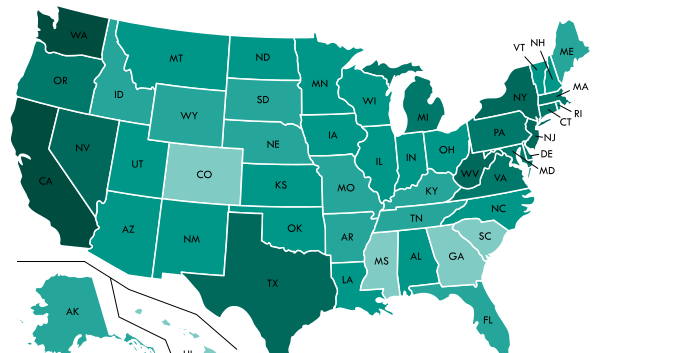
Most common states for program analyst leads
| Rank | State | Population | # of jobs | Employment/ 1000ppl |
|---|---|---|---|---|
| 1 | District of Columbia | 693,972 | 851 | 123% |
| 2 | Montana | 1,050,493 | 384 | 37% |
| 3 | Nebraska | 1,920,076 | 605 | 32% |
| 4 | South Dakota | 869,666 | 272 | 31% |
| 5 | Delaware | 961,939 | 288 | 30% |
| 6 | Virginia | 8,470,020 | 2,459 | 29% |
| 7 | Idaho | 1,716,943 | 493 | 29% |
| 8 | Alaska | 739,795 | 207 | 28% |
| 9 | New Mexico | 2,088,070 | 546 | 26% |
| 10 | Maryland | 6,052,177 | 1,489 | 25% |
| 11 | Kansas | 2,913,123 | 733 | 25% |
| 12 | New Hampshire | 1,342,795 | 329 | 25% |
| 13 | Colorado | 5,607,154 | 1,357 | 24% |
| 14 | Rhode Island | 1,059,639 | 257 | 24% |
| 15 | Arkansas | 3,004,279 | 673 | 22% |
| 16 | Nevada | 2,998,039 | 652 | 22% |
| 17 | Minnesota | 5,576,606 | 1,195 | 21% |
| 18 | Oregon | 4,142,776 | 864 | 21% |
| 19 | Utah | 3,101,833 | 611 | 20% |
| 20 | Connecticut | 3,588,184 | 694 | 19% |
Most common cities for program analyst leads
| Rank | City | # of jobs | Employment/ 1000ppl | Avg. salary |
|---|---|---|---|---|
| 1 | North Chicago | 1 | 3% | $88,427 |
| 2 | Hampton | 1 | 1% | $97,561 |
| 3 | Silver Spring | 1 | 1% | $97,435 |
| 4 | Arlington | 1 | 0% | $97,853 |
| 5 | Washington | 1 | 0% | $105,178 |
Program Analyst Lead job outlook: Expert opinions
Our panel of program analyst lead experts

UMass Lowell
University of Washington
University of Southern Maine
Western Kentucky University
John Jay College of Criminal Justice of the City University of New York
University of California, Santa Cruz
University of Minnesota - Twin Cities
Drexel University
New Jersey Institute of Technology
Wake Forest University

Illinois Wesleyan University

University of California, Irvine

Coastal Carolina University
Bradley University

Adelphi University

Oklahoma Baptist University

Swarthmore College

The Touro College

Western Carolina University
Michael Ciuchta Ph.D.
Associate Professor, Program Coordinator, Masters of Science in EntrepreneurshipUMass Lowell
Department of Marketing, Entrepreneurship & Innovation
What Program Analyst Lead skills would you recommend for someone trying to advance their career?
Michael Ciuchta Ph.D.: Obviously we are seeing a tremendous increase in AI and other digital technologies. These will become a more crucial skill set for many careers going forward. But I wouldn't downplay the role of what are traditionally seen as soft skills like empathy, communications, and judgment. Not only can these distinguish you from robots but from your human competitors as well.
What will help Program Analyst Leads increase their earning potential?
Michael Ciuchta Ph.D.: If all you want is the highest potential starting salary, then you should aim for careers that offer them. But that is a shortsighted way to view things. For example, many careers that have tournament-like pay structures (think entertainment) often have very low starting salaries but the so-called winners enjoy outsized financial gains. If you are thinking about a more traditional career, I think it's important to make sure you are more valuable to your employer than they are to you. This means you have to market yourself, both to your current employer as well as to potential ones. Of course, this approach may not be for everyone and maximizing your salary potential is only one thing you should be considering when assessing job and career opportunities.
What general advice would you give to a Program Analyst Lead?
Victor Menaldo: Learn, learn and learn some more. Adopt a growth mindset where you never stop learning. Gain economic literacy and financial literacy and historical literacy and statistical literacy. This will allow you to complement AI: ask it good questions, contextualize and evaluate its answers, and ask good follow up questions.
Tove Rasmussen
LecturerUniversity of Southern Maine
Specialized Sales, Merchandising And Marketing Operations
What general advice would you give to a Program Analyst Lead?
Tove Rasmussen: Tove Rasmussen advises graduates beginning their career in the field to...
What Program Analyst Lead skills would you recommend for someone trying to advance their career?
Tove Rasmussen: Tove Rasmussen believes that the skills that will become more important and prevalent in the field in the next 3-5 years are...
What Program Analyst Lead skills would you recommend for someone trying to advance their career?
Timothy Rich PhD: Think about the types of jobs that interest you and the skills necessary for those jobs early. So many students start thinking about post-graduation life spring their senior year, when it should be an incremental process much earlier. Another pieces of advice would be to talk to faculty and alum about your interests, find internship or research opportunities when possible, and try to figure out early your strengths and weaknesses. It's easy for students, especially high performing ones, to not fully consider what their weaknesses are. I encourage students to jot down what they see as their skills too and to share them with others. It helps them to identify what's a common skill versus something that might make them stick out.
Professor Shonna Trinch Ph.D.
ProfessorJohn Jay College of Criminal Justice of the City University of New York
Ethnic, Cultural Minority, Gender, And Group Studies
What general advice would you give to a Program Analyst Lead?
Professor Shonna Trinch Ph.D.: Being able to negotiate a salary is also a skill that students need to learn and one that is rarely taught in college. Students need to be able to ask for more than they are offered, but also take jobs at entry levels, prove themselves and then ask for an increase in pay six months into the job after they have shown that they are doing the work and achieving their goals.
What Program Analyst Lead skills would you recommend for someone trying to advance their career?
Stephanie Lain Ph.D.: I would advise graduates to be open to considering jobs in lots of different fields. The skills acquired through their major- such as problem-solving, critical thinking, and writing- are ones that transfer well to a variety of situations.
What general advice would you give to a Program Analyst Lead?
Dr. Paige Novak P.E. (Minnesota), BCEE: Ask questions, stay curious and open minded, take opportunities to learn and develop new skills.
What Program Analyst Lead skills would you recommend for someone trying to advance their career?
Mark Stehr PhD: At the start of your career, it's very important to land a role where you learn a lot and find good mentors. The additional skills will pay dividends as your career progresses.
What will help Program Analyst Leads increase their earning potential?
Mary Rodena-Krasan Ph.D.: A degree in German Studies is extraordinarily flexible, giving you a skill set that makes you suitable to a variety of fields. Be open to every opportunity and never underestimate the skill sets learning a new language has afforded you - cross-cultural competence, interlinguistic technological adeptness, problem solving, information analysis, and critical thinking. Employers want someone they don't have to hand-hold. Studying a foreign language requires a lot of self-initiative - apply that to every assignment at the job and don't be afraid to suggest approaches! Your ability to undertake something new and be successful has already been proven by your German studies degree!
What general advice would you give to a Program Analyst Lead?
Michael Smullen: Make yourself uncomfortable. Early graduates find success later on by seeking out numerous challenges: how to respectfully ask questions in a business setting, how to cultivate personal and professional confidence, how to create or expand their professional network, how to chart a course for their career and personal aspirations, and how to maintain a healthy work-life balance. Each of these demands stepping beyond one's comfort zone and engaging in unfamiliar actions. It's not merely about setting intentions; it entails embracing novel experiences solely for the sake of growth. Whether it's attending a seminar on home-buying or participating in a networking event, reaching out to a manager for guidance on enhancing value, or reflecting deeply on personal fulfillment, pushing oneself through discomfort will foster mental agility and resilience. Recent graduates should pay close attention to the danger complacency may signify overlooking crucial opportunities that could lead to future regret.
What general advice would you give to a Program Analyst Lead?
Dr. Mark Evans: Add value beyond what you are asked to do. Take ownership of your work. Volunteer for the most difficult jobs and clients.
What Program Analyst Lead skills would you recommend for someone trying to advance their career?
Dr. Mark Evans: Don't stop learning. Treat your first job like more graduate school. Learn everything you can.
Carmela Ferradáns Ph.D.
Professor of Hispanic StudiesIllinois Wesleyan University
Hispanic Studies Department
What soft skills should all Program Analyst Leads possess?
Carmela Ferradáns Ph.D.: Communication, problem-solving, self-reliance.
What skills will help Program Analyst Leads earn the most?
Carmela Ferradáns Ph.D.: Cross-cultural understanding and knowledge of a second language for sure; experience abroad.
David Feldman Ph.D.
Professor of Urban Planning and Public Policy and Political Science, Director, Water UCI, Director, MPP ProgramUniversity of California, Irvine
Urban Planning and Public Policy
What skills stand out on Program Analyst Lead resumes?
David Feldman Ph.D.: Succinct writing, critical thinking, strong quantitative analytical skills.
What soft skills should all Program Analyst Leads possess?
David Feldman Ph.D.: Ability to communicate well, good teamwork skills, displaying patience, being able to take and respond to constructive criticism, collaborative ability.
Sourav Batabyal Ph.D.
Assistant Professor, Finance and EconomicsCoastal Carolina University
Finance and Economics Department
Will there be an enduring impact of the coronavirus pandemic on Program Analyst Leads?
Sourav Batabyal Ph.D.: In the U.S., the first confirmed COVID-19 case was reported on January 22, 2020. Since then, this pandemic has forced us to shut down many businesses and paused many economic activities. Social distancing requirements imposed to fight the epidemic have crushed many industries including airlines, leisure & hospitality, bars & restaurants, Broadway & entertainment, etc. Unemployment peaked at 14.7% in April and then eventually fell to 7.9% in September. The colleges and universities across the country have canceled in-person classes and switched to online instruction to control coronavirus spread. On June 8, NBER announced that the U.S. economy was in recession since February. This recession is different than any other recent economic downturn. It's pegged to the global health crisis caused by the coronavirus pandemic.
The Coronavirus Aid, Relief, and Economic Security (CARES) Act was passed by Congress with bipartisan support and signed into law by President Trump on March 27, 2020. It was an over $2 trillion economic relief package that provided direct financial assistance to American workers, families, and small businesses, and preserved jobs for American industries. The Federal Reserve lowered the target range for the federal funds rate from 0 to 1/4 percent. Interest rates near zero will likely stay in place for years, as the Federal Reserve seeks to restructure the economy characterized by low inflation and a lockdown-affected labor market. The major economies are experiencing sharp economic contractions, as evidenced by falling real GDP, real income, employment, industrial production, and wholesale, retail sales.
In Fall 2020, many colleges and universities announced their plans for a phased return to face-to-face (F2F) instruction. At Coastal Carolina University (CCU), we are in Phase 1 of the Coastal Comeback plan. Every one of us needs to follow the standards and guidelines for the soft comeback to F2F instruction. These standards are: wearing masks, physical and social distancing, avoid public gathering, sanitation and disinfection, personal protective equipment, health screening and monitoring, and COVID-19 testing and infection containment.
Recent graduates may find it more challenging than standard times to find their first job in a recession-hit economy. Those students who already finished an internship or have prior job experience may find it easier to be absorbed in this labor market. If they don't find the suitable jobs they are looking for, we can see a rise in graduate school enrollments in the coming semesters. The recovery process will be slower if Congress and the White House delay the second round of fiscal stimulus. It will take a long time for output to go back to the full employment level, but hiring will take momentum, once we have the vaccine and therapeutics available for everyone. The coronavirus pandemic will remain in our memories and represent not just a global health crisis, but also a cautionary tale of how society is ready to overcome such adversity in the future. Students need to be resilient, stay informed, keep faith in what they are doing; then a whole new world of opportunities will open up for them, once the pandemic is over.
Are there any particularly good places in the United States for Program Analyst Leads to find work opportunities?
Sourav Batabyal Ph.D.: Economics helps us to learn how to make optimal decisions, given scarce resources. Our students get jobs in banking, finance, real estate, data science, insurance, government, healthcare, nonprofit, and international organizations. Some of them opt for graduate school in economics, finance, business, law, public administration, health science, etc., after they graduate. We prepare students to develop critical thinking that helps them to make better decisions in their personal and professional lives.
Many companies are encouraging employees to work from home for an extended period. Therefore, those jobs which can be performed remotely will be in high demand today. Economists will play pivotal roles in government, financial intermediaries, research institutes, and businesses, as countries outline plans to resurrect their economy's return to normalcy. We expect the banking, finance, real estate, data science, and healthcare industries should see a surge in demand for qualified professionals beginning the third quarter of 2022.
How do you envision technology impacting Program Analyst Leads in the next 5 years?
Sourav Batabyal Ph.D.: Technology helped to mitigate the impact of COVID-19 on education systems. Due to the outbreak of the coronavirus, all Spring 2020 classes were transferred to the online format. Even though many courses are taught by synchronous online modality, Fall 2020 saw the return of a few F2F and hybrid classes. Due to the continued uncertainties related to the potential spread of COVID-19, the American Economic Association (AEA) transferred its 2021 Annual Meeting to a completely virtual event.
Coastal Office of Online Learning worked diligently with CCU faculty to provide the necessary tools to engage students in a digital learning environment. Both students and teachers are adjusting to the new normal of virtual classrooms through Zoom or Teams. Faculties are integrating many digital learning tools into their courses, e.g., learning management system (Moodle), core instructional tools (Zoom, Teams, Echo360, etc.), academic integrity tools (Turnitin, Respondus Lockdown Browser, etc.), communication tools (Office 365, VoiceThread, etc.), and course content accessibility tools (Ally, Microsoft, Adobe, etc.) for improved course design and engagement.
Online teaching is the need of the hour, but it won't replace F2F instructions in the future, as most students still believe they learn better in a F2F environment. For successful online education, we need to make sure each course is accessible, which means that broadband internet is available to every student. In the coming years, we will continue to improve our digital infrastructure for seamless teaching to avoid any future disruption in education.
Candace Esken Ph.D.
Assistant Professor of Management & LeadershipBradley University
Foster College of Business
What hard/technical skills are most important for Program Analyst Leads?
Candace Esken Ph.D.: The most important hard skills for management analysts are problem-solving, data analysis, and presentation skills. The central focus of their work revolves around solving problems for clients by analyzing large chunks of data and drawing meaningful conclusions. Analysts also spend a great deal of time creating sophisticated presentations to enhance communication with clients. Management Analysts should be especially skilled with excel and PowerPoint.
Hanna Kim Ph.D.
Associate Professor, ChairAdelphi University
Anthropology, College of Arts and Sciences
What skills stand out on Program Analyst Lead resumes?
Hanna Kim Ph.D.: Considering the undergraduate anthropology curriculum, many colleges and universities try to cover at least 2-3 of the 4 major subfields of Anthropology in their curriculum.
I say "try to" as the reality is that having faculty in all 4 subfields is not possible for many reasons. (The 4 subfields are cultural anthropology, archeology, biological anthropology (sometimes physical anthropology), and anthropological linguistics. These subfields are mirrored in graduate school where students going for PhDs will be focused on 1 subfield.)
For undergraduates with an anthropology degree seeking employment, I can speak only from the faculty side, not the employer side. My students report these factors as relevant to their being hired (and accepted into competitive schools in museum studies, social work, law school, etc.:
Analytical skills; clear writing; ability to synthesize large amounts of reading and data into well-supported arguments and interpretations; open-mindedness toward different identities and ways of being.
A hugely important skill that anthropology graduates have is the ability to be presented with a complex situation or problem, and to be able to chart a plan on how to approach the problem, gather data and other necessary information to solve the problem, and then to come up with a solution or possible strategies. Too often, particularly in situations involving human behavior, what is needed is a stronger grasp of social and cultural factors that could impede the desired outcome. Students of anthropology know that ways of doing things, and even seeing and thinking, are profoundly influenced by categories of thought that are culturally situated. This means that problem solving has to consider a network of variables that have an impact on behavior. Anthropology students, I would argue, would embrace this complexity rather than be hesitant to acknowledge it in favor of a more expedient and, in the long run, less successful solution.
Dr. Daryl Green
Associate Professor of BusinessOklahoma Baptist University
College of Business
What are the biggest trends we'll see in the Program Analyst Lead job market given the pandemic?
Dr. Daryl Green: I have been researching emerging employment trends for several years. While working for the Department of Energy as a senior engineer, I have served as a college recruiter. There were gaps in the students' skill sets compared to employers' needs. I later co-authored a book called Job Strategies for the 21st Century to provide students with the necessary tools for future employment. 2021 will be very difficult due to the pandemic. From my research, here are 2021 employment trends to consider:
-Global Market - We are connected! Since employers can tap into human resources across the world, students will compete against others across the globe.
-Students who understand this employment reality will be better prepared.
-AI and Automation - Artificial intelligence is disruptive technology. Companies can avoid the high expense of labor through automation. According to 2013 Oxford University study, nearly half of American jobs are at risk of being taken over by computers by 2033. Students need to understand AI technologies.
-New Work Model - 2020 brought in the explosion of working from home due to Covid-19. Employees already wanted to have more flexibility in life. They got it from employers. Companies responded by offering 70% of full-time workers the ability to work from home!
-Freelancing - Freelancing is part of the gig economy. It goes much further than Airbnb and Uber. In the gig economy, businesses hire independent contractors to perform individual jobs, called "gigs." The total freelancing income is almost $1 trillion. Therefore, students who have an entrepreneurial mindset will fare better.
-Digital & Ecommerce - Covid-19 ushered the digital economy. If companies did not have a digital platform in 2020 with the lockdowns, they did not exist. According to the Internet World Stats, there are currently 4,208,571, 287 internet users. Therefore, students cannot afford to miss this continuing trend of digital platforms.
Will there be an enduring impact of the coronavirus pandemic on Program Analyst Leads?
Stephen O'Connell: Recessions are a tough time to enter the job market and we're in the worst recession since the Great Depression. It remains to be seen whether the labor market will bounce back strongly, but it certainly won't bounce back in time to ease the situation of the class of '21 very much. Be ready to be persistent and resilient in your job search.
On the positive side for public policy work, the Trump Administration and the pandemic have left us with immense challenges of resuming normal, evidence-based policymaking and managing recovery from the pandemic. So public policy analysis may be a more robust area of the job market.
What are the biggest trends we'll see in the Program Analyst Lead job market given the pandemic?
Jodi Smolen: Given the pandemic, new employees must be very proactive. They may be working from home--so they need to speak up, ask for advice and make sure they are delivering what is needed. They are missing out on those chance meetings in the hallway--so they may have to schedule Zoom sessions with peers or supervisors to touch base more often.
Students in marketing need to be savvy with social media. They need to be comfortable posting and following on Twitter, Instagram, Facebook and LinkedIn. Companies are looking for ways to meet their clients in comfortable spaces.
Given the pandemic, I think job trends are subject to change. Companies are still figuring out when/if they will be able to return to the office. Some firms are fully in-person while others are rotating staff in and out of the office, so they are not at full capacity. As business picks up for companies, I see they will be able and willing to hire more employees to handle the influx. At Touro College, our students receive a superior education. As marketing students, they should compile a portfolio of class projects as they move through their classes and add anything they create on their own time as well.
Will there be an enduring impact of the coronavirus pandemic on Program Analyst Leads?
Angela Sebby Ph.D.: While jobs may be slower to return to the capacity pre-Covid, the industry and tourism employment will rebound as people still want to travel and explore diverse foods, cultures, and experiences. However, the enduring impact will be the rapid onset of technology that allowed for limited contact with employees and others has become the new norm. Although human interaction is an important aspect of service in the tourism industry, employers have found that they can reduce the number of personal interactions but still deliver an acceptable level of quality service. What would have taken years to adopt, COVID created an amplified adoption.
What technical skills for a Program Analyst Lead stand out to employers?
Angela Sebby Ph.D.: Business, creative, and organizational skills - I would recommend that upcoming graduates are proficient in Word, Excel (highly used), Powerpoint, Outlook (especially how to send meeting requests and calendar organization), TEAMS, Gantt charts for team management, Mindmapping for creativity, and design software. Additionally, I would recommend that they learn how to properly utilize social media for marketing and PR, not just personal posting. Finally, email etiquette would be essential.