Explore jobs
Find specific jobs
Explore careers
Explore professions
Best companies
Explore companies
Job outlook for program developers in the United States
Are program developer jobs in demand?
Program developer job and salary trends over time
Program developer jobs over time
Program developer job growth rate over time
| Year | # of jobs | % of population |
|---|---|---|
| 2021 | 787 | 0.00% |
| 2020 | 790 | 0.00% |
| 2019 | 799 | 0.00% |
| 2018 | 8,601 | 0.00% |
| 2017 | 9,244 | 0.00% |
Average program developer salary over time
Program developer salary by year
| Year | Avg. salary | Hourly rate | % Change |
|---|---|---|---|
| 2026 | $74,749 | $35.94 | +3.4% |
| 2025 | $72,286 | $34.75 | +2.3% |
| 2024 | $70,650 | $33.97 | +2.5% |
| 2023 | $68,940 | $33.14 | +3.0% |
| 2022 | $66,928 | $32.18 | +0.4% |
Program developer jobs by state
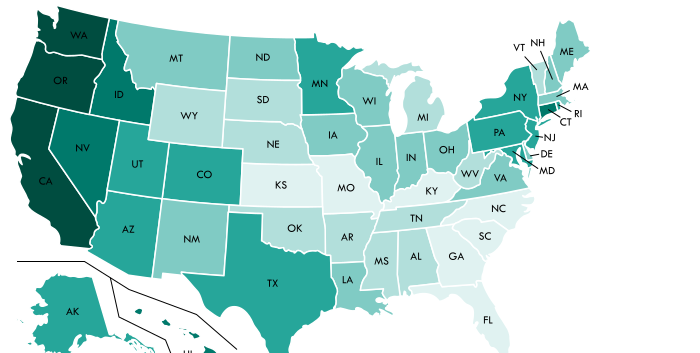
Most common states for program developers
| Rank | State | Population | # of jobs | Employment/ 1000ppl |
|---|---|---|---|---|
| 1 | Vermont | 623,657 | 298 | 48% |
| 2 | North Dakota | 755,393 | 251 | 33% |
| 3 | Wyoming | 579,315 | 185 | 32% |
| 4 | New Hampshire | 1,342,795 | 405 | 30% |
| 5 | Montana | 1,050,493 | 303 | 29% |
| 6 | District of Columbia | 693,972 | 200 | 29% |
| 7 | Colorado | 5,607,154 | 1,428 | 25% |
| 8 | Nebraska | 1,920,076 | 438 | 23% |
| 9 | South Dakota | 869,666 | 203 | 23% |
| 10 | Minnesota | 5,576,606 | 1,220 | 22% |
| 11 | Delaware | 961,939 | 200 | 21% |
| 12 | New Mexico | 2,088,070 | 413 | 20% |
| 13 | Maine | 1,335,907 | 272 | 20% |
| 14 | Pennsylvania | 12,805,537 | 2,492 | 19% |
| 15 | Georgia | 10,429,379 | 1,949 | 19% |
| 16 | North Carolina | 10,273,419 | 1,928 | 19% |
| 17 | Wisconsin | 5,795,483 | 1,054 | 18% |
| 18 | Iowa | 3,145,711 | 572 | 18% |
| 19 | Arkansas | 3,004,279 | 548 | 18% |
| 20 | Alaska | 739,795 | 127 | 17% |
Most common cities for program developers
| Rank | City | # of jobs | Employment/ 1000ppl | Avg. salary |
|---|---|---|---|---|
| 1 | Juneau | 2 | 6% | $78,415 |
| 2 | Annapolis | 2 | 5% | $77,373 |
| 3 | Dover | 2 | 5% | $73,251 |
| 4 | Moline | 2 | 5% | $71,309 |
| 5 | Maple Grove | 2 | 3% | $74,855 |
| 6 | Columbia | 2 | 2% | $77,336 |
| 7 | Greeley | 2 | 2% | $78,120 |
| 8 | Hartford | 2 | 2% | $89,731 |
| 9 | Atlanta | 3 | 1% | $57,414 |
| 10 | Tampa | 3 | 1% | $56,892 |
| 11 | Baton Rouge | 2 | 1% | $67,818 |
| 12 | Des Moines | 2 | 1% | $66,025 |
| 13 | Little Rock | 2 | 1% | $63,888 |
| 14 | Plano | 2 | 1% | $72,097 |
| 15 | Denver | 2 | 0% | $78,738 |
| 16 | Indianapolis | 2 | 0% | $67,283 |
| 17 | Minneapolis | 2 | 0% | $74,788 |
| 18 | Phoenix | 2 | 0% | $80,918 |
Program Developer job outlook: Expert opinions
Our panel of program developer experts
University of Massachusetts Boston
New York University

East Tennessee State University

Committee on the Status of Women in Astronomy - CSWA

The USA Hockey Foundation
Pacific Lutheran University

Hartwick College

ASCP - Associated Skin Care Professionals
Muhlenberg College
American University
Ellen Birchander
Graduate Program Director and Clinical Assistant ProfessorUniversity of Massachusetts Boston
Department of Gerontology
What skills stand out on Program Developer resumes?
Ellen Birchander: The field of aging is very different than other disciplines. It encompasses all aspects of life for an older adult; healthcare, transportation, entertainment, consumerism, marketing, technology, social work, housing, insurance, nutrition, etc. This affords many opportunities for individuals who are passionate about working with older adults and their families. There are many entry-level options and lots of room for growth.
There are several characteristics that are advantageous. The most important characteristic is a love/ passion for working with an aging population. In addition, it helps to be curious and a quick learner, and to be patient.
Skills in the field transcend many disciplines. It is very important to have excellent interpersonal and listening skills. This is essential not only for direct service work but to continue to learn about a dynamic field that is constantly changing as people and environments change. Next, organizational skills are essential for negotiating the many intricate responsibilities that encompass an individual's life. Management skills allow individuals to move within a changing field. An understanding of health and wellness, social aspects of aging, and psychology are also very useful skill sets to have. No one lives in a vacuum, so understanding family dynamics is very useful.
In today's world, every profession requires some degree of proficiency with technology. The field of aging is no different. Attention to detail, analytical skills, and professionalism are key elements to success in the field.
As individuals gain experience and hone skills, the opportunities to develop policy and programs, direct home and community-based services, direct residential long-term care services, work in other fields such as finance, housing, entertainment as experts in aging increases.
Working as a gerontologist allows you to impact other people's lives with the goal of promoting autonomy, independence, and continued quality of life. There is little that is so fulfilling as making a difference.
What are the biggest trends we'll see in the Program Developer job market given the pandemic?
Noel S. Anderson Ph.D.: The biggest trend in job market will be for those educators who have experience teaching and in curriculum and program development for online- or blended-learning formats, particularly in the STEM fields, not only in schools but within educational non-profits and NGOs. There is also an increasing need for leaders in these areas as well.
Will there be an enduring impact of the coronavirus pandemic on Program Developers?
Dr. Frederick Gordon Ph.D.: Graduate students will need to refocus on the changing institutional role, being both remote and in-person, and impacting agency goals and performance.
What type of skills will young Program Developers need?
Dr. Frederick Gordon Ph.D.: Budgeting skills are essential, as well as apparent, logical written ability.
What experience really stands out on Program Developer resumes?
Dr. Frederick Gordon Ph.D.: Program concentration and meaningful internship experience.
Nicolle Zellner (on behalf of members of the CSWA)
ChairCommittee on the Status of Women in Astronomy - CSWA
What type of skills will young Program Developers need?
Nicolle Zellner (on behalf of members of the CSWA): I believe (hope) that the effects of the pandemic will be short-lived and that there will be a surge in job opportunities once a vaccine is available. Nevertheless, greater flexibility and versatility in skills are always useful. For example, astronomers who have analyzed large data sets or worked with machine learning algorithms will be in significant demand.
Interdisciplinary studies are also on the rise. New fields like astrobiology are rapidly growing, and there are ripe potentials for researchers with unique combinations of expertise or who can work with broad collaborations spanning disciplines.
With the growth of data, especially from large astronomical surveys, technical skills like computer programming and experience with data science tools and machine learning is increasingly useful. The ability to communicate complex ideas to a range of audiences is a necessity in most fields, and astronomers generally have great relevant experience with community outreach.
How do you envision technology impacting Program Developers in the next 5 years?
Nicolle Zellner (on behalf of members of the CSWA): Advances in optics technology (laser frequency combs, for example) have already impacted high precision radial velocity measurements that the exoplanet community has been using to search for Earth-sized exoplanets. In the next five years, this technology will continue to be developed and used by other sub-fields in astronomy, including cosmology and Galactic dynamicists.
In planetary science, there are a number of advances that are rapidly changing how we do an exploration of our solar system. For example, NASA is strongly pushing for commercial partnerships that may facilitate delivering scientific payloads to the Moon, and small satellites (e.g., CubeSats) are opening up a lot of new options for both scientists, technologists, and engineers to get more involved in solar system missions.
Computational and algorithmic advances make it easier to aggregate and analyze large datasets, especially with the increasing prevalence of astronomical sky surveys. The increasing popularity of open-source tools and cloud usage for sharing data, I think, is and will be pushing reproducibility of research to be a more heavily emphasized expectation of the standard research process and evaluation metric of a researcher's work.
What are the biggest trends we'll see in the Program Developer job market given the pandemic?
Tamara Tranter: Remote, remote, remote. I also believe we will see more people trying to enter different fields than the fields they were in pre-pandemic. Our norms have shifted, and almost everyone has had to pivot in some way to show their value. People with experience in different areas will be able to add more value to a company that has had to downsize.
Jordan Levy Ph.D.
Associate Professor of AnthropologyPacific Lutheran University
Anthropology Department
What experience really stands out on Program Developer resumes?
Jordan Levy Ph.D.: Any research project where students develop independent research skills. This can be part of the coursework, or part of an internship, or through a summer research assistantship. Anthropology is known for its holistic and comparative perspective and our ability to communicate effectively with people from diverse cultural backgrounds. Our qualitative research methods, in particular, have a range of applications. If students can develop interview skills and their capacity to make sense of human behavior, while also pursuing their undergraduate degrees, this knowledge and skill set will be attractive to a range of employers. As the U.S. becomes more diverse, our society will demand a workforce to better understand and interact with people from a range of cultural backgrounds.
What technology do you think will become more important and prevalent for Program Developers in the next 3-5 years?
Jordan Levy Ph.D.: Most of the students I work with are, fortunately, very quick to learn new communication technologies. This is so important because, as the COVID pandemic has shown us, the ability to work remotely is crucial. Communicating in a range of formats (writing emails, recording videos, participating in group discussions via Zoom, etc.) while also making your arguments and content clear to a range of audiences is essential, now more than ever.
What Program Developer skills would you recommend for someone trying to advance their career?
Jordan Levy Ph.D.: Some students enter college having taken a "gap year" between high school and university. Any kind of volunteer or work experience that further develops their interpersonal communication skills is beneficial for the range of discussion and small group work that university-level classes require. Some students do service projects in other countries, which is great because they also gain international experiences that contribute to their overall formation as informed global citizens. These experiences can then tell what kinds of classes they take in university and can remain a source of inspiration for what careers they pursue.
Namita Sugandhi Ph.D.
Assistant Professor of AnthropologyHartwick College
Anthropology Department
What technology do you think will become more important and prevalent for Program Developers in the next 3-5 years?
Namita Sugandhi Ph.D.: Documentation and public engagement will remain crucial parts of Anthropological work, and technology that allows us to record, analyze, and share data will continue to be necessary. Over the next several years, it will be essential to find new and innovative ways of connecting virtually to audiences' broader network. This will require the ability to think out-of-the-box and adapt to unique circumstances and new technologies. Technologies that allow people to build relationships across space will continue to transform how we experience social life. Those who are new to the job market will have to master these new virtual strategies of communication and self-promotion and need to understand and navigate the impact of this pandemic on the non-virtual world.
Emily Morgan
Associated Skin Care Professionals (ASCP)ASCP - Associated Skin Care Professionals
What type of skills will young Program Developers need?
Emily Morgan: Standards are elevating in the skincare industry, and this is a good thing! However, esthetic graduates may find that the basics needed to pass their state board exams may not cut it for gainful employment. Estheticians looking for a new job should be prepared to show that they have a strong knowledge of sanitation and safety protocols, treatment techniques, and ingredients. Certifications in more advanced esthetic services will improve the chances of gainful employment. This demonstrates to potential employers that the esthetician is eager to learn, grow, and offer a new means of income. Belonging to an association such as Associated Skin Care Professionals (ASCP) also shows an impressive level of professionalism and maturity, and shows that the esthetician is serious about protecting and flourishing in their new career, which will be very attractive to employers.
Dr. Steven Coutinho
ProfessorMuhlenberg College
Department of Philosophy
Will there be an increase or decrease in demand for Program Developers in the next 5 years?
Dr. Steven Coutinho: This depends on how the field responds to current changes. If Philosophy Departments focus on training graduates for successful careers outside of academia, especially training in applied ethics, politics, and other areas of contemporary concern, I would predict an increase in demand for graduates, given the reasons stated in 1. above.
What technology do you think will become more important and prevalent for Program Developers in the next 3-5 years?
Dr. Steven Coutinho: Since Philosophy majors get jobs in any and every sector, the technologies they will need will depend on their specific employment area.
However, anyone considering a career as a Philosophy professor will have to develop online and distance teaching expertise. This has changed the teaching experience dramatically, as the technologies and skills are vastly different from those required for in-person instruction.
How do you envision technology impacting Program Developers in the next 5 years?
Dr. Adelaide Kelly-Massoud: Well, every teacher and teacher candidate was thrust into distance learning. Misguided attempts to foster understanding often leaned our adult distant learning pedagogy. Teachers, and those who prepare teachers, found their job to research, define, design, and implement meaningful teaching and learning using a virtual platform. Words such as synchronous and asynchronous are now a part of our everyday vernacular. But there is a much more optimistic change on the horizon that we can thank coronavirus for.
Communication and collaboration have been forced to change. Parents and Teachers are more connected and have been put in a position to leverage technology to build networks of support and consistent dialog. I urge teachers to leverage this in their future as we work to reopening schools; we should learn from this experience to leverage technology to keep us connected.