Explore jobs
Find specific jobs
Explore careers
Explore professions
Best companies
Explore companies
Job outlook for program management analysts in the United States
Program management analyst job growth summary. After extensive research, interviews, and analysis, Zippia's data science team found that:
The projected program management analyst job growth rate is 11% from 2018-2028.
About 108,400 new jobs for program management analysts are projected over the next decade.
Program management analyst salaries have increased 8% for program management analysts in the last 5 years.
There are over 25,137 program management analysts currently employed in the United States.
There are 179,486 active program management analyst job openings in the US.
The average program management analyst salary is $79,266.
Are program management analyst jobs in demand?
Program management analyst job and salary trends over time
Program management analyst jobs over time
Program management analyst job growth rate over time
| Year | # of jobs | % of population |
|---|---|---|
| 2021 | 25,137 | 0.01% |
| 2020 | 24,010 | 0.01% |
| 2019 | 23,216 | 0.01% |
| 2018 | 22,390 | 0.01% |
| 2017 | 21,563 | 0.01% |
Average program management analyst salary over time
Program management analyst salary by year
| Year | Avg. salary | Hourly rate | % Change |
|---|---|---|---|
| 2026 | $79,266 | $38.11 | +2.8% |
| 2025 | $77,095 | $37.07 | +2.0% |
| 2024 | $75,603 | $36.35 | +1.4% |
| 2023 | $74,555 | $35.84 | +1.4% |
| 2022 | $73,542 | $35.36 | +0.0% |
Program management analyst jobs by state
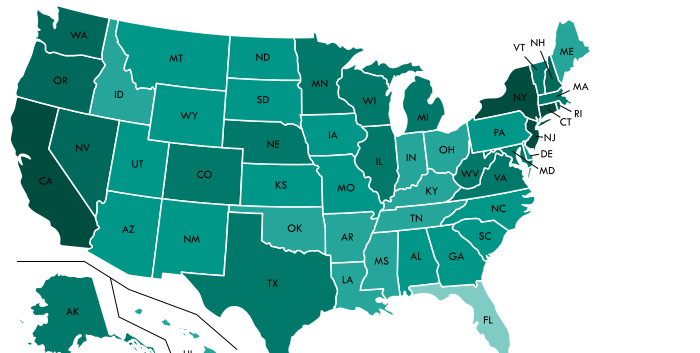
Most common states for program management analysts
| Rank | State | Population | # of jobs | Employment/ 1000ppl |
|---|---|---|---|---|
| 1 | District of Columbia | 693,972 | 935 | 135% |
| 2 | Delaware | 961,939 | 451 | 47% |
| 3 | North Dakota | 755,393 | 305 | 40% |
| 4 | Virginia | 8,470,020 | 3,170 | 37% |
| 5 | Oregon | 4,142,776 | 1,361 | 33% |
| 6 | Idaho | 1,716,943 | 573 | 33% |
| 7 | New Hampshire | 1,342,795 | 437 | 33% |
| 8 | Colorado | 5,607,154 | 1,695 | 30% |
| 9 | Minnesota | 5,576,606 | 1,636 | 29% |
| 10 | South Dakota | 869,666 | 248 | 29% |
| 11 | Massachusetts | 6,859,819 | 1,882 | 27% |
| 12 | Nebraska | 1,920,076 | 524 | 27% |
| 13 | Illinois | 12,802,023 | 3,360 | 26% |
| 14 | Connecticut | 3,588,184 | 948 | 26% |
| 15 | Rhode Island | 1,059,639 | 279 | 26% |
| 16 | Maryland | 6,052,177 | 1,530 | 25% |
| 17 | New York | 19,849,399 | 4,700 | 24% |
| 18 | New Jersey | 9,005,644 | 2,165 | 24% |
| 19 | Arizona | 7,016,270 | 1,699 | 24% |
| 20 | New Mexico | 2,088,070 | 493 | 24% |
Most common cities for program management analysts
| Rank | City | # of jobs | Employment/ 1000ppl | Avg. salary |
|---|---|---|---|---|
| 1 | Washington | 58 | 9% | $103,612 |
| 2 | Burlington | 2 | 8% | $83,876 |
| 3 | Annapolis | 2 | 5% | $84,744 |
| 4 | Dover | 2 | 5% | $74,508 |
| 5 | Bethesda | 2 | 3% | $84,566 |
| 6 | Atlanta | 4 | 1% | $73,826 |
| 7 | Tampa | 4 | 1% | $57,344 |
| 8 | Baton Rouge | 3 | 1% | $57,591 |
| 9 | Birmingham | 3 | 1% | $75,433 |
| 10 | Des Moines | 3 | 1% | $72,496 |
| 11 | Sacramento | 3 | 1% | $104,268 |
| 12 | Phoenix | 4 | 0% | $76,083 |
| 13 | Jacksonville | 3 | 0% | $59,142 |
| 14 | San Diego | 3 | 0% | $84,319 |
| 15 | Boston | 2 | 0% | $84,040 |
| 16 | Denver | 2 | 0% | $81,056 |
Program Management Analyst job outlook: Expert opinions
Our panel of program management analyst experts
Pennsylvania State University
Boise State University
University of Minnesota - Duluth
Washington State University

Florida State University

Bradley University

Kent State University
Drexel University
Molloy College

University of Georgia, Terry College of Business
Elon University

Angelo State University

Auburn University

Manhattan College

Bradley University

Menlo College

DePaul University
University of Oregon
What general advice would you give to a Program Management Analyst?
Dr. David Powell Ph.D.: Job security is one of the primary advantages of being a public administrator. Public administrators also enjoy a great variety in job functions and duties. While average salaries may be a bit lower when compared to the private sector, benefits are usually superior to what private firms offer.
What Program Management Analyst skills would you recommend for someone trying to advance their career?
Dr. David Powell Ph.D.: Public administration is always a good field to enter as government touches the lives of everyone on a daily basis. Public administration careers are also very stable as most public administrators are civil servants. As such, they are hired, and keep their positions, based upon their qualifications and performance.
What will help Program Management Analysts increase their earning potential?
Dr. David Powell Ph.D.: MPA (Master's of Public Administration) graduates typically work in local, state, and national government. Some of the positions they typically hold are management analyst, program analyst, policy analyst, budget analyst, finance manager, and human resources manager/specialist among others. We also have graduates who work in local nonprofit organizations in a variety of policy areas such as housing, senior services, etc.
Dr. Jennifer Eury Ph.D.
Undergraduate Management Major Program Coordinator and Clinical Associate Professor of Management and OrganizationPennsylvania State University
Management Sciences And Quantitative Methods
What general advice would you give to a Program Management Analyst?
Dr. Jennifer Eury Ph.D.: For graduates, especially recent graduates, seeking to maximize their salary potential, especially when they are starting a full-time position, I encourage them to continue to keep learning. Stay current with industry trends. Take advantage of training opportunities available to you in your workplace. Talk with others, especially those who have worked in the field for some time, about ways to strengthen your skill set. I also encourage recent graduates to be willing to take on a new assignment, to be a part of a new committee – all in the spirit of continuing to learn more about their field. Over time, you can garner information power, or even expert power, and develop a reputation for being a valuable resource in your organization and field.
What Program Management Analyst skills would you recommend for someone trying to advance their career?
Dr. Jennifer Eury Ph.D.: I would encourage a graduating management major to begin their career with an open mind. Work hard and be willing to take on challenging tasks, especially if it means having an opportunity to learn more about the organization and the industry. I would also encourage graduates to start to build their personal board of directors, and some call it. Take the time to get to know the people in your workplace, find mentors, and surround yourself with people who will support you, as you grow in the field.
What will help Program Management Analysts increase their earning potential?
Dr. Jennifer Eury Ph.D.: In the next 3-5 years, I suspect a variety of skills will be important. I would argue, though, that the skills that will be most important are not necessarily “new” skills – they are leadership skills, interpersonal skills, and ethical decision-making skills – arguably skills we need more now than ever before. Considering the current state of affairs – here, in the U.S. and around the world – we need people with strong leadership capabilities, people who can work well with others, and people who will engage in and promote ethical behavior. I should also add, that within the Smeal College of Business at Penn State, and specifically through our management coursework, we are helping students to develop knowledge, skills, and abilities in ethical, inclusive, strategic, and sustainable thinking; culture; interpersonal/relational; leadership/influence; managerial functions; teamwork/collaboration; and understanding the business environment.
What general advice would you give to a Program Management Analyst?
Owen McDougal: The key to success is the desire to listen, learn, and think critically. A solid work ethic is important. Employees need to not just do what needs to be done, but embrace tasks and activities that provide value during lull times. In many employment operations, there is a need to find constructive activities during slack times, and step up to put in extra effort during busy times. A willingness to do what needs to be done for the organization is notable. Teamwork is critical. Working well with others and covering for colleagues when they need support sets people apart. Skills can be taught, but work ethic and collegiality are often conscious decisions.
What Program Management Analyst skills would you recommend for someone trying to advance their career?
Brett Zollinger Ph.D.: There will be so much data coming to us from various online sources (including much that is AI-generated) that knowing how to scrutinize it, mine it for quality gems, and then apply it will be highly valuable to organizations. Sociology graduates on the job will need solid footing in research methods, data literacy, and AI prompt engineering -- skills being taught in sociology curricula. The ability to make compelling cases for new or enhanced programmatic funding will be increasingly important, a reason that we require grant proposal writing in our core sociology curriculum. Also, sociology majors tend to be good at "reading the room" for the many social cues occurring in meetings, collaborative work, etc., and they also tend to be skilled in anticipating ways that organizational change affects other social actors - both internal and external to the organization. It's difficult to imagine that these abilities won't always be highly appreciated by employers for the foreseeable future.
Ahmed Maamoun Ph.D.
Assistant Professor of Marketing & 8X Recipient of the University of Minnesota’s Certificate for “Outstanding Teaching and Dedication to Helping Students Learn”University of Minnesota - Duluth
Marketing
What will help Program Management Analysts increase their earning potential?
Ahmed Maamoun Ph.D.: The news from the job market is quite startling. A recent study from McKinsey & Company
estimates that nearly half of all U.S. jobs will be automated by 2030. Artificial Intelligence,
machine learning, and robots will make routine and conventional jobs obsolete. Most of what
students are learning will be irrelevant and dated by the time they graduate. This highlights the
need for emphasizing not just the academic abilities of graduates, but their soft and professional
skills as well. Graduates (regardless of their undergraduate major) who demonstrate a capacity to
think critically, communicate clearly, learn adaptively, make ethical decisions, work well with
others, and solve complex problems will stand a better chance of surviving in that ever-changing
job market. For example, in one survey, 93% of employers reported that "a candidate's
demonstrated capacity to think critically, communicate clearly, and solve complex problems is
more important than his or her undergraduate major."
Sarah Whitley Ph.D.
Associate Professor, Career TrackWashington State University
Work And Family Studies
What Program Management Analyst skills would you recommend for someone trying to advance their career?
Sarah Whitley Ph.D.: communication-frame communication with respect to varied communication abilities and cultural differences; critical thinking-accurately summarize and interpret data and effectively communicate actions and rationale, recognizing diverse perspectives; critical thinking-multi-task well in a fast-paced environment; leadership-seek out and leverage diverse resources and feedback from others to inform direction and use innovative thinking to go beyond traditional methods; teamwork-collaborate with others to achieve common goals and effectively manage conflict, interact with and respect diverse personalities, and meet ambiguity with resilience; technology-navigate change and be open to learning new technologies
C. Darren Brooks Ph.D.
Assistant Department Chair and Executive Director, Center for Human Resource ManagementFlorida State University
Department of Management and the Center for Human Resource Management
What soft skills should all Program Management Analysts possess?
C. Darren Brooks Ph.D.: While advancements in technology, artificial intelligence (AI), and data analytics occupy center stage in many areas of management practice, soft skills continue to be seen as equally or even more important skills for success in the field of management. Soft skills are typically described as personal attributes, qualities, and characteristics that enable us to interact more effectively with others. In most fields of management, our ability to communicate, work with, and interact with other people constitutes a significant portion of the work we do. Consequently, employers are focused on identifying candidates who possess strong skills are areas of communication (verbal, written, and non-verbal), leadership and followership, collaboration, an ability to work in teams, intellectual curiosity, adaptability, conflict management, problem-solving, creativity.
Candace Esken Ph.D.
Assistant Professor of Management & LeadershipBradley University
Foster College of Business
What skills stand out on Program Management Analyst resumes?
Candace Esken Ph.D.: Management analysts, or consultants, should have strong skills associated with data analytics and problem-solving. Any evidence of these skills on an applicant's resume is a key indicator of being a strong candidate. For example, proficiency with various statistical data analysis software programs or data management systems helps a candidate's resume stand out. It also helps if an applicant has several years of work experience in a related field.
What soft skills should all Program Management Analysts possess?
Candace Esken Ph.D.: Excellent communication skills are absolutely essential for management analysts. Usually, these skills are best demonstrated during the interview process with little room for error. In addition, applicants should have strong interpersonal skills because much of their job requires them to work with managers and employees of various organizations. Furthermore, soft skills such as leadership, confidence, and time management are highly valued.
What hard/technical skills are most important for Program Management Analysts?
Candace Esken Ph.D.: The most important hard skills for management analysts are problem-solving, data analysis, and presentation skills. The central focus of their work revolves around solving problems for clients by analyzing large chunks of data and drawing meaningful conclusions. Analysts also spend a great deal of time creating sophisticated presentations to enhance communication with clients. Management Analysts should be especially skilled with excel and PowerPoint.
What skills will help Program Management Analysts earn the most?
Candace Esken Ph.D.: Analysts who have both sets of critical hard and soft skills, a tough combination to deliver, will have the most earning potential. Typically, once an analyst has proven themselves on several projects and built a credible reputation, they will have opportunities for increased earnings. Furthermore, analysts with an MBA degree typically earn a higher salary and receive larger signing bonuses.
Will there be an enduring impact of the coronavirus pandemic on Program Management Analysts?
Michael Ellis Ph.D.: Most economics undergraduates obtain jobs as analysts, especially in the financial and non-financial business industries, because of their skills in analyzing data. The pre-coronavirus pandemic trend of increasing job opportunities for those who can analyze data will not be reversed by the pandemic and in fact may increase the growth of such job opportunities.
What type of skills will young Program Management Analysts need?
Lauren D’Innocenzo Ph.D.: We are seeing more and more the need for core skills (formerly known as soft skills). These skills include being able to work in a team, leadership, critical problem-solving, and negotiations, to name a few. Many employers see these skills as transferable across contexts and increase the likelihood that the individual will be able to work with others and think outside of the box in collaborative, knowledge-intensive environments. We know that much of the learning for jobs occurs on the job and having these core skills can really help you to stand out as a team-oriented individual, who is willing to think beyond their own needs, and can learn organizational-specific skills needed to succeed in the employer's company.
Will there be an enduring impact of the coronavirus pandemic on Program Management Analysts?
Lauren D’Innocenzo Ph.D.: The coronavirus pandemic has certainly tightened the job market, with fewer available jobs in many sectors such as the service industry, but at the same time, has created many other opportunities for graduates in fields such as healthcare and supply chain. For new graduates, strategically considering opportunities may help to overcome some of the challenges presented in the current economy.
For example, if you are looking to gain experience in service, applying to service-oriented positions in IT or healthcare may offer more opportunities and give you more breadth of experience. I believe the potential for an enduring impact exists in a graduate's ability to adapt to changing demands and willingness to cast a wider net for available positions. Graduates who are myopically focused and unwilling to test their knowledge in different areas may not see the same opportunities, and over time, the lack of opportunities can add up. Now is a great time to work on your resilience and flexibility.
What experience really stands out on Program Management Analyst resumes?
Lauren D’Innocenzo Ph.D.: Similar to above, having experience around these core skills can really help anyone, including new graduates, stand out from the crowd. This experience can come from taking courses designed to build these skills or engaging in positions or internships that provide opportunities to grow these skills. For example, at Drexel University, we offer a program (Organizational Management) designed specifically to grow these skills through experiential learning that any student can take, regardless of undergraduate major. Outside of the classroom, being a peer leader, working as a camp counselor, or taking on an internship working in a team can be very helpful in building these skills. The key is to highlight these opportunities and skills in your resume. Don't just talk about the tasks you did, but describe the core skills needed for the position and built as a result of the position.
Additionally, remote and virtual work is not going away anytime soon. In fact, many organizations have offloaded brick and mortar locations and have strategically decided to rely more on remote business. Now more than ever, demonstrating your ability to successfully work in a remote environment will be extremely favorable for many employers.
What general advice would you give to a Program Management Analyst?
Brian Noll: To "put your head down" and do your work! Never complain about having to work additional hours as this is the norm in the accounting profession. Having a good work ethic is essential to success in your career. Lastly, stay off your phone! Your phone should be used for personal matters on your own time and not during work hours.
Ron Aubé Ph.D.
Adjunct Professor of ManagementUniversity of Georgia, Terry College of Business
Department of Management
What are the biggest trends we'll see in the Program Management Analyst job market given the pandemic?
Ron Aubé Ph.D.: Covid-19 raised awareness about the importance of trust and flexibility in the workplace. Organizations have been forced to explore options beyond traditional office solutions and learned to adapt for different tasks and projects while maintaining employee morale and productivity. Remote work and entrusting employees is not only possible, but necessary, as well as profitable. Companies found that employees can remain effective and productive, while enjoying increased job satisfaction and progressive organizations look for opportunities to arrange talent-sharing partnerships with other organizations.
Remote work has in some ways dehumanized employees and much remains to be done to prioritize the well-being of employees, treating them as people first and workers second. Personal factors promoting physical health and emotional well-being are trendy. Gartner (2020) finds that 32 percent of organizations are replacing full-time employees with contingent workers as a cost-saving measure. The workforce will be increasingly distributed requiring new forms of management and leadership at the top and ways to enhance job satisfaction. Furthermore, the cross-generational workforce curve is being reshaped as many workers aged over 65 are retiring due to infection concerns. While young workers are currently more likely to be in jobs impacted by the crisis, this exodus of older workers opens the door for them to step in.
Unlike typical recessions where the consumption of goods collapses while services remain largely stable, this pandemic has created the opposite. The service industries (entertainment, travel, lodging, full-service restaurants, elective healthcare, and childcare) have been the most adversely affected driven by the impact of social distancing (Source: U.S. Bureau of Labor Statistics). Employment opportunities in production, transportation, storage, and selling of goods (excluding retail) are therefore expected to rise. Fueled by the new realities of social distancing and the increased need for digital collaborations in the workforce, fields related to artificial intelligence are growing at an accelerated pace.
Migration away from large urban centers is becoming noticeable as fewer people come to work and spend money in the city. As a result, the most significant drop in hiring has occurred in large metropolitan areas, while outside the cities, hiring is on the rise.
What skills stand out on Program Management Analyst resumes?
Brooke Buffington: Skills that standout are often position specific, but there are always skills that a wide-variety of employers seek. These skills align with the competencies developed by the National Association of Colleges and Employers (NACE), which include skills in critical thinking/problem solving, oral/written communication, teamwork/collaboration, digital technology, leadership, professionalism/work-ethic, career management, and global/intercultural fluency.
What type of skills will young Program Management Analysts need?
Dr. Andy Tiger Ph.D.: Students will have experience in learning with different modalities; therefore, they should emphasize their communication skills and comfort with technology. Data analytics technology allows converting large data sets into useful information quickly. Students need to be comfortable with this type of analytics tools such as Tableau and Power BI.
Are there any particularly good places in the United States for Program Management Analysts to find work opportunities?
David Martin Ph.D.: Location wise is tough right now, since states have taken very different approaches to their COVID-19 responses, especially regarding which businesses can be open and operate, capacity, etc. This is also a very fluid situation that changes day by day. That being said, resorts, hotels, and restaurants located in what have traditionally been high volume tourist destinations will come back first, in my opinion. Beach resorts, in particular, are well placed to have a healthy summer, assuming that all goes well with the vaccines. Cities and locations that are more business and conference driven will take longer to return to their pre-COVID-19 numbers.
What general advice would you give to a Program Management Analyst?
Angela Grotto Ph.D.:
How would you rate the starting salaries for Program Management Analysts, as well as the prospects for salary advancement?
Angela Grotto Ph.D.:
Are there any particularly good places in the United States for Program Management Analysts to find work opportunities?
Jennifer Robin Ph.D.: Virtually any place there are organizations, there are HR opportunities! The rule of thumb is one HR staff member for every 75 employees or so, but many companies hire their first staff member dedicated to HR when they are much smaller.
Are there any particularly good places in the United States for Program Management Analysts to find work opportunities?
Dr. Shalini Gopalkrishnan: In International business, the top places in the USA are areas where the Multinationals are, so check out the global 500 and see where they are located, and that is where the jobs are. The usual suspects, New York, California, Chicago...
What type of skills will young Program Management Analysts need?
Dr. Shalini Gopalkrishnan: The top skills will be " learning to learn," "Analytical skills," even for nonanalytical jobs, understanding technology trends, communication, storytelling and learning how to manage time, and quickly assessing and summarizing information.
How do you envision technology impacting Program Management Analysts in the next 5 years?
Dr. Shalini Gopalkrishnan: Technology has already made inroads by reducing travel (not due to covid alone, but before that, too) and using video conferencing tools, AI (Artificial Intelligence ) will enable smoother conversations across cultures, VR (Virtual Reality) will allow people to immerse empathetically in other cultures to understand the business methods, Blockchain will allow intrafirm authentication.
What experience really stands out on Program Management Analyst resumes?
Helen LaVan Ph.D.: This answer varies, depending on whether the graduate is an undergraduate or graduate. For undergraduates, ideally, there should be an internship and involvement in University activities.
Undergraduate students who must work while in college should strive for positions where they learn skills related to their chosen primary and work-readiness skills. Undergraduate students who work at the same employer during all four years of undergraduate school should strive for promotion within that one organization. For graduate students there should be involvement in community and professional associations.
The community activities should be related to the chosen career area. Gaps in employment are no longer as much of a problem as previously. There are published ways of dealing with gaps in resumes.
How do you envision technology impacting Program Management Analysts in the next 5 years?
Helen LaVan Ph.D.: Some organizations will see how productive individuals can be working remotely and permanently convert some jobs that would ordinarily be at the workplace to remote jobs. Online skill-enhancing opportunities, such as entirely online degrees or certificate programs, will enable some individuals to develop or change their career areas.
Will there be an enduring impact of the coronavirus pandemic on Program Management Analysts?
Helen LaVan Ph.D.: Some individuals may seek job-related opportunities, including promotions, because they hold incorrect beliefs about the job market's nature. For example, I recently reviewed options for our Master of Science in Human Resources (MSHR) graduates within the Chicago Metropolitan area. The number of posted opportunities surprised me.
This does not include, perhaps, even half of the options not posted on job posting boards, such as exclusively on employers' career pages or with external recruiters only. Individuals may have depression and will begin to self-medicate and will persist in these behaviors. Since more individuals will be working remotely, employers and coworkers who might have noticed these behaviors in the past will not see and refer them to resources.
What are the biggest trends we'll see in the Program Management Analyst job market given the pandemic?
Benjamin Clark Ph.D.: State and local budgets have been and will continue to be struck because of Covid-19. Congress has been throwing around the idea of state and local government support in a new stimulus package, but nothing was going to happen before the election. This may be the key to contracted or expanded hiring by states and local governments.
Trend-wise, remote work may be one of the things that come out of the pandemic. Many of our students have been able to do internships remotely very successfully. Many employers are finding that remote work offers the flexibility that many employees have been yearning for. Thus, I would expect that more jobs will be location-neutral when hiring springs back to life. This will give employers more options for candidates-particularly in places that are very expensive or in places where people have historically been hesitant to move.
What technology do you think will become more important and prevalent for Program Management Analysts in the next 3-5 years?
Benjamin Clark Ph.D.: There are two things on this front that I think will become more important and prevalent. The first one is the virtual meeting platforms like Zoom, Google Meet, GoToMeeting, etc. As people become more familiar with them, they've become less hesitant to use them. Will this eliminate all travel and face-to-face meetings in the long-run, nope. But they will make some of these interactions more comfortable and less costly. The second thing isn't so much a technology as it is an output of technology-data. Understanding, using, manipulating, and analyzing data will be one of the critical things is moving forward that comes from a wide range of technologies. I'm not even talking about AI, deep learning, or data science here-though those will likely become more important to administrators, too.
Will there be an increase or decrease in demand for Program Management Analysts in the next 5 years?
Benjamin Clark Ph.D.: At some point, the Baby Boomers will retire. We've been talking about that for twenty years now, and many of them have hung onto their careers longer than prior generations, due to recessions and just living longer, healthier lives. However, highly skilled workers will be needed to replace these folks moving forward. The changes in technology may replace some jobs. Again, the management of that tech and the data they produce are vital areas younger generations can step in and immediately provide value.