Explore jobs
Find specific jobs
Explore careers
Explore professions
Best companies
Explore companies
Job outlook for programmer/analyst leads in the United States
Programmer/analyst lead job growth summary. After extensive research, interviews, and analysis, Zippia's data science team found that:
The projected programmer/analyst lead job growth rate is 9% from 2018-2028.
About 56,000 new jobs for programmer/analyst leads are projected over the next decade.
Programmer/analyst lead salaries have increased 8% for programmer/analyst leads in the last 5 years.
There are over 108,206 programmer/analyst leads currently employed in the United States.
There are 75,216 active programmer/analyst lead job openings in the US.
The average programmer/analyst lead salary is $105,013.
Are programmer/analyst lead jobs in demand?
Programmer/analyst lead job and salary trends over time
Programmer/analyst lead jobs over time
Programmer/analyst lead job growth rate over time
| Year | # of jobs | % of population |
|---|---|---|
| 2021 | 108,206 | 0.03% |
| 2020 | 121,005 | 0.04% |
| 2019 | 97,770 | 0.03% |
| 2018 | 155,423 | 0.05% |
| 2017 | 155,792 | 0.05% |
Average programmer/analyst lead salary over time
Programmer/analyst lead salary by year
| Year | Avg. salary | Hourly rate | % Change |
|---|---|---|---|
| 2026 | $105,013 | $50.49 | +3.4% |
| 2025 | $101,553 | $48.82 | +2.3% |
| 2024 | $99,254 | $47.72 | +0.5% |
| 2023 | $98,728 | $47.47 | +1.2% |
| 2022 | $97,554 | $46.90 | +1.7% |
Programmer/analyst lead jobs by state
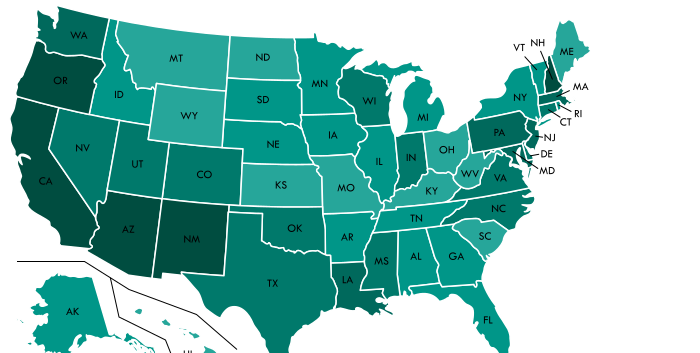
Most common states for programmer/analyst leads
| Rank | State | Population | # of jobs | Employment/ 1000ppl |
|---|---|---|---|---|
| 1 | District of Columbia | 693,972 | 416 | 60% |
| 2 | Alaska | 739,795 | 192 | 26% |
| 3 | Montana | 1,050,493 | 235 | 22% |
| 4 | Idaho | 1,716,943 | 336 | 20% |
| 5 | Kansas | 2,913,123 | 562 | 19% |
| 6 | Michigan | 9,962,311 | 1,658 | 17% |
| 7 | Massachusetts | 6,859,819 | 1,169 | 17% |
| 8 | New Mexico | 2,088,070 | 353 | 17% |
| 9 | Nevada | 2,998,039 | 492 | 16% |
| 10 | Arkansas | 3,004,279 | 476 | 16% |
| 11 | Delaware | 961,939 | 148 | 15% |
| 12 | Minnesota | 5,576,606 | 676 | 12% |
| 13 | New Hampshire | 1,342,795 | 156 | 12% |
| 14 | Illinois | 12,802,023 | 1,471 | 11% |
| 15 | North Carolina | 10,273,419 | 1,179 | 11% |
| 16 | Georgia | 10,429,379 | 1,160 | 11% |
| 17 | Colorado | 5,607,154 | 600 | 11% |
| 18 | Connecticut | 3,588,184 | 368 | 10% |
| 19 | North Dakota | 755,393 | 77 | 10% |
| 20 | Arizona | 7,016,270 | 659 | 9% |
Most common cities for programmer/analyst leads
| Rank | City | # of jobs | Employment/ 1000ppl | Avg. salary |
|---|---|---|---|---|
| 1 | Farmington | 1 | 4% | $97,923 |
| 2 | Duluth | 1 | 3% | $88,582 |
| 3 | Fairfield | 1 | 1% | $123,113 |
| 4 | Detroit | 2 | 0% | $91,270 |
Programmer/Analyst Lead job outlook: Expert opinions
Our panel of programmer/analyst lead experts
Kent State University
SUNY College at Geneseo
Siena College
University of Maine
University of Central Arkansas
Indiana University - Purdue University Indianapolis
Cumberland University
California State University - Bakersfield
University of Missouri - Columbia
Mercer University
The University of the South
Indiana University Bloomington
Ashford University

University of Guam
What Programmer/Analyst Lead skills would you recommend for someone trying to advance their career?
Dr. Swagata Banerjee PhD: Digital literacy: As technology continues to evolve, proficiency in digital tools and platforms will become increasingly essential. Adaptability: The ability to quickly learn new skills and adapt to changing circumstances will be crucial in a rapidly evolving industry landscape. Data literacy: Understanding and analyzing data will become more important for making informed decisions and optimizing strategies. Interdisciplinary skills: The ability to work across different disciplines and collaborate effectively with diverse teams will be highly valued. Emotional intelligence: Soft skills such as empathy, communication, and teamwork will continue to be in demand as workplaces become more interconnected and dynamic.
Prof. Mohammad Elahee Ph.D.
Perlroth Professor of Int’l. BusinessWhat Programmer/Analyst Lead skills would you recommend for someone trying to advance their career?
Prof. Mohammad Elahee Ph.D.: A combination of both hard and soft skills will be needed to survive in this ‘dog eat dog world’. Hard skills that will be in high demand are familiarity with new AI- and machine-driven technologies and quantitative reasoning. Soft skills that employers will be looking for include emotional intelligence, communication and interpersonal skills and a “can do attitude”. Paradoxical though it may sound, AI would actually create more demand for people with emotional and social intelligence.
What will help Programmer/Analyst Leads increase their earning potential?
Bradley Andrew Ph.D.: Once you have your first job, ask about or determine the 20% of your supervisor’s job that they hate and start doing that for them. They will love you for it and it will quickly get you recognition. You’ll also be well on your way to learning your boss’s job. Continue doing this as you progress in your career (Kudos to Theo Epstein, former GM for the Red Sox, for this recommendation)
No matter the task you’re given, do it to the absolute best of your abilities. In the professional world, you may often be given menial tasks or tasks that you don’t believe are part of your job description. Doing those tasks to the absolute best of your ability leads to increased trust, recognition and responsibility and will put you “above class.” If asked, the coffee you bring should be the best your boss has ever had. You never know who’s watching.
Don’t expect credit and don’t ask for credit when things go right; give the credit to others.
What Programmer/Analyst Lead skills would you recommend for someone trying to advance their career?
Dr. Vaneet Kaur: There are two sets of skills I will highly encourage graduates to proactively start building. Firstly, business graduates need to develop higher-order skills and capabilities like knowledge-based dynamic capabilities. These will help them to (a) constantly collect knowledge about emerging opportunities (and threats) in the industry, (b) mobilize themselves and their resources to bring identified opportunities into fruition, and (c) constantly renew their skills to effectively respond to the changes in the environment. Developing such knowledge-based dynamic capabilities will automatically prepare them for the different waves of skill set requirements that will keep arising in the job market. Secondly, it is no secret that we are living in the times of artificial intelligence and automation. So, in this day and age, it is extremely important that graduates learn to ride the wave of automation rather than being discouraged by it. Business graduates are set to contribute to the world with their business acumen and expertise, what they can do to complement it is to develop low-code, no-code skills. Such skills will help graduates to automate routine processes so that their time and energies can be strategically channelized towards those activities and processes that can add significant value to their organizations.
Jasmine Tang
SUNY College at Geneseo
Bilingual, Multilingual, And Multicultural Education
What Programmer/Analyst Lead skills would you recommend for someone trying to advance their career?
Jasmine Tang: Be confident of their major/minor or the subject they like and do best of the field they like for themselves not for money or please their parents or fulfill the dream of others.
What will help Programmer/Analyst Leads increase their earning potential?
Sunita Goel PhD: Great. Will send you the responses soon. Please let me know the latest deadline by which you need them.
What general advice would you give to a Programmer/Analyst Lead?
Dr. Ryan LaRochelle Ph.D.: Be flexible. Today's job market is not the same as the one that your parents or grandparents entered into. It's unlikely that you'll be with the same company for your entire working career, so look at every experience as a potential opportunity to learn and explore. Also, the work environment you're joining is more important than the job title and position description. Do some research about what it's like to work at the place that is looking to hire you, and don't be afraid to reach out to current employees to get some candid feedback. Your job title and job description is much easier to change or renegotiate over time, but it's really hard to completely transform a toxic organizational culture and environment.
What general advice would you give to a Programmer/Analyst Lead?
Dr. Ron Duggins: A finished degree or certificate does not mean it is time to stop learning, in fact, the learning is only beginning in terms of career development. While experience and hard skills are important, most hiring of young workers is done based upon their character, which includes attitude and mindset, and their potential to learn what they need once they get into the new role. As one enters their early career, entering into an organization with the attitude and mindset of a learner is key. I heard a colleague say 'plan tight, but hang loose' and this applies to starting your career. It is good to have plans and ideas, but be sure to be flexible or loose in working out the plan and be open to pathways, knowledge, and experience that is unexpected. Another piece of advice I am finding more helpful all the time is to remember that most early jobs are not permanent and one is not locking themselves into a career forever. In my career coaching and advising students I see a good deal of worry that the student and young professionals will make a wrong decision that will mess up their lives. If one takes an early job that ends up not to be a fit then that is not a life crashing mistake or problem, that is learning and refining. A third piece of general advice is to bring your passion to the job, don't expect the job to be the source of passion. This does not mean that you should not look for a job in an industry or area that is interesting or exciting for you, but the most successful workers are those that can find a reason to be passionate in their work in just about any situation.
Robert Affe
Senior Lecturer, EmeritusWhat Programmer/Analyst Lead skills would you recommend for someone trying to advance their career?
Robert Affe: Realize that your first job is not a lifetime job. In fact, you probably will not have that job in a year or two, so keep a steady emotional mindset about your responsibilities. Digital/tech industries are evolving at an accelerated pace. Learn to “think like your boss”. It will demonstrate that you are observant, and can learn; and your boss will appreciate and likely reward that extra effort. Demonstrate your "commitment to the enterprise”, whether it is your specific assignment or the other goal of the company. Do what is expected of you——and then do more.
What Programmer/Analyst Lead skills would you recommend for someone trying to advance their career?
David Olawale PhD, PMP: - Get one or two mentors within and outside the organization you would be working at. Be willing to seek and take on new projects and learn new things that will help you to grow and develop your capacity and leadership abilities.
What general advice would you give to a Programmer/Analyst Lead?
Dr. Karah Sprouse D.B.A.: Year after year I tell my graduates that the best thing that they can do is get in the game. As a new graduate, you are not supposed to know exactly what you want to do with your degree, and even if you do know, the only way to become experienced is through it. Do your best to find a job opportunity that aligns with your values, interests, and qualifications and begin navigating your career path from there. Secondly, be patient with yourself as you are learning new things and do not be afraid to ask questions when you need help or clarity to do your job well. Companies are in desperate need of new graduates who are motivated to learn and bring value where possible.
What Programmer/Analyst Lead skills would you recommend for someone trying to advance their career?
Prof. Kim Jovanovich P.E.: Attached please see the responses to your interview questions. I hope this sheds some light on the questions you asked!
Dr. John Tarjan
Chair, Management/MarketingCalifornia State University - Bakersfield
Business Administration, Management And Operations
What general advice would you give to a Programmer/Analyst Lead?
Dr. John Tarjan: Before interviewing and/or starting a new job, do your homework. Learn everything you can about the company—its market, competitive strategy, culture and history. If possible, talk with people who work there or others who know the company well to get an idea what it takes to be successful there. Be respectful of the culture and traditions. Dress, speak and act as appropriate and expected. While every organization should reexamine itself occasionally, one should first demonstrate a longstanding commitment to the organization before expecting to be listened to about potential changes. Show up when expected, treat other employees, customers and suppliers with respect. While the forgoing may seem unnecessary to some to even mention, unfortunately, many, if not most employers would disagree.
What will help Programmer/Analyst Leads increase their earning potential?
Joseph Taylor: The role of a Business Analyst can vary greatly from company to company, and even from department to department, so it is very important to look at the details of a particular position that you are applying for. One common factor from all Business Analyst is that they are generally expected to make sense of data, and to be effective communicators that can apply insights to real-world problems.
Dr. Harvey James Jr., PhD
Professor of Agricultural and Applied EconomicsUniversity of Missouri - Columbia
Agricultural Business And Management
What Programmer/Analyst Lead skills would you recommend for someone trying to advance their career?
Dr. Harvey James Jr., PhD: Keep skills current by taking advantage of all professional development opportunities that arise. For example, if you completed an undergraduate (i.e., B.A. or B.S. degree), then if your company will pay for or subsidize an MS degree, you should accept that offer. Showing a willingness and ability to learn and adapt is crucial in a workplace environment that is expected to change, especially when it is not clear today what that change will look like tomorrow.
What general advice would you give to a Programmer/Analyst Lead?
Benjamin Greulich Ph.D.: I have attached my responses to those three questions. Let me know if you are looking for something a little bit different and I would be happy to reanswer/update anything!
What general advice would you give to a Programmer/Analyst Lead?
Christopher Wayne FACHE, MBA, MS: While both healthcare administrative and medical roles are projected to grow I think the top new grads will have a minor in areas such as finance, information technology, marketing and many others. However, subject matter expertise is just the price of admission, so be sure to take full advantage of your degree program and ongoing education to appreciate the importance of learning so many other skills likely available to you such as sales and marketing, how to build consensus/facilitate, problem solve, writing and public speaking. These will be the skills that can lead to leadership opportunities if that’s something of interest.
What will help Programmer/Analyst Leads increase their earning potential?
Anil Agarwal: Some skills will always be in Demand - such as Interpersonal communications , Project Management , Learning different languages and having great listening skills. What new skills will be in demand : Social media, content and Digital marketing. Data Analytics and or Business Analytics. Cross cultural management , Leadership Skills. Financial Management . Getting an MBA, MFS ( Masters of Finance ) , MSM ( Masters in Analytical Marketing ) or a Masters in Economics or an MHA ( Masters in Health Sciences. The fields of Bio Technology are also exploding if that is your bent of mind.
James Sellmann Ph.D.
Dean, Professor of Philosophy and Micronesian StudiesUniversity of Guam
College of Liberal Arts & Social Sciences
What general advice would you give to a Programmer/Analyst Lead?
James Sellmann Ph.D.: General advice is to keep in mind that you must leverage your skills, especially your soft skills of being able to work with people, to communicate effectively and to be able to solve problems. Be real. Don't try to pretend to be someone else to impress others. Be your authentic self. And show up on time.