Explore jobs
Find specific jobs
Explore careers
Explore professions
Best companies
Explore companies
Job outlook for project scientists in the United States
Project scientist job growth summary. After extensive research, interviews, and analysis, Zippia's data science team found that:
The projected project scientist job growth rate is 17% from 2018-2028.
About 20,800 new jobs for project scientists are projected over the next decade.
Project scientist salaries have increased 14% for project scientists in the last 5 years.
There are over 21,256 project scientists currently employed in the United States.
There are 53,045 active project scientist job openings in the US.
The average project scientist salary is $79,073.
Are project scientist jobs in demand?
Project scientist job and salary trends over time
Project scientist jobs over time
Project scientist job growth rate over time
| Year | # of jobs | % of population |
|---|---|---|
| 2021 | 21,256 | 0.01% |
| 2020 | 23,425 | 0.01% |
| 2019 | 23,344 | 0.01% |
| 2018 | 22,283 | 0.01% |
| 2017 | 22,626 | 0.01% |
Average project scientist salary over time
Project scientist salary by year
| Year | Avg. salary | Hourly rate | % Change |
|---|---|---|---|
| 2025 | $79,073 | $38.02 | +3.1% |
| 2024 | $76,722 | $36.89 | +4.7% |
| 2023 | $73,283 | $35.23 | +3.3% |
| 2022 | $70,933 | $34.10 | +1.9% |
| 2021 | $69,585 | $33.45 | --2.1% |
Project scientist jobs by state
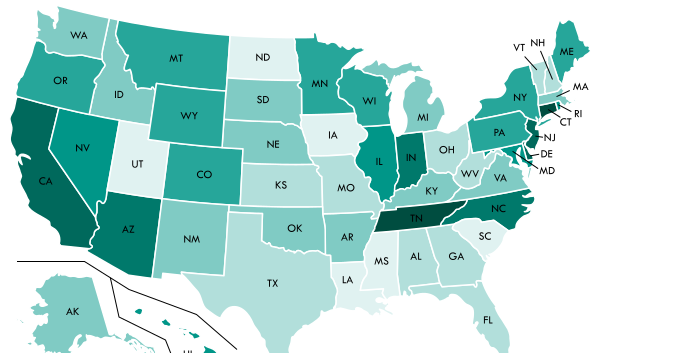
Most common states for project scientists
| Rank | State | Population | # of jobs | Employment/ 1000ppl |
|---|---|---|---|---|
| 1 | North Dakota | 755,393 | 204 | 27% |
| 2 | Vermont | 623,657 | 170 | 27% |
| 3 | New Hampshire | 1,342,795 | 323 | 24% |
| 4 | Montana | 1,050,493 | 253 | 24% |
| 5 | Rhode Island | 1,059,639 | 236 | 22% |
| 6 | South Dakota | 869,666 | 191 | 22% |
| 7 | Massachusetts | 6,859,819 | 1,448 | 21% |
| 8 | District of Columbia | 693,972 | 143 | 21% |
| 9 | North Carolina | 10,273,419 | 2,056 | 20% |
| 10 | Minnesota | 5,576,606 | 1,131 | 20% |
| 11 | Wisconsin | 5,795,483 | 1,094 | 19% |
| 12 | Idaho | 1,716,943 | 326 | 19% |
| 13 | New Mexico | 2,088,070 | 377 | 18% |
| 14 | Maine | 1,335,907 | 243 | 18% |
| 15 | Pennsylvania | 12,805,537 | 2,228 | 17% |
| 16 | Iowa | 3,145,711 | 548 | 17% |
| 17 | Nebraska | 1,920,076 | 331 | 17% |
| 18 | Kansas | 2,913,123 | 476 | 16% |
| 19 | Indiana | 6,666,818 | 981 | 15% |
| 20 | Missouri | 6,113,532 | 944 | 15% |
Most common cities for project scientists
| Rank | City | # of jobs | Employment/ 1000ppl | Avg. salary |
|---|---|---|---|---|
| 1 | San Fernando | 12 | 49% | $92,994 |
| 2 | Lawndale | 12 | 36% | $92,148 |
| 3 | Alhambra | 12 | 14% | $92,370 |
| 4 | Beverly Hills | 1 | 3% | $92,563 |
| 5 | Glendale Heights | 1 | 3% | $85,098 |
| 6 | Alpharetta | 1 | 2% | $60,996 |
| 7 | Los Angeles | 23 | 1% | $92,453 |
| 8 | Loveland | 1 | 1% | $73,040 |
| 9 | Mountain View | 1 | 1% | $100,565 |
| 10 | Palm Bay | 1 | 1% | $57,852 |
| 11 | Pasadena | 1 | 1% | $92,501 |
| 12 | Boston | 2 | 0% | $66,069 |
| 13 | Baltimore | 1 | 0% | $78,317 |
| 14 | Baton Rouge | 1 | 0% | $48,799 |
| 15 | Colorado Springs | 1 | 0% | $75,185 |
| 16 | Denver | 1 | 0% | $73,802 |
| 17 | Jacksonville | 1 | 0% | $58,168 |
Project Scientist job outlook: Expert opinions
Our panel of project scientist experts
Northeastern State University
SUNY Stony Brook
Washburn University of Topeka
Pepperdine University
University of Hawaii at Manoa
University of San Diego
Northwestern University
Georgetown University
Santa Fe College
Jackson State University
San Jose State University
Washington State University
University of Kentucky
Kent State University
What general advice would you give to a Project Scientist?
Dr. Taufika Williams PhD: Finding a job at with an undergraduate degree may be quite doable but upward mobility in your career often requires a terminal degree (i.e. PhD). Stay in school for as long as you can! Some students will work in biotechnology for a few years after their undergraduate studies are over and then return to school for graduate education. The work experience can tremendously benefit graduate research.
What Project Scientist skills would you recommend for someone trying to advance their career?
Frank David MD, PhD: My main piece of advice is to network. Do tons of informational interviews with folks and then follow up to see if there are possible opportunities or other connections that folks can help you make. Many biotech and pharma positions go to folks with 'inside tracks' because they are recommended by current employees or already know the hiring manager. Also: be flexible about the type of role whenever possible. For example, if you’re looking at an entry-level lab-based job, don’t get hung up on the specific disease area. Or if you’re interested in regulatory science, cast a broad net and also explore roles in program management and medical writing, which involve similar activities and required skills. Finally: it’s great to look for opportunities at biotech and pharma firms, but don’t forget about contract research organizations, consultancies, and other vendors that serve drug companies. Those types of organizations are often more willing to train folks who are coming straight out of school, and those positions are great stepping stones to eventually move 'to the client side' (into drug companies) as experienced hires.
What will help Project Scientists increase their earning potential?
Frank David MD, PhD: In basic research jobs, the key lab-related skills will continue to be the ones that are commonly used for discovering and developing new therapies: mammalian cell culture, in vitro assays, transfection, immunoprecipitation, Western blots, etc. It’s typically not necessary to 'check all the boxes' in terms of bench skills for a job, but having a few of these key techniques under your belt will give a company confidence that you can learn others. In general across the industry, effective written communication and project management are key skills that cut across almost all jobs and divisions within biotech and pharma. Anything you can do to build and highlight those capabilities will serve you in good stead.
What general advice would you give to a Project Scientist?
Dulanjani Wijayasekara Ph.D.: Having experience and a well highlighted skill set to match the job description. This can be obtained by pursuing advanced education and training, such as obtaining a master's or doctoral degree in the field you are interested in.
What will help Project Scientists increase their earning potential?
Ross Weatherman Ph.D.: The jobs that our graduates in biochemistry and molecular biology are taking are really diverse in terms of the types of companies and in the types of job requirements. They are not all big jobs in pharmaceutical and biotech companies. Many start working for smaller diagnostic labs or support labs for manufacturing or food processing. Also, I tell our students to expect to change jobs or employers in a few years. For our students, the job market seems to be pretty dynamic for them in the first 5-10 years either because they choose to change jobs or their companies go through some sort of change.
What general advice would you give to a Project Scientist?
Dr. Vitaly Citovsky: One cannot get high salaries with a bachelor's degree in biology. To maximize your future salary you need to get a terminal degree such as PhD or MD. Alternatively one could go to law school. If you still want to begin working after BSc, look for industry jobs; these would be low-level technicians but make much more money than in academia.
What will help Project Scientists increase their earning potential?
Dr. Vitaly Citovsky: Multi-prong advice: try to get a higher degree, look for jobs that you enjoy (e.g., research, patient care) rather than chase the money.
Susan Bjerke
Associate Professor of BiologyWashburn University of Topeka
Biological And Physical Sciences
What Project Scientist skills would you recommend for someone trying to advance their career?
Susan Bjerke: Maximizing your salary is important, but don’t forget that jobs can come with other benefits that may compensate for a lower starting salary. For instance, maybe you get to work out in the field instead of being tied to a desk all day. Maybe you have the opportunity to work from home some of the time. Some employers offer matches for retirement plans or discounted health insurance for spouses. Negotiating for the best salary you can makes sense, but also look into those intangibles!
What will help Project Scientists increase their earning potential?
Susan Bjerke: Some of the skills that will be important in the next 3-5 years will be general critical thinking skills and the ability to adapt to changing technology. Almost all science fields are increasingly dependent on technology, so being able to learn new skills and change the way you do things in your job will be important. Being an effective communicator, both in writing and orally, is an overlooked skill in the sciences and is always an important asset.
What general advice would you give to a Project Scientist?
Rachel Tan Ph.D.: I do not have an answer for this. My response would be to be proactive during undergraduate studies, to discern where you find joy and curiosity. Pursue that topic. I do not think that the salary should be the priority when considering careers.
What will help Project Scientists increase their earning potential?
Rachel Tan Ph.D.: Listen and be curious: ask questions (the why and how?), ask for opportunities, do extra readings outside of work. Aim for excellence: treat each assigned task as priority–go above and beyond. Connect: talk to colleagues, your boss, staff–be excited to learn from others. Be grateful: constantly reflect on the small details that led you to this point, for gratitude gives you foundation for joy during your career.
What general advice would you give to a Project Scientist?
Qing Li: Develop your specialty and be good at one thing; jobs will be after you rather than you after jobs.
What will help Project Scientists increase their earning potential?
Nicole Danos PhD: In addition to many sought after hard skills that our Biology program graduate have been trained in (cell and microbial culture, DNA sequencing and bioinformatics, antibody staining, data analysis and biostatistics), graduates should remember to leverage the other scientific skills they learned. This includes things like researching and summarizing the state of knowledge in a field, distilling relevant information for peers and supervisors, presenting experimental designs and results and all around thinking about problems from start to finish. All of our graduates should be able to leverage these soft science skills, since they all had to do an independent research project.
What general advice would you give to a Project Scientist?
Nathaniel Stern: To answer this question we need to be clear what field the graduate intends to continue in. If they want to continue in Physics as a “field”, then they will most likely need to go to graduate school in Physics, Astronomy, or a related field. There are many opportunities for graduates with majors in Physics, but many of these are in different fields. Physics majors excel in these other opportunities, but in order to do “physics”, meaning studying the science of matter and energy, one generally goes to graduate school. If this is the graduate’s plan, then the advice is to be passionate about the research topic that you choose. One does not need to know ahead of time that a particular direction of research is the best possible direction for them, but they should have interest in it. Research often involves small academic questions, and if one doesn’t find these interesting then it can be a bit of a slog. More generally, advice matches other career paths, however: do something that you love, and also choose impactful problems. Even if your own work is a small part of the whole, if you can see the impact of the field it can be exciting all the time. If the graduate is not going to graduate school in Physics or a related subject, then they are likely entering a technical career such as engineering, finance, education, data science, or consulting. Physics is a great basic training for whatever direction someone takes since it trains you to think and problem solve, especially in reducing a problem to its core questions (as opposed to building encyclopedic knowledge of relevant facts). But, whatever specific career path a graduate takes will likely bring more specialized methods, knowledge, and applications. Physics is a great starting point, but future endeavors will broaden thinking to new challenges outside of the rigid rules of physical laws. So, graduates should be willing to, and excited to, adapt to new cultures.
What will help Project Scientists increase their earning potential?
Nathaniel Stern: Within academic physics, your potential can be maximized by doing impactful work in graduate school that matters to other people. The next step is to communicate this impact broadly, and then figure out how to take the next step in the field. That is a lot of steps, but if one can successfully do those things in graduate school, they can build the profile, community, and intellectual leadership to demand the highest salary. Outside of academic physics, the requirements are probably not that different, but I do not have explicit knowledge of them myself. So I would fall back on the standard goals of innovation and communication, which should help one succeed in any knowledge-related career.
What general advice would you give to a Project Scientist?
Meghan McGee-Lawrence Ph.D.: Take full advantage of the education and training opportunities offered to you either while you are completing your degree or when you start your first post-degree position. Academic institutions and employers are invested in the success of their recruits and regularly provide professional development opportunities to help folks build up skillsets – so make time to seek out and capitalize on those opportunities when they are offered, and document them on your CV (curriculum vitae) / resumes.
What will help Project Scientists increase their earning potential?
Meghan McGee-Lawrence Ph.D.: Cast a wide net! A huge variety of career paths can be pursued with a degree like this, including industry, academic research, healthcare, education, and more. It is a very versatile degree, and can be a foundation for a multitude of different professions. Talk to recent graduates from your program (as many as possible!) and see what they did with their degree – the more information you can collect, the better prepared you’ll be to seek out opportunities yourself. Take the time to figure out where your interests lie – and understand that you may have to try a few different paths out before you find the right one for you. The first position you land after graduation doesn’t have to be the job you perform for the next 30 years of your life – so use each opportunity as a learning experience to figure out what you’d really like to do long-term.
Luz Garcini PhD, MPH
Assistant ProfessorWhat general advice would you give to a Project Scientist?
Luz Garcini PhD, MPH: Find a purpose and a meaning in their work and be open to learning from interdisciplinary fields.
What Project Scientist skills would you recommend for someone trying to advance their career?
Luz Garcini PhD, MPH: Interdisciplinary, commitment to diversity, flexibility in thinking and approach, fast learning of technological advances, advanced statistical knowledge and skills in mixed methodologies.
What will help Project Scientists increase their earning potential?
Luz Garcini PhD, MPH: Build a unique niche and new skills (another language), disseminate your work via high impact networks/avenues, get mentoring in negotiation.
What general advice would you give to a Project Scientist?
Ivica Labuda PhD: The 21st century is the century of biotechnology, which means that opportunities for a successful, impactful career in the field are there for those who go after them. Your blossoming career path may take you from the private sector, to government agencies, to academia and beyond, so taking advantage of every opportunity to gain exposure to the different sides of biotech will set you up to grasp varied and exciting opportunities.
What Project Scientist skills would you recommend for someone trying to advance their career?
Ivica Labuda PhD: Certainly everyone in the biotech field would benefit from having knowledge of biotechnology techniques and skills in concert with understanding the regulatory framework. That provides a good foundation so that one can interact confidently in every aspect of the biotech world. With AI progress, the next step is to add the basic understanding of the speed at which we can evolve new techniques and materials. Not everybody needs to code, but everyone needs to think about how to maximize its benefits for biotechnology.
What will help Project Scientists increase their earning potential?
Ivica Labuda PhD: Everyone's career is a unique path, but a strong education gets your foot in the door and graduate programs such as Georgetown's MS in Biotechnology are accelerators for your potential. An advanced degree and the exposure to real-world internships they often provide bring you to a much higher starting point in negotiations and can help you gain confidence to start at higher positions. Salary, however, is just one measure of success -- also important to consider are satisfaction from the working environment, a great team, and potential for professional and personal growth.
What general advice would you give to a Project Scientist?
Kristopher Koudelka Ph.D.: There are two skillsets, and one field I see become more important. The first skillset is application of material. You must know the language of your field; however, most content can be quickly found through simple research. People who can apply this knowledge, and formulate the new questions are more valuable employees. The second skill set is troubleshooting. Very often experiments fail or give strange results, how one can glean as much information as possible from the experiment and then plan the next course of action is a huge asset. The field I see becoming more important is computer programming. Very often these fields deal with large datasets that are so big, complex, or repetitive that computer assistance isn’t just helpful… but mandatory.
What will help Project Scientists increase their earning potential?
Kristopher Koudelka Ph.D.: Always keep learning. These fields change fast! The leading edge is always unveiling new information that can be applied to the area you are working on, and there will be new techniques developed that allow you to answer questions in more efficient ways. You must learn to regularly update yourself through conversations, reading, conferences, and trainings. This change is fun and exciting, embrace it. It will keep your job feeling new.
What Project Scientist skills would you recommend for someone trying to advance their career?
Jeff Heslep: A good entry-level starting salary is great, but it may not maximize your salary potential if the job doesn't help you grow. You might want to take learning opportunities and experience over money early on in your career. Focus on experience, learning, and growth early so your salary potential in the long run will be much higher. Be wary of companies offering a sign-on bonus for certain positions. The reason companies need to offer a sign-on bonus for specific positions is often because the job is very demanding and unpleasant, or they are positions that stagnate and offer little growth opportunities. You'll have plenty of time to advance and make a higher salary after you have a good system of self-improvement in place and ways to master your skills.
What will help Project Scientists increase their earning potential?
Jeff Heslep: Know how to interpret data. Don't simply know what expected results are necessary for successful projects, know why and be able to explain the data. Technology in the form of automation, machine learning, and robotics is going to become more prevalent in the near future. Knowing how to program automated systems and how to prompt AI is going to be very beneficial. Lab skills will continue to be necessary, but continuing to grow with the advancement of technology is ideal.
What general advice would you give to a Project Scientist?
Hung-Chung Huang: Master key concepts in genetics, molecular biology and biochemistry; also learn at least one programming language like R or Python.
What Project Scientist skills would you recommend for someone trying to advance their career?
Hung-Chung Huang: Cloud computing, AI (e.g., ChatGPT) computing, machine learning, HMM, neural network, and natural language processing.
Dr. Harit Agroia
Adjunct Professor of Public HealthSan Jose State University
Health Services/Allied Health/Health Sciences
What general advice would you give to a Project Scientist?
Dr. Harit Agroia: The day-to-day of a Health Science Researcher may vary depending on the organization, industry and setting in which the role is based. Generally, the Health Science Researcher may be responsible for the following: working in close collaboration with a research team to identify research gaps, conducting population-level data analyses to understand the distribution and burden of and social determinants of disease within a specified geographic region, designing research plans including aims, objectives, theoretical or conceptual frameworks, data collection tools, analyses, results visualization and interpretation, and dissemination of findings. Health Science Researchers may spend their day collecting data which may involve manual extraction and data entry or conducting interviews or focus groups. Conducting interviews and focus groups may require travel related to the job as being in the field and area where the research is focused provides additional observational data that may be integrated into the analysis or provide context for the results. The data analysis portion of the job may require basic to advanced statistical analysis skills; many researchers work in close collaboration with biostatisticians to complete more complex analyses. For qualitative analyses, data analysis may require transcribing notes, coding and identifying themes to organize the results. These day-to-day tasks are completed in the setting of larger team environment and in consultation with senior management and principal investigators.
What Project Scientist skills would you recommend for someone trying to advance their career?
Dr. Harit Agroia: The Health Science Researcher provides an exciting opportunity for individuals to explore areas of health that they are curious about; this role will be very well-enjoyed by someone who is curious, analytical and detail-oriented. One challenge about the role is that there may be times when research data may have to be re-collected or analyzed with evolving changes to research design and methodologies; being able to manage this effectively requires flexibility and adaptation in order to be thorough and successful in achieving set research goals.
What general advice would you give to a Project Scientist?
Lindsey du Toit: The ability to put advanced, including molecular plant pathology, skills and methods pathology in the context of fundamental principles of plant pathology is so important. There is a real danger of being trained/educated so narrowly that you lose the bigger picture and context of the work. Make an effort to learn from people with expertise in related disciplines to avoid working in an isolated ivory tower, and to benefit from the amazing cross-pollination that can happen with shared expertise.
What Project Scientist skills would you recommend for someone trying to advance their career?
Lindsey du Toit: Enquire about salary ranges for the types of position for which you’re applying, and opportunities for promotions/salary ranges. Pay attention to the value of the benefits package associated with positions you are seeking. These benefits may not translate to direct salary payments, but can be worth a very significant amount over the duration of your career.
What will help Project Scientists increase their earning potential?
Lindsey du Toit: Take every opportunity you can to learn, network, and build an effective team of people that bring a greater breadth and depth of skills and expertise to the work on which you will be focusing. Cultivate a life-long sense of intellectual curiosity and learning. Don’t be afraid to ask questions. Treat ignorance as an opportunity to learn. Questions demonstrate you want to understand the situation/problem effectively and that you are paying attention. Always demonstrate integrity in your work. It is one of the most valuable traits you can bring to your career. Be kind and supportive of your colleagues.
Dr. David Harmon
Professor of Animal & Food SciencesUniversity of Kentucky
Animal Sciences
What general advice would you give to a Project Scientist?
Dr. David Harmon: Reading and writing skills are never more important. If you want to do research you have to compete for funds.
What Project Scientist skills would you recommend for someone trying to advance their career?
Dr. David Harmon: Opportunities abound. The job opportunities outnumber current graduates. Decide what you want to be good at and then be good at it.
What will help Project Scientists increase their earning potential?
Dr. David Harmon: Be productive as a graduate student. Publishing is still the road to success.
What general advice would you give to a Project Scientist?
Dr. Christopher Post PhD: Start local and get an internship while an undergraduate. Any position with the federal lands agencies (parks, forests, BLM, etc.) are tough to get and you have to work your way in to that federal system. Start local with regional/county/city parks and forests and work up to the federal level. Also keep that balance between the science (the biology and earth science) and the more social science/humanities (ethics, economics, communications) material you’ve learned as undergraduate. These jobs are all about communicating complex scientific/environmental issues with the general public so that context is very important. You have to be nimble and know both areas (the science and the social science) and their overlap.
What Project Scientist skills would you recommend for someone trying to advance their career?
Dr. Christopher Post PhD: Geographic Information Science—the ability to take field data and make it visual with maps so that you and others can witness and analyze spatial relations is the most important skill set in environmental careers right now and will continue as such. Everything in nature moves—albeit sometimes slowly—and understanding those interactions is key to unfolding humanity’s impacts on the environment, and vice versa.
What will help Project Scientists increase their earning potential?
Dr. Christopher Post PhD: Having field and lab experience as an undergraduate—showing you can put theory to practice via internships or other undergraduate research opportunities should best position a student for maximizing that starting salary.