Explore jobs
Find specific jobs
Explore careers
Explore professions
Best companies
Explore companies
Job outlook for public information specialists in the United States
Are public information specialist jobs in demand?
Public information specialist job and salary trends over time
Public information specialist jobs over time
Public information specialist job growth rate over time
| Year | # of jobs | % of population |
|---|---|---|
| 2021 | 2,069 | 0.00% |
| 2020 | 2,085 | 0.00% |
| 2019 | 2,086 | 0.00% |
| 2018 | 2,038 | 0.00% |
| 2017 | 1,992 | 0.00% |
Average public information specialist salary over time
Public information specialist salary by year
| Year | Avg. salary | Hourly rate | % Change |
|---|---|---|---|
| 2026 | $47,725 | $22.94 | +2.7% |
| 2025 | $46,464 | $22.34 | +1.9% |
| 2024 | $45,590 | $21.92 | +1.2% |
| 2023 | $45,058 | $21.66 | +2.2% |
| 2022 | $44,086 | $21.20 | +2.2% |
Public information specialist jobs by state
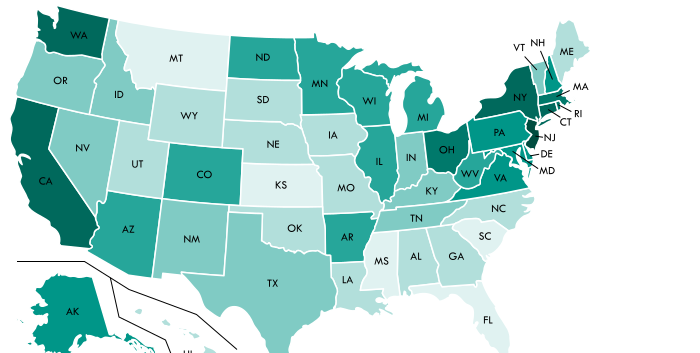
Most common states for public information specialists
| Rank | State | Population | # of jobs | Employment/ 1000ppl |
|---|---|---|---|---|
| 1 | District of Columbia | 693,972 | 315 | 45% |
| 2 | North Dakota | 755,393 | 164 | 22% |
| 3 | Wyoming | 579,315 | 125 | 22% |
| 4 | Alaska | 739,795 | 158 | 21% |
| 5 | Vermont | 623,657 | 133 | 21% |
| 6 | Massachusetts | 6,859,819 | 1,343 | 20% |
| 7 | Rhode Island | 1,059,639 | 214 | 20% |
| 8 | Delaware | 961,939 | 197 | 20% |
| 9 | Montana | 1,050,493 | 196 | 19% |
| 10 | South Dakota | 869,666 | 166 | 19% |
| 11 | Utah | 3,101,833 | 539 | 17% |
| 12 | Nebraska | 1,920,076 | 324 | 17% |
| 13 | New Hampshire | 1,342,795 | 222 | 17% |
| 14 | Oregon | 4,142,776 | 669 | 16% |
| 15 | Iowa | 3,145,711 | 497 | 16% |
| 16 | Washington | 7,405,743 | 1,098 | 15% |
| 17 | Minnesota | 5,576,606 | 860 | 15% |
| 18 | Colorado | 5,607,154 | 818 | 15% |
| 19 | Arizona | 7,016,270 | 958 | 14% |
| 20 | Idaho | 1,716,943 | 241 | 14% |
Most common cities for public information specialists
| Rank | City | # of jobs | Employment/ 1000ppl | Avg. salary |
|---|---|---|---|---|
| 1 | Tallahassee | 2 | 1% | $34,338 |
| 2 | Little Rock | 1 | 1% | $45,788 |
| 3 | Los Angeles | 1 | 0% | $57,701 |
| 4 | Saint Paul | 1 | 0% | $45,894 |
| 5 | Virginia Beach | 1 | 0% | $53,499 |
Public Information Specialist job outlook: Expert opinions
Our panel of public information specialist experts
New Jersey Institute of Technology
Grand Valley State University
University of Kentucky
Elon University
Winthrop University
Bowie State University
University of Florida
Wartburg College
Washington State University
Point Loma Nazarene University
Washington State University
San Francisco State University
California State University - Dominguez Hills
What general advice would you give to a Public Information Specialist?
Laura Willis Calo Ph.D.: A couple of skills that will become all the more important in coming years are editing and critical thinking. With AI being able to produce initial drafts of content, our role as 'writer' is transitioning to that of 'editor.' In reworking AI-generated content, we need to think critically to ensure it is in line with the strategy driving our work.
What Public Information Specialist skills would you recommend for someone trying to advance their career?
Laura Willis Calo Ph.D.: Highlight your relevant experiences from internships and/or courses focused on experiential learning. Complete certifications, such as those offered through PRSA, Hubspot, and Google, that further develop your skills and demonstrate your mastery.
What will help Public Information Specialists increase their earning potential?
Laura Willis Calo Ph.D.: Stay up-to-date with the news! Being able to speak about current events will help you stand out in an interview and once you land the job. Get involved in your local PRSA chapter/district - this will help you grow your professional network and build your reputation.
What general advice would you give to a Public Information Specialist?
Dr. Joy Daggs: I think making yourself the most well-rounded candidate you can be is the best way to maximize your salary potential. Try lots of things in your undergraduate experience. What you think you want to do as a freshman may not be as appealing after you try it. Most jobs do not require only one skill, so having a variety of skills where you can plug in several places in an organization is helpful. Even if you want to go into something like event planning, you still need writing skills, design skills, interpersonal skills, etc. to do that job effectively.
Don't be afraid to negotiate your salary. There are workshops from organizations such as AAUW (American Association of University Women) to help you build those skills.
What Public Information Specialist skills would you recommend for someone trying to advance their career?
Dr. Joy Daggs: 1. Knowing how to use AI responsibly. It can be used to make work more efficient. It's important to understand how to use it appropriately at a tool.
2. Understanding social media and how to interpret data to create and change messages.
3. 'Soft skills' such as public speaking, conflict management, and relationship building are not going away. You may need to learn to adapt those skills to a digital platform, such as Zoom or Teams. I am seeing current articles from publications such as Forbes about current graduates struggling in these areas, so sharpening these skills and your writing skills will set you apart.
What will help Public Information Specialists increase their earning potential?
Dr. Joy Daggs: I have quite a bit of advice:
1. Get as much experience as an undergraduate as possible. Many programs require internships, but even if they don't, seek opportunities to get experience. Take leadership roles in student organizations. Even if it's not specifically a 'public relations' entitled position, anything where you practice your skills is helpful. Even if you need to work a job in retail or service, those jobs still provide important benefits other than a paycheck. Don't discount your experiences!
2. Don't pass up opportunities to meet professionals. Many schools and departments bring their alumni on campus or do virtual events so that you can meet and chat with professionals. Even if it's not required for class, GO. You never know when a casual conversation may lead to an internship or an important professional connection.
3. Use your LinkedIn profile to your advantage. Make sure you have a professional picture that shows you in your best light. Follow organizations that you want to work for and other professional organizations related to your interests. I know of people getting interviews based off of LinkedIn interactions. Check your other social media accounts to make sure that you are not presenting yourself poorly. Most likely, organizations will Google you or look up your personal social media. There are reports of students losing opportunities because of poor social media choices.
What Public Information Specialist skills would you recommend for someone trying to advance their career?
David Painter Ph.D.: Many Communication Specialists appreciate the variety in their work as well as their ability to decide which industry they want to promote. From crafting compelling brand narratives for tourist or hospitality organizations to managing digital platforms for financial or legal organizations to strategizing communication plans for sports, fashion, or automotive companies, the possibilities are nearly infinite. Moreover, communication specialists enjoy the creativity, strategic thinking, and collaboration their role demands. However, the job can also be stressful, particularly during crises or when managing conflicting narratives. Long hours and balancing multiple projects can be challenging, but for many, the fast-paced nature and the ability to shape public perception make it worth it.
What Public Information Specialist skills would you recommend for someone trying to advance their career?
Andrew Wood Ph.D.: People entering the field should become increasingly familiar with technologies related to social media, artificial intelligence, and augmented reality, while demonstrating an interest in contemporary issues such as health care, climate change, environmental justice, community engagement, and similarly high-impact issues. It's one thing to possess a degree in communication studies; it's a much more important thing to translate the field's concepts and theories to the problems (and opportunities) that are transforming our planet.
What Public Information Specialist skills would you recommend for someone trying to advance their career?
Dr. Alice Veksler Ph.D., BCPA: Practice your interpersonal skills and think about how what you have learned in your coursework translates to your chosen field of work. Teamwork, conflict resolution, social media savvy, and professionalism can make or break a career. Being able to articulate and demonstrate mastery of these skills with concrete examples during an interview can help land the job and then embodying the skillset of an excellent communicator will lead to professional success. Networking is also key so making sure that you do internships and engage with others in your chosen field helps with securing a job. Forging connections early in one's career can pay massive dividends down the road. We say that 'you get jobs by talking to people' and this maxim is especially true for a broad field like communication studies. Finally, I always encourage a healthy work-life balance to avoid burnout and maximize productivity.
What general advice would you give to a Public Information Specialist?
Yao Sun: The world has never been so eager for enhanced communication. Individuals, parties, organizations, etc. all need conversations and dialogues to improve the understanding toward each other as well as toward the new challenges that we are facing. Being a Communication Specialist can play an important role in this regard.
What Public Information Specialist skills would you recommend for someone trying to advance their career?
Dr. Mikhila Wildey PhD: I think the ability to engage and connect with people will be very important in the field as we shift more and more to a culture that is driven by AI. Although AI can be a useful tool, it likely won’t ever fully replace the value of human interaction and connection. In addition, employers often comment that they want to see employees with strong work ethic, and I think this will continue to be the case in 3-5 years. Having a strong work ethic can separate the people that move forward in their careers to those who remain stagnant.
What will help Public Information Specialists increase their earning potential?
Dr. Mikhila Wildey PhD: My general advice for a graduate beginning their career in the field is to work hard, stay open-minded, and network! Most employees won’t stay in the same position for their entire career, and so I often tell graduates to not get too hung up on the first job needing to be the 'perfect' job for them. Often, the first job will be a place where they learn how to navigate the workplace, learn about their own strengths/weaknesses, and figure out what they like and don’t like. I encourage graduates to use this information to help them make decisions about the next steps in their career. And, if they are working hard and networking with people at their job, then opportunities will often times present themselves or be more available to them as they navigate their future career path.
Ying Lu Ph.D.
Associate ProfessorUniversity of Kentucky
Hospitality Administration/Management
What Public Information Specialist skills would you recommend for someone trying to advance their career?
Ying Lu Ph.D.: Introducing and instructing customers on how to use various tech equipment to have a better consumption experience.
What general advice would you give to a Public Information Specialist?
Kenn Gaither Ph.D.: Adopt a growth mindset and keep learning. The skills from college are still valuable and useful, but so too is the ability to stay at the forefront of relevant trends. Public relations practitioners are strategic communicators, requiring disciplinary expertise, knowledge of cultural and technological trends and news, and a broad skill set. Continuing to invest in these areas will give a new graduate both a competitive edge and pathway for upward mobility.
What Public Information Specialist skills would you recommend for someone trying to advance their career?
Kenn Gaither Ph.D.: Interpersonal skills will become as valuable as ever. AI will eliminate some of the more menial parts of public relations, allowing practitioners to get to face-to-face, which is still the space where opportunity, innovation and relationships-building thrive.
What will help Public Information Specialists increase their earning potential?
Kenn Gaither Ph.D.: Focus on your skills honed by coursework, internships or involvement in student media organizations. Although you might not have significant full-time experience yet, offer your skill set as salary negotiation lever. Also, know your worth. If you receive an offer, consult with a mentor or career advisor to discuss strategies to maximize your salary potential and know a good starting point. Finally, ask about opportunities for promotion and timelines. Sometimes it can pay off to take slightly less than anticipated if there is a clear path toward salary increases or the company has a track-record of rapidly advancing entry-level employees.
Bonnye Stuart
Internship Coordinator, Speech Communication Coordinator, Study Abroad Adviser, Integrated Marketing Communication InstructorWinthrop University
Public Relations, Advertising, And Applied Communication
What Public Information Specialist skills would you recommend for someone trying to advance their career?
Bonnye Stuart: Communication skills – in-person and mediated – will become more important as personal communication becomes less frequent and online communication takes center-stage. Analyzing analytics will be crucial as companies and organizations strive to 'really know' their publics behaviors and reach them where they are. Understanding Search Engine Optimization will be a great skill. Writing for a variety of formats – from long form storytelling to blogging will be important. Other skills will include videoing, photography, content creation, website editing and revision and trend watching!
What Public Information Specialist skills would you recommend for someone trying to advance their career?
Dr. Rochelle Daniel: My general advice to a graduate who transitions into that first professional job in the Communication field is similar to advice I give Communication students for navigating internship workspaces (Communications Internship Handbook: What HBCU Students Need to Know, 2022). Be intentional about learning the organizational or office culture, really listen to find out what is expected of you, be flexible and adaptable when there are changes in workflow, and don't be afraid to ask questions.
What will help Public Information Specialists increase their earning potential?
Dr. Rochelle Daniel: When starting a career in Communications, you can maximize your salary by demonstrating adaptability to change, willingness and eagerness to learn new skills to enhance your performance, and a willingness to solve problems.
Dr. Rebecca Frazer
Assistant Professor of Public RelationsUniversity of Florida
Public Relations, Advertising, And Applied Communication
What general advice would you give to a Public Information Specialist?
Dr. Rebecca Frazer: Research the average salaries for the different types of positions you are interested in and take note of what skills are needed for higher paying positions. Students should be thinking about what skills they can build to maximize their earning potential before they even reach the job market.
What Public Information Specialist skills would you recommend for someone trying to advance their career?
Dr. Rebecca Frazer: The ability to harness new technologies without becoming distracted from key goals will drive success in the future of the field. With the explosion of artificial intelligence technologies and the proliferation of new social media platforms in recent years, some practitioners may be struggling to keep up. The most successful practitioners will work to understand new technologies and strategically harness their power, while also staying focused on the fundamental role of public relations: building strong, genuine, mutually-beneficial relationships with key publics.
What will help Public Information Specialists increase their earning potential?
Dr. Rebecca Frazer: Be eager, flexible, and willing to learn. Entry-level PR positions often involve a broad range of different tasks that may require the employee to quickly teach themselves new skills, software, and applications. Demonstrating an ability to catch on quickly and an eagerness to take on new challenges goes a long way in impressing an employer.
What Public Information Specialist skills would you recommend for someone trying to advance their career?
Dr. Penni Pier: You must be confident in the skill sets you have and negotiate for a beginning salary that is commensurate with your skills. A lot of emerging professionals shy away from negotiation (or making the right fit for that matter) because they are afraid of turning down a job. Interviews and the first series of negotiations set the tone for the relationship you will have with your employer. You also must be willing to look in geographic areas and related industries that need your skill sets to make give you the most opportunities to be choosy with your first professional position. While at your first position, it is important to make sure that your portfolio stays current, and they you are continuing to do professional development. Be proactive and learn (or enhance) any skills you find lacking. Work on client interaction and how to be a good collaborator with your colleagues. If you do these things and there is room for advancement with the organization that first hired, you this will give you a “leg up” in terms of salary potential. If there is not opportunity for advancement a first position will give you tangible work experience for your portfolio and an opportunity to practice your skills which in turn will make you more marketable if or when you decide to move on.
Ms. Chelsea Thomas
Scholarly Assistant ProfessorWashington State University
Public Relations, Advertising, And Applied Communication
What will help Public Information Specialists increase their earning potential?
Ms. Chelsea Thomas: Public relations is a unique and dynamic field that allows professionals to execute both strategic and tactical initiatives. This profession allows one to experience a fast-paced industry where creativity, objectivity and strategy meet. No two days are likely the same; one can be filled with socializing at planned events, another working with media to manage external relations, and another spending quality time strategizing with a client representative. With the growing need for an organization to build and maintain a positive relationship with the target audience and stakeholders, public relations is an excellent profession for those skilled in communication and customer relationship management.
What general advice would you give to a Public Information Specialist?
Dr. Nick DiFrancesco: Communication- many grads lack even basic communication skills such as presenting, writing, or conversation; the industry is going to be seeking out not just the best and brightest, individuals who are personable, can relate and have rational discussions with others. The inability to engage in conversation and debate, or network with others is a serious issue among students, and these are skills that are absolutely vital to any professional.
What will help Public Information Specialists increase their earning potential?
Dr. Nick DiFrancesco: Be reliable and willing to do different things. You don’t know where your best suited after graduation, but demonstrating that you can be counted on is not easily forgotten by most employers. Similarly, employees who decide to pigeon-hole themselves into a narrow set of tasks are rarely asked to do much beyond that, and can impede the progress in one’s career.
Margarita Pintado Burgos Ph.D.
Professor of SpanishPoint Loma Nazarene University
Romance Languages, Literatures, And Linguistics
What Public Information Specialist skills would you recommend for someone trying to advance their career?
Margarita Pintado Burgos Ph.D.: I think the most important skills have remained the same for a while, and they will continue to be prevalent in the near future. To read well, to synthesize information, to interpret content with a critical eye, to serve as bridge between different groups of peoples and cultures, to create compelling content, to offer diverse perspectives, to discern (for example) between fake news and real news, are some of the skills I think will be prevalent in the next 3-5 years.
What general advice would you give to a Public Information Specialist?
Michelle Galey: PR is a great profession to enter now because of the growing demand for PR professionals, varied career opportunities, growth potential, competitive salary and benefits, and work-life balance and flexibility. Plus, working in PR allows you to be creative and work with so many different software tools and platforms. With the increasing reliance on digital media and online platforms, there is a growing demand for PR professionals who can effectively navigate these channels and stay up to date with current trends and technologies. We live in an era of 24/7 communication and public scrutiny, so organizations need highly skilled PR professionals to manage and mitigate potential crises effectively. Although this is a sad reality, it provides more work for PR professionals!
What Public Information Specialist skills would you recommend for someone trying to advance their career?
Michelle Galey: From my experience being a PR practitioner myself and talking to my former PR students, it’s easy to find both rewards and challenges in the PR profession. My former students tell me that they enjoy the variety, creativity, impact, and networking opportunities in the field but that can sometimes come with high pressure, stress, unpredictability, client expectations, and mundane administrative tasks. These tasks can range from data entry to maintaining media lists and contact databases. Despite the challenges, they find the field rewarding and fulfilling, knowing they have an opportunity to grow in their careers and make significant impacts within their organizations and for their clients.
What will help Public Information Specialists increase their earning potential?
Michelle Galey: A PR professional and a new hire entering the field might have different responsibilities, but they often share some common tasks as well. Both the seasoned PR professional and the new hire play important roles in the PR process. While the PR professional’s day may be centered around strategy development, media relations, and working directly with clients and upper administration, the new hire is often involved with research, press release writing, event planning, social media coordination, and administrative tasks. However, as new hires gain experience and expertise, they will take on more responsibilities and play a more significant role in their firms and organizations.
What general advice would you give to a Public Information Specialist?
Dr. Geri Merrigan: I advise them to think about half a dozen situations in which they have been both happy and effective, and ask themselves, "Which of my skills or capacities contributed to me being happy in those situations? What made me effective?" Then, find out which industries and organizations most need those skills and capacities. I got this exercise from Richard Bolles’ book, What Color is Your Parachute?
What Public Information Specialist skills would you recommend for someone trying to advance their career?
Dr. Geri Merrigan: Listening, empathy, and perspective-taking remain as important as ever, because change is the only certainty, and globalization connects us to people quite different from ourselves. That means skills for inclusive communication matter – analyzing an audience and crafting messages for diverse stakeholders. Finally, understanding the technology (especially AI) that is most consequential for your industry/sector, for Communication Studies majors, means understanding current events, reading about AI, and evaluating the credibility of what you read.
What will help Public Information Specialists increase their earning potential?
Larry Hygh Jr., Ed.D.: Be open to all opportunities even if the opportunity is not something you have planned for your career trajectory. Networking is extremely crucial in the field of communications. Network, network, network, then network some more!
What Public Information Specialist skills would you recommend for someone trying to advance their career?
Kailee Gaither: I would tell graduates to always be open to new ideas and opportunities, make sure you show up and work hard, and enjoy what you do. It is important to remain a lifelong learner and engage in ongoing professional development and networking. The world is changing quickly.