Explore jobs
Find specific jobs
Explore careers
Explore professions
Best companies
Explore companies
Job outlook for publications designers in the United States
Are publications designer jobs in demand?
Publications designer job and salary trends over time
Publications designer jobs over time
Publications designer job growth rate over time
| Year | # of jobs | % of population |
|---|---|---|
| 2021 | 109 | 0.00% |
| 2020 | 107 | 0.00% |
| 2019 | 115 | 0.00% |
| 2018 | 116 | 0.00% |
| 2017 | 116 | 0.00% |
Average publications designer salary over time
Publications designer salary by year
| Year | Avg. salary | Hourly rate | % Change |
|---|---|---|---|
| 2026 | $56,121 | $26.98 | +2.4% |
| 2025 | $54,786 | $26.34 | +3.5% |
| 2024 | $52,957 | $25.46 | +3.4% |
| 2023 | $51,201 | $24.62 | +2.2% |
| 2022 | $50,087 | $24.08 | +1.6% |
Publications designer jobs by state
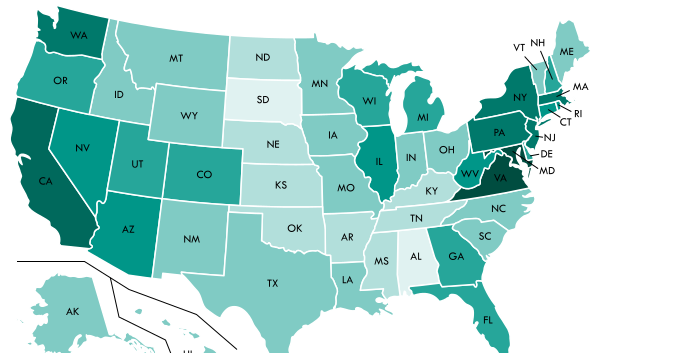
Most common states for publications designers
| Rank | State | Population | # of jobs | Employment/ 1000ppl |
|---|---|---|---|---|
| 1 | District of Columbia | 693,972 | 199 | 29% |
| 2 | Washington | 7,405,743 | 719 | 10% |
| 3 | Massachusetts | 6,859,819 | 605 | 9% |
| 4 | Oregon | 4,142,776 | 386 | 9% |
| 5 | Virginia | 8,470,020 | 659 | 8% |
| 6 | Minnesota | 5,576,606 | 370 | 7% |
| 7 | Utah | 3,101,833 | 203 | 7% |
| 8 | California | 39,536,653 | 2,552 | 6% |
| 9 | New York | 19,849,399 | 1,142 | 6% |
| 10 | Georgia | 10,429,379 | 677 | 6% |
| 11 | Maryland | 6,052,177 | 333 | 6% |
| 12 | Colorado | 5,607,154 | 319 | 6% |
| 13 | New Hampshire | 1,342,795 | 85 | 6% |
| 14 | Rhode Island | 1,059,639 | 64 | 6% |
| 15 | Illinois | 12,802,023 | 653 | 5% |
| 16 | North Carolina | 10,273,419 | 492 | 5% |
| 17 | Wisconsin | 5,795,483 | 313 | 5% |
| 18 | Missouri | 6,113,532 | 279 | 5% |
| 19 | Iowa | 3,145,711 | 156 | 5% |
| 20 | Vermont | 623,657 | 30 | 5% |
Publications Designer job outlook: Expert opinions
Our panel of publications designer experts
University of Akron
Louisiana State University at Shreveport

Highline College
Bowling Green State University
Belmont University

Eastern Illinois University

Siena College
Methodist University
Mansfield University of Pennsylvania
What general advice would you give to a Publications Designer?
David Flynn: Everything that you see has been touched by a designer. The field is expanding with technology, but basic communication design principals remain paramount. It doesn’t matter if it’s a newspaper ad or a social post, you must have a professional that knows how to communicate a message, move the viewer's eye, and make the point. Designers work in every company and in every industry, worldwide.
What will help Publications Designers increase their earning potential?
David Flynn: We spend our day creating items that need to communicate a message clearly and quickly to a person or public. Information, directions, product benefits, packaging, events, advertising, anything and everything is designed to inform.
What will help Publications Designers increase their earning potential?
Allen Garcie MFA: On the technical side, software is always evolving so skills related to this are always important. However, I think keeping up with advancements in artificial intelligence (AI) is going to be most important for designers over the next 3 to 5 years. This is an area that's already changing the design field as companies like Adobe and others continue to integrate AI into their software. On the other hand, being a designer isn't all about developing technology-related skills though. I also think developing non-technical skills like creativity, collaboration, and adaptability are extremely important for any designer.
What soft skills should all Publications Designers possess?
Diana Boyd: -Collaboration/Teamwork
-Interpersonal
-Reliability
-Ethical behavior
-Self-starter
Jenn Stucker
Associate Professor, Chair of The Graphic Design DivisionBowling Green State University
School of Art
What soft skills should all Publications Designers possess?
Jenn Stucker: A good designer's soft skills include empathy, critical thinking, context, collaboration, leadership, networking, and the ability to present and articulate ideas.
Doug Regen
Professor of PracticeBelmont University
Graphic Design Department
What skills will help Publications Designers earn the most?
Doug Regen: Brilliant Ideas are executed flawlessly. Team player. Ability to motivate and lead others. Strong communicator and presentation skills.
Samantha Osborne
Assistant Professor of Graphic Design, Owner, Samantha Osborne DesignEastern Illinois University
Art + Design
What soft skills should all Publications Designers possess?
Samantha Osborne: Three soft skills stand out most: an ability to see the big picture, an ability to "read" people, and an ability to make a convincing argument for your design solution(s).
i. An ability to see big picture: there are an infinite number of details in graphic design, whether you work in website design on the front or back end, or in print media with physical outputs. It's easy to get caught up on the details, especially when clients are making specific demands about things such as paper type. A skilled designer must be able to see beyond the details and look at the big picture for an effective design solution. For example, a client may be asking for an invitation design for an up-coming event. A skilled designer will ask questions and dig in, eventually uncovering that perhaps for a successful event, the client also needs a splash page and social media, either in place of or in addition to an invitation. A skilled designer addresses design problems holistically, rather than minutely.
ii. An ability to "read" people: designers are trained in art-specific vocabulary. Hue, saturation, pixels, gestalt...most non-art folks don't use or speak that language. When clients are describing their goals, they aren't using art-vocabulary. It's a designer's job to translate what the client is saying into an advanced and effective creative solution. They must be able to speak and understand the language of non-creative folks, as well as the language of the broader creative industry.
iii. An ability to make a convincing argument for your design solution(s): many young and inexperienced designer tend to get their hearts broken when a client smashes one of their [very well thought-out] ideas. Rather than rolling over, a designer must learn to navigate how best to build support for their idea(s). That might mean in some instances you work more fluidly with the client throughout the design process, so that they feel they have ownership in the development of the solution. In other instances it might mean that the designer is presenting options, rather than a single solution, so that the client feels empowered to make choices throughout the design process. And in some instances, it might be a matter of better explaining and presenting your idea to a client; perhaps the designer needs to push back more, perhaps they need to provide more research as to why their solution is best, or maybe they simply need to present it with more excitement and enthusiasm.
What will help Publications Designers increase their earning potential?
Scott Foster: Make yourself indispensable. Instead of waiting for internal promotions or raises, individuals can increase their earnings by moving across their field. By augmenting their skill set and taking on new challenges in their current job, workers can benefit a lot from moving into a new job or even a new field. The best time to look for a new job is when you already have one.
Tori Jordan Hord
Assistant Professor of Graphic DesignMethodist University
Department of Art
How do you envision technology impacting Publications Designers in the next 5 years?
Tori Jordan Hord: In the graphic design field, the majority of what we do revolves around technology. Software and tools are updated daily, so we always need to be aware of, and adapting to, new technology and approaches in order to stay relevant. Remote work is not a new concept for graphic designers; however, I do think we will continue to see a rise in remote work opportunities. Because of this, I envision there to be an invigorating focus on creating and improving technology that fosters collaboration in the next few years, which is a wonderful thing for designers.
What technology do you think will become more important and prevalent for Publications Designers in the next 3-5 years?
Michelle Lockwood: A year ago, even six months ago, we would never have expected our lives to have taken the turns they have, due to the COVID-19 pandemic. In that same sense, we cannot know what obstacles we will encounter in the next year, six months, or even next week. The aspect of technology that seems most important now is software that can bring the human experience of connection into our individual and separated lives. Technology has enabled those of us in design and applied arts, to continue creating and communicating. As always has been, technology is a tool, but it is not usually the entire idea. Yes, every message is altered and influenced by the medium with which it was created. Still, those beginning in this field need to remember that their uniqueness comes from the union of what is in their mind and their heart, and how they articulate and communicate that union.
Will there be an enduring impact of the coronavirus pandemic on Publications Designers?
Michelle Lockwood: Oh, yes! There will be an enduring impact of the coronavirus pandemic on graduates, and all of us. It has already changed so much about how we interact, do business, socialize, learn, love, and just plain live. There is no way that it could not impact the future of this field, or any area, in my opinion. I think the job market will look very different in the months and years to come. We will adapt, and there will be more opportunities for creativity, more problems to solve, and more chances to engage and inform. But those practicing will need to remain flexible, adapt gracefully to changing circumstances, and find pockets where they can solve problems, and use their unique skillset to illuminate, inform, and delight -- just as we have always done -- only differently.