Explore jobs
Find specific jobs
Explore careers
Explore professions
Best companies
Explore companies
Job outlook for purchasing program managers in the United States
Are purchasing program manager jobs in demand?
Purchasing program manager job and salary trends over time
Purchasing program manager jobs over time
Purchasing program manager job growth rate over time
| Year | # of jobs | % of population |
|---|---|---|
| 2021 | 188 | 0.00% |
| 2020 | 193 | 0.00% |
| 2019 | 196 | 0.00% |
| 2018 | 189 | 0.00% |
| 2017 | 191 | 0.00% |
Average purchasing program manager salary over time
Purchasing program manager salary by year
| Year | Avg. salary | Hourly rate | % Change |
|---|---|---|---|
| 2026 | $76,255 | $36.66 | +4.0% |
| 2025 | $73,331 | $35.26 | +1.8% |
| 2024 | $72,017 | $34.62 | +2.7% |
| 2023 | $70,091 | $33.70 | +3.7% |
| 2022 | $67,566 | $32.48 | +3.2% |
Purchasing program manager jobs by state
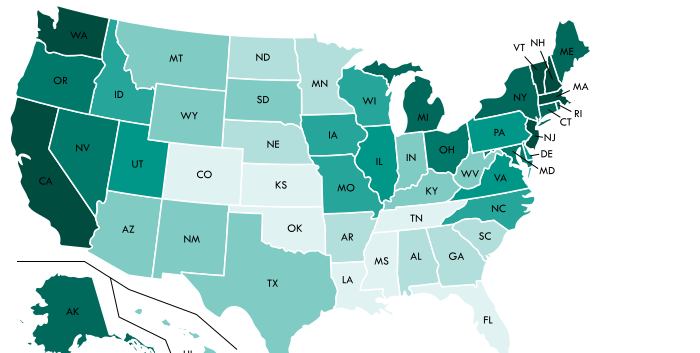
Most common states for purchasing program managers
| Rank | State | Population | # of jobs | Employment/ 1000ppl |
|---|---|---|---|---|
| 1 | District of Columbia | 693,972 | 492 | 71% |
| 2 | Washington | 7,405,743 | 2,943 | 40% |
| 3 | North Dakota | 755,393 | 201 | 27% |
| 4 | Rhode Island | 1,059,639 | 250 | 24% |
| 5 | New Hampshire | 1,342,795 | 306 | 23% |
| 6 | Delaware | 961,939 | 205 | 21% |
| 7 | Virginia | 8,470,020 | 1,696 | 20% |
| 8 | Oregon | 4,142,776 | 815 | 20% |
| 9 | Utah | 3,101,833 | 606 | 20% |
| 10 | Massachusetts | 6,859,819 | 1,286 | 19% |
| 11 | Minnesota | 5,576,606 | 1,032 | 19% |
| 12 | Montana | 1,050,493 | 198 | 19% |
| 13 | Colorado | 5,607,154 | 980 | 17% |
| 14 | Connecticut | 3,588,184 | 627 | 17% |
| 15 | Nebraska | 1,920,076 | 302 | 16% |
| 16 | Idaho | 1,716,943 | 270 | 16% |
| 17 | Maryland | 6,052,177 | 909 | 15% |
| 18 | South Dakota | 869,666 | 128 | 15% |
| 19 | Illinois | 12,802,023 | 1,820 | 14% |
| 20 | New Jersey | 9,005,644 | 1,259 | 14% |
Most common cities for purchasing program managers
| Rank | City | # of jobs | Employment/ 1000ppl | Avg. salary |
|---|---|---|---|---|
| 1 | Dearborn | 1 | 1% | $97,213 |
Purchasing Program Manager job outlook: Expert opinions
Our panel of purchasing program manager experts
Freed-Hardeman University
University of Tennessee

Swarthmore College

Western Carolina University
Auburn University at Montgomery

Maryville University

Azusa Pacific University

Pennsylvania State University - New Kensington

Mr. Supply Chain
What's a day at work look like for a Purchasing Program Manager?
Kristen Roberson: That depends on the role they are in, but the big hurdle is going to be landing that first role. They need to be willing to shift their plans, be ready to try contract or project-based work. No matter where they land, the ability to self-manage will be more critical than before 2020 since more work will be remote and much more video conferences, and a lot less travel.
Scott Gilpatric
Professor and Department HeadUniversity of Tennessee
Department of Economics, Haslam College of Business
What will help Purchasing Program Managers increase their earning potential?
Scott Gilpatric: The easy answer is being really proficient with handling data, including being comfortable with learning to code in whatever manner might be needed. There's no question those skills are likely to open doors. But in a very different way, one thing that really matters is being able to talk comfortably about ideas and developments in economics, business, or policy areas, signaling a strong base of knowledge. Towards that end, reading deeply, not just the headlines but long-form analysis in places like The Economist and other high-quality publications can be really beneficial.
What's a good job out of college for Purchasing Program Managers?
Stephen O'Connell: Work that uses your skills and builds new ones. There is a premium on your own flexibility over the couple of years, with a lot of job-market volatility due to uncertain structural impacts of the pandemic.
Will there be an enduring impact of the coronavirus pandemic on Purchasing Program Managers?
Angela Sebby Ph.D.: While jobs may be slower to return to the capacity pre-Covid, the industry and tourism employment will rebound as people still want to travel and explore diverse foods, cultures, and experiences. However, the enduring impact will be the rapid onset of technology that allowed for limited contact with employees and others has become the new norm. Although human interaction is an important aspect of service in the tourism industry, employers have found that they can reduce the number of personal interactions but still deliver an acceptable level of quality service. What would have taken years to adopt, COVID created an amplified adoption.
What soft skills should all Purchasing Program Managers possess?
TeWhan Hahn Ph.D.: Writing skills including email writing, being able to work in teams, and knowing the workplace etiquettes.
Meaghan Goodman Ph.D.
Program Director & Assistant ProfessorMaryville University
Speech-Language Pathology
What's a day at work look like for a Purchasing Program Manager?
Meaghan Goodman Ph.D.: A bachelor's in communication sciences and disorders can prepare you for three different tracks. First, it can prepare you to become a licensed Speech-Language Pathology Assistant (SLPA). This is someone who works under a fully credential speech-language pathologist. Often times, they carryout intervention plans developed by a fully credentialed speech-language pathologist. If graduate school is on your horizon, a bachelor's degree in communication sciences and disorders will prepare you for acceptance into a Speech-Language Pathology program, or an Audiology program. If you are not accepted into a graduate program right away, working as a speech-language pathology assistant (SLPA) is a great way to get experience in the field!
What's a good job out of college for Purchasing Program Managers?
Bala Musa Ph.D.: A good job out of college is one that allows you to apply creative and critical thinking skills. Future work environments will require employees to innovate and adapt. Any job that helps you cultivate, sharpen and apply those skills will serve you and your organization well. It will prepare you to adapt in the face of change and future disruptions.
What type of skills will young Purchasing Program Managers need?
Adrian Tan: The feedback from business leaders is that they wish to see a balanced mix of different skills in new graduates. An unexpected skill mentioned is the ability to use spreadsheets such as Excel. Companies do not expect to have to train new employees to use spreadsheets, though it turned out that spreadsheets are widely used (at varying levels of complexity) at all levels in organizations. An assumption here is that if a graduate already has good spreadsheet skills, then the graduate should also have the ability to quickly pick up on other more complex business IT skills required by the organization.
Businesses also need to know if their new employees can effectively interact with internal or external audiences. In this regard, excellent presentation skills are the minimum expectation from businesses. Presentation skills (both formal and informal) include the ability to read people, to communicate, and to covey information appropriately to the different types of audiences they may encounter - and these may sometimes include bored, skeptical, adversarial or even hostile audiences.
Every organization also requires graduates to show that they are good team-players. In addition to that, it is a big advantage if graduates can also demonstrate sound leadership skills in the context of teamwork. This is because new employees with leadership potential are viewed as those who are willing to go the extra mile, able to function with minimum supervision, can roll with the punches to jump back into the fray, and trusted to welcome (instead of to avoid) new assignments or challenges. Leadership skills are also seen as closely aligned with the possession of a corporate entrepreneurial mindset in that such employees are more willing to challenge the status quo, come up with out-of-the-box ideas, and help lead transformation efforts that can guide the organization in the future.
How do you envision technology impacting Purchasing Program Managers in the next 5 years?
Adrian Tan: Large organizations will likely continue to invest in data mining efforts to better understand their supply chain dynamics. Smaller companies (defined as those with reduced access to funding) will likely make increased use of cloud computing applications to remain competitive. Governments, verification or certification organizations may invest in blockchain technologies in order to reliably track sources or destinations of goods.
Are there any particularly good places in the United States for Purchasing Program Managers to find work opportunities?
Daniel Stanton: Every business and government organization has a supply chain, and that means there are job opportunities for supply chain professionals virtually everywhere. I always encourage people to focus on industries and regions that align with their personal priorities, while factoring in the upside opportunities and downside risks. It's easier to get a job with a company that is growing, and in a region that has a strong economy. But you can still find opportunities with companies that are trying to cut costs in their supply chain to survive an economic downturn.
How do you envision technology impacting Purchasing Program Managers in the next 5 years?
Daniel Stanton: Technology is having a huge impact on supply chains! Many of our planning and execution processes are being automated, and robots and autonomous vehicles are changing the way we think about transportation and material handling. Sensors and telecommunications are also giving us better visibility to what's happening throughout the supply chain, and making it much easier to control supply chain activities around the world from a laptop or cellphone. I know some people are concerned about technology replacing the work that people are doing today, and eliminating supply chain jobs. But I think there are many more examples of companies that are creating new positions for people who can plan and orchestrate the vast number of complex activities that need to be aligned in order for a supply chain to function effectively.