Explore jobs
Find specific jobs
Explore careers
Explore professions
Best companies
Explore companies
Job outlook for quality assurance scientists in the United States
Quality assurance scientist job growth summary. After extensive research, interviews, and analysis, Zippia's data science team found that:
The projected quality assurance scientist job growth rate is 6% from 2018-2028.
About 5,700 new jobs for quality assurance scientists are projected over the next decade.
Quality assurance scientist salaries have increased 14% for quality assurance scientists in the last 5 years.
There are over 11,235 quality assurance scientists currently employed in the United States.
There are 106,373 active quality assurance scientist job openings in the US.
The average quality assurance scientist salary is $68,108.
Are quality assurance scientist jobs in demand?
Quality assurance scientist job and salary trends over time
Quality assurance scientist jobs over time
Quality assurance scientist job growth rate over time
| Year | # of jobs | % of population |
|---|---|---|
| 2021 | 11,235 | 0.00% |
| 2020 | 11,265 | 0.00% |
| 2019 | 11,608 | 0.00% |
| 2018 | 11,777 | 0.00% |
| 2017 | 12,025 | 0.00% |
Average quality assurance scientist salary over time
Quality assurance scientist salary by year
| Year | Avg. salary | Hourly rate | % Change |
|---|---|---|---|
| 2026 | $68,108 | $32.74 | +3.8% |
| 2025 | $65,628 | $31.55 | +1.8% |
| 2024 | $64,486 | $31.00 | +3.3% |
| 2023 | $62,434 | $30.02 | +4.5% |
| 2022 | $59,773 | $28.74 | +1.6% |
Quality assurance scientist jobs by state
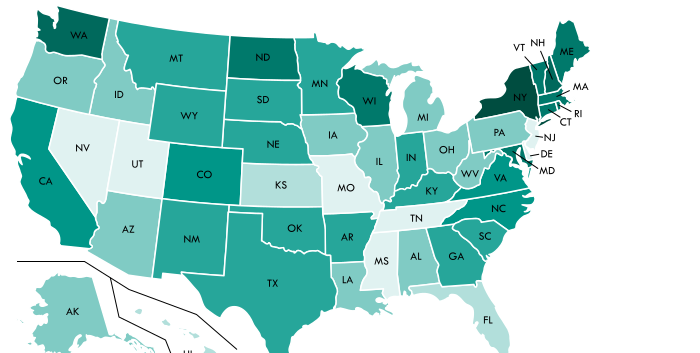
Most common states for quality assurance scientists
| Rank | State | Population | # of jobs | Employment/ 1000ppl |
|---|---|---|---|---|
| 1 | New Hampshire | 1,342,795 | 374 | 28% |
| 2 | District of Columbia | 693,972 | 195 | 28% |
| 3 | Delaware | 961,939 | 263 | 27% |
| 4 | Maryland | 6,052,177 | 1,425 | 24% |
| 5 | Virginia | 8,470,020 | 1,836 | 22% |
| 6 | Vermont | 623,657 | 129 | 21% |
| 7 | Utah | 3,101,833 | 606 | 20% |
| 8 | Massachusetts | 6,859,819 | 1,319 | 19% |
| 9 | Rhode Island | 1,059,639 | 200 | 19% |
| 10 | Minnesota | 5,576,606 | 986 | 18% |
| 11 | Connecticut | 3,588,184 | 639 | 18% |
| 12 | North Dakota | 755,393 | 135 | 18% |
| 13 | North Carolina | 10,273,419 | 1,783 | 17% |
| 14 | New Jersey | 9,005,644 | 1,571 | 17% |
| 15 | South Dakota | 869,666 | 149 | 17% |
| 16 | Wisconsin | 5,795,483 | 951 | 16% |
| 17 | Colorado | 5,607,154 | 897 | 16% |
| 18 | Oregon | 4,142,776 | 680 | 16% |
| 19 | Alaska | 739,795 | 115 | 16% |
| 20 | Indiana | 6,666,818 | 974 | 15% |
Most common cities for quality assurance scientists
| Rank | City | # of jobs | Employment/ 1000ppl | Avg. salary |
|---|---|---|---|---|
| 1 | Midland | 1 | 2% | $63,162 |
| 2 | Denver | 1 | 0% | $69,652 |
| 3 | Indianapolis | 1 | 0% | $66,169 |
| 4 | Irvine | 1 | 0% | $68,918 |
Quality Assurance Scientist job outlook: Expert opinions
Our panel of quality assurance scientist experts
Queens University of Charlotte
California State University - East Bay
North Carolina State University
Northern Kentucky University
University of the Pacific
Brigham Young University
Northern Kentucky University
Southwestern College
Harding University

Methodist University
What general advice would you give to a Quality Assurance Scientist?
John Richardson: Skills? Well, both hard and soft... Obviously, you will need to have the basic lab and knowledge skills that would be expected of a competent chemistry graduate. Yes, your new employer will spend time training you in the specific skills that pertain to your new job, but basic knowledge and skill sets (e.g., pipetting, calculating dilution factors, having baseline knowledge of common instrumentation) will be expected. As for soft skills, be friendly, cooperative, and curious. Extend these character traits to both your peers and supervisors. Other useful skills that my former students mention would be having some basic knowledge of business and perhaps coding.
Justin Moss
Assistant ProfessorQueens University of Charlotte
Chemistry
What Quality Assurance Scientist skills would you recommend for someone trying to advance their career?
Justin Moss: Likes: Ability to contribute positively to world advances, rewarding & intellectually stimulating work, ability to be creative. Dislikes: Investment of time to earn an advanced degree, continuous on-the-job training, amount of math involved.
What will help Quality Assurance Scientists increase their earning potential?
Justin Moss: The primary duties of a research chemist include designing and conducting experimental procedures, preparing solutions, using specialized equipment, data analytics software, observing safety protocols, reporting work in written documents, and communicating orally in group meetings. Work is done independently and in a team setting.
What general advice would you give to a Quality Assurance Scientist?
Monika Sommerhalter: Know your worth and look for opportunities to grow. Set yourself professional goals, whether it is a large goal (such as getting a promotion) or smaller goals (attending a workshop to master a new skill) on an ongoing basis. Keep your resume up-to-date so that it is easier for you to apply for new job opportunities within or outside of your company.
What Quality Assurance Scientist skills would you recommend for someone trying to advance their career?
Monika Sommerhalter: Expand and take care of your professional network throughout your career. Start by keeping in touch with your peers and mentors from university. Personal connections can help you find more job openings and professional development opportunities. If you surround yourself with a supportive professional network, your career path will also feel more rewarding.
What will help Quality Assurance Scientists increase their earning potential?
Monika Sommerhalter: The skill of learning itself! Being able to acquire new skills will become more important as technological progress speeds up. With more automation and machine assisted analysis, more data will be generated. The ability to distinguish relevant and meaningful information from superfluous data without getting overwhelmed will therefore also matter. Communication skills will always be relevant. Research and production teams need group members who can communicate their findings in an efficient and clear manner. With respect to Chemistry: Most analytical chemistry techniques, for example High Performance Liquid Chromatography (HPLC), will remain important for many years to come, but there will always be extensions and new developments, such as Ultra(HPLC) and new chromatography materials and detection methods. Having a solid foundation and to understand the basic principles of essential laboratory techniques in Chemistry combined with a curious and open mind to appreciate or even come-up with novel developments is a great recipe for success!
What will help Quality Assurance Scientists increase their earning potential?
Lucian Lucia: THIS IS A VERY LOADED QUESTION! CHEMISTS RECOGNIZE HOW IMPERATIVE IT REMAINS FOR CHANGING THE QUALITY OF OUR LIVES, YET, WE INTENSELY FEEL AND FACE THE BURDEN OF ITS IMAGE AS A POLLUTING FORCE AND ENVIRONMENTAL HAZARD. IN MANY WAYS, WE HAVE BROUGHT THE BURDEN ON OURSELVES BY NOT RECOGNIZING AND EMBRACING THE POTENTIAL OF GREEN CHEMISTRY AS A FORCE FOR GOOD AND CHANGE. AS WITH ANY TECHNOLOGY, THERE ARE PROS AND CONS, BUT THE COMMUNITY OF CHEMISTRY HAS NOT SUFFICIENTLY PROVIDED A COGENT ARGUMENT FOR WHY IT SHOULD BE PURSUED BY MANY MORE STUDENTS. TODAY, MORE THAN EVER, IT HAS CAUGHT THE ATTENTION OF MANY OTHER DISCIPLINES WHO DIP THEIR FEET IN IT BECAUSE IT IS SO ESSENTIAL TO MANY OF THE CHALLENGES WE ENUMERATED ABOVE. WE ARE A NOBLE PROFESSON, LIKE LAW OR MEDICINE, BUT SHROUDED IN MYSTERY BECAUSE WE DO NOT TEND TO ENGAGE IN ARGUMENTS OVERCOMING THE POLEMICS WE FACE IN SOCIETY. CHEMISTRY CAN DO A LOT OF GOOD, BUT WE NEED TO MANAGE OUR SCIENCE TO FOCUS ON ITS SUSTAINABILITY AND PROCLAIM IT FROM THE ROOFTOPS.
What Quality Assurance Scientist skills would you recommend for someone trying to advance their career?
Isabelle Lagadic Ph.D.: I’ve met employers asking me if I could teach my students basic skills like “being on time”, “writing a proper email”, “clearly and carefully documenting their work”, “using critical thinking to stop a recording or an experiment when it is obvious that it is not working”. Those very basic skills that everyone takes for granted in addition of basic technical skills are going to become the most prevalent in the coming years. What’s scary is the collision between the inevitable advancement of Ai in this field and this lack of basic skills. It is difficult to train people on tomorrow’s skills if they don’t already master today’s skills.
What will help Quality Assurance Scientists increase their earning potential?
Isabelle Lagadic Ph.D.: To expect a significant difference between the academic place and the workplace in terms of the work expectations, time management, independent work, having to take initiatives, etc. Many chemistry (or science majors in general) graduates think that their degree prepared them well for a job and are both disappointed and overwhelmed when they are confronted with the reality of the workplace. Not that starting at an entry level in this field is complicated, but because they haven’t been taught the skills, both technical and soft, to feel comfortable in the workplace.
What will help Quality Assurance Scientists increase their earning potential?
Konstantinos Vogiatzis: It’s hard to respond to this question, since chemical technology is exciting in any aspect! The chemical elements are the alphabet of a chemist, and the decillion of different combinations between them form an enormous chemical space that needs to be explored for the discovery of new, fascinating molecular structures. Modern AI is actively helping the chemist to navigate the molecular space. Some people (like me!) dislike the laborious chemical synthesis, but for others this is the true beauty of our discipline.
What will help Quality Assurance Scientists increase their earning potential?
Dr. Jingbo Liu PhD: A chemist’s day-to-day tasks vary greatly depending on their specific role and field. However, everyday tasks include designing and conducting experiments, analyzing data, writing reports, and maintaining safety protocols in the laboratory. Someone entering the field might start as a laboratory assistant or technician, preparing samples, maintaining equipment, and assisting with experiments and research. They could also be involved in data analysis, using various software tools to interpret and visualize experimental results. Furthermore, they may participate in team meetings to discuss their findings and plan future research directions. It’s a dynamic and exciting field with plenty of opportunities for learning and growth.
What will help Quality Assurance Scientists increase their earning potential?
Joseph Harrison: Chemists typically like using their problem-solving skills to advance science, but sometimes Chemists, especially in entry-level positions can be repetitive (i.e., doing the same analysis over and over again)
Dr. Jaron Hansen
Professor and ChairBrigham Young University
Chemistry
What will help Quality Assurance Scientists increase their earning potential?
Dr. Jaron Hansen: Chemists are involved in a wide range of jobs on a day-to-day basis. A chemist's day-to-day activities can vary widely depending on their specific role, industry, and field of specialization. However, here are some common tasks that chemists might engage in: Research and Experimentation, Analysis and Testing, Product Development, Quality Control, Data Analysis and Interpretation, Documentation and Reporting, Collaboration and Communication, Lab Maintenance and Safety.
What Quality Assurance Scientist skills would you recommend for someone trying to advance their career?
Patrick Hare: Don’t just look for ‘chemist’ positions. A chemistry degree sets you up to do lots of different things under lots of different names. Once you get a job, keep networking (or if you haven’t done so, start)! Your first position won’t be your last, and having a group you can tap for help getting the next job or just figuring out problems that arise in the current one is very useful.
What will help Quality Assurance Scientists increase their earning potential?
Patrick Hare: Facility with using and interpreting AI results is an obvious growing need. Many of those skills are just applied analytical and critical thinking. The trick will be to do the applying and keep them fresh. Understanding how the systems work will also be useful.
What Quality Assurance Scientist skills would you recommend for someone trying to advance their career?
Dr. Daniel King: Chemistry is such a broad field that people with a wide range of skill sets have the opportunity to be successful. People who are particularly strong in math often gravitate towards careers associated with physical or analytical chemistry. People who struggle with math but have strong experimental skills can find a career in organic, inorganic or biochemistry. People who do not like laboratory work but like chemistry might find a career as a theoretical or computational chemist. Careers might involve working in an office, working in a laboratory or working outside, depending on the subdiscipline that you choose. In addition, chemistry is likely to be part of the solution to many, if not most, of the world’s biggest problems, such as climate change, health, clean water, agriculture, affordable energy, pollution. Consequently, it is unlikely that the need for chemists will be diminishing anytime soon.
What Quality Assurance Scientist skills would you recommend for someone trying to advance their career?
David Hecht Ph.D.: Not sure- with a solid chemistry bkg and training, graduates should be equipped to learn and adapt as needed. Soft skills are VERY important and need to be developed.
What will help Quality Assurance Scientists increase their earning potential?
David Hecht Ph.D.: Work to stay positive and have a 'can do' attitude. Be willing to take on new tasks, responsibilities and try to go the 'extra mile'. Don't be afraid to say you do not know how to do something, but are willing to learn.
What Quality Assurance Scientist skills would you recommend for someone trying to advance their career?
Dennis Province Ph.D.: In the field of science, it is always a good idea to have all the skills that you can get. If you want to work in a microbiology lab, you should think about learning some chemistry or statistics. Important work never stays in one tiny corner of science; it bridges many fields and so should your skill set. People skills are also very important. Can you talk to people and communicate and listen to new ideas?
A gap year usually implies finding work as a research technician before applying to graduate or professional school. If this is the case, one question that employers and graduate programs have about their applicants are about their fitness: can they withstand the rigor at the next level? A recent graduate needs to show evidence that they are responsible and timely. The gap year should be filled with activities that show this.
What are the biggest trends we'll see in the Quality Assurance Scientist job market given the pandemic?
Dennis Province Ph.D.: Trends indicate that the job market is definitely going digital. Virtual interviews and job fairs are much more common now.
What general advice would you give to a Quality Assurance Scientist?
Dennis Province Ph.D.: You never know where you will end up later in life and what skills you will need in the future. Open your mind and become a lifelong learner. Be a student of life and learn from others at every step of the journey. Employers are always looking for workers that show initiative. Decide where you want to work and what you think you might want to do and have the courage to contact someone, and let them know! Most jobs or opportunities are found and decided with an informal conversation. Employers want the best people and those tend to be type that take the initiative.
Stephanie Hooper Marosek Ph.D.
Chair, Associate ProfessorMethodist University
Department of Chemistry and Physical Science
What skills stand out on Quality Assurance Scientist resumes?
Stephanie Hooper Marosek Ph.D.: Skills that make recent chemistry graduates stand out are research experience, internships, part-time work in labs, and hands-on familiarity with certain types of preparation, techniques, and analysis equipment. Most jobs in the field of chemistry are for analysts, so the ability to understand and perform certain methods and analyze/interpret data is a valuable skill.
Are there any particularly good places in the United States for Quality Assurance Scientists to find work opportunities?
Stephanie Hooper Marosek Ph.D.: Places that are associated with research and development, pharmaceutical or biotech companies, or large research universities are likely to have positions available for laboratory analysts. For example, our graduates are fortunate that the Research Triangle Park in the Raleigh/Durham area is close by. There are many R&D, biotech, pharmaceutical, or similar types of labs in the surrounding areas that are often looking for entry-level chemists. If a graduate is not limited by geography, then they will be able to find employment as a chemist within a few months of graduation.
What are the biggest trends we'll see in the Quality Assurance Scientist job market given the pandemic?
Stephanie Hooper Marosek Ph.D.: I think the biggest trends will be more of a willingness for graduates to expand their geographic areas in which they are searching for jobs. For chemistry graduates, there will always be a job in a lab somewhere, but you must be willing to move for it. The less a graduate is limited by location, the higher their chances of employment. Another likely trend will be an increase in graduate school applications. With a decrease in certain job markets, graduates will return to higher education in pursuit of a master's or Ph.D. to improve their resume or C.V. Many chemistry graduate programs offer tuition remission and teaching stipends/assistantships, so this is a very viable option for recent graduates who are struggling to find employment as a chemist.