Explore jobs
Find specific jobs
Explore careers
Explore professions
Best companies
Explore companies
Job outlook for reading/math tutors in the United States
Are reading/math tutor jobs in demand?
Reading/math tutor job and salary trends over time
Reading/math tutor jobs over time
Reading/math tutor job growth rate over time
| Year | # of jobs | % of population |
|---|---|---|
| 2021 | 1,410 | 0.00% |
| 2020 | 16,619 | 0.00% |
| 2019 | 21,364 | 0.01% |
| 2018 | 7,735 | 0.00% |
| 2017 | 7,759 | 0.00% |
Average reading/math tutor salary over time
Reading/math tutor salary by year
| Year | Avg. salary | Hourly rate | % Change |
|---|---|---|---|
| 2025 | $34,816 | $16.74 | +2.5% |
| 2024 | $33,966 | $16.33 | +0.3% |
| 2023 | $33,873 | $16.29 | +1.8% |
| 2022 | $33,269 | $15.99 | +1.7% |
| 2021 | $32,705 | $15.72 | +3.7% |
Reading/math tutor jobs by state
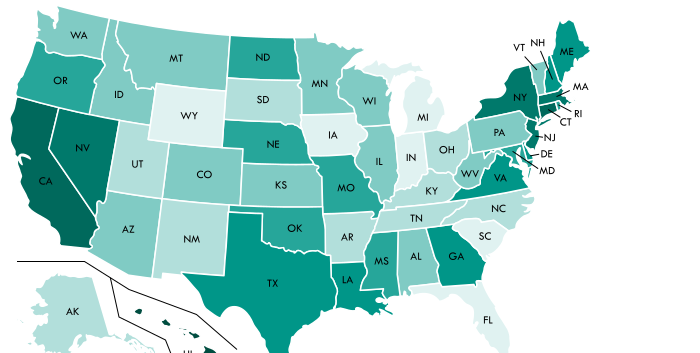
Most common states for reading/math tutors
| Rank | State | Population | # of jobs | Employment/ 1000ppl |
|---|---|---|---|---|
| 1 | Vermont | 623,657 | 105 | 17% |
| 2 | Minnesota | 5,576,606 | 870 | 16% |
| 3 | Wyoming | 579,315 | 79 | 14% |
| 4 | South Dakota | 869,666 | 92 | 11% |
| 5 | New Hampshire | 1,342,795 | 135 | 10% |
| 6 | Rhode Island | 1,059,639 | 99 | 9% |
| 7 | Montana | 1,050,493 | 96 | 9% |
| 8 | Delaware | 961,939 | 87 | 9% |
| 9 | Alaska | 739,795 | 68 | 9% |
| 10 | North Dakota | 755,393 | 66 | 9% |
| 11 | Nebraska | 1,920,076 | 147 | 8% |
| 12 | Idaho | 1,716,943 | 133 | 8% |
| 13 | Connecticut | 3,588,184 | 269 | 7% |
| 14 | Kansas | 2,913,123 | 162 | 6% |
| 15 | New Mexico | 2,088,070 | 127 | 6% |
| 16 | Maine | 1,335,907 | 81 | 6% |
| 17 | Hawaii | 1,427,538 | 80 | 6% |
| 18 | Nevada | 2,998,039 | 152 | 5% |
| 19 | Mississippi | 2,984,100 | 144 | 5% |
| 20 | West Virginia | 1,815,857 | 98 | 5% |
Most common cities for reading/math tutors
| Rank | City | # of jobs | Employment/ 1000ppl | Avg. salary |
|---|---|---|---|---|
| 1 | Austin | 1 | 0% | $35,084 |
| 2 | Dallas | 1 | 0% | $34,080 |
Reading/Math Tutor job outlook: Expert opinions
Our panel of reading/math tutor experts

Northern Arizona University
Davidson College
Capital University

Cabrini University
University of Michigan

University of Louisville

Franklin and Marshall College
Universty of San Francisco
Southern Oregon University
Texas State University
University of Louisville
Merrimack College
Thomas More University
University of Kansas

College of Saint Benedict
Queens College of the City University of New York
California State University - Fresno

Villanova University
Pennsylvania State University, the Behrend College.
Lafayette College
Lawrence Lenhart
Associate Chair nd Associate ProfessorNorthern Arizona University
Department of English
What skills will help Reading/Math Tutors earn the most?
Lawrence Lenhart: For someone working for themselves (e.g., tutor, freelance writer/editor, etc.): initiative, career self-management, innovative thinking / for someone working for a company (e.g., teacher, journalist, ): ability to leverage their strengths to support not just themselves, but entire departments; understanding/willingness to contribute to leadership's vision
What skills stand out on Reading/Math Tutor resumes?
Cynthia Lewis Ph.D.: Demonstrated facility with language; the ability to tap into how the tutor learned what the tutee needs to know and to use that knowledge in tutoring; the ability to interest students in both reading and writing accomplished prose; a command of the vocabulary of English grammar and an ability to explain good grammatical practices; a grasp of the elements of composition and style.
(Some of these skills would come out in a cover letter versus a resume.)
Bradley Conrad Ph.D.
Associate ProfessorCapital University
School of Education
What skills stand out on Reading/Math Tutor resumes?
Bradley Conrad Ph.D.: First and most obviously, it's important that they have worked with kids in some capacity in the past and particularly helpful if they have previous teaching experience. Illustrating a past history in curriculum writing (e.g., lesson plans), implementing various pedagogies, and building rapport with students help an applicant stand out. Any field experiences in K-12 settings, whether traditional or non-traditional, should be included in the resume. Depending on the content area in which the student will tutor, it should be clear on the resume and/or cover letter that the student has knowledge of or experience teaching in that particular area.
What soft skills should all Reading/Math Tutors possess?
Bradley Conrad Ph.D.: First and foremost, teachers need to be able to build relationships with students and illustrate care. In my and my colleagues' book Lesson Planning with Purpose: Five Approaches to Curriculum Design, we offer what we call the perceptive teaching framework, which highlights eight qualities of fantastic teachers, all of which are based on the vast research literature and our own research. Four of those eight qualities might be categorized as soft skills and deal with who the teacher is as a person - open-mindedness, self-and other-awareness, caring, and authenticity. Those so-called "soft skills are essential to any great teacher.
Amber Gentile
Graduate Secondary Education Program Coordinator, Middle Level Program Coordinator, Assistant Professor of Teacher EducationCabrini University
Teacher Education Program
What skills stand out on Reading/Math Tutor resumes?
Amber Gentile: Applicants that have experience in classrooms and/or with children are the ones that stand out. Being comfortable with and building relationships with children is pivotal to the learning process. Similarly, teaching skills improve by spending time observing other teachers and receiving feedback from them. Applicants must highlight their general communication and computer skills and understand and use technology and programs to enhance the teaching and learning process.
What soft skills should all Reading/Math Tutors possess?
Amber Gentile: Elementary teachers need to have the skills (communication, advocacy, interpersonal, collaboration) to build healthy relationships with their students and create communities conducive to learning (organization, creativity, patience, and problem-solving).
What skills will help Reading/Math Tutors earn the most?
Amber Gentile: In general, the longer you teach, the more you earn, so a commitment and love of the profession will help you earn the most. Similarly, enjoying being with children may prompt you to serve as a leader in extracurricular school activities, which can supplement a teacher's income. Leadership skills are important in the classroom and can enhance a teacher's earning potential with increased responsibilities and involvement in the school.
Laura Aull
Associate Professor and Writing Program DirectorUniversity of Michigan
English Language & Literature Department
What skills will help Reading/Math Tutors earn the most?
Laura Aull: The best is a combination of the above skills, including strong writing skills and strong digital communication and oversight skills.
What will help Reading/Math Tutors increase their earning potential?
Karen Chandler Ph.D.: Interest in graduate programs seems to indicate that more students are considering returning to university to pursue higher degrees. For those in the workplace outside higher ed, an environment, whether actual or virtual, that fosters recent graduates' development would be important. This would involve clear communication and trust.
Will there be an enduring impact of the coronavirus pandemic on Reading/Math Tutors?
M. Alison Kibler Ph.D.: Some things seem to have changed in the pandemic, but F&M's graduates in American Studies did quite well in the first pandemic season of job hunting.
What type of skills will young Reading/Math Tutors need?
M. Alison Kibler Ph.D.: The key for today's graduate is to come ready with relevant skills and experience. A college degree without relevant skills and experience will just not be as sufficient as in previous years to land that first, post-graduate role.
Creativity, proactivity along with strong communication skills and intellectual grit to anticipate and respond proactively to the unexpected are the competencies most prized in today's labor market. Showing that one worked through the pandemic, and even pursued additional skills and experiences relevant to a role or field, will make a graduate stand out from among their less prepared and proactive peers.
In the last class of American Studies graduates (class of 2020), I saw some students take a new path to a job. For example, one student had an internship where she worked remotely for a digital marketing firm. This then became a full-time job after graduation. Another student had worked on legal research (also remote) over the summer and in her senior seminar, and then got a job as a legal assistant in the New York DA's office. She hopes to ultimately go to law school. This is a job that other AMS alumni have secured in the past. Other students got jobs as community organizers, teachers, museum curators and entry-level business positions. These paths seemed largely the same as in the past. All built on course work and/or internships where they developed skills and deepened interest in topics. The student that went to work as a community organizer, for example, had done a senior research project on homelessness.
What are the biggest trends we'll see in the Reading/Math Tutor job market given the pandemic?
Elliot Neaman Ph.D.: In the corporate world, companies are now having to shift from a physical workspace to working at home, so that means young people entering the workforce have an advantage since they are usually more tech savvy than older people, although that is not always the case. There will be new opportunities in companies that see a lot of demand because of the pandemic. Think about at-home exercise companies like Peleton. Obviously a lot of businesses are suffering or disappearing, like retail and restaurants, so you'll see a shift away from that, but service industries are going to become even more important, especially those that fill the niche of providing services at home.
What Reading/Math Tutor skills would you recommend for someone trying to advance their career?
Elliot Neaman Ph.D.: Again, good tech training is a central requirement. I would learn to code if I were a young person. I would use the gap year to do a lot of reading and perhaps learn a language.
What general advice would you give to a Reading/Math Tutor?
Elliot Neaman Ph.D.: Above all, be flexible. The world of work was already changing very fast before the pandemic, but now all kinds of new trends are emerging. You have to be nimble and you have to learn how to learn and quickly. So don't get stuck in the old categories but think about what you can get excited about. Then, figure out the skills you need to adapt to the new workplace. If you want to start a new business, think hard about how to adapt. Even with the vaccines and the eventual overcoming of the pandemic, we are not going to be going back to the pre-COVID world. If I were in the sciences, I'd obviously think about biotech. If I were in the humanities, I would try to figure out what kind of demand there will be for people with writing skills and creative talent.
Amy Belcastro Ph.D.
Professor of EducationSouthern Oregon University
Educational Administration And Supervision
What are the biggest trends we'll see in the Reading/Math Tutor job market given the pandemic?
Amy Belcastro Ph.D.: I would refer you to my first email and add what many are saying, the genie is not going gently back into the bottle. Working from a distance is not going away. That said, the ripple effect will shift how we educate, communicate, and employ people. The ability to thrive within ambiguity, communicate effectively via technology and with cultural humility, and be innovative within and outside of the box will be in high demand.
What Reading/Math Tutor skills would you recommend for someone trying to advance their career?
Amy Belcastro Ph.D.: First, focus on updating your current resume to clearly communicate and provide evidence of your transferable skills and cognitive competencies such as strong communication and technology skills; the ability to work well with others who may be different in backgrounds, beliefs, etc.; leadership skills, and problem solving and complex thinking. After you have done this, assess where you are lacking and create a plan to strengthen your resume by seeking experiences. A very popular method of doing this is by completing a digital badge or micro-credential at an institute of higher education. It is a way of acknowledging competencies and skills in much less time than a college degree would take. Some may only be a few credits. This is becoming very popular for the workforce and therefore more institutions of higher education are offering these, some in partnership with companies.
What general advice would you give to a Reading/Math Tutor?
Amy Belcastro Ph.D.: First is to take the time to know what are your strengths and areas for improvement. You are intentionally crafting your professional reputation. Next, consider where you want to be in five years and what steps are needed to get there. It is the balancing act of long-term goals and short-time needs. Being intentional is key. Every step matters so step with intention. That said, there are many roads to Rome so explore, take risks, but be aware that you are crafting your professional reputation and self.
Are there any particularly good places in the United States for Reading/Math Tutors to find work opportunities?
Dr. Yasmine Beale-Rivaya Ph.D.: Not surprisingly, large metropolitan areas offer the largest volume and greatest range of opportunities for job aspirants with advanced foreign language skills. A recent survey of job advertisements in Texas found Arabic, Chinese, and Spanish to be the fastest-growing foreign language preferences, with increasingly numerous opportunities in Houston, Dallas/Fort Worth, San Antonio, Austin, and El Paso and their surrounding areas.
However, the career benefits afforded by expertise in a foreign language and culture are remarkable across all parts of the U.S. According to a recent employment study by Burning Doors (summarized in Forbes) more than seven in ten majors in Foreign Languages and Literatures have secured employment appropriate to their level of education within five years of taking their first job. This is first among all humanities, and also ahead of business management, marketing, education, all social sciences, biomedical sciences, health professions, and social work.
Our undergraduate and graduate students pursue many different career paths. Every year, we have several students enter Ph.D. programs and several have gone on to become tenure-track professors and visiting professors. You will also find Texas State's graduates all over the state engaging high school students with exciting language programs that include high school travel abroad and internship programs. The most recent trend, however, is for companies to select our graduates to fill very necessary service gaps due to their language skills. We already have former students working in government jobs such as the U.S. Labor Department, in health departments as translators, in the courts, as city emergency operators, and as community coordinators. We are also finding that there is more and more demand for our graduates in business fields such as business management, finance, marketing, international sales, and even the legal profession. In each of these cases, the students were hired due to their high-level and specialized language skills.
What are the biggest trends we'll see in the Reading/Math Tutor job market given the pandemic?
Dr. Yasmine Beale-Rivaya Ph.D.: This is a difficult question as we don't know what permanent changes the pandemic will produce. However, current literature on jobs and consumer interest has to do with providing a customized experience. Customers are no longer satisfied being treated as a number. They want to consume products and services that they can identify with, that make them feel as if they were produced or created with them in mind. To this point, customers want to be talked to and marketed to in their preferred language. I believe that the most successful companies will be those that can market and communicate with their customers on their level. They will want to employ people who can address multiple markets. In a highly-competitive globalized market, the higher-level language skills one has, the more versatile and valuable one becomes to an employer.
What skills stand out on Reading/Math Tutor resumes?
Dr. Yasmine Beale-Rivaya Ph.D.: Job candidates whose resumes indicate advanced foreign language skills and international sophistication generally receive greater consideration from potential employers.
The skills that I think will be the most important are demonstrating that one has the ability to respond to customers in a way that resonates personally with them. In terms of language, that means being able to communicate with customers in their language, and especially, in their dialect. It won’t be enough to just be able to speak the language. Employees will need those unquantifiable skills and a deep knowledgebase that only comes through a sustained and broad knowledge of the culture and literature. This level of cultural sophistication is in demand across various professional fields, such as journalism, international relations, translation, interpretation, publishing, higher education, global business, health care, and customer service.
I believe employers are going to look for employees who can produce professional material in the target language at a high skill level and also produce material that is targeted to their different customer markets. Content will need to be creative and reference all those items that form part of a person’s cultural memory and traditions. Thus, companies will not be able to rely on auto-translations.
Among our language offerings at Texas State are Chinese, Japanese, Arabic, Russian, and Portuguese, which are all designated as Critical Languages by the U.S. Department of State. Academic programs that enable students to acquire foreign language skills while acquiring intercultural competency in critical languages help prepare them to meet the specific demand for specialists in global communications and international affairs.
Advanced language study in the form of minors or second majors complements the skills of graduates in other academic majors such as International Relations, International Studies, History, Political Science, Psychology, English, Anthropology, Philosophy, Religious Studies, Economics, Mass Communication, Communication Studies, Journalism and Mass Communication, Criminal Justice, and Computer Science, providing students the opportunity to enhance their professional career opportunities.
What are the biggest trends we'll see in the Reading/Math Tutor job market given the pandemic?
Janet Kelly Ph.D.: Telecommuting. We learned that employees - public employees - can serve the public effectively while working from home. We should see less clustering of public administrators in city centers, a reduced need for public buildings and other physical infrastructure, and more emphasis on the kinds of skills that support telecommuting.
What skills stand out on Reading/Math Tutor resumes?
Janet Kelly Ph.D.: Evidence that the candidate can work effectively in teams and can meet deadlines. Employers tell me our graduates are plenty capable, but sometimes are deficient in the soft skills associated with teamwork and may struggle with organizing their work schedule to meet project deadlines (translate: they procrastinate).
What type of skills will young Reading/Math Tutors need?
Deborah Margolis Ph.D.: COVID has taught us many things about education in the U.S., for example, that we were woefully underprepared to deal with a pandemic. But it has also taught us that some of the most important characteristics needed for young graduates looking to enter the field are flexibility, resilience, and perseverance.
We have always wanted to be sure that graduates of education programs are prepared to teach the students in their classrooms as well as the content, but what we have learned is that we can't plan for all possible scenarios and that while we might try and we might get better at planning for the unexpected, good teachers need to be flexible in their thinking and in their ability to shift gears and do things differently. Good teachers need to be resilient in the face of adversity so that they can recognize risk factors and manage them without alarm and panic because panicky adults signal alarm to students.
For many years we have known that perseverance is one of the most important characteristics involved in student success and we have learned that the same is true for teachers. Changes in modality have been challenging for most if not all teachers and those who have been able to persevere in the face of the changes have been more successful. Graduates also need to have familiarity and comfort with educational technology platforms. Finally and perhaps most importantly, graduates need to have knowledge of and willingness to support the social-emotional development of students. This is true in any teaching setting but is critical during times of unusual, chronic, and unrelenting stress.
Are there any particularly good places in the United States for Reading/Math Tutors to find work opportunities?
Deborah Margolis Ph.D.: The COVID pandemic has triggered the retirement of many seasoned educators, so many districts are in need of committed new graduates. Typically, during non-pandemic times, urban districts tend to have more openings. Commitment to teach in an urban or otherwise underserved district can provide a wonderful experience for new graduates looking to make a meaningful contribution to the education and lives of the students with whom they work.
How do you envision technology impacting Reading/Math Tutors in the next 5 years?
Deborah Margolis Ph.D.: One of the many things that COVID has taught us is the importance of educational technology and that educators need to have facility with technology. We have also learned that some things that we thought had to be done in person, can be done remotely/virtually. Since some experts suggest that we may be dealing with COVID and remnants of COVID until 2025, educational technology will continue to play an important role for us in the U.S. The use of technology during the pandemic has also shown us ways that education can be enhanced for those who might otherwise be unable to access on-ground educational opportunities.
Dr. Jodie Mader Ph.D.
Professor, Chair, Faculty Development DirectorThomas More University
History Department
What experience really stands out on Reading/Math Tutor resumes?
Dr. Jodie Mader Ph.D.: What stands out is one's ability to critically think and write. Applicants that can demonstrate the ability to communicate and think critically will be essential to the modern employer.
Will there be an enduring impact of the coronavirus pandemic on Reading/Math Tutors?
Dr. Jodie Mader Ph.D.: There is will the obvious social and economic impacts. Jobs will change and graduates need to be cognizant of where jobs will be located and adapt their skills to them. Graduates need to be aware of the new and old skills required of employers, and a key one will be their command of technology and their ability to use it.
Luis Corteguera
Professor and ChairUniversity of Kansas
Department of History
What are the biggest trends we'll see in the Reading/Math Tutor job market given the pandemic?
Luis Corteguera: The pandemic and the economic crisis has only highlighted the value of a university education. People with a BA/BS continue to do better economically than those without, and the difference will increase. The specific area of study will be less important than having the degree in hand. Rather than seeking an education that offers professional training - which are hard to predict and employers usually provide - a liberal arts education will actually prove more valuable in the long-run, since employers consider such graduates to have a greater variety of intellectual and analytical skills that will enable them to adapt and be trained to solve the complex problems of the future.
What Reading/Math Tutor skills would you recommend for someone trying to advance their career?
Luis Corteguera: Learning a language is one of the most important skills to acquire, and there are many opportunities that can later be complemented with university courses. Any kind of professional experience can also be valuable, not necessarily because it will help to build a resume for the future, but more importantly, to explore interests and maybe discard options. These experiences can also give students a better awareness and appreciation for the skills that can best be acquired through university studies.
What general advice would you give to a Reading/Math Tutor?
Luis Corteguera: Make a plan for the future that outlines short-, medium-, and long-term goals. Discuss these plans with a variety of people (family, friends, acquaintances, professionals in areas of interst), and if available, with career planning professionals at the university, many of which continue to offer support even after graduation. Request "informational interviews" with all kinds of people in professions that may be of interest, even if you don't know them personally. Not only are these helpul to ask questions about career paths, but these interviews can also help to build professional networks.
Jeffrey Anderson Ph.D.
Associate ProfessorCollege of Saint Benedict
Department of Peace Studies
What are the biggest trends we'll see in the Reading/Math Tutor job market given the pandemic?
Jeffrey Anderson Ph.D.: Gap years in our field, where graduates collect some really formative experiences, are common. The pandemic has made this more challenging for a couple of reasons. First, deployments in organizations like the Peace Corps have continued to be pushed back. International placements have been very hard hit. Second, when many formerly direct service positions do start, many have been in a remote format. This has been a challenge for graduates to make connections with coworkers and the community in which they serve.
These issues are likely to continue for the near future. The pandemic, however, has created widespread concern for topics connected to social determinants of health. COVID has shined a light on healthcare inequalities, unhealthy environments, and the vulnerability, economic and otherwise, of essential workers. Already, I have observed more positions in our field being created by hospital systems, departments of health, health insurance organizations, and nonprofits designed to reduce health disparities. This has created engaging work opportunities for our graduates.
Zavi Gunn
DirectorQueens College of the City University of New York
Center for Career Engagement and Internships
What skills stand out on Reading/Math Tutor resumes?
Zavi Gunn: The ability to analyze data, spreadsheets, formulas, and pivot tables is increasingly in demand. Highlighting your collaborative, creative, and innovative side is also a plus. In addition, employers look for digital competency - particularly video editing and social media management skills.
Negin Tahvildary Ph.D.
Lecturer, Director, Mediator Mentors ProgramCalifornia State University - Fresno
Department of Philosophy
Will there be an enduring impact of the coronavirus pandemic on Reading/Math Tutors?
Negin Tahvildary Ph.D.: There is no doubt that the pandemic, economic hardships and virtual learning are overwhelming college students around the nation more than before. At the same time as someone who teaches Peace and Conflict Studies, I am a strong believer that one can convert a challenge into an opportunity. For instance online teaching has definitely made us - the educators - become more creative and redesign our courses and redefine our curricula to be more inclusive of different populations and humanize our online course and establish a social presence. In the meantime I invite my students to stretch out of their comfort zone and face the invisible and visible barriers with creativity and enthusiasm. If we can establish strong proactive communication, we can motivate students and reduce the anxiety of this uncertain time, especially when it comes to making choices for their future professional lives.
What type of skills will young Reading/Math Tutors need?
Negin Tahvildary Ph.D.: Considering that for the first time in history, there are five generations in the workplace, and with recent changes in the population demographics locally and nationally, it is essential for future practitioners to gain proper knowledge in cultural competence, develop social-emotional skills and most importantly, practice critical thinking. These three skills are transferable regardless of the industry. We need to empower compassionate, highly-trained, intellectually-curious, adaptive leaders to efficiently deliver services that meet the social and cultural needs of our nation and the globe.
What experience really stands out on Reading/Math Tutor resumes?
Negin Tahvildary Ph.D.: Beyond our central role of educating the next generation of graduates, we must also prepare them to be career-ready, to begin contributing to our nation's success as the next generation of leaders. As a former lawyer and UN officer, I think effective teaching in my field means providing my students with as much exposure to hands-on experience. Therefore, I value students who seek opportunities beyond their normal academic settings and participate in extracurricular activities. I personally have developed a program called the Mediator Mentors as a service-learning initiative which promotes problem-solving skills through cross-age mentorship. At the same time, jobs are becoming more hybrid and therefore we should encourage students to choose between various minors and certificate programs also available on our campuses. For instance, at Fresno State Philosophy Department, apart from traditional philosophy courses, we offer several minors and certificates within the Pre-Law, Peace and Conflict Studies, Religious Studies, and Middle East Studies programs as well as Social Justice and Social Change.
What are the biggest trends we'll see in the Reading/Math Tutor job market given the pandemic?
Sally Scholz Ph.D.: Many of our graduates had to shift gears rapidly. Students who had planned to launch a new career decided instead to take up part-time or temporary positions that would allow them more flexibility. One of the biggest trends is not in the job market, per se, but in the work/life planning. Many of our graduates found themselves moving back home to live with parents rather than launching into a new city. Even those with new jobs spent the first six months of the position being trained and working remotely. They tended to stay with parents in order to save money and avoid moving to a new city during a time when finding a social community would be difficult.
What skills stand out on Reading/Math Tutor resumes?
Dr. Amy Carney Ph.D.: That's a hard one to pin down for a history major! I think it entirely depends on the job. Having the ability to fine-tune your resume and cover letter for each job application to highlight the most important skills for that job is a super ability to have. But in general, I would say that demonstrating strong critical thinking and communication skills will always be high on my list for a strong resume. Having those skills front and center will serve as a solid foundation on which a person can best sell him/herself in any job application.
Are there any particularly good places in the United States for Reading/Math Tutors to find work opportunities?
Dr. Amy Carney Ph.D.: We need great teachers, lawyers, archivists, librarians, analysts, et cetera, everywhere in the country. There are often opportunities at think tanks, research institutes, publishers, and government agencies around the country. History is also a viable route for people interested in management and leadership positions in business, and such jobs are likewise available around the country.
What are the biggest trends we'll see in the Reading/Math Tutor job market given the pandemic?
Dr. Amy Carney Ph.D.: I think one of the biggest trends we are going to continue to see in the job market is also a valuable skill for college grads and soon-to-be college grads: flexibility. This has always been a minor trend for many jobs - for example, are you willing to move to another part of the state or country for a job? But flexibility is a much more prominent trend now - are you capable of quickly learning the necessary skills to do your job in different formats? In this regard, someone with a history degree, or another humanities or liberal arts degree, will be in a very strong position to apply for a wide range of jobs because of the diverse portfolio of transferable skills students learn in these majors, not the least of which are communication skills.
What type of skills will young Reading/Math Tutors need?
Eric Ziolkowski Ph.D.: The unnatural experiences, over a protracted period, of enforced quarantine, masking, "social distancing," working "remotely," deprivation of normal group activities (clubs, sports competitions, etc.) - all such experiences are likely to produce a generation of students with an increased appreciation of the human need for social connectedness complementing a deepened awareness of the limitless resources of one's private inner life.
What experience really stands out on Reading/Math Tutor resumes?
Eric Ziolkowski Ph.D.: No area of academic inquiry is better suited than religious studies, an inherently interdisciplinary area devoted to critically fathoming the limitless spiritual resources of religions, for encouraging students to cultivate the kinds of intellectual perspectives and skills that will be needed to navigate the existential quandaries and challenges of the post-pandemic world.
Will there be an enduring impact of the coronavirus pandemic on Reading/Math Tutors?
Eric Ziolkowski Ph.D.: It is difficult to predict, but it seems that college and university students who have been pursuing their degrees during the time of the pandemic may be expected to proceed through subsequent life and their careers with a heightened sense of the instability and precariousness of the "normal," "everyday" modes of being.