Explore jobs
Find specific jobs
Explore careers
Explore professions
Best companies
Explore companies
Job outlook for recreation program coordinators in the United States
Are recreation program coordinator jobs in demand?
Recreation program coordinator job and salary trends over time
Recreation program coordinator jobs over time
Recreation program coordinator job growth rate over time
| Year | # of jobs | % of population |
|---|---|---|
| 2021 | 2,417 | 0.00% |
| 2020 | 2,982 | 0.00% |
| 2019 | 3,285 | 0.00% |
| 2018 | 3,238 | 0.00% |
| 2017 | 3,226 | 0.00% |
Average recreation program coordinator salary over time
Recreation program coordinator salary by year
| Year | Avg. salary | Hourly rate | % Change |
|---|---|---|---|
| 2026 | $41,569 | $19.98 | +7.9% |
| 2025 | $38,514 | $18.52 | +5.1% |
| 2024 | $36,628 | $17.61 | +2.1% |
| 2023 | $35,868 | $17.24 | +2.8% |
| 2022 | $34,889 | $16.77 | +2.4% |
Recreation program coordinator jobs by state
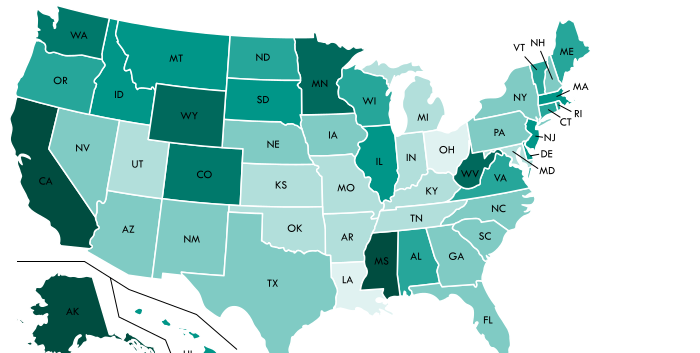
Most common states for recreation program coordinators
| Rank | State | Population | # of jobs | Employment/ 1000ppl |
|---|---|---|---|---|
| 1 | North Dakota | 755,393 | 301 | 40% |
| 2 | Delaware | 961,939 | 317 | 33% |
| 3 | Kansas | 2,913,123 | 735 | 25% |
| 4 | New Mexico | 2,088,070 | 514 | 25% |
| 5 | South Dakota | 869,666 | 221 | 25% |
| 6 | Arkansas | 3,004,279 | 689 | 23% |
| 7 | Idaho | 1,716,943 | 383 | 22% |
| 8 | New Hampshire | 1,342,795 | 270 | 20% |
| 9 | Alabama | 4,874,747 | 908 | 19% |
| 10 | Oklahoma | 3,930,864 | 659 | 17% |
| 11 | Montana | 1,050,493 | 182 | 17% |
| 12 | Rhode Island | 1,059,639 | 182 | 17% |
| 13 | Minnesota | 5,576,606 | 819 | 15% |
| 14 | Utah | 3,101,833 | 472 | 15% |
| 15 | Nebraska | 1,920,076 | 283 | 15% |
| 16 | Colorado | 5,607,154 | 808 | 14% |
| 17 | Oregon | 4,142,776 | 577 | 14% |
| 18 | Connecticut | 3,588,184 | 498 | 14% |
| 19 | District of Columbia | 693,972 | 93 | 13% |
| 20 | Arizona | 7,016,270 | 814 | 12% |
Most common cities for recreation program coordinators
| Rank | City | # of jobs | Employment/ 1000ppl | Avg. salary |
|---|---|---|---|---|
| 1 | Iowa City | 1 | 1% | $38,779 |
| 2 | Peoria | 1 | 1% | $47,220 |
| 3 | Long Beach | 1 | 0% | $57,740 |
Recreation Program Coordinator job outlook: Expert opinions
Our panel of recreation program coordinator experts
University of New Hampshire
California State University - Sacramento
Trine University
Temple University

University of New Hampshire
University of New Hampshire

University of New Hampshire
Eastern Kentucky University
Central Washington University
Shepherd University
The University of Georgia
Central Michigan University
Clemson University
Eastern Washington University
Middle Tennessee State University

Kent State University
Seattle University
East Tennessee State University

The USA Hockey Foundation
What Recreation Program Coordinator skills would you recommend for someone trying to advance their career?
Matthew Frye M.S., CTRS/L: The role of recreation is shifting toward public health and community wellness across the lifespan. Recreation professionals need to become better acquainted with the wants and needs of older adults, community members with disabilities, and other traditionally underrepresented groups.
What will help Recreation Program Coordinators increase their earning potential?
Matthew Frye M.S., CTRS/L: A degree in recreation management is certainly the fastest way to promotion and advancement in our field. But, even as a new professional, having a degree makes you valuable due to the breadth and depth of the skill set with which you leave school. Otherwise, be sure that you can clearly articulate the role you play in your communities pursuant to the public good (overall health, increased property values, youth development and retention, etc),
Dr. KC Bloom Ph.D.
ProfessorWhat will help Recreation Program Coordinators increase their earning potential?
Dr. KC Bloom Ph.D.: Recreation managers work in a variety of settings and their tasks vary day to day. They may work on nature conservation projects, run programs for different groups, and focus on community and environmental health. Those entering the field often start in assistant or coordinator roles, spending time both planning and engaging with the public.
Dr. Jamie Hoffman CTRS
Chair, ProfessorCalifornia State University - Sacramento
Leisure And Recreational Activities
What Recreation Program Coordinator skills would you recommend for someone trying to advance their career?
Dr. Jamie Hoffman CTRS: Recreation Managers typically walk the walk and talk the talk. With that said, they are advocates for health, wellness and experiences. This includes protecting and preserving natural environments, providing accessible and inclusive experiences and serving individuals of all backgrounds, ages and abilities. Depending on the agency one works for, this may prevent or promote the ability of the Recreation Manager to navigate bureaucracy and or other challenges related to funding, deficits in assets, equipment or spaces. Whether the Recreation Manager is working in a government agency, non-profit organization or for profit business, each environment poses its own challenges. Having consistent professional training and development opportunities as well as cost effective avenues for education, some barriers exist to continue to grow and develop in ones career. When discussion a Recreation Managers likes of their job the list is lengthy. Having the opportunity to work in many diverse environments: hostels, arenas, parks & recreation organizations, non-profits, athletic gyms and clubs, sports facilities …etc., this creates endless spaces and places for one to work. In addition to environments, the populations one may have the opportunity to work with are also very diverse. Recreation Managers work with individuals from the crib to the crypt including tot program, youth sports, teen centers, co-ed adult sports, senior centers etc. As far as abilities, one can work with individuals with neurodiversity, physical disabilities, addiction..etc. In addition, the Recreation Manager has the potential to work with and impact individuals from diverse cultures. This broad scope of practice is an attractive aspect of working as a Recreation Manager. Having the opportunity to increase the quality of life of individuals is a tremendous component of job satisfaction. Recreation Managers strive to maintain life balance and develop healthy lifestyle choices. Having the opportunity to have your work be fun and enjoyable is a choice but also an honor.
What will help Recreation Program Coordinators increase their earning potential?
Dr. Jamie Hoffman CTRS: Day-to-day management in the field of recreation varies based on the facility, season, and program. If we are talking about someone working in an arena, one day may be the set-up for a Taylor Swift concert and that night a strike of the production starting at midnight including a clean sweep and turnover of the facility to have an ice arena for Disney on Ice for a three day show. Clearly the tasks associated with managing a facility that has such a high volume of attendees as well as drastic variety of events and shows is demanding on both the facility and maintenance staff as well as the manager. In contrast another example of a Recreation Manager’s day-to-day workload may include a director of a state park. This individual is managing nature spaces, ensure safety of visitors, providing programming including interpretive walks and talks at various sites throughout the park as well as maintaining oversight of capital improvement projects such as the redevelopment of a space or construction of a building. While many of the job responsibilities of a Recreation Manager include oversight of staff, facilities and programs or events, the day-to-day operations and tasks associated with doing the job are so drastically different based on the spaces and experiences provided. This is one of the reasons becoming a Recreation Manager is such a fulfilling career because there is such a drastic variety of job responsibilities as well as opportunities within the field leaving life to never have a dull moment.
Brandon Podgorski
Associate Professor of Sport Management - Trine UniversityTrine University
Parks, Recreation, And Leisure Facilities Management
What Recreation Program Coordinator skills would you recommend for someone trying to advance their career?
Brandon Podgorski: Be a sponge and try to learn as much about the industry and your organization as possible. Not only will this make you valuable to your current employer, but it will prepare you for future roles in parks and recreation management, because the field is so broad. Don't let any job be beneath you and be the type of person people like to be around. At its heart, parks and recreation management is a people-facing industry, so you want to provide your uses with the best experience possible.
What will help Recreation Program Coordinators increase their earning potential?
Brandon Podgorski: I like to reverse engineer this question. Find the jobs that pay the most and start to acquire the education and experience needed to land these positions as early as possible in your career. Have a value mindset and think about the things you can do to add value to your employer. You'll see your career take off on a faster trajectory than your peers.
Daniel Funk Ph.D.
Professor and Ed Rosen Senior Research FellowTemple University
Parks, Recreation, And Leisure Facilities Management
What general advice would you give to a Recreation Program Coordinator?
Daniel Funk Ph.D.: Parks and recreation as a profession offers a diverse employment and career ecosystem as individuals work in and across a variety of settings. A beneficial element to focus on when beginning a career is to adopt a service excellence perspective. In other words, focus on designing and delivering experiences that enhance users' (or participants) physical, mental, and social well-being. Also, don't forget to apply what you learned in academic courses and through industry internships. The knowledge and experience gained will become more relevant and valuable as you move upward beyond entry level positions. Given the current age of the workforce in P&R, there will be opportunities for advancement into leadership/management roles.
What Recreation Program Coordinator skills would you recommend for someone trying to advance their career?
Daniel Funk Ph.D.: The US Bureau of Labor and Statistics projects employment of recreation workers will grow 5% from 2022 to 2032 providing opportunities for both employment and potential career advancement. Key skills for P&R professionals will be interpersonal (ability to build relationships with participants, colleagues, and community leaders), communication (ability to create and convey information to diverse audiences), organizational (ability to manage multiple projects and tasks), problem-solving (ability to critically think to adapt to situations and address diverse participant needs) and leadership (ability to motivate participants and inspire colleagues). As the US population ages, there will be demand for life-long recreation and well-being for older adults.
What will help Recreation Program Coordinators increase their earning potential?
Daniel Funk Ph.D.: When beginning a career in P&R, a professional should be willing to seek out opportunities within an organization (to gain diverse skills and competencies across functional areas) and willing to move geographically to similar organizations. It will also be beneficial to join national, state, and regional organizations like National Recreation and Parks Association, National Intramural Recreational Sports Association, and American Therapeutic Recreation Association. Attempt to attend their conferences to keep up with current trends and network.
Robert Barcelona Ph.D.
Department Chair and Associate ProfessorUniversity of New Hampshire
Department of Recreation Management & Policy
What skills will help Recreation Program Coordinators earn the most?
Robert Barcelona Ph.D.: One of the emerging trends that we are seeing is comfortability with data analysis - particularly having the skill set to collect, analyze, and interpret quantitative data, and to make decisions based on that analysis. Those with the skills to analyze large-scale park usage data, for instance, can help drive decisions and set policy regarding pricing, maintenance, staffing, and transportation, among others. Being comfortable working with and managing data can be a difference-maker.
What skills stand out on Recreation Program Coordinator resumes?
Robert Barcelona Ph.D.: I think the more practical experiences a student has coming out of their university program, the better. Skills like program and event planning, social media marketing, experience with budgeting and financial decisions, risk management, revenue generation, and staff supervision are key.
What soft skills should all Recreation Program Coordinators possess?
Robert Barcelona Ph.D.: Collaboration is a really important soft skill - having the ability to work with others to achieve common goals is such a critical skill for recreation professionals to have. Flexibility and adaptability are also important - how do you manage when things don't go according to plan or when you have to improvise? Creativity and outside-the-box thinking are really important, especially in the age of COVID-19. Look at the creative programs and events that have emerged during the pandemic - virtual 5K races and fitness classes, online instructional programs, self-guided nature programs, do-it-yourself summer camp - and many, many others. Finally, understanding the value of diversity and inclusion is critical today - recreation is for everyone, so professionals need to understand how to increase access and reduce barriers to recreation participation for the entire community.
What hard/technical skills are most important for Recreation Program Coordinators?
Robert Barcelona Ph.D.: Being comfortable with specific technology applications like facility scheduling and maintenance and point-of-sale software, spreadsheets and databases, desktop publishing, and Photoshop are all really important. In the end, recreation specialists need to have a solid foundation in program and event design, personnel management, organizational leadership, finance and budgeting, risk management, marketing and promotion, program evaluation, facility and equipment management, strategic and master planning, and working in government and policy environments.
Jayson Seaman
Associate Professor of Outdoor Leadership and ManagementUniversity of New Hampshire
Department of Recreation Management and Policy
How have salaries changed over time for Recreation Program Coordinators?
Jayson Seaman: For full-time jobs, entry-level salaries are comparable to other human service fields like education or social work. Seasonal or contract work pays reasonably well and often gives the kind of flexibility and geographical mobility young outdoor professionals appreciate. Managerial or administrative positions are compensated adequately and usually well-benefitted, especially in federal or municipal agencies. We're seeing interest in some states in outdoor education and recreation becoming a credentialed area in schools, which will more closely align salaries with school-based jobs like teaching.
What are the biggest trends we'll see in the Recreation Program Coordinator job market given the pandemic?
Jayson Seaman: I anticipate strong employment following the pandemic in both outdoor recreation and education sectors. People have rediscovered the outdoors as an important resource for leisure and wellness, and communities with lots of outdoor amenities are thriving. There will be many opportunities to manage and serve outdoor users in the future both directly and indirectly. Additionally, families and parents have also relished the opportunity during the pandemic to enroll their kids in outdoor activities. What service providers have managed to stay open have experienced a surge of interest, with so few other opportunities for kids to stay healthy, active, and connected to peers. We're even seeing bipartisan interest among legislators to support outdoor education and recreation in and out of schools going forward.
What certifications/licenses/courses can have the biggest impact for Recreation Program Coordinators?
Jayson Seaman: I am on the outdoor leadership side of the field where wilderness medical training is important as are other activity- or discipline-specific certifications from groups like the American Canoe Association (paddlesports) and the American Mountain Guides Association (alpine and rock climbing). Job candidates should be sure to pursue certification through reputable, national bodies and associations.
What will help Recreation Program Coordinators increase their earning potential?
Michael Ferguson Ph.D.: There are two primary channels that will help people increase their earning potential in the field of recreation management and policy: 1) education, and 2) field experience. Ideally, a combination of both. An undergraduate and master's degree in recreation management and policy establishes foundations in the theories, philosophies, research, methods, and administration of outdoor recreation management while preferably gaining skills and proficiencies in outdoor activities such as climbing, canoeing and backpacking (see the RMP OLM site for more insight). Field experience in parks and protected areas can be acquired through internships, practicums, field research, and job shadowing as well.
Will there be an enduring impact of the coronavirus pandemic on Recreation Program Coordinators?
Michael Ferguson Ph.D.: The COVID-19 pandemic has had a profound impact upon outdoor recreation both in the United States and worldwide. In the decades leading up to the pandemic, outdoor recreation visitation had consistently and incrementally increased across local, state, and federal parks and protected areas. Adding fuel to this visitation fire, the pandemic has caused dramatic and abrupt increases in visitation across an already overwhelmed parks and protected areas system. This explosion in interest in parks and protected areas has created both benefits and challenges for the visitors, communities, stakeholder, and managers who are dependent upon the outdoor recreation industry. Moreover, the pandemic has open myriad opportunities for students graduating with a degree in Recreation Management and Policy. Now more than ever, parks and protected areas at the local, state, federal, private, and non-profit levels are demanding an educated and skilled workforce to manage and protect these resources while simultaneously providing high-quality outdoor recreation experiences.
What certifications/licenses/courses can have the biggest impact for Recreation Program Coordinators?
Michael Ferguson Ph.D.: There are numerous certifications, licenses, and competencies that will significantly increase a student's job opportunities and prospects. Within the realm of parks and protected areas, these include, but are not limited to: geographic information systems, parks planning and management, natural resource management, social science research, quantitative and qualitative research methods, advanced statistical analysis, wilderness first responder (WFR), certified park and recreation professional (CPRP), certified parks and recreation executive (CRPE), aquatic facility operator (AFO), american institute for avalanche research and education 1-3 (AIARE), association for challenge course technology 1-3 (ACCT), etc., just to name a few.
Dr. Brian G. Clark
Assistant ProfessorEastern Kentucky University
Department of Recreation & Park Administration
What will help Recreation Program Coordinators increase their earning potential?
Dr. Brian G. Clark: Continuing to further your education is always an excellent way to increase your earning potential in any field. Separating yourself from other candidates by obtaining an undergraduate and/or graduate degree is going to go a long way in our current competitive job market. Another area is gaining certifications and professional trainings. There are so many different certifications and trainings for recreation practitioners, and this will increase your job opportunities as well as your earning potential. I recommend looking for the job you want and setting yourself up by meeting the preferred qualifications not just the required or minimum qualifications.
Will there be an enduring impact of the coronavirus pandemic on Recreation Program Coordinators?
Dr. Brian G. Clark: Parks and Natural areas have seen a huge increase in visitor usage during the pandemic. More and more people have been engaging in outdoor recreation as a way to be active while indoor recreation centers have been closed or having limited capacity. So, there will probably be an enduring impact on graduates in a couple different ways. One will be how we recover and restore these natural areas after we have seen the carrying capacity exceeded. With the increase in visitor usage there will be an impact on these areas and restoring these natural areas will be a major project over the years to come. Also, there will be an opportunity to capitalize on this increase in outdoor recreation and continue to provide areas and experiences for these visitors. I believe this increase will continue and the real challenge will be how to manage these areas in a sustainable way. I hope this increase will lead to more support of parks and recreational areas and therefore more land availability and funding.
What's a good job out of college for Recreation Program Coordinators?
Dr. Brian G. Clark: There are so many jobs within the recreation and park profession. Recreation, Parks and Tourism is the largest industry in the world! You can work for state and local parks, YMCA, federal parks and land management agencies, outdoor retailer stores, local guides and outfitters, university programs, wounded warriors, Special Olympics, and even the military with the (MWR) morale, welfare and recreation. All of these areas provide numerous jobs and positions with great benefits and really the opportunity to transform the lives of the people in your communities. Parks and Recreation professionals are health care providers. We are even seeing physicians starting to prescribe physical activity in park settings to their patients.
Dr. David Rolfe
Associate ProfessorCentral Washington University
Department of Sport and Movement Studies
What are the biggest trends we'll see in the Recreation Program Coordinator job market given the pandemic?
Dr. David Rolfe: A big trend of recreation during the pandemic is being creative in programming when the vast majority of our work is dependent on close personal interaction. For example, how do we encourage people to participate in healthy and fun activities when we are severely limited? Is it possible to open parks, community centers, gyms, sports leagues, etc. while mitigating risk? This is the big trend right now.
What certifications/licenses/courses can have the biggest impact for Recreation Program Coordinators?
Dr. David Rolfe: Although a certification is not necessarily required for many positions in Recreation, often upper-level managers and directors are encouraged to be a "Certified Parks and Recreation Professional" (CPRP). This is a certification offered through the National Recreation and Parks Association. Additionally, there are certifications for specific career tracks within Recreation Management: Aquatic Facility Operator (AFO) for pool managers, Certified Playground Safety Inspector (CPSI) for those interested in maintaining playground equipment. These are really only needed for specific positions; not the recreation generalist.
What's a good job out of college for Recreation Program Coordinators?
Dr. David Rolfe: A good entry-level position in Recreation would be something like a Recreation Coordinator, Recreation Specialist, Camp Director, or any entry-level manager overseeing a specific function of a recreation operation such as aquatics, youth, sports, teen, seniors, etc. These would all be great entry-level positions because they offer the employee some limited responsibility in staff and budget management, all while still maintaining a direct connection to the customers served. These positions are often found in municipal parks and recreation departments, non-profit organizations (such as the YMCA or Boys and Girls Clubs of America), and commercial businesses (such as resorts, outfitters, private clubs/gyms).
Dr. Stacey Kendig
Director and Associate ProfessorShepherd University
School of Recreation, Sport and Exercise Science
Will there be an enduring impact of the coronavirus pandemic on Recreation Program Coordinators?
Dr. Stacey Kendig: I think there have been many challenges with college graduates and finding employment in their specific areas of interest over the past several years even without a pandemic. Most of our recent graduates have stayed in touch using social media platforms; many of ours using LinkedIn, so we are somewhat aware of where they have found jobs. There are some who have found a position within their academic program and others who have struggled with finding employment, so have simply taken positions that may not be remotely related to their degree program. I think there is so much competition in the workforce, that our graduates need to be more proactive in securing employment. I also believe that a master's degree has become a requirement of many organizations. This, due to employers seeking a workforce in "specific" and not general areas. Now, throw in the pandemic and this creates an even larger challenge and barrier for graduates, simply due to the reduction in most workforces. For example, the sport industry with the cancellations of most, have reduced workforces because people are not needed (stadiums, hotels, restaurants, etc.). We can only hope that things will improve over the next couple of years. Yes, I believe this pandemic is going to have long-term impacts on employment for college graduates, no matter what academic program they have completed.
What's a good job out of college for Recreation Program Coordinators?
Dr. Stacey Kendig: A "good job" out of college is a broad statement/concept. I think that this is relevant to each individual graduate depending upon their professional and career goals. I believe that one graduates idea of a "good" job can be quite different from others. For example, some graduates only look at salary as the guiding point to secure employment. Therefore, to that graduate, this would be considered good! On the other hand, another graduate may perceive a good job in the sport industry working as an Assistant to a Director (marketing as an example). Keep in mind that many graduates just want "a job" and do not seek positions that carry a lot of responsibility or require time in a leadership role. This is a tough question to give a definitive answer to as I think it an individual preference.
What technical skills for a Recreation Program Coordinator stand out to employers?
Dr. Stacey Kendig: Most definitely one of the technical skills that employers are looking for in a college graduate is their computer/technological skill level. With the current pandemic and so many people working from home, it is critical that employees have the most current technology skills. Another technical skill that I know I would look for is communication skills; both written and oral! Again, with so much of our time being spent using technology, computers, and cell phones, it is important that graduates understand the dynamics of "professionalism" with technology. Another technical skill would be interpersonal and the ability to develop professional and positive working relationships. This has also become a challenge with the increasing use of technology and not having the face to face interaction in a professional work environment.
Dr. Gary Green
Assistant Dean of Academic Affairs, Professor, Natural Resources, Recreation and TourismThe University of Georgia
Warnell School of Forestry & Natural Resources
What are the biggest trends we'll see in the Recreation Program Coordinator job market given the pandemic?
Dr. Gary Green: Families and people will seek to use parks and facilities that offer camping, cabins, etc that allow people to continue to isolate themselves from others, but still enable them to spend recreation and leisure time with families and/or friends. The economy has hurt many people, so simple and cheap options for recreational activities such as hiking, fishing, nature-watching, walking etc will continue to increase.
What skills stand out on Recreation Program Coordinator resumes?
Dr. Gary Green: Strong communication, both written and oral, are always skills that employers look for as well as previous experience from internships, volunteering and participation in recognized clubs. Critical thinking, good time management and strong organizational skills are also important.
Are there any particularly good places in the United States for Recreation Program Coordinators to find work opportunities?
Dr. Gary Green: Many universities have employment boards with current job postings, as do state and federal agencies. There are also career centers in most towns that can help assist graduates in finding positions. Whether in person or via Zoom attending professional conferences is always a good way to expand your network and learn about work opportunities.
Robert Frost
ChairpersonCentral Michigan University
Department of Recreation, Parks and Leisure Services Administration
Are there any particularly good places in the United States for Recreation Program Coordinators to find work opportunities?
Robert Frost: We tend to primarily follow state or regional opportunities, (Michigan and Midwest). These opportunities seem to be consistently available.
What skills stand out on Recreation Program Coordinator resumes?
Robert Frost: Corresponding to the new delivery formats are the accompanying skills; virtual programming, video production, social media abilities, and overall creativity and flexibility.
What are the biggest trends we'll see in the Recreation Program Coordinator job market given the pandemic?
Robert Frost: The pandemic has pushed program delivery into new forms. We are seeing jobs being reinvented to accommodate greater on-line/virtual delivery formats and flexibility in delivery times and scheduling. We also are seeing a growth in less clinical and more community-day program formats.
Marieke Van Puymbroeck Ph.D.
Professor, Graduate CoordinatorClemson University
Parks, Recreation, and Tourism Management
What are the biggest trends we'll see in the Recreation Program Coordinator job market given the pandemic?
Marieke Van Puymbroeck Ph.D.: I think the biggest trends that we'll see is versatility in programming. The pandemic has really stretched the way we think about providing programming. We will likely have more options to do programming virtually, because one thing we've learned is that sometimes, it's just more desirable to do something virtually. For example, if there is a snowstorm, programming wouldn't be impacted if there were virtual options.
What skills stand out on Recreation Program Coordinator resumes?
Marieke Van Puymbroeck Ph.D.: A variety of skills and certifications always set individuals apart from the crowd. In this day and age, being able to provide virtual programming, offer innovative ideas about programming, and engage people virtually are particularly important.
Are there any particularly good places in the United States for Recreation Program Coordinators to find work opportunities?
Marieke Van Puymbroeck Ph.D.: Some states have stronger recreation and parks programs than others; however, all states have them, so depending on the student's preference, there are jobs available across the country!
Matt Chase Ph.D.
Professor, Recreation and Tourism ManagementEastern Washington University
Department of Wellness and Movement Sciences
What are the biggest trends we'll see in the Recreation Program Coordinator job market given the pandemic?
Matt Chase Ph.D.: Well that depends on what sector one is looking at: private, public, non-profit, etc. RM graduates have access to a huge and complex industry when considering recreation, leisure, travel, tourism, sport, and entertainment. Currently, the outdoor recreation sector is blowing up. The public wants access to outdoor recreation experiences and equipment. Any sort of recreation that can be done outside during the pandemic is in high demand.
In fact, several states are opening up offices of outdoor recreation in order to capitalize on and manage the demand. Other sectors are not fairing as well. For example, travel and tourism are down right now for obvious reasons, however, once the pandemic is under control, this sector will become healthy again. We anticipate the motivation to travel and recreate will be as strong as ever. I suspect we will start to see opportunities for employment in this area again by Summer 2021, although it may take a year or two for the industry to fully recover.
The same holds true for public and non-profit entities - once people feel safe again, the demand for recreation experiences will be strong. With the trend toward working from home and moving to more desirable places to live, we anticipate a lot of people will be arranging their lives around recreation opportunities. There will always be work for recreation management graduates.
What Recreation Program Coordinator skills would you recommend for someone trying to advance their career?
Matt Chase Ph.D.: The recreation industry values hands-on, applied experience. That and we are a certification driven industry. Students would be well served to pursue applicable certifications (and there are many) as well as applicable seasonal work. I anticipate opportunities for seasonal work will open up again in late spring and summer. All of the sectors - public, private, and non-profit - have opportunities for seasonal work - spring through fall. And of course, opportunities for winter seasonal work are available in the ski resort industry, as well as resorts and recreation operations that are located in the SE and SW.
What general advice would you give to a Recreation Program Coordinator?
Matt Chase Ph.D.: As I said above, the recreation industry values experience, along with formal education. I recommend that people acquire a variety of experiences in the industry. Be open minded too. We all start the higher education journey with an end goal in sight, however, since the recreation industry is so broad and diverse, people end up migrating to where the opportunities exist. That's what I mean about an open-minded approach. A new graduate may end up in an aspect of the industry she never anticipated at the start of her career. Once graduates have accumulated some on-the-job experience, they will have access to other opportunities and mobility. The degree in RM sets graduates up for entry-level professional positions in the industry. As such, I highly recommend that soon to be graduates take full advantage of their professional internship experience. By this I mean, soon to be graduates should have a good idea of what aspects of the industry are appealing and which aspects of the industry are not appealing. They should choose an internship that sets them up for a positive career trajectory. My experience has been that students who choose their internships wisely, more often than not, walk into professional-level positions once they are done with school.
Last, soon to be graduates should try to find a mentor while in school and once they are on the job. An effective mentor can make a huge difference for the new professional. And remember, this industry is about people and passion. The industry is looking for employees who have a great attitude, who enjoy creating meaningful recreation experiences, and who fully understand the importance of customer service as it relates to an effective and sustainable business model.
Will there be an enduring impact of the coronavirus pandemic on Recreation Program Coordinators?
Dr. Rudy Dunlap Ph.D.: This is an intriguing question and one that we'll only be able to answer with the benefit of hindsight. Some graduates may be anticipating that their inability to find a position immediately and the corresponding time gap on their resume might inhibit their ability to get interviews or job offers once the pandemic abates. My intuition is that this fear is unfounded. Unlike when an individual runs into career obstacles, we're experiencing this pandemic as a society, and employers have struggled as much as graduates. When it comes to employment in parks and recreation, I suspect that we're headed for a collective "reset" in which employers try to revive their dormant workforces, and any blank spots on the resumes of new graduates will be forgiven.
Relative to its enduring impact, my greater concern is the psychological toll that the pandemic has taken on some new university graduates. Many students who completed their degrees in May or August have had to move home with parents and spend the ensuing months either unemployed or working outside of parks and recreation. In some cases, this profound upheaval in young graduates' lives has resulted in depression and other mental health challenges that, if not properly treated, could function as obstacles that outlast the economic effects of the pandemic.
What experience really stands out on Recreation Program Coordinator resumes?
Dr. Rudy Dunlap Ph.D.: Parks and recreation is not a nine-to-five field, and we work when others are playing, as the saying goes. How does a potential employer identify those graduates who will be willing to go the extra mile when it comes to executing the agency's mission? For the newly minted graduate, volunteer experiences are a great indicator of someone's dedication to the field. Most students will have internships and seasonal work experiences of one sort or another, but not all students will show their enthusiasm by serving as a volunteer little league coach or by cleaning up the local stream on the weekends. The post-pandemic job market in parks and recreation, especially for entry-level positions, will be competitive, so new grads need to do whatever they can to set themselves apart.
Will there be an enduring impact of the coronavirus pandemic on Recreation Program Coordinators?
Dr. Mary Ann Devine Ph.D.: I believe there is one enduring impact on graduates of recreation, park, and tourism programs. It will realize how important public recreation and park outlets are to our health. Kent State University graduates are positioned to be leaders to continue the efforts to promote public recreation, park, and tourism initiatives for the betterment and quality of life for their communities. Throughout this pandemic, people have turned to their local, state, and national parks to improve their health by enjoying nature, taking hikes, or socially connecting (appropriately distanced, of course) with friends. Public recreation services have become environments for promoting healthy involvement and social connections by creating community gardens, pop-up drive-in movie theaters, virtual community concert venues, virtual workshops, and outdoor exercise opportunities.
What type of skills will young Recreation Program Coordinators need?
Dr. Mary Ann Devine Ph.D.: Graduates in recreation, park, and tourism services will need to have creative, strategic, think critically skills when it comes to meeting the public needs related to quality of life and. They will need to know how to collaborate with a variety of businesses, organizations, and agencies in their communities to address public needs on extremely limited budgets due to the COVID-19 pandemic. I believe that collaborative sharing of resources among public, private, and non-profit agencies is going to be critical to boosting the economy of a community, creating opportunities for supporting mental, physical, and emotional health, and meeting the needs of a diverse community.
What experience really stands out on Recreation Program Coordinator resumes?
Dr. Mary Ann Devine Ph.D.: Experiences that provide opportunities to work with diverse groups within a community, particularly marginalized groups, are unique skill sets that aids in students' stand out from peers who do not have these experiences. Also, experiences that give students opportunities to develop and improve leadership, interpersonal, and writing skills, specific to the field of recreation, park, and tourism.
Theresa Earenfight Ph.D.
Professor of History, Director, Women, Gender, and Sexuality Studies ProgramSeattle University
History Department
Will there be an enduring impact of the coronavirus pandemic on Recreation Program Coordinators?
Theresa Earenfight Ph.D.: As a historian of the European Middle Ages, I'm struck by how students this past year have acquired something scarce: historical empathy. The past can seem so remote, so very different from our lived experiences today, and this can make history seem irrelevant. But this fall, I was teaching a section on the bubonic plague, which historians of medicine now know was a global pandemic, not just an epidemic in Europe. Usually, students are fascinated by the gruesome medical details, but not this group.
They did not need or want to look death in the eyes. They wanted to know how did people react? How did they get back to normal? When we ticked off the list of reactions--fear, distrust of science (such as it was in 1348), xenophobia, scapegoating, economic collapse, hoarding supplies, turn to religion, gallows humor about worms crawling about corpses--they got it. When we talked about the aftermath--eat, drink, be merry, and protest the inequality--they got it. That is historical empathy, and I'm sad that this was how it had to be learned, but it will give them broader compassion that can encompass people alive today.
Will there be an enduring impact of the coronavirus pandemic on Recreation Program Coordinators?
Dr. Frederick Gordon Ph.D.: Graduate students will need to refocus on the changing institutional role, being both remote and in-person, and impacting agency goals and performance.
What type of skills will young Recreation Program Coordinators need?
Dr. Frederick Gordon Ph.D.: Budgeting skills are essential, as well as apparent, logical written ability.
What are the biggest trends we'll see in the Recreation Program Coordinator job market given the pandemic?
Tamara Tranter: Remote, remote, remote. I also believe we will see more people trying to enter different fields than the fields they were in pre-pandemic. Our norms have shifted, and almost everyone has had to pivot in some way to show their value. People with experience in different areas will be able to add more value to a company that has had to downsize.