Explore jobs
Find specific jobs
Explore careers
Explore professions
Best companies
Explore companies
Job outlook for regional program directors in the United States
Regional program director job growth summary. After extensive research, interviews, and analysis, Zippia's data science team found that:
The projected regional program director job growth rate is 8% from 2018-2028.
About 12,800 new jobs for regional program directors are projected over the next decade.
Regional program director salaries have increased 8% for regional program directors in the last 5 years.
There are over 18,565 regional program directors currently employed in the United States.
There are 96,999 active regional program director job openings in the US.
The average regional program director salary is $75,546.
Are regional program director jobs in demand?
Regional program director job and salary trends over time
Regional program director jobs over time
Regional program director job growth rate over time
| Year | # of jobs | % of population |
|---|---|---|
| 2021 | 18,565 | 0.01% |
| 2020 | 16,046 | 0.00% |
| 2019 | 17,351 | 0.01% |
| 2018 | 15,930 | 0.00% |
| 2017 | 15,781 | 0.00% |
Average regional program director salary over time
Regional program director salary by year
| Year | Avg. salary | Hourly rate | % Change |
|---|---|---|---|
| 2026 | $75,546 | $36.32 | +2.7% |
| 2025 | $73,588 | $35.38 | +3.8% |
| 2024 | $70,878 | $34.08 | +0.1% |
| 2023 | $70,819 | $34.05 | +0.9% |
| 2022 | $70,157 | $33.73 | +3.7% |
Regional program director jobs by state
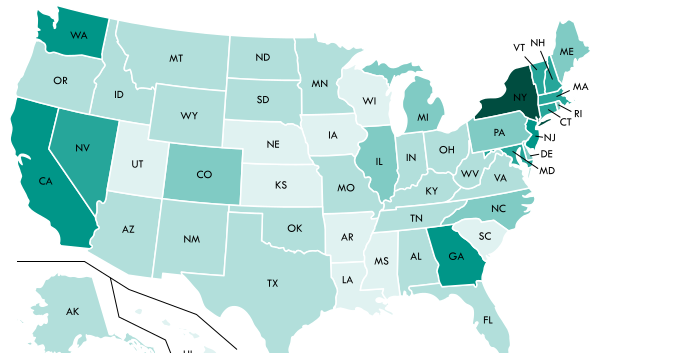
Most common states for regional program directors
| Rank | State | Population | # of jobs | Employment/ 1000ppl |
|---|---|---|---|---|
| 1 | District of Columbia | 693,972 | 441 | 64% |
| 2 | South Dakota | 869,666 | 282 | 32% |
| 3 | Vermont | 623,657 | 160 | 26% |
| 4 | West Virginia | 1,815,857 | 410 | 23% |
| 5 | North Dakota | 755,393 | 166 | 22% |
| 6 | Delaware | 961,939 | 200 | 21% |
| 7 | Wyoming | 579,315 | 121 | 21% |
| 8 | South Carolina | 5,024,369 | 1,007 | 20% |
| 9 | Alabama | 4,874,747 | 956 | 20% |
| 10 | Rhode Island | 1,059,639 | 197 | 19% |
| 11 | New Hampshire | 1,342,795 | 245 | 18% |
| 12 | Montana | 1,050,493 | 184 | 18% |
| 13 | Colorado | 5,607,154 | 972 | 17% |
| 14 | Oregon | 4,142,776 | 713 | 17% |
| 15 | Connecticut | 3,588,184 | 597 | 17% |
| 16 | Oklahoma | 3,930,864 | 639 | 16% |
| 17 | Utah | 3,101,833 | 485 | 16% |
| 18 | Louisiana | 4,684,333 | 719 | 15% |
| 19 | Mississippi | 2,984,100 | 443 | 15% |
| 20 | Washington | 7,405,743 | 1,011 | 14% |
Most common cities for regional program directors
| Rank | City | # of jobs | Employment/ 1000ppl | Avg. salary |
|---|---|---|---|---|
| 1 | Vacaville | 1 | 1% | $94,351 |
| 2 | Los Angeles | 2 | 0% | $86,421 |
| 3 | New York | 1 | 0% | $117,448 |
| 4 | Riverside | 1 | 0% | $85,541 |
| 5 | Sacramento | 1 | 0% | $93,714 |
| 6 | San Francisco | 1 | 0% | $95,158 |
Regional Program Director job outlook: Expert opinions
Our panel of regional program director experts
Middle Tennessee State University
Freed-Hardeman University

Swarthmore College

Auburn University at Montgomery
Western Carolina University
Auburn University at Montgomery

Maryville University

Davenport University

Azusa Pacific University
Thiel College
What are the biggest trends we'll see in the Regional Program Director job market given the pandemic?
Frank Lambert Ph.D.: Undoubtedly, while the pandemic is continuing, and possibly beyond, comfort working with technology will become an even more pronounced trend for librarians. From information literacy, to running programs online and conducting online instruction, to story times, technology is what helps connect communities with their public libraries even more. Libraries were stuck between a rock and a hard place when the pandemic struck. For SO many people in our community, the library is their primary source with the outside world via the WWW. When libraries had to close to reduce the chances of disease spread, not only was computer access to the Internet lost, but so was access to the Internet at home for those people who could not afford Internet access and instead have to rely on mobile hotspots for access. With libraries closed though, these hotspots could not be signed out. In the future, government should consider libraries an essential service. How was a community member to apply for unemployment benefits if he/she did not have access to the WWW from home? How can that same member apply for other social services or apply for a new job without an Internet connection? Had governments declared public libraries essential services and provided them with the resources needed to stay open, including giving libraries power over enforcing mask mandates, then the pandemic might have had a different look to it.
What soft skills should all Regional Program Directors possess?
Frank Lambert Ph.D.: Graduates in librarianship should have a definite public service ethic as one of their primary soft skills. Librarianship is a rewarding career, but you will not get rich being one. However, people become librarians more often than not just based on that desire to serve. Being a team player is very helpful. You need to work with other professionals and paraprofessionals closely. Working well in a team environment is pretty much essential, regardless whether you are working at a public service desk or behind the scenes in a technical services department. Being open to learning new things is a great soft skill. If you thrive in environments where the only constant is change, then librarianship is a great career. Finally, if you like puzzles or solving problems, then librarianship is for you. You want to run towards challenging information-based problems to start working on them right away. There is nothing more satisfying than finding the answer to a complex and challenging information-based problem and seeing the gratitude on your patron's face.
How have salaries changed over time for Regional Program Directors?
Frank Lambert Ph.D.: Salaries continue to rise. There are hundreds of graduates across the nation every semester, and yet there are still multiple job openings. Retirement of baby boomers in librarianship appears to be increasing. I would not say there is a shortage of qualified candidates; however, according to the Library Journal's most recent salary survey, their 2019 Placements & Salaries survey learned that full-time grads earned on average 6.2 percent more than they did in 2018 www.libraryjournal.com
This also was a 24% increase from 2011 salary levels. Salaries increasing this much may be due to, as I wrote, a glut of open positions in librarianship due to retirements, but closer analysis should be conducted before anything definitive is stated.
What's a day at work look like for a Regional Program Director?
Kristen Roberson: That depends on the role they are in, but the big hurdle is going to be landing that first role. They need to be willing to shift their plans, be ready to try contract or project-based work. No matter where they land, the ability to self-manage will be more critical than before 2020 since more work will be remote and much more video conferences, and a lot less travel.
Will there be an enduring impact of the coronavirus pandemic on Regional Program Directors?
Stephen O'Connell: Recessions are a tough time to enter the job market and we're in the worst recession since the Great Depression. It remains to be seen whether the labor market will bounce back strongly, but it certainly won't bounce back in time to ease the situation of the class of '21 very much. Be ready to be persistent and resilient in your job search.
On the positive side for public policy work, the Trump Administration and the pandemic have left us with immense challenges of resuming normal, evidence-based policymaking and managing recovery from the pandemic. So public policy analysis may be a more robust area of the job market.
What's a good job out of college for Regional Program Directors?
Stephen O'Connell: Work that uses your skills and builds new ones. There is a premium on your own flexibility over the couple of years, with a lot of job-market volatility due to uncertain structural impacts of the pandemic.
Brett Lehman Ph.D.
ProfessorAuburn University at Montgomery
Department of Sociology, Anthropology, and Social Work
What's a good job out of college for Regional Program Directors?
Brett Lehman Ph.D.: There is a business side and a human side to this answer. On the business side, I hope graduates are provided benefits like health insurance, a gainful salary, and opportunities for advancement. The way to hit a home-run is to get a job where those needs are taken care of and you still get to use your skills for something you feel is important. Most sociology students get into the subject because they care about the human side, want to help people, and see opportunity for creating positive social change. You'll get motivated sociology graduates when you show them a path towards achievement on the human side; then when we there's less worry about the business side, some impressive results could follow!
Will there be an enduring impact of the coronavirus pandemic on Regional Program Directors?
Angela Sebby Ph.D.: While jobs may be slower to return to the capacity pre-Covid, the industry and tourism employment will rebound as people still want to travel and explore diverse foods, cultures, and experiences. However, the enduring impact will be the rapid onset of technology that allowed for limited contact with employees and others has become the new norm. Although human interaction is an important aspect of service in the tourism industry, employers have found that they can reduce the number of personal interactions but still deliver an acceptable level of quality service. What would have taken years to adopt, COVID created an amplified adoption.
What technical skills for a Regional Program Director stand out to employers?
Angela Sebby Ph.D.: Business, creative, and organizational skills - I would recommend that upcoming graduates are proficient in Word, Excel (highly used), Powerpoint, Outlook (especially how to send meeting requests and calendar organization), TEAMS, Gantt charts for team management, Mindmapping for creativity, and design software. Additionally, I would recommend that they learn how to properly utilize social media for marketing and PR, not just personal posting. Finally, email etiquette would be essential.
What soft skills should all Regional Program Directors possess?
TeWhan Hahn Ph.D.: Writing skills including email writing, being able to work in teams, and knowing the workplace etiquettes.
Meaghan Goodman Ph.D.
Program Director & Assistant ProfessorMaryville University
Speech-Language Pathology
Will there be an enduring impact of the coronavirus pandemic on Regional Program Directors?
Meaghan Goodman Ph.D.: At this point it is hard to say. Certainly, there were immediate impacts as students and professors alike shifted to learning and teaching in a virtual world. Some students had to tackle online learning while sharing resources like Wi-Fi with parents and other siblings. Long term, it is possible that coronavirus may impact hiring for the foreseeable future. With more money needing to be shifted towards personal protective equipment, and cleaning procedures and supplies, many businesses including hospital systems and school districts will be taking a closer look at their bottom line.
I do think this pandemic highlighted a need for highly skilled Speech-Language Pathologists. For some, contracting COVID-19 meant intubation (a procedure in which a tube in inserted through the mouth and into the trachea to provide breathing support for critically ill patients). We are often consulted for patients requiring prolonged intubation. After a patient has intubation removed, we are often consulted in evaluating damage to a patient's swallow as well as their vocal quality. Because of the nature of intubation, patients aren't able to speak, so alternative forms of communication must be established, lending another opportunity for a Speech-Language Pathologists to demo
What's a day at work look like for a Regional Program Director?
Meaghan Goodman Ph.D.: A bachelor's in communication sciences and disorders can prepare you for three different tracks. First, it can prepare you to become a licensed Speech-Language Pathology Assistant (SLPA). This is someone who works under a fully credential speech-language pathologist. Often times, they carryout intervention plans developed by a fully credentialed speech-language pathologist. If graduate school is on your horizon, a bachelor's degree in communication sciences and disorders will prepare you for acceptance into a Speech-Language Pathology program, or an Audiology program. If you are not accepted into a graduate program right away, working as a speech-language pathology assistant (SLPA) is a great way to get experience in the field!
What technical skills for a Regional Program Director stand out to employers?
Meaghan Goodman Ph.D.: Speech-Language Pathologists help people improve their speech, language, swallowing, hearing, and other communication abilities. The goal of our profession is ultimately to help people effectively communicate and improve quality of life. Therefore, the skills that standout to employers are Speech-Language Pathologists who
-Like to think critically and problem solve,
-Are passionate about the field and demonstrate a desire to continually learn more,
-Are dedicated to serving people and helping them live their best lives,
-And those who possess strong advocacy skills!
What soft skills should all Regional Program Directors possess?
Todd Terry: Graduates as they prepare to enter the workforce should pay particular attention to their ability to communicate with coworkers. This communication could happen through face-to-face interactions, remote meetings with the aid of technology for example, meeting by computer software, written communication through instant messaging, or emails. Also, part of communicating is being a good listener.
Graduates should have good critical thinking skills. They will need to be adaptive and able to analyze data to make good informed decisions.
In today's work environment, working on teams is a regular function. Therefore, employers are looking for the candidate who can professionally interact with other team members, have a positive attitude and a good work ethic.
What are the biggest trends we'll see in the Regional Program Director job market given the pandemic?
Bala Musa Ph.D.: Remote working and telecommuting will continue to grow proportionately, as part of organizational operations. Self-managed teams, global collaborations and machine-learning will be among the biggest trends in organizations of the future.
What certifications/licenses/courses can have the biggest impact for Regional Program Directors?
Bala Musa Ph.D.: Digital literacy, cultural literacy, information technology, data management and human communication skills courses and certifications will continue to be relevant in the workplace.
What are the biggest trends we'll see in the Regional Program Director job market given the pandemic?
Mary Beth Mason Ph.D.: I think we are going to see teletherapy as a more common service delivery model across settings. I think that that will be what I call a "Pandemic Positive". I think many states will pass legislation post pandemic for teletherapy to be a reimbursable service.
What certifications/licenses/courses can have the biggest impact for Regional Program Directors?
Mary Beth Mason Ph.D.: I think one of the great things about being a speech-language pathologist is that we can work across the lifespan in a variety of settings. In order to have that flexibility, graduates should get their Certificate of Clinical Competence from the American Speech-Language-Hearing Association (ASHA), professional state license, and credential to work in public school setting. It is important to get those three credentials as soon as possible after graduation because they will meet the current standards. If they wait, there might be new standards in place which means they might need additional coursework and/or pass additional tests.
What's a good job out of college for Regional Program Directors?
Mary Beth Mason Ph.D.: I think it's important for new graduates to remain open to different work settings when looking for a job. Happiness is a balancing act between work and home so it's important to consider factors such as schedule and commute in addition to work setting and caseload.
New clinicians need to complete a Clinical Fellowship experience before applying for their Certificate of Clinical Competency from ASHA. I always tell students to ask about their Clinical Fellowship mentor during their interview. That is always a good question to ask in the interview when the employer asks if you have questions. Successful completion of the Clinical Fellowship is the final step in the certification process so it's really important to have a good working relationship with that person. A good mentor can help a new clinician have a great experience in any setting.
My final piece of advice to new graduates is to always negotiate. I tell my students to call me for a pep talk if they need one because I know their worth and value. Employers expect some back and forth following the initial offer. A good employer is not going to withdraw an offer because you counter for increased salary or better benefits. In helping professions like speech-language pathology, I think many don't want to seem aggressive, but negotiating job offers is completely acceptable.
Bottom line is we all need to have a job that we like that allows us to have a life that we love.