Explore jobs
Find specific jobs
Explore careers
Explore professions
Best companies
Explore companies
Job outlook for rehabilitation program coordinators in the United States
Are rehabilitation program coordinator jobs in demand?
Rehabilitation program coordinator job and salary trends over time
Rehabilitation program coordinator jobs over time
Rehabilitation program coordinator job growth rate over time
| Year | # of jobs | % of population |
|---|---|---|
| 2021 | 1,123 | 0.00% |
| 2020 | 1,247 | 0.00% |
| 2019 | 1,356 | 0.00% |
| 2018 | 1,329 | 0.00% |
| 2017 | 1,292 | 0.00% |
Average rehabilitation program coordinator salary over time
Rehabilitation program coordinator salary by year
| Year | Avg. salary | Hourly rate | % Change |
|---|---|---|---|
| 2025 | $42,109 | $20.24 | +4.4% |
| 2024 | $40,336 | $19.39 | +0.9% |
| 2023 | $39,977 | $19.22 | +2.2% |
| 2022 | $39,113 | $18.80 | +0.5% |
| 2021 | $38,900 | $18.70 | +0.8% |
Rehabilitation program coordinator jobs by state
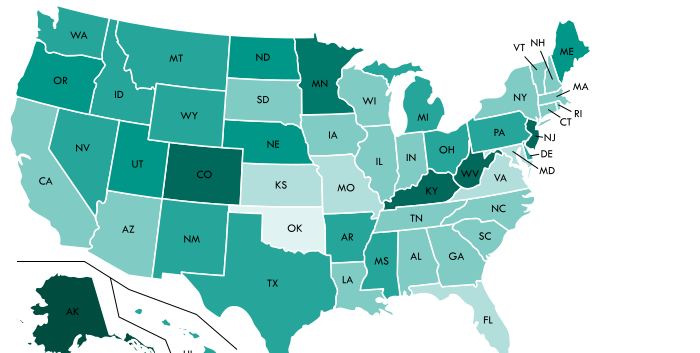
Most common states for rehabilitation program coordinators
| Rank | State | Population | # of jobs | Employment/ 1000ppl |
|---|---|---|---|---|
| 1 | Vermont | 623,657 | 246 | 39% |
| 2 | North Dakota | 755,393 | 255 | 34% |
| 3 | Wyoming | 579,315 | 198 | 34% |
| 4 | Delaware | 961,939 | 304 | 32% |
| 5 | Rhode Island | 1,059,639 | 318 | 30% |
| 6 | Maine | 1,335,907 | 324 | 24% |
| 7 | South Dakota | 869,666 | 200 | 23% |
| 8 | New Mexico | 2,088,070 | 446 | 21% |
| 9 | Idaho | 1,716,943 | 356 | 21% |
| 10 | West Virginia | 1,815,857 | 367 | 20% |
| 11 | Alabama | 4,874,747 | 907 | 19% |
| 12 | New Hampshire | 1,342,795 | 243 | 18% |
| 13 | Hawaii | 1,427,538 | 249 | 17% |
| 14 | Oklahoma | 3,930,864 | 586 | 15% |
| 15 | Montana | 1,050,493 | 162 | 15% |
| 16 | Colorado | 5,607,154 | 724 | 13% |
| 17 | Connecticut | 3,588,184 | 449 | 13% |
| 18 | Utah | 3,101,833 | 394 | 13% |
| 19 | Minnesota | 5,576,606 | 647 | 12% |
| 20 | Nebraska | 1,920,076 | 230 | 12% |
Most common cities for rehabilitation program coordinators
| Rank | City | # of jobs | Employment/ 1000ppl | Avg. salary |
|---|---|---|---|---|
| 1 | Carbondale | 1 | 4% | $38,661 |
| 2 | Ottumwa | 1 | 4% | $40,643 |
| 3 | Newnan | 1 | 3% | $43,349 |
| 4 | OFallon | 1 | 3% | $38,859 |
| 5 | Jupiter | 1 | 2% | $37,321 |
| 6 | Manhattan | 1 | 2% | $38,860 |
| 7 | Midland | 1 | 2% | $47,435 |
| 8 | Cape Coral | 1 | 1% | $37,434 |
| 9 | Davenport | 1 | 1% | $41,139 |
| 10 | Melbourne | 1 | 1% | $37,666 |
| 11 | Mobile | 1 | 1% | $41,758 |
| 12 | Birmingham | 1 | 0% | $41,872 |
| 13 | Huntington Beach | 1 | 0% | $41,181 |
| 14 | Miami | 1 | 0% | $36,962 |
| 15 | Modesto | 1 | 0% | $43,256 |
| 16 | Orlando | 1 | 0% | $37,784 |
Rehabilitation Program Coordinator job outlook: Expert opinions
Our panel of rehabilitation program coordinator experts
University of Nevada - Las Vegas
Pennsylvania State University - Abington
Husson University

Lipscomb University
University of Arkansas at Little Rock

Washington University School of Medicine in St Louis
Brenau University
South College
East Tennessee State University
Assumption University
LaGrange College
Columbia University Irving Medical Center
Ohio Wesleyan University
Seattle University
East Tennessee State University

Hartwick College
Muhlenberg College
American University
Pace University
Szu-Ping Lee PT, PhD
Associate ProfessorUniversity of Nevada - Las Vegas
Rehabilitation And Therapeutic Professions
What general advice would you give to a Rehabilitation Program Coordinator?
Szu-Ping Lee PT, PhD: Most people like the job because they enjoy working with people and helping them. There is a high level of satisfaction that comes from improving other people's lives. In fact, healthcare workers consistently report some of the highest levels of career satisfaction. However, caring for people is hard work. Doing a good job as a rehabilitation specialist takes a lot of mental and physical energy. Therefore, burnout is fairly common.
What Rehabilitation Program Coordinator skills would you recommend for someone trying to advance their career?
Szu-Ping Lee PT, PhD: Aging is happening globally. Our society requires rehabilitation specialists to care for our elderly and individuals recovering from injuries or other illnesses. A World Health Organization commissioned study estimated that 1 in 3 persons in the world will need some form of rehabilitation care in their lifetime, and this demand is growing. Therefore, the job market for rehabilitation specialists is expanding in many areas of the U.S. and abroad.
Elsa Drevyn PT, DPT
Clinical Assistant Professor and Director of Clinical Education and Vice Chair for Clinical EducationWhat general advice would you give to a Rehabilitation Program Coordinator?
Elsa Drevyn PT, DPT: It brings a lot of satisfaction to help someone recover or achieve the greatest potential that they possibly can after an injury, accident, illness, etc. This profession probably offers more flexibility than many as far as job sharing, hours, settings, etc. There is also flexibility in the types of settings that we can work in and the opportunity to change settings throughout our careers. We deal with a lot of emotional situations, patients in pain and distressed, that does take a toll. There is pressure from administrators for increased productivity and that also gets taxing.
What will help Rehabilitation Program Coordinators increase their earning potential?
Elsa Drevyn PT, DPT: There is increased awareness of what we do and how we can assist an individual. There is also increased autonomy and the push for even more autonomy. There is high demand in the different settings and salaries have improved over the years.
What will help Rehabilitation Program Coordinators increase their earning potential?
Abigail Akande Ph.D., CRC: New issues are emerging, yet some that are prevalent now will remain prevalent. Technology and telehealth; immigrant cross-cultural sensitivity and international service provision; multilingualism; disability and chronic health conditions among older adults/seniors; vocational rehabilitation and career counseling; and co-occurring mental illness and substance abuse.
What skills stand out on Rehabilitation Program Coordinator resumes?
Chad Howland: I believe having strong interpersonal skills is important when first entering the field. The rehabilitation specialist must work to be an active listener and encourage their patient/client to be an active participant in meeting their own healthcare goals. Exposure to different clinical settings and experiential learning across diverse patient/client populations is a plus. In addition, rehabilitation specialists should be a part of their respective national organizations. Certainly, being involved in the national or state chapter of a professional organization speaks to the job candidate's professional growth, along with taking on a leadership role within their profession. In regard to specific skills, well-rounded education in the foundational sciences (anatomy, biomechanics, neurology) has become essential for rehabilitation specialists.
What soft skills should all Rehabilitation Program Coordinators possess?
Chad Howland: As outlined previously, a rehabilitation specialist needs to be an active listener and form a partnership with their patient/client. Expanding upon this point, they need to be effective communicators with other healthcare professionals. Establishing trust between various stakeholders is essential.
What hard/technical skills are most important for Rehabilitation Program Coordinators?
Chad Howland: In this day and age, rehabilitation specialists should become well versed in technology and information gathering. Most hospital systems use electronic medical records and documentation. Due to the recent pandemic, rehabilitation specialists need to be comfortable performing examinations and select interventions remotely. Telehealth is a growing area within clinical practice. Also, new graduates might seek to pursue post-professional training in specialized areas such as orthopedics, manual therapy, neurorehabilitation, or pediatrics - just to name a few.
What skills stand out on Rehabilitation Program Coordinator resumes?
Dr. Ruth Henry: Exposure to a variety of therapy settings. The outpatient clinics are the most common type of shadowing and patient care. While those are valuable, it is good for students to have had at least some observation hours in a greater variety of settings--inpatient, acute care, long-term care, or school settings. For a potential employee coming right out of their therapy training, skills in teamwork are desirable since the therapist usually works with a team of healthcare professionals.
What soft skills should all Rehabilitation Program Coordinators possess?
Dr. Ruth Henry: Important soft skills for rehab are creativity and flexibility. Not every "textbook" type of therapy will work for every patient, so being about to "think outside the box" in developing a novel protocol is useful. During the pandemic, flexibility was essential because some sessions had to be held remotely, and while those sessions are not ideal, being able to adapt to the current needs is essential. People skills are also needed. Therapists meet with their patients several times per week over a period of several weeks, and sessions are more fun for the patient if the therapist has an ability to interact with them; this helps the therapist make a connection for the patient and better compliance with the program can result. On the other hand, silent therapy sessions with no therapist/patient interaction can be awkward and unmotivating.
What hard/technical skills are most important for Rehabilitation Program Coordinators?
Dr. Ruth Henry: It goes without saying that experience and skill in manual therapy are the cornerstones of the therapist's skill set. Experience in or exposure to a variety of treatment modalities, including heat & cold therapy, ultrasound, TENS, K-tape, electrical stimulation, cupping, and others, is also useful. Willingness to try new modalities when the patient's needs indicate a different approach.
Dr. Raymond Ortega Ph.D.
Associate ProfessorUniversity of Arkansas at Little Rock
Rehabilitation Counseling Program
What skills stand out on Rehabilitation Program Coordinator resumes?
Dr. Raymond Ortega Ph.D.: The job market for rehabilitation counselors has changed substantially over the years. Initially, it was limited to public sector agencies but now includes several private and non-profit opportunities. As a result, the requisite skillset has also increased. The essential skills that "stand out" include knowledge of career and occupational standards and requirements, legal and regulatory standards, physical and psychological disability, and counseling skills.
What soft skills should all Rehabilitation Program Coordinators possess?
Dr. Raymond Ortega Ph.D.: Ability to work well with others, cultural awareness, empathy, adaptability, problem-solving, dependability.
What hard/technical skills are most important for Rehabilitation Program Coordinators?
Dr. Raymond Ortega Ph.D.: Effective counseling skills, legal and ethical documentation and record-keeping, written and oral communications, use of technology, and adaptive equipment.
Erin Foster Ph.D.
Assistant Professor of Occupational Therapy, Neurology and PsychiatryWashington University School of Medicine in St Louis
Program in Occupational Therapy
What skills stand out on Rehabilitation Program Coordinator resumes?
Erin Foster Ph.D.: Track record of publications, presentations, funding; advanced statistical analysis; clinical experience; teaching and mentoring.
What soft skills should all Rehabilitation Program Coordinators possess?
Erin Foster Ph.D.: Grit, resilience, persistence; flexibility, adaptability; ability to work in multi/inter-disciplinary teams, collaborate, interpersonal skills; ethics, integrity; leadership & management.
What hard/technical skills are most important for Rehabilitation Program Coordinators?
Erin Foster Ph.D.: Scientific writing, scientific communication, research design and methodology, analysis, the ability to synthesize knowledge/evidence from various sources to generate new questions, hypotheses & and studies, problem-solving.
What skills will help Rehabilitation Program Coordinators earn the most?
Erin Foster Ph.D.: Communicating your research and its impact clearly and effectively to diverse audiences through various channels (e.g., social media, scientific presentations, in conversations with "lay" stakeholders). Self-advocacy and negotiation skills.
Dr. Robert Cantu
Associate ProfessorBrenau University
Physical therapy Department
What skills stand out on Rehabilitation Program Coordinator resumes?
Dr. Robert Cantu: These are not necessarily skills per se, but as a hiring manager, this is what I would look at in a resume for a new grad:
Clear objective statement in the resume that matches the needs of the clinic. This shows a focus on job seeking and career path.
Clinical education experiences that match the needs of the clinic.
Skills gained in their clinical training that matches the clinic's needs: Examples: Strong manual therapy training in a clinic that emphasizes one-on-one care of patients. Strong exercise training in sports medicine clinics.
For those with some career experience:
Job stability--i.e., how long is the candidate at one place of employment. At least 18-24 months in a job or longer is good. This means they were perceptive and chose wisely. Six jobs in the first 5 years will raise red flags.
Current and frequent continuing education attendance in the area in which the clinic specializes. This shows a focus on growing and staying current in clinical skills.
What soft skills should all Rehabilitation Program Coordinators possess?
Dr. Robert Cantu: People skills: For the workgroup: ability and willingness to work in groups and manage conflict. Flexibility: Willingness to occasionally work late or come in early to accommodate the patient load. Team player attitude. Willingness to play their assigned part on the team. Strong commitment and discipline for timely completion of tasks such as daily paperwork. This shows "discipline in the drudgery," which is critical for the smooth operation of the clinic and results in better customer service.
People skills: For patient management: Empathy, the warmth of personality, a caring demeanor, and express kindness. And absolutely, a willingness to always put the patient first. Good eye contact, firm but kind, reassuring handshake (or a kind elbow bump). The understanding is that even though they work for a company, ultimately, the clinician works for the patient.
Will there be an enduring impact of the coronavirus pandemic on Rehabilitation Program Coordinators?
Dr. Roberta “Bertie” Gatlin: Potentially, could have difficulty with employment opportunities as some employment positions have been furloughed and not brought back. Many of these furloughs have been in the PTA field and out-patient ortho or sports settings. Other sites, especially acute care hospital based, in-patient rehab and out-patient clinics are now realizing the aftermath of COVID and the need for extensive rehabilitation services for the post COVID patients. The trend is we hope the employment opportunities are available to the rehabilitation professionals as they complete their final clinicals and graduate.
What certifications/licenses/courses can have the biggest impact for Rehabilitation Program Coordinators?
Dr. Roberta “Bertie” Gatlin: In the field of physical therapy the professional has many opportunities to specialize in residency training. There are fields such as pediatrics, neurology, orthopedics, to name a few. These residencies are offered through the accrediting program of the American Board of Physical Therapy Residency and Fellowship Education. Here is the link here. www.abptrfe.org
What will help Rehabilitation Program Coordinators increase their earning potential?
Dr. Roberta “Bertie” Gatlin: Unfortunately many salary rates are limited by the corporate organizations. There are more practitioners going into private practice which allows them to have better salary based on the reimbursement contracts with payors. Those that seek residency and fellowship training often have an increase in salary but this would be based on the employers management structure, like an tiered program or career ladder.
Mary Andreae
Assistant ProfessorEast Tennessee State University
Department of Rehabilitative Sciences
What soft skills should all Rehabilitation Program Coordinators possess?
Mary Andreae: Soft skills needed are: Networking, teamwork, interprofessional networking and collaboration, and time management.
How have salaries changed over time for Rehabilitation Program Coordinators?
Mary Andreae: Salaries have slowly increased over the years. With the advent of the new requirement for all registered dietitians to have earned a Master's degree (to be implemented in the year 2014), we expect to see salaries continue in the upward trend.
Susan Scully-Hill Ph.D.
Associate Professor of Human Services and Rehabilitation Studies and Director of the School Counseling program at Assumption UniversityAssumption University
Department of Human Services and Rehabilitation Studies
What are the biggest trends we'll see in the Rehabilitation Program Coordinator job market given the pandemic?
Susan Scully-Hill Ph.D.: What I am seeing now is that schools are increasing the number of "school support personnel" by hiring additional school counselors, school adjustment counselors, learning coaches, student engagement officers, instructional aides, and para-professionals. Student engagement in remote learning is, overall, very low and schools are seeing more students failing multiple subjects than they have ever before. Currently schools are working hard to increase student engagement and academic outcomes by increasing support personnel. I think this trend will continue even as students transition back to in-person learning. Transitioning back to in- person learning will create challenges for many students-not just academic challenges but social, and emotional as well. Making up for lost classroom and learning time will be a priority and therefore additional school personnel will be required.
What certifications/licenses/courses can have the biggest impact for Rehabilitation Program Coordinators?
Susan Scully-Hill Ph.D.: -Being licensed as a school counselor and/or a school adjustment counselor will have the biggest impact on our graduates. Licensed counselors will be sought after to fill student support personnel positions.
-Coursework focused on academic, learning, social, emotional, and behavioral interventions will be essential for counselors who wish to work in the schools and have a positive impact on student learning outcomes.
What technical skills for a Rehabilitation Program Coordinator stand out to employers?
Amber Leiker McGlawn Ph.D.: Since Kinesiology is such a broad field, necessary technical skills will vary by discipline. In general, though, being able to critically assess an individual, team, or situation, and make evidenced-based decisions is incredibly important. It's great to have the content knowledge, but employers want to know that you can put it into action! Some employers require specific certifications and credentials (e.g., Certified Strength and Conditioning Specialist, Certified Personal Trainer, Athletic Trainer Certified, etc.), so make sure you're on the lookout for requirements at least a year before you graduate to give yourself plenty of time to prepare.
What's a good job out of college for Rehabilitation Program Coordinators?
Amber Leiker McGlawn Ph.D.: I like to be blunt with my students-your first job out of college most likely isn't going to be your dream job, but that's okay! A good job out of college is one that can help not only build your resume, but build your professional character. For example, in our senior seminar course at LaGrange College, we set short-term and long-term career goals. In analyzing your own goals, look for a first job that can help you build skills that will be applicable as you're on your way to dream job, and ones that can still apply once you get there.
What are the biggest trends we'll see in the Rehabilitation Program Coordinator job market given the pandemic?
Amber Leiker McGlawn Ph.D.: With the pandemic, I think a lot more people are recognizing the role of healthy living habits in the prevention of disease. As Exercise Science practitioners have the ability to provide services to improve baseline health, I'm hoping to see increases in the utilization of exercise for preventative care, especially once the general population feels safe to do so again. Until then, we'll likely continue to see opportunities to provide services online or in smaller, more personal settings. Either way, creativity will be key with the ever-changing dynamics of the pandemic.
What are the biggest trends we'll see in the Rehabilitation Program Coordinator job market given the pandemic?
Christopher Kevin Wong Ph.D.: In the short term, the immediate effect has been reduced clinic density and overall patient care. Thus, there may be fewer opportunities for new graduate Rehab Techs at the current time. In addition, elective surgeries are down in number in many areas thus there are fewer people to rehabilitate from such surgeries. Other people with minor injuries and dysfunctions that have comorbidities that put them at risk for COVID may opt to wait or use telehealth (which has little role for Rehab Techs). It may be a good time to take the next step to apply to professional programs if you can afford it.
For rehab professionals, however, the demand for care remains strong in telehealth, home care, hospital based, out patient care. However, assumed is potential care for people with COVID if in institutional settings and for exposure to COVID via patients in any setting.
In the long term, there will be many people with lingering cardiovascular impairment that may introduce more opportunities for Rehab Techs particularly in Physical and Respiratory Techs in both private and hospital based out-patient care. The job market for rehab care will rebound, though telehealth will likely remain as a part of how we interact with patients.
What's a good job out of college for Rehabilitation Program Coordinators?
Christopher Kevin Wong Ph.D.: As a parent of college and post-college age kids, at some level any job that can support you out of school is a good job. Beyond that, if the job interests and challenges you that makes job satisfaction more likely. In addition, if the job can help develop you for whatever next step you want to take that makes the job particularly useful. Ultimately, I like to live by the motto: plan for tomorrow, but live for today.
As such, rehab tech or aide positions can help expose you to the clinical profession you may be interested in, develop knowledge that may have been learned in an academic setting without real life application, and meet requirements for professional program applications. Sometimes, such a job may help you realize the profession you thought you were interested in is not what you thought. In the ideal case, meeting the right professional may set you up with a career mentor that can inspire or influence you for decades.
Alternately, a job as a lab assistant or research coordinator, whether clinical or bench research, can also introduce you to the research side of various professions. Such a position also can develop knowledge gained as an undergraduate and prepare you for academic professional or research programs. Clinical research will also provide exposure to patients/subjects that can be a very personal experience with them and their families.
Will there be an enduring impact of the coronavirus pandemic on Rehabilitation Program Coordinators?
Dr. Andrew Busch: In terms of students gaining the types of experiences needed for internships, graduate school applications, etc., surprisingly we have not seen a great deal of impact within the Exercise Science arena. For Sport Management majors, that is different, because almost all major sporting events where undergraduate students have worked in the setup, preparation, planning, organizing, etc. to gain experience have been shut down in that industry. So those majors have been severely affected. For Exercise Science majors however, undergraduate students have still been able to get the observation hours needed for graduate schools, and to fulfill internship responsibilities off campus at private businesses or rehabilitation centers.
What type of skills will young Rehabilitation Program Coordinators need?
Dr. Andrew Busch: Obviously any type of specific-skill training is beneficial, but what we have found is employers are looking for young graduates eager to learn, who have been taught problem solving skills/approaches. So many successful individuals within many industries did not go into that industry with exact experiences, but they were quick learners with an ability to think creatively and solve problems/questions from a holistic approach. We look to provide our students with hands-on experiential learning opportunities that give them the chance to apply the content/theories/processes they learn in a real-world setting. For example, we teach our students how to conduct a VO2max test on subjects with various exercise modalities (treadmill, stationary bike, rower). They don't need to become experts at testing VO2 on only the 'Bruce Protocol', because they may encounter a work situation where that is not necessary, or they don't have that equipment, so we are constantly asking students how they could answer the same question, given different circumstances.
What experience really stands out on Rehabilitation Program Coordinator resumes?
Dr. Andrew Busch: For students looking to get into graduate school and those looking to get hired within the field of Exercise Science (Physiology, Kinesiology, Athletic Training, Physical Therapy, Strength Coaching) the more hands-on experiences one can be exposed to, the better equipped they will be to hit the ground running. I know of many different four-year institutions that hand out degrees in this field where the students never actually work with a real person. Everything is a theory or textbook-based approach, and while those things are certainly important, if a student is never asked to actually apply those concepts, and asked to respond to the issues/questions that arise when those concepts don't always work like advertised in the textbook, they are missing out on the big picture of what a degree should be giving them. If practical experiences are not part of a given academic program, then students should seek out these experiences, because that is what they will be asked about in their interview process with employers. What have you done? Why are you interested in this field? What differences can you make? They are never asked what score they got on their midterm or final exam.
Theresa Earenfight Ph.D.
Professor of History, Director, Women, Gender, and Sexuality Studies ProgramSeattle University
History Department
Will there be an enduring impact of the coronavirus pandemic on Rehabilitation Program Coordinators?
Theresa Earenfight Ph.D.: As a historian of the European Middle Ages, I'm struck by how students this past year have acquired something scarce: historical empathy. The past can seem so remote, so very different from our lived experiences today, and this can make history seem irrelevant. But this fall, I was teaching a section on the bubonic plague, which historians of medicine now know was a global pandemic, not just an epidemic in Europe. Usually, students are fascinated by the gruesome medical details, but not this group.
They did not need or want to look death in the eyes. They wanted to know how did people react? How did they get back to normal? When we ticked off the list of reactions--fear, distrust of science (such as it was in 1348), xenophobia, scapegoating, economic collapse, hoarding supplies, turn to religion, gallows humor about worms crawling about corpses--they got it. When we talked about the aftermath--eat, drink, be merry, and protest the inequality--they got it. That is historical empathy, and I'm sad that this was how it had to be learned, but it will give them broader compassion that can encompass people alive today.
What experience really stands out on Rehabilitation Program Coordinator resumes?
Theresa Earenfight Ph.D.: Altruism. Anyone who reaches out and does work that repairs the shredded world and does not ask for an avalanche of cash. And an understanding of how privilege works and a desire to work to rein in the harm of unchecked privilege.
Will there be an enduring impact of the coronavirus pandemic on Rehabilitation Program Coordinators?
Dr. Frederick Gordon Ph.D.: Graduate students will need to refocus on the changing institutional role, being both remote and in-person, and impacting agency goals and performance.
What type of skills will young Rehabilitation Program Coordinators need?
Dr. Frederick Gordon Ph.D.: Budgeting skills are essential, as well as apparent, logical written ability.
Namita Sugandhi Ph.D.
Assistant Professor of AnthropologyHartwick College
Anthropology Department
What technology do you think will become more important and prevalent for Rehabilitation Program Coordinators in the next 3-5 years?
Namita Sugandhi Ph.D.: Documentation and public engagement will remain crucial parts of Anthropological work, and technology that allows us to record, analyze, and share data will continue to be necessary. Over the next several years, it will be essential to find new and innovative ways of connecting virtually to audiences' broader network. This will require the ability to think out-of-the-box and adapt to unique circumstances and new technologies. Technologies that allow people to build relationships across space will continue to transform how we experience social life. Those who are new to the job market will have to master these new virtual strategies of communication and self-promotion and need to understand and navigate the impact of this pandemic on the non-virtual world.
What are the biggest trends we'll see in the Rehabilitation Program Coordinator job market given the pandemic?
Namita Sugandhi Ph.D.: Historically, pandemics have created significant shifts in both the social and economic conditions of life, and this one is no different. The most influential trends that I expect in the job market are tighter hiring practices that will require candidates to have multiple skillsets, pushing many workers into increasingly unsafe and unfair positions. An unfortunate mantra of gratitude developed amongst the employed, early in the pandemic, was, "At least I still have a job." I think that sentiment still exists for people. Many employers know this and will continue to use it to their advantage. They pressure their employees to work under conditions that are increasingly unhealthy and untenable for themselves and their families. This will exacerbate many of the existing inequalities that this pandemic has already highlighted. In addition to becoming more ruthless and exploitative, I think future hiring patterns will highly value a candidates' ability to demonstrate resilience and innovation during the pandemic. A candidate's technological prowess - even for a non-technical job - will also be much more visible and impact standards and expectations of professionalism in the job market.
Dr. Steven Coutinho
ProfessorMuhlenberg College
Department of Philosophy
What technology do you think will become more important and prevalent for Rehabilitation Program Coordinators in the next 3-5 years?
Dr. Steven Coutinho: Since Philosophy majors get jobs in any and every sector, the technologies they will need will depend on their specific employment area.
However, anyone considering a career as a Philosophy professor will have to develop online and distance teaching expertise. This has changed the teaching experience dramatically, as the technologies and skills are vastly different from those required for in-person instruction.
How do you envision technology impacting Rehabilitation Program Coordinators in the next 5 years?
Dr. Adelaide Kelly-Massoud: Well, every teacher and teacher candidate was thrust into distance learning. Misguided attempts to foster understanding often leaned our adult distant learning pedagogy. Teachers, and those who prepare teachers, found their job to research, define, design, and implement meaningful teaching and learning using a virtual platform. Words such as synchronous and asynchronous are now a part of our everyday vernacular. But there is a much more optimistic change on the horizon that we can thank coronavirus for.
Communication and collaboration have been forced to change. Parents and Teachers are more connected and have been put in a position to leverage technology to build networks of support and consistent dialog. I urge teachers to leverage this in their future as we work to reopening schools; we should learn from this experience to leverage technology to keep us connected.
Will there be an enduring impact of the coronavirus pandemic on Rehabilitation Program Coordinators?
Dr. Adelaide Kelly-Massoud: How could there not be? The coronavirus era's teacher candidates are leveraged to be the most influential teachers in our nation's history. I believe this to be true. Children, across the country and world, have been exposed to social isolation, a disruption in learning, political, and social unrest. Now, more than ever, students, ALL students, need teachers who can create the therapeutic learning environments that will allow students to thrive once again. Access and inequity have long plagued our academic system and led to significant and horrifying achievement gaps. The coronavirus forced that outside education to see the disparities play out on their television screens and social media feeds. As the quarantine lifestyle became the new norm, the divide grew. Those who could, and were willing to pay, could maintain face-to-face instruction, while others struggle to get access to technology.
Students whose academic career is driven by the goal setting and progress monitoring, often used in special education, were sent home for parents and teachers struggling to find a way to make things work. Enduring impacts on our graduates aren't all negative. I think teacher candidates that worked through the coronavirus and pursued a degree and have both a level of commitment and a clear image of teaching demands. I believe they saw first-hand how bad things can be and how vital their role is. I am optimistic that a silver lining to a terrible year is that teacher candidates persevered for their future students and that this quality is now deeply ingrained in their craft.
Dr. Sheying Chen Ph.D.
Professor of Public Administration/Social PolicyPace University
Department of Public Administration
Will there be an increase or decrease in demand for Rehabilitation Program Coordinators in the next 5 years?
Dr. Sheying Chen Ph.D.: State and local governments re-evaluate their current capacities and plan for reduced revenues in the coming fiscal years. This will result in a shift in hiring in the public sector that may last for some time; thus, graduates should be better prepared for finding job opportunities, networking, etc. There is likely a decrease in demand for graduates in the next couple of years, although the trend is not unique to this field. It's an excellent time to go back to school and get a degree in active pursuit of new skills for the changing work environment. Active learners may demand more creative programming and increased networking that may also help to advance the field of public administration.